
KA Community
“Come for the software. Stay for the community.”

The mission of the KA Community is to help Knowledge Architecture clients more effectively use Synthesis to achieve their business goals.
When you become a Knowledge Architecture client you become a member of the KA Community. The KA Community provides a rich variety of opportunities to learn from and with other Synthesis clients and the Knowledge Architecture team, including our annual KA Connect conference, quarterly Client Roundtables, monthly Intranet Tours, and our dynamic online community.
Membership in the KA Community is limited to active clients of Knowledge Architecture.
Intranet Tours



Our monthly Intranet Tours provide a great way to see how other AEC firms use Synthesis to evolve and grow their firms.
Client Roundtables
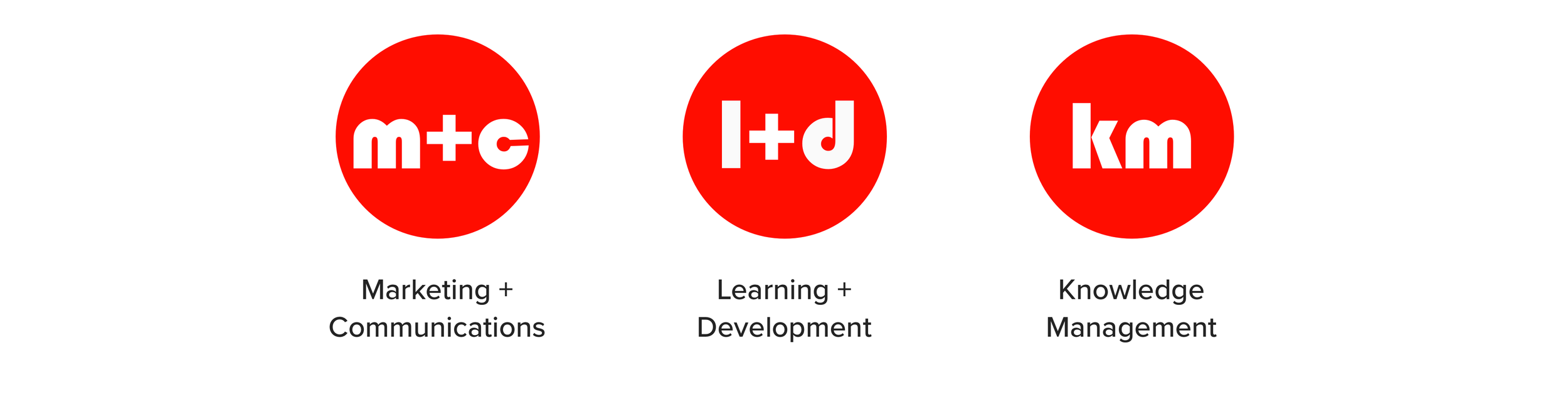
Each quarter we get clients together over Zoom to share knowledge and inspiration, brainstorm solutions to challenging problems, and build their professional networks.
We are currently running three 90-minute roundtables a quarter — Marketing + Communications, Learning + Development, and Knowledge Management.
Client Roundtables are free of charge and are limited to active clients of Knowledge Architecture.
KA Connect Conference

KA Connect is our annual knowledge management conference for the AEC industry. Our programs focus on sharing strategies and best practices for using knowledge management, internal communications, learning + development, and intranet programs to help AEC firms evolve and grow.
KA Community Online
Our online client community is a forum for Knowledge Architecture clients to share ideas, discuss best practices, and connect with their peers. Membership is limited to current clients of Knowledge Architecture.
Smarter by Design Podcast
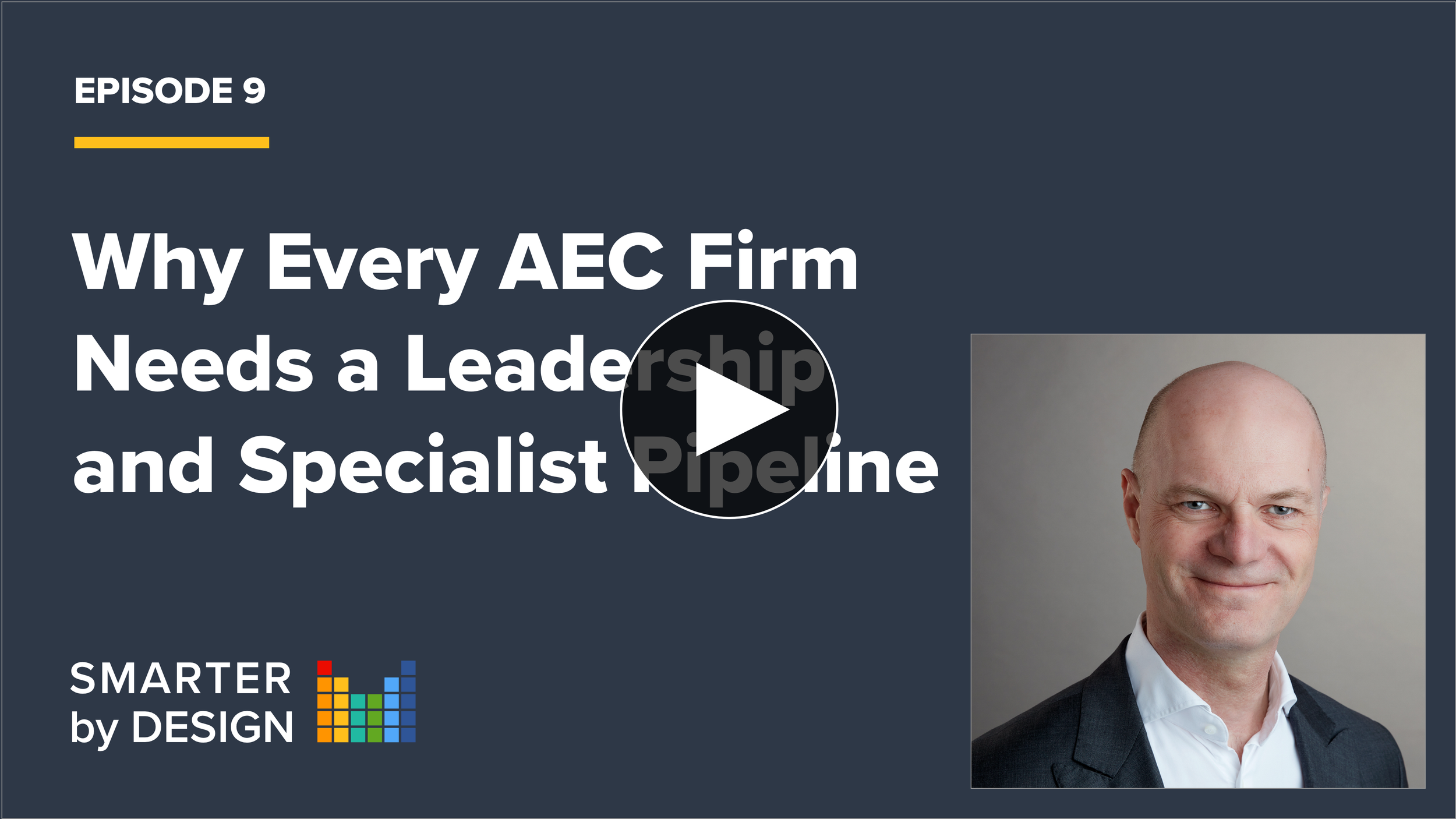
In this episode of the Smarter by Design podcast, I’m joined by Kent Jonasen, CEO of the Leadership Pipeline Institute and co-author of the third edition of The Leadership Pipeline as well as author of The Specialist Pipeline. Kent has spent decades helping organizations rethink leadership development, succession planning, and the challenge of scaling expertise inside complex companies.
His work starts from a deceptively simple premise: leadership is not leadership.
Each transition—from leading yourself to leading others, leading leaders, leading functions, and eventually leading an enterprise—is fundamentally a different job that requires different skills, different priorities, and even different values.
But this conversation goes far beyond leadership development.
Many organizations unintentionally build systems where leadership becomes the only visible path for growth, recognition, and advancement. Specialists—deep technical experts, practitioners, strategists, and problem-solvers—often feel forced toward management roles simply to continue progressing in their careers. Over time, this creates frustration, weak leadership transitions, and the gradual loss of highly valuable expertise.
Kent and I explore why organizations need both leadership pipelines and specialist pipelines working together. We discuss:
Why leadership transitions so often fail
The hidden importance of discovering and aligning with your “work values” in career progression
Why many specialists feel alienated inside traditional organizations
The difference between knowledge experts and knowledge leaders
How companies accidentally push people into management roles they never truly wanted
Why specialist career paths need more than just new titles
How dual leadership and specialist pipelines create healthier long-term organizational design
Along the way, we connect these ideas directly to architecture, engineering, and construction firms, where specialized expertise is often the core engine of competitive advantage. From healthcare planners to sustainability experts to technical design specialists, many AEC firms are wrestling with how to scale expertise, accelerate development, and reduce dependency on a shrinking number of senior experts.
If you lead an AEC firm, oversee learning and development, manage technical teams, or are thinking about succession planning and long-term capability building, this episode offers a powerful framework for rethinking how careers evolve inside organizations. More importantly, it raises a deeper question: what if building a stronger company starts not just with developing better leaders, but with designing better systems for developing expertise itself?
▶ Watch or Listen
Watch or listen to this episode via YouTube, Spotify, Apple Podcasts or wherever you get your podcasts.
📺 🎧 YouTube
📺 🎧 Spotify
📺 🎧 Apple Podcasts
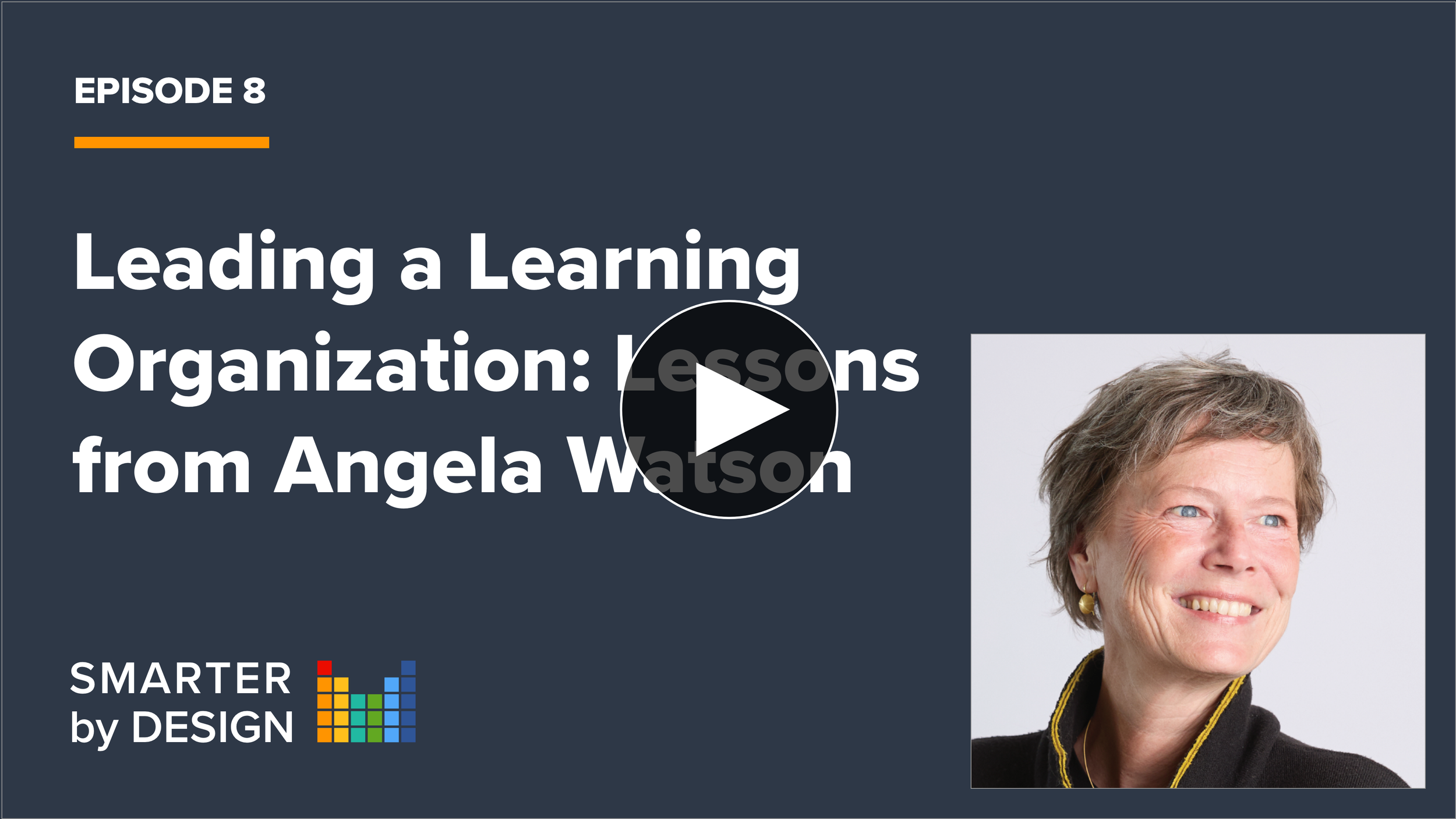
In this episode of the Smarter by Design podcast, I'm joined by Angela Watson, President and CEO of Shepley Bulfinch, a nationally recognized architecture firm whose work spans healthcare, higher education, and civic design. Angela leads with a conviction she traces back to her time teaching at MIT: that real learning doesn't happen through lecture — it happens through doing, through struggle, and through the kind of exploration that only comes when people are given room to fail safely and try again. That belief didn't stay in the classroom. It became the foundation for how she thinks about leading a firm.
Learning by doing is the foundation of how AEC professionals and firms develop. The problem is that great ideas stay trapped in pockets — one team figures something out, another team struggles with the same thing, and the knowledge never travels. Angela saw that dynamic playing out at Shepley Bulfinch as the firm grew into a national practice, work-sharing across five offices with project cycles too long and feedback loops too slow to rely on informal transfer alone. Becoming a learning organization became an operational necessity, but it turned out to be much harder than it looked.
The conversation traces the full arc of what that effort has looked like in practice and what Angela has learned leading it. Why it's so hard for subject matter experts to codify and teach what they know. Why the traditional apprenticeship model is breaking down as plates get fuller and mentorship gets crowded out. What Shepley Bulfinch learned from building Birdfeeder, their internal peer-to-peer learning platform — what worked, what was too ambitious, and what the firm is rethinking now. And why the harder problem isn't building a course catalog — it's connecting learning to where someone actually wants to go in their career.
The thread running underneath all of it is psychological safety. Angela talks about "Back to the Future," Shepley Bulfinch's reframe on lessons learned — a format designed to celebrate the imperfect and make it safe to share what went wrong. She reflects on what it took for her, as CEO, to model that vulnerability publicly, and why she believes culture is the soil in which any learning organization either takes root or doesn't.
If you lead an AEC firm, manage a team, or are thinking seriously about how your organization develops its people, this episode is for you. Angela offers deep insight into what's worked, what hasn't, and what is still to be figured out on Shepley Bulfinch's journey to becoming a learning organization.
▶ Watch or Listen
Watch or listen to this episode via YouTube, Spotify, Apple Podcasts or wherever you get your podcasts.
📺 🎧 YouTube
📺 🎧 Spotify
🎧 Apple Podcasts
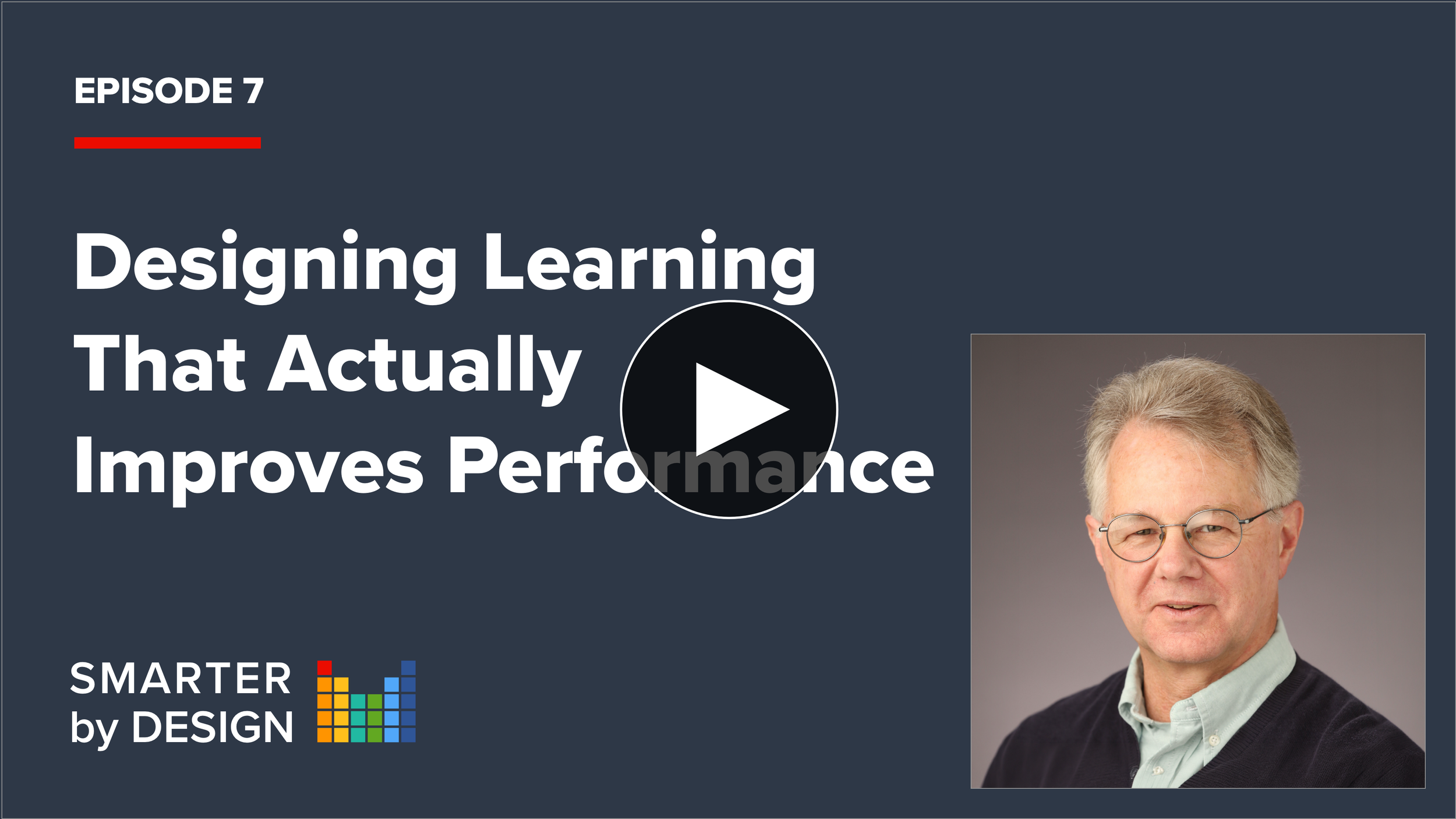
In this episode of the Smarter by Design podcast, I’m joined by Clark Quinn, a cognitive scientist who has spent his career translating decades of learning research into practical guidance for organizations. He is the founder of Quinnovation and co-founder of the L&D Accelerator. His work is grounded in a simple conviction: most organizations are leaving enormous potential on the table — not for lack of effort or care, but because the science of how people actually learn has rarely made it into the room where learning decisions get made.
In most AEC firms, learning and development didn’t start with a formal strategy. It emerged organically. Executives responsible for talent came up through practice. L&D leaders stepped into their roles because they wanted to make their firms better, not because they were trained in the discipline. Subject matter experts shared what they know without ever having been taught how to teach.
As a result, most learning organizations in the AEC industry were largely built by accident rather than by design. And in that gap lies a significant opportunity: to create learning that doesn’t just inform, but actually improves capability and performance.
That is what this conversation is about.
Clark walks us through the science that most accidental L&D leaders never had access to. He explains why training so often stops at information transfer, what it really takes to design for performance rather than content delivery, and what the research says about learning design that actually moves the needle. We explore the shift from content-heavy training to practice-led learning, how to identify the root causes behind critical performance gaps before reaching for a training solution, and how to determine whether learning is even the right intervention.
We also step back and look at what a true learning ecosystem requires: not just courses, but performance support, job aids, communities of practice, mentoring, and the cultural conditions where learning compounds over time. Where knowledge is shared openly. Where failure is discussed. And where leadership sets the tone.
Finally, we go deep on one of the most important dynamics in any AEC firm: how to effectively work with busy and highly billable subject matter experts by drawing out what they know, pairing them with skilled learning designers, and building a coaching culture that makes expertise transferable at scale.
If you lead an AEC firm, build learning programs, or teach others what you know—and you’ve largely been figuring it out as you go—this conversation offers a foundation for doing it smarter. By design.
▶ Watch or Listen
Watch or listen to this episode via YouTube, Spotify, Apple Podcasts or wherever you get your podcasts.
📺 🎧 YouTube
📺 🎧 Spotify
🎧 Apple Podcasts
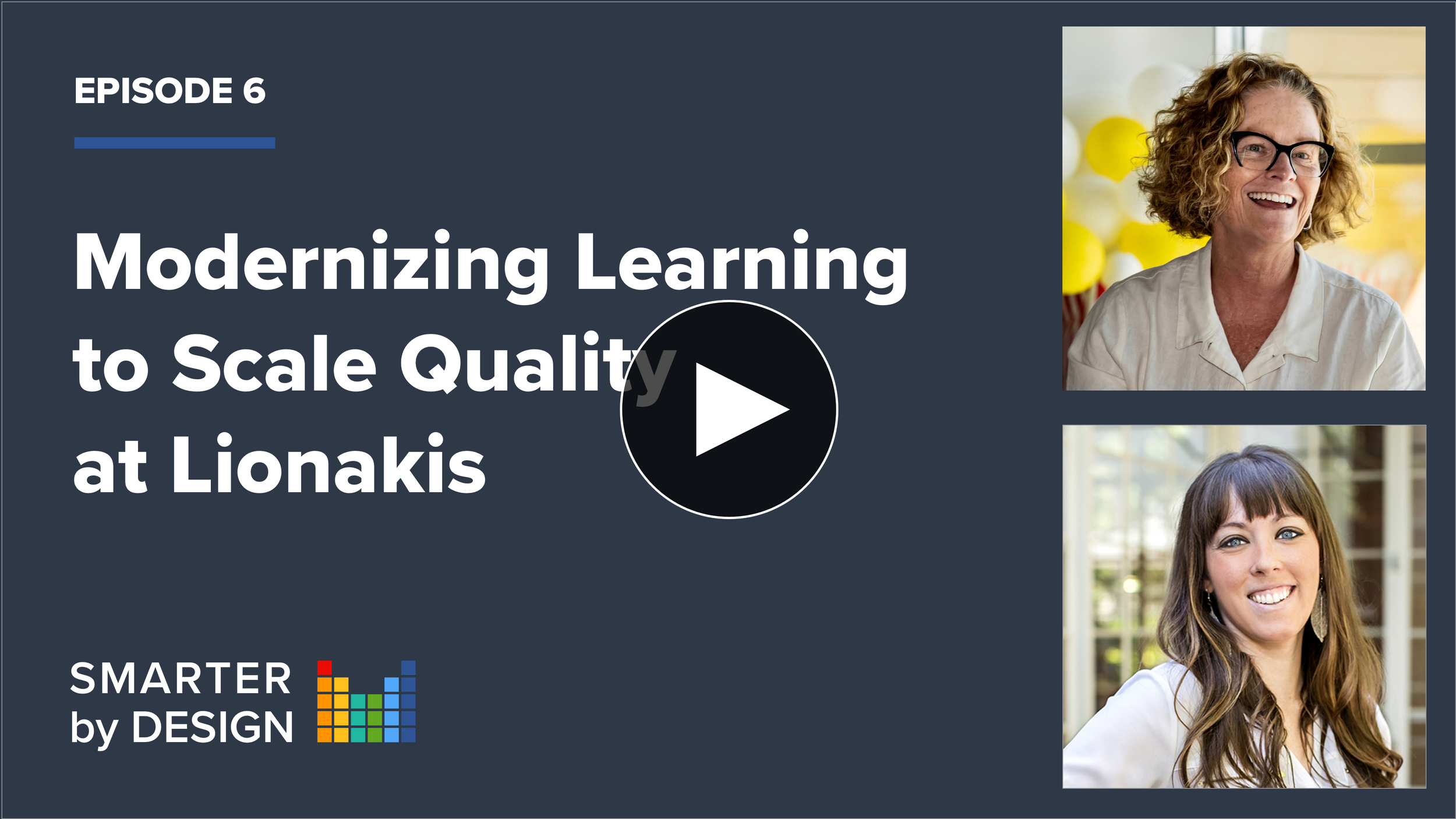
In this episode of Smarter by Design, I’m joined by Laura Knauss, President and Chief Practice Officer at Lionakis, and Kristina Williams, Director of Design Technology at Lionakis, for a conversation about how their firm is modernizing learning to scale quality and consistency across their practice.
At the heart of that shift is a deep respect for the apprenticeship model. For generations, one-on-one mentorship has been the foundation of how architects and engineers learned their craft—and it remains essential today. But as firms grow, diversify, and take on increasingly complex work, Lionakis has recognized that apprenticeship alone isn’t enough to provide the consistent, firmwide foundation that today’s environment demands.
In response, Lionakis is repositioning apprenticeship by building a more intentional and scalable learning system that ensures every team member starts from a shared baseline, while still allowing mentorship to do what it does best: helping people apply that knowledge in the context of real projects.
We explore two major shifts behind that transformation.
First, the evolution of Lionakis’s Design Technology Boot Camp. What began as long, lecture-heavy training sessions has been reimagined into a more modular, learner-centered experience built around short, focused video lessons, hands-on exercises, and live, collaborative sessions. Along the way, Kristina shares what they’ve learned about attention, retention, and how to design learning that actually sticks.
Second, we look at how those same principles are being applied beyond Boot Camp to reshape how the firm teaches practice itself. From specifications and building envelope design to programming and coordination, Lionakis is moving away from ad hoc training toward a more strategic learning roadmap that captures core project knowledge, standardizes how it’s taught, and makes it accessible across the entire firm.
The goal is both simple and ambitious: to create a shared foundation that allows any team member, in any office, to step into any project and contribute with confidence, consistency, and clarity.
What emerges is a picture of a firm learning how to operate as a modern learning organization—where knowledge, learning, and practice are tightly connected, and where investment in learning is directly tied to the quality of the work.
If you’re thinking about how to scale expertise, support the next generation of talent, or move beyond training as a one-time event, this conversation offers a clear and compelling path forward.
▶ Watch or Listen
Watch or listen to this episode via YouTube, Spotify, Apple Podcasts or wherever you get your podcasts.
📺 🎧 YouTube
📺 🎧 Spotify
🎧 Apple Podcasts
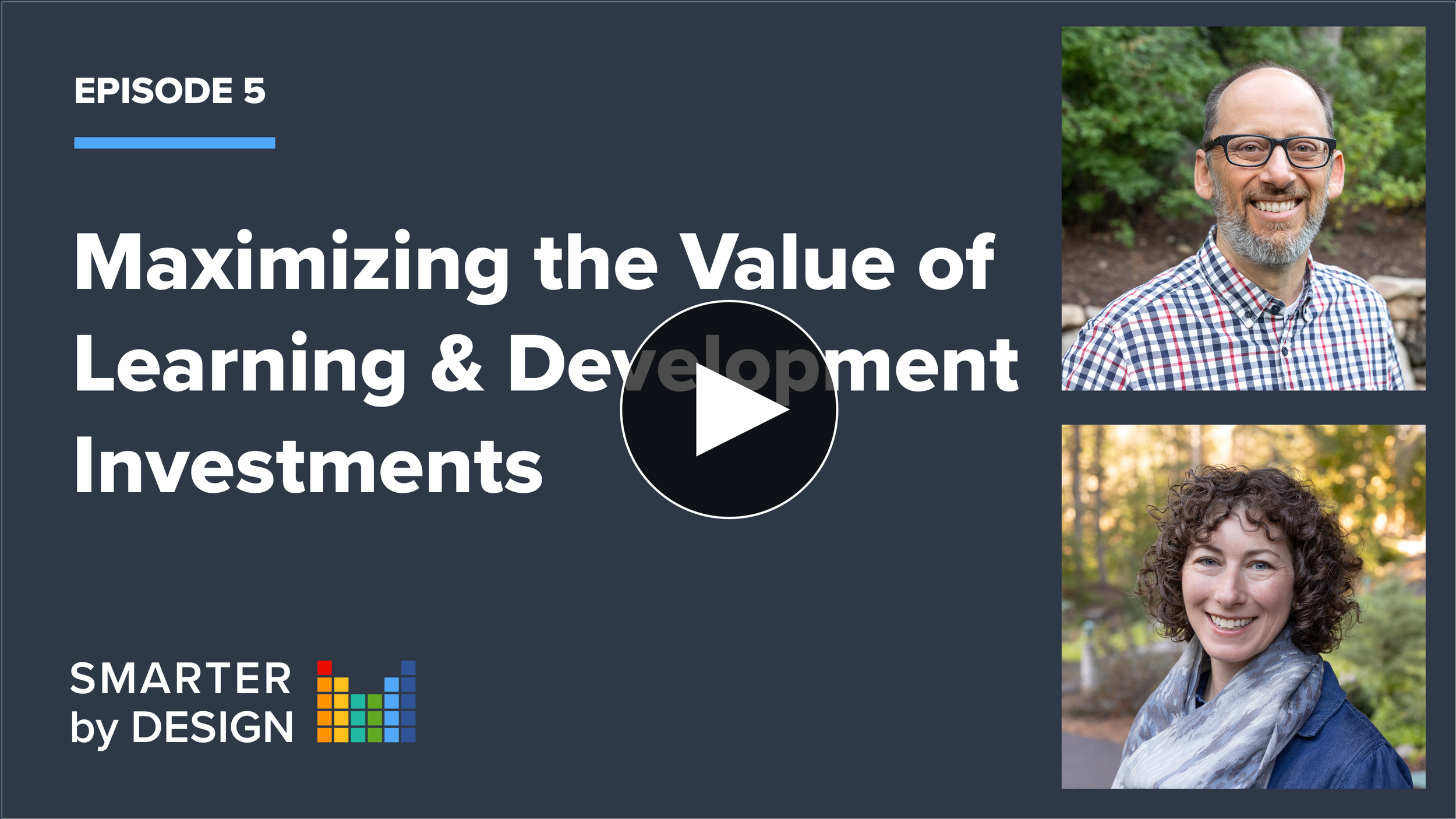
In this episode of the Smarter by Design podcast, Susan Strom and I discuss The Modern Learning Organization Pipeline—a framework for helping AEC firms prioritize and maximize the return on their learning and development investments.
For decades, most AEC learning programs have relied on familiar formats: lunch-and-learns, live training sessions, and recorded presentations. But a new generation of tools—AI search, modern intranets, modular learning systems, and knowledge agents—is dramatically increasing the potential ROI of learning assets. When knowledge can be searched instantly, accessed on demand, and revisited whenever someone needs it, learning assets become far more valuable than they used to be.
That shift creates a new challenge: how do firms decide where to invest their time and energy? You can’t manage all the knowledge in your firm. So the real question becomes: which knowledge and learning investments produce the greatest return?
In this conversation, Susan and I walk through how to identify, prioritize, and design high-impact learning experiences in AEC firms using the Modern Learning Organization Pipeline.
Along the way, we explore:
Why AEC firms need to evolve into modern learning organizations
How firms can maximize the value of learning and development investments
The DESIRE framework, a practical tool for prioritizing learning opportunities
Why learning experiences should increasingly be treated like products
How firms are modernizing learning experiences for the AI era
How learning content can become searchable organizational knowledge
Why learner involvement and piloting are essential to good learning design
The rise of dedicated knowledge and learning roles inside AEC firms
Underlying the discussion is a broader idea: the industry is entering a platform shift in how knowledge, learning, and expertise are developed and distributed. As AI-powered knowledge and learning platforms like Synthesis make knowledge more accessible and reusable, the potential return on learning investments is rising dramatically. The challenge for firms is where to invest their time and energy to create the greatest impact.
If you’re leading an AEC firm and wondering where to invest in learning, knowledge, and capability building, this episode introduces a practical framework for prioritizing the opportunities that will matter most.
▶ Watch or Listen
Watch or listen to this episode via YouTube, Spotify, Apple Podcasts or wherever you get your podcasts.
📺 🎧 YouTube
📺 🎧 Spotify
🎧 Apple Podcasts
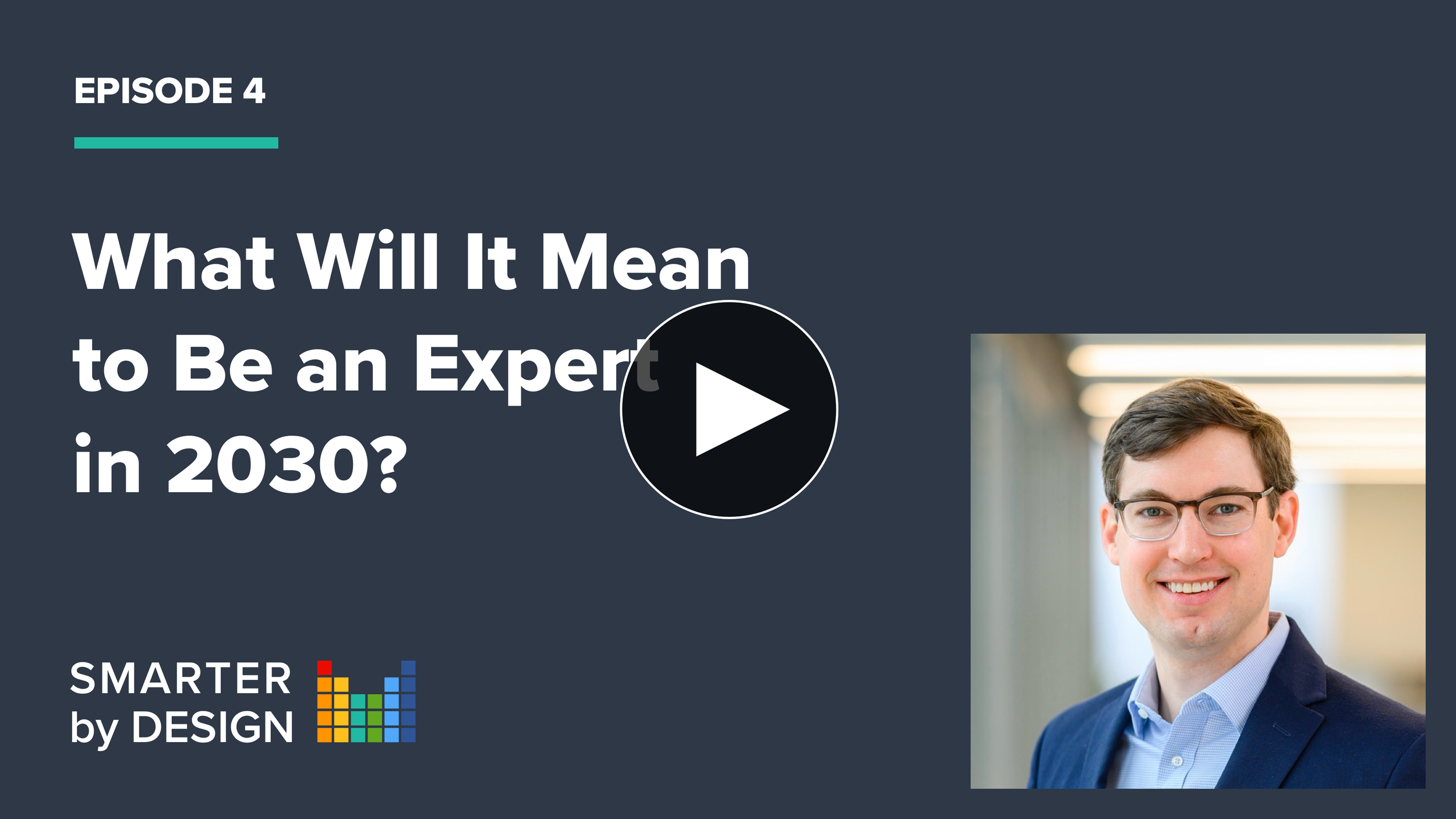
In this episode of the Smarter by Design podcast, I’m joined by Christopher Myers, Peetz Family Professor of Leadership and Faculty Director of the Center for Innovative Leadership at Johns Hopkins University, for a wide-ranging conversation about expertise, learning, and how AI is reshaping knowledge-intensive organizations like healthcare providers and AEC firms.
Christopher studies how professionals learn from experience and from one another. Together, we explore what happens when AI becomes extraordinarily good at synthesizing information but still struggles with judgment, context, and tacit nuance. In fields like healthcare, architecture, and engineering—where decisions carry real liability and long feedback loops—the distinction between synthesis and judgment matters deeply.
We examine a growing paradox: In the near future AI may be able to perform much of the “junior work” that once served as the apprenticeship path to becoming an expert. If AI creates the slide decks, drafts the notes, checks the drawings, and summarizes the literature, how do emerging professionals gain the reps, exposure, and judgment that traditionally came from doing those tasks? And if organizations eliminate junior roles in pursuit of efficiency, what happens to the future pipeline of senior expertise?
The conversation also explores how expertise actually forms. Christopher shares his research on vicarious learning—how professionals learn from stories, informal conversations, and communities of practice—and why hybrid work may be compressing or eroding some of those learning opportunities. We discuss why informal knowledge sharing sometimes outperforms formal systems, and how simulation and AI-powered scenarios may offer new ways to scale apprenticeship in the future.
At the center of the episode is a deeper question: What will it mean to be an expert in 2030? As AI raises the “standard of care” across industries, leaders must rethink not only how work gets done, but how judgment, responsibility, and organizational intelligence are developed over time.
If you’re leading an AEC firm and wondering how AI will affect your talent pipeline, apprenticeship model, or long-term expertise, this conversation offers a thoughtful and research-backed perspective on what may lie ahead.
▶ Watch or Listen
Watch or listen to this episode via YouTube, Spotify, Apple Podcasts or wherever you get your podcasts.
📺 🎧 YouTube
📺 🎧 Spotify
🎧 Apple Podcasts
The Smarter by Design podcast explores how leading architecture, engineering, and construction (AEC) firms are reimagining knowledge management, learning, and AI to build smarter, more adaptive practices. Hosted by Christopher Parsons, Founder and CEO of Knowledge Architecture, the show dives into the real stories behind how firms are scaling expertise, transforming culture, and creating modern learning organizations.
Smarter by Design Newsletter
Published by Knowledge Architecture and written by our Founder and CEO, Christopher Parsons, Smarter by Design explores how forward-thinking firms are building cultures of learning, scaling expertise, and rethinking knowledge management for the modern era.