
SMPS WEBINAR | Beyond Proposal Automation: Rethinking How AEC Firms Win Work in the AI Era
In this session, Nicole Chavas, Chief Operating Officer at Greenprint Partners, shared how her team is taking a clean-sheet approach to designing work in the AI era. At a 35-person firm without dedicated knowledge management or L&D teams, AI is becoming a core teammate embedded directly into how work gets done.
Rather than layering AI into existing processes, Nicole is rethinking those processes entirely, starting from a challenge most growing firms share: the people who hold the knowledge the firm needs are often not the same people doing the work that needs it. Institutional memory, market awareness, process expertise and client relationships live in different heads, and getting them into the right conversation at the right time is harder than it sounds.
Three principles are guiding Greenprint's approach: redesign the work instead of retrofitting what already exists, foster human connection where it matters most, and use AI to elevate implicit knowledge into repeatable processes.
Nicole walked through two parallel efforts. The first reimagines the pursuit process — from how the firm surfaces and evaluates opportunities to how it develops the content that wins them — using AI to draw on institutional knowledge rather than reinvent it each time. The second builds a learning and development pipeline from scratch, capturing expertise through structured interviews with subject matter experts, then using AI to transform those conversations into scalable learning content.
She also explored what it takes to shift mindsets across a firm, and why the emerging KM function may sit at the intersection of strategy and operations, bridging the "why we do things" with the "how we do things" and making sure the organization's collective knowledge is greater than what any one person carries.
Enjoy!
In this session, Nicole Chavas, Chief Operating Officer at Greenprint Partners, shared how her team is taking a clean-sheet approach to designing work in the AI era. At a 35-person firm without dedicated knowledge management or L&D teams, AI is becoming a core teammate embedded directly into how work gets done.
Rather than layering AI into existing processes, Nicole is rethinking those processes entirely, starting from a challenge most growing firms share: the people who hold the knowledge the firm needs are often not the same people doing the work that needs it. Institutional memory, market awareness, process expertise and client relationships live in different heads, and getting them into the right conversation at the right time is harder than it sounds.
Three principles are guiding Greenprint's approach: redesign the work instead of retrofitting what already exists, foster human connection where it matters most, and use AI to elevate implicit knowledge into repeatable processes.
Nicole walked through two parallel efforts. The first reimagines the pursuit process — from how the firm surfaces and evaluates opportunities to how it develops the content that wins them — using AI to draw on institutional knowledge rather than reinvent it each time. The second builds a learning and development pipeline from scratch, capturing expertise through structured interviews with subject matter experts, then using AI to transform those conversations into scalable learning content.
She also explored what it takes to shift mindsets across a firm, and why the emerging KM function may sit at the intersection of strategy and operations, bridging the "why we do things" with the "how we do things" and making sure the organization's collective knowledge is greater than what any one person carries.
Enjoy!
Featured Guest
Nicole Chavas, Chief Operating Officer, Greenprint Partners
Nicole is President & COO of Greenprint Partners, a Chicago-based urban planning, civil engineering and landscape architecture firm. In leading all aspects of firm operations, she brings a passion for rallying resources, talent and partnerships to scale sustainable infrastructure—a passion that has informed her approach to team leadership and company growth since 2014. Nicole's love of learning is inherent in every initiative she leads. Whether it’s spearheading a proposal, accelerating adoption of a new knowledge management system or recruiting and onboarding employees, she is committed to transparency, collaboration and continuous learning every step of the way.
Moderator
Christopher Parsons, Founder and CEO, Knowledge Architecture
As Founder and CEO of Knowledge Architecture, Christopher is responsible for product design, marketing strategy, and organizational health. He is also the executive producer of KA Connect, our annual knowledge management conference for the AEC industry. Christopher is the author of Smarter by Design, a bi-weekly newsletter exploring how leading AEC firms manage information, share knowledge, and build learning organizations. He has been a technology leader in the AEC industry since 2002, including serving as Chief Information Officer for Steinberg Architects and Information Technology Director for SMWM (now Perkins+Will).
DEEP DIVE | Building Marketing Knowledge Agents: How LS3P, EUA, and Muller Engineering Are Putting Knowledge to Work with Synthesis
Featured Guests
Katie Robinson, Chief Marketing and Knowledge Officer, LS3P
AJ Zandt, Marketing Specialist and Content Writer, EUA
Shayna Lindeman, Senior Communications Specialist, Muller Engineering
Webinar Summary
AEC marketing teams have spent years building and maintaining some of the richest knowledge collections inside their firms: structured CRM data, employee resumes, project descriptions, proposal language, client testimonials, past proposals, market research, and insights captured from subject matter experts.
Synthesis Knowledge Agents offer a new way to put all of that knowledge to work by helping marketing teams find, connect, and apply what their firms already know. The result can be faster workflows, stronger content, and fewer repetitive demands on both marketing teams and the subject matter experts they rely upon.
In this 90-minute webinar, Katie Robinson, Chief Marketing & Knowledge Officer at LS3P; AJ Zandt, Marketing Specialist and Content Writer at EUA; and Shayna Lindeman, Senior Communications Specialist at Muller Engineering, shared the marketing knowledge agents their firms are building and using as participants in the Synthesis Knowledge Agents beta.
Through three 15-minute case studies, they demonstrated real-world agents designed to support marketing, business development, and communications. Their examples showed how firms are using knowledge agents to reduce repetitive work, uncover relevant experience and evidence, and give marketing teams a stronger starting point for creating thoughtful, tailored content.
We explored:
How firms are identifying high-value opportunities for marketing knowledge agents
How agents help teams research RFPs, surface hard-to-find project evidence, and turn it into stronger proposal language, resumes, and qualifications
How agents can reduce repetitive work and make the day-to-day experience of marketing professionals more productive and rewarding
How agents can reduce demands on subject matter experts, allowing them to spend more time on billable work and serving clients
How firms are structuring grounding knowledge and instructions to produce useful, trustworthy results
What marketing teams are learning as they build, refine, and introduce agents within their firms
Where human expertise and judgment remain essential
How agent ownership and content stewardship may reshape the role of AEC marketing teams
Following the presentations, Susan Strom, Chief Client Officer at Knowledge Architecture, facilitated an open conversation with the speakers and audience about what it takes to build useful agents, what these early implementations are revealing, and where marketing knowledge agents may go next.
Featured Guests
Katie Robinson, Chief Marketing and Knowledge Officer, LS3P
AJ Zandt, Marketing Specialist and Content Writer, EUA
Shayna Lindeman, Senior Communications Specialist, Muller Engineering
Webinar Summary
AEC marketing teams have spent years building and maintaining some of the richest knowledge collections inside their firms: structured CRM data, employee resumes, project descriptions, proposal language, client testimonials, past proposals, market research, and insights captured from subject matter experts.
Synthesis Knowledge Agents offer a new way to put all of that knowledge to work by helping marketing teams find, connect, and apply what their firms already know. The result can be faster workflows, stronger content, and fewer repetitive demands on both marketing teams and the subject matter experts they rely upon.
In this 90-minute webinar, Katie Robinson, Chief Marketing & Knowledge Officer at LS3P; AJ Zandt, Marketing Specialist and Content Writer at EUA; and Shayna Lindeman, Senior Communications Specialist at Muller Engineering, shared the marketing knowledge agents their firms are building and using as participants in the Synthesis Knowledge Agents beta.
Through three 15-minute case studies, they demonstrated real-world agents designed to support marketing, business development, and communications. Their examples showed how firms are using knowledge agents to reduce repetitive work, uncover relevant experience and evidence, and give marketing teams a stronger starting point for creating thoughtful, tailored content.
We explored:
How firms are identifying high-value opportunities for marketing knowledge agents
How agents help teams research RFPs, surface hard-to-find project evidence, and turn it into stronger proposal language, resumes, and qualifications
How agents can reduce repetitive work and make the day-to-day experience of marketing professionals more productive and rewarding
How agents can reduce demands on subject matter experts, allowing them to spend more time on billable work and serving clients
How firms are structuring grounding knowledge and instructions to produce useful, trustworthy results
What marketing teams are learning as they build, refine, and introduce agents within their firms
Where human expertise and judgment remain essential
How agent ownership and content stewardship may reshape the role of AEC marketing teams
Following the presentations, Susan Strom, Chief Client Officer at Knowledge Architecture, facilitated an open conversation with the speakers and audience about what it takes to build useful agents, what these early implementations are revealing, and where marketing knowledge agents may go next.
Webinar Timeline
Introduction
00:00 Welcome + How Firms are Using AI in Marketing
Katie Robinson of LS3P
05:35 LS3P, FRANK, and Why Marketing Agents
08:03 Project Experience Agent
10:33 Resume Helper Agent
12:32 SF 330 Experience Matrix Agent
14:49 Proposal Production Assistant Agent
17:02 Building Step-by-Step Actions in the Agent
AJ Zandt of EUA
19:04 EUA's Proposal and Interview Library
21:36 Proposal Content Agent
26:34 Cover Letter Agent
29:13 Project Narrative Generator Agent
30:04 Project Number Finder Agent
32:45 Filtering Grounding Knowledge by Date
Shayna Lindeman of Muller Engineering
34:16 Muller Engineering and Finding the Low-Hanging Fruit
38:05 Mulli Content Buddy Agent
44:31 Quote Finder Agent
48:36 Proof Assistant Agent
53:04 Proposal Query Agent
56:44 Closeout Companion Agent
Q+A
58:22 Q: What knowledge base and first agents should we start with?
1:00:52 Q: When do you use Synthesis agents vs. Copilot, ChatGPT, or Claude?
1:03:45 Q: Did you set a minimum number of hours for projects to appear on resumes?
1:05:34 Q: Do these processes use a lot of tokens?
1:06:25 Q: How does EUA curate the proposal examples its agents draw on?
1:08:19 Q: How long does it take to develop an agent and show its value?
1:14:11 Q: Did you draft agent instructions from a recorded team conversation?
1:15:49 Q: Can agent actions live in the agent or on a page?
1:16:36 Q: How have agents changed the way you champion Synthesis in the firm?
1:22:30 Q: Do agents learn and adapt from chats and queries?
1:24:28 Q: How do we filter out irrelevant ERP project data?
1:27:59 Closing and Knowledge Agents Public Beta
More Case Study Webinars
View Upcoming Events
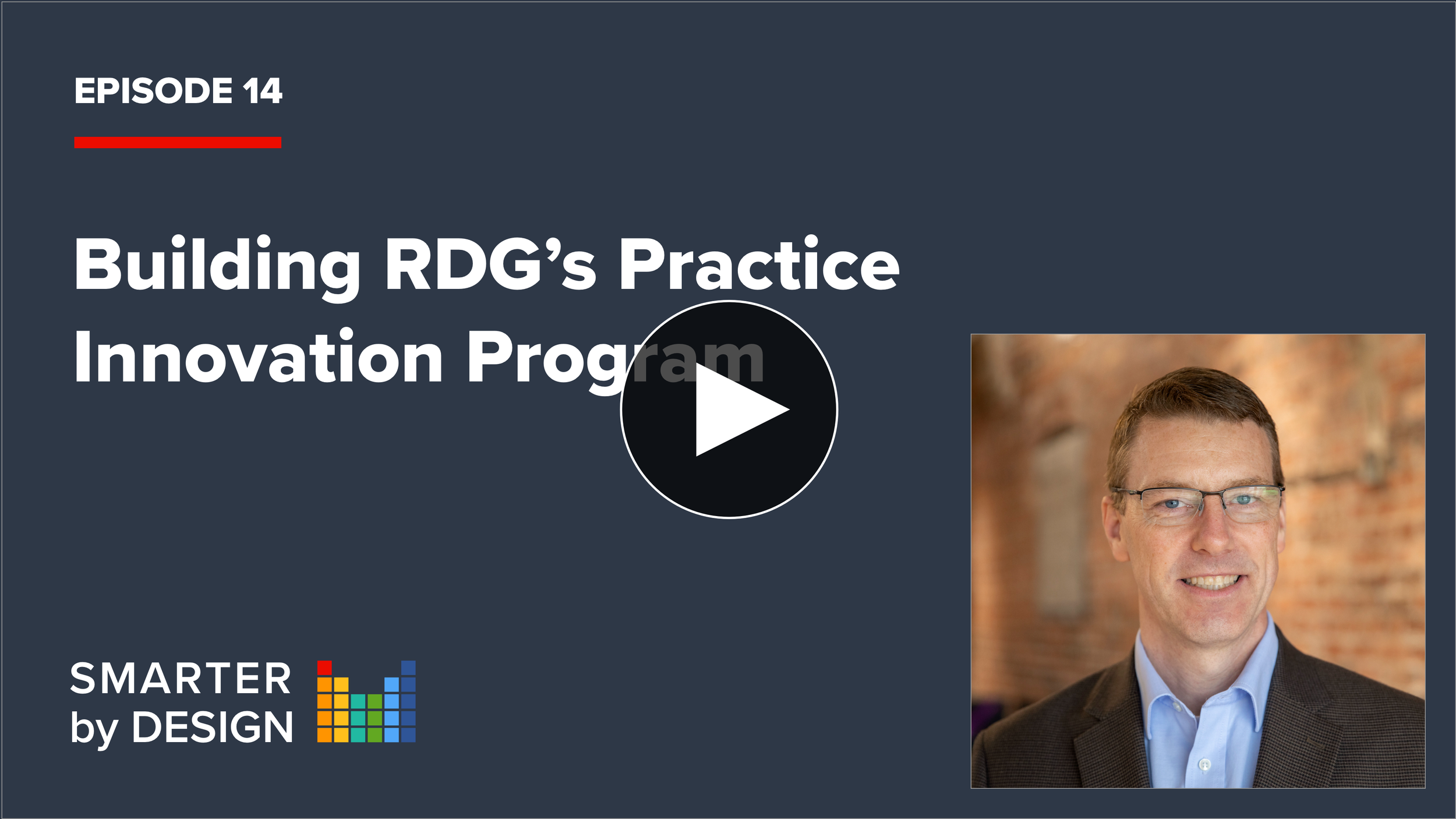
Building RDG’s Practice Innovation Program | Ron Heims of RDG
Ron Heims has spent his entire career at RDG Planning and Design, moving from architect to IT director to his current role as Director of Practice Innovation. It’s a role dedicated to a question many AEC leaders are sitting with: who is actually responsible for making the firm better at how it works?
In this episode of the Smarter by Design podcast, Christopher Parsons talks with Ron about what a practice innovation program looks like from the inside. The conversation explores how Ron discovers and prioritizes innovation projects across a firm with too many good ideas, how he uses process mapping to diagnose undocumented workflows before any technology gets involved, and how he brings people with competing opinions together to build consensus around a better way forward.
Ron also explains how RDG decides when to buy software and when to build it, and how he and his team have developed a suite of custom tools tailored specifically to RDG's workflows, including a project management platform built with agentic coding tools that connects project teams to RDG's Synthesis intranet knowledge in the flow of work.
A big part of what makes the innovation program work is what happens after a tool gets built. Ron talks about his approach to change management and adoption, including how he keeps early adopters close, responds to feedback quickly, and creates the conditions for people to actually want to change how they work. Building better tools is one challenge. Getting them adopted across a multi-office firm is another problem entirely, and Ron has learned a lot about both.
If you lead or manage an AEC firm and you sense that someone should be focused on innovation on a more dedicated basis, this episode is for you.
▶ Watch or Listen
Watch or listen to this episode via YouTube, Spotify, Apple Podcasts or wherever you get your podcasts.
📺 🎧 YouTube
📺 🎧 Spotify
📺 🎧 Apple Podcasts
Ron Heims has spent his entire career at RDG Planning and Design, moving from architect to IT director to his current role as Director of Practice Innovation. It’s a role dedicated to a question many AEC leaders are sitting with: who is actually responsible for making the firm better at how it works?
In this episode of the Smarter by Design podcast, Christopher Parsons talks with Ron about what a practice innovation program looks like from the inside. The conversation explores how Ron discovers and prioritizes innovation projects across a firm with too many good ideas, how he uses process mapping to diagnose undocumented workflows before any technology gets involved, and how he brings people with competing opinions together to build consensus around a better way forward.
Ron also explains how RDG decides when to buy software and when to build it, and how he and his team have developed a suite of custom tools tailored specifically to RDG's workflows, including a project management platform built with agentic coding tools that connects project teams to RDG's Synthesis intranet knowledge in the flow of work.
A big part of what makes the innovation program work is what happens after a tool gets built. Ron talks about his approach to change management and adoption, including how he keeps early adopters close, responds to feedback quickly, and creates the conditions for people to actually want to change how they work. Building better tools is one challenge. Getting them adopted across a multi-office firm is another problem entirely, and Ron has learned a lot about both.
If you lead or manage an AEC firm and you sense that someone should be focused on innovation on a more dedicated basis, this episode is for you.
▶ Watch or Listen
Watch or listen to this episode via YouTube, Spotify, Apple Podcasts or wherever you get your podcasts.
📺 🎧 YouTube
📺 🎧 Spotify
📺 🎧 Apple Podcasts
📚 Show Notes + Resources
Heims, Ron. "Low-Code, High-Impact: Solving Real Business Problems with Custom AI Apps" KA Connect 2025.
📃 Episode Transcript
This transcript was lightly edited for clarity.
Chris: You are Ron Heims, Director of Practice Innovation at RDG Planning and Design. Welcome to Smarter by Design.
Ron: Thank you. I'm excited to be here.
Chris: Yes, we've known each other a very long time at this point, pre-Knowledge Architecture, actually. So it's fun to have you here on the pod.
To that end, I'd love to talk a little bit about your journey from being an architect, and then an IT director, and now a director of practice innovation. How did that happen?
Ron: Okay. My degree is in architecture from Iowa State University. When I graduated from Iowa State University, I got hired at RDG, where I still work. I was hired, I think, largely because of my technical skills back then in the world of transitioning into AutoCAD.
When I started at the firm, our Des Moines office only had about 25 people. We had three Sun SPARCstations, and I came in helping transition us over to Windows PCs with AutoCAD, because we could buy a lot more for the same amount of money. So as I came in, I was researching technology. I was always interested in the technology side of things.
For about four to five years or so, I was really managing all the technology for the firm, as well as teaching and educating people on AutoCAD, and doing architecture work, all together. And after about four or five years, it became evident that either we had to hire someone to do technology or I was going to transition and do it.
So I thought about that a lot and decided that I wanted to take a slightly different route than most people do through our profession, and transitioned to overseeing the technology for the entire company at the time. And so I grew in that role through managing the technology and becoming the IT director overall.
And then, oh, it was probably 2022, I think, when we went through a reorganization internally as a company through some merging of different positions. And at that point, I also wanted to make room for some of my staff that I'd grown on my team, and we transitioned my role to director of practice innovation. So we handed the IT side of it off to Adam, and then I became the director of practice innovation.
Chris: Okay, so what is that?
Ron: The director of practice innovation is a role that is about innovating process. As IT director, I did a lot of it too, but as IT director, I really managed servers, hardware, software. But I also did innovation, bringing in new technology, new systems.
When we transitioned this role, those more hardware- and software-based responsibilities went to Adam, and then my role became more about looking at process. I work a lot with project managers. We work a lot with our QA team and our design technology team, looking at how we can improve our processes to streamline how we work, and allow us to have tools that are better and get more done.
A lot of that really rolled into data quality, too, because we see the value of the data that we have on our projects that we aren't always very good at collecting, and being able to manage that, use that, and then help our company make better decisions based on that data.
Chris: I can clearly understand the line between you and Adam, and traditional technology. How about design technology? Because that feels like it gets mixed in with process and innovation.
Ron: It does. So design technology is a key part of my team, in that we work together a lot, and we work a lot with IT as well. But design technology really does fall into design process and performance. So it's kind of a gray area when you go between Revit and Bluebeam and all these different tools, as well as the hardware and software side, I guess, or the server side. So DT, design technology, is really integrated with the practice innovation team.
Chris: I'm assuming you haven't worked on a project in over 10 years. Is that a fair assumption?
Ron: I have from the standpoint of the data side, but it's really just more like building Power BI dashboards for data we have. So yes, I haven't really worked on projects in a long time.
Chris: How is that? Because I've talked to people about this before. You're helping people innovate practice, but having not worked on projects, do you find that that helps or hurts? What's been your experience with that?
Ron: It can be a detriment from the standpoint that when you're not doing all the different things day to day, you don't understand what the pain points might be. So you just have to listen a lot, I guess, and ask a lot of questions in the process.
And we'll even use process mapping when we go through to understand the flow of data and the flow of process, and that helps to get that information from the people that we're working with.
Chris: I'd be curious to know some of the more recent innovation projects you've worked on, and maybe we can just talk about process mapping and your whole approach to innovation.
Ron: Okay. So, some of the more recent innovations we've done: I spoke about one last year at KA Connect, which was the receipts app. It was just a process that was really broken within our company. And that wasn't necessarily project management, but it's something that really hit a lot of people.
So in that case, quite honestly, I'd had the idea to build something like that for quite some time, because the chore of getting your receipts from your company credit card to our accounting staff was always a pain, right? People would email them, or they would hold them in a folder or envelope or whatever, and then turn them in and try to match them up to projects.
And then you realize that we have the tools with the mobile apps that we can build today to just integrate that with our accounting system, so you can pull a project number that's active, add it, take a picture of a receipt, let AI do the work of uploading the data, and then submit it, and it's out of your hair. You don't have to think about it.
And that app, when we launched it, just took off really fast, because it made everyone's life easier, from the person submitting the receipts to the accounting staff, all the way through.
Chris: So for someone that didn't attend KA Connect last year and hasn't seen your talk, why are you building a receipts app and not just buying something off the shelf?
Ron: I think it's making the process as simple and intuitive and painless as possible. We actually had people that were using some other platforms, and one of the guys that I had test it was using another platform. His comment to me was that using this receipts app that I built, he was able to save about two or three hours a month.
Mostly because the other platform wasn't integrated, right? He had to take his projects and upload them into this other platform, and then he had to enter his stuff in there, and then he had to export it out and put it in a spreadsheet to give to accounting, because accounting couldn't see it.
So I think what makes it really valuable is that we're integrating with our accounting system. Our accounting staff can see the data pretty much instantly once you've uploaded the receipt. So it just took the friction out of the process.
And because it was so easy to use, people use it, versus, "Oh, I'll get to that later, because I've got to go look up the project number and then put it in the system and then put in the data and track it all down." So when it became simpler and easier, people just started using it very quickly.
Chris: Yeah, simpler, easier. And the integration, I think, is what you're saying is the key part.
Ron: Yes. Totally.
Chris: Is some of it also that you could build only the exact features and functions that RDG needed? Whereas when you buy commercial software, they have to cover a wide range of markets and user types.
Ron: Right. Yeah, I think that's what makes it so valuable: it was customized to just our project list and the 10 different ways we categorize our receipts in our accounting system. You take a picture of the receipt, and then the AI tool reads the receipt and fills in the name, the amount, the date, all that for you.
So it was very customized to ours, and I was even able to build in a favorites list, which basically pulls in only the projects that are on the person's timesheet, because that data is in Deltek as well, so they have that list right in front of them.
So yeah, it's because it was totally customized to our process specifically, versus having to try to shift our process into somebody else's tool that had way more than we needed.
Chris: So for somebody listening who's saying, "Okay, cool, you're building apps. We don't have that capability." And this was pre-Claude Code that you built this, or any of these new agentic coding tools.
Ron: Yes.
Chris: Can you talk about how you were able to do that as an architect turned technologist turned director of practice innovation?
Ron: Are you talking from a platform standpoint?
Chris: Yeah, from a platform standpoint.
Ron: Okay. So I had actually had the idea to do something like a receipts app a long time ago, because I had tried several different platforms over the years. I had tried about five or six different platforms to build it in, and nothing could do it the way I needed it to.
And then I was trying to build a different app one day, and again, I tried that in several different platforms. And it was interesting, because I was building the app, and I couldn't do something as simple as putting a dollar sign on a field that should have a dollar sign. And I was so frustrated that day, I was like, "There's got to be a better way."
I just went out to the web and started searching again, and I came across the Glide platform, which we've used to build that app and several other apps internally. And I was able to build the guts of the receipts app in less than a week, and then we've improved it a little bit since then, because the platform had all the key pieces I needed. It had an easy, simple interface, it had the ability to integrate with external databases, and it had a simple way to post or publish a web app.
So I found that platform and was really impressed with it. I've built several different apps in that platform, and it's been a really solid platform for us from the perspective of the needs that we had.
Chris: So if I said the reason it's possible for you to go so fast is that you found a low-code, no-code platform, but you understand the business process. You've done the process map, you understand the pain points. So you're just dragging and dropping components to build an app with the screens and the UI that you need, branding it according to your firm, and then publishing it. It's more like assembling a kit of Legos. Is that a fair summary?
Ron: Yeah. That is a fair summary. Because it integrates well with platforms, and it is low-code, no-code, so you don't have to know how to write the code. Once you learn how to use their platform, it's pretty simple.
Chris: I'm guessing, though, the integration was the hardest part of that for somebody who isn't a programmer.
Ron: Yes. Because you've got to understand databases, and database synchronization is what we used.
Chris: That was a great example of how you're working and the tools you're using. What does a typical month look like? Are people coming to you with inbound, like, "Build me something"? Are you going out and doing listening tours? How are you finding projects, and then how are you prioritizing where to spend your time?
Ron: When I went into the practice innovation role, I basically started meeting with different groups of people. So we had a project management group that I'd meet with. I'd meet with the QA/QC group, and with the design technology group, and we would basically go in and say, "How can we make our processes better?"
So it was really meeting with groups, and we would brainstorm about ways to make our company better and our processes better, and then we would prioritize from there what we wanted to do or build, and then we would go and work on building that and putting it together with a team of people.
Chris: How do you make decisions in terms of what gets green-lit and what stays on the back burner?
Ron: I think part of it is that through leadership, we will talk about the different things that we've thought about. I am the kind of guy that likes to jump in and get my hands dirty. So I love to tinker and play with things and see if I can create something. I love just going in and learning and creating something, and then running through testing ideas and thinking, "Okay, this really could work." So I will see if I can take that further.
But from a group standpoint, we would literally try to prioritize what the group's needs were and what the biggest pain points were for those different groups, and then talk with leadership about that and prioritize from there.
Chris: Do you end up doing design research around the process and building a prototype before you make a go/no-go decision? Or do you decide before you even spend any time researching?
Ron: It depends on the project. Some that are smaller things, I may just jump right into, but for other things, I will build a process map, right? So I'll use a whiteboard technology, and I'll literally sit down with somebody and walk through it, like, "Okay, what's the first thing you do?"
And we'll walk through it several times, because many times you get a real general version first, and then you've got to get a more detailed version down to the individual steps. So laying that out, I think, was really valuable from the standpoint of knowing where the repetition happens, where the double entry of data happens, where the pain points and the frustrations were.
Literally mapping that out onto a whiteboard has been very valuable, and we've done that on many of the different tools that we've built.
Chris: I'm curious about that. You said you do multiple passes. Is that multiple passes with the same person, or does that mean multiple different people?
Ron: Both. Some of the processes that were a little smaller, I would literally map out and sit down with the person, because as I went through the first time, you feel like, "Okay, I don't feel like I got everything," right? And so we'd go back and have them review it, and then review it again with them and go through it.
Other things, we'd do with a team of people. So we'd have a shared whiteboard, and everyone could put their information into it and share how they were doing it, and then we would just refine that down to a simpler process that worked for everyone.
Chris: Yeah. So what's interesting is what's going on here, in addition to you building software, is you're having to get people at RDG aligned on what good looks like and how we're going to work, right?
Ron: Yes.
Chris: Because people might have seven different processes for doing a project management task, and you have to say, "We're going to agree to consolidate." Yeah?
Ron: Yes. That is probably one of the biggest challenges of this role, because you do find people have their ways of doing things, and bringing that together to get consensus on how we can do it better is really valuable.
In fact, in about the last year and a half, we really kicked off a process within our company for project management improvement. And one of the reasons we did that was because we were getting a lot of feedback from our younger staff that would come in and work on one project, and they were like, "Okay, I've got this all figured out." Then they would jump to another project, and they were totally lost, because the project manager did things totally differently.
Chris: That's only an RDG problem.
Ron: Yes.
Chris: I'm just going to let you know that that is...
Ron: Okay. I figured that was the case.
Chris: I've never heard that exact story before.
Yeah, and you're multi-office, right? So that's another wrinkle on it too.
Ron: Yes. Yep. We are multi-office.
Chris: So did this really truly come from younger staff? You're hearing feedback like, "Hey, I'm going to different projects," and so in order to make their experience better, you have to go a level up and standardize?
Ron: Yeah. I mean, it was from that, and also just from knowing that there were no standard processes in place. We obviously knew that, because everybody does things their own way. But we did hear from younger staff in some of our employee surveys and things like that.
So we said, "Let's see if we can solve that problem and make it easier for our staff to be able to change between different projects or different project managers."
Chris: So what were some of the things you were tackling? Because obviously project management's a big ball of things. So how did you get started trying to simplify?
Ron: So we kicked off a team of people through an initiative we call Project Pando, based on the Pando tree, which has interlocking roots underneath the ground. And so we basically pulled a group of people together to talk about what we could be doing to make things better.
And really we started off with something as simple as, "Hey, you've got to understand your scope and share that with your team. You need to establish roles and responsibilities on your projects." Because we've got people that come onto a project, and they don't understand what they're supposed to be doing, because the project manager didn't communicate that with them.
Chris: They just start giving them tasks, but they don't understand the bigger picture.
Ron: Exactly. And so we've gone through a whole process of defining what the different roles on the project are and what the responsibilities are for those people, and now we're building that into tools so that people know those up front.
Then one simple thing we got to was project schedules. People didn't understand the schedule on the project, when the deadlines were, and when the milestones were.
And so, interestingly enough, one of the first things I built from that standpoint was just a spreadsheet that did a simple Gantt chart, but it had formulas in it to make it halfway automated. And people loved it. It was one of those things like, "Oh, wow, this makes my life easier, so I'll use the tool."
So we did that, and we got into even things like, "Hey, you need to have regular team meetings. You need to have design reviews. You need to have BIM model reviews and QA reviews and things like that." So we've gone through over a year now of different training classes for our PMs to walk through a standard process.
And the hard part is that we're building some of the tools as we're doing it, and so it's a moving target.
Chris: So we started with something as simple as a receipts app, and then it sounded like there was a middle tier where you were working with maybe smaller teams, where there was one subject matter expert or leader. I know that you built a parks app, where you have logging features. So I'm guessing that didn't require as many stakeholders to design.
Ron: Right. Yes.
Chris: And now you're getting into more business transformation that also happens to have a technology component to it. You're having to standardize the process and how we're going to work, then you're training people on that, and then you're building technology and tools to make that easier to comply with.
Ron: Yeah.
Chris: Because I'm guessing in RDG's long history, this isn't the first time people have gotten together and tried to say, "This is how we're going to manage projects," right?
Ron: No. It's not the first.
Chris: So what would be different this time is... Actually, what is the answer to that? Why do you think this time you'll get it?
Ron: I think this time we're a different company than we were in the past. In 2022, we did an internal reorganization. We used to have separate business centers in different offices, and now we've switched to more of a studio model, where we have studios of people, but they can be across offices.
And so that caused people to work together between different office locations, and I think that really started to show that, "Oh, wow, the people in this office used to do things totally differently than this office." And so that highlighted those differences. Because the people that you were around were probably the people you followed the most, and when we started working in studios across offices, it became more apparent that there were differences.
Chris: So the ability to work share across offices just really made that clear.
Ron: Yeah. It drove it to the next level.
Chris: And from the tech perspective, it sounds like as you're working, you will build something as simple as a spreadsheet for scheduling. I happen to have gotten a really cool demo yesterday from you of something that you're building. And now that's more like software versus a spreadsheet.
Ron: Right.
Chris: And I'm curious if that's a typical process for you, to start with a lower-fidelity thing like a spreadsheet to validate the use case, or not?
Ron: In that particular case, I thought about trying to build an app first, but part of it was that we were on a timeline, and I didn't have time to build the app that I wanted to build. So I just went with what most people were using anyway. I already knew that they knew how to use Excel, and I just made a better version for them of things they would have.
I gathered several different scenarios of how people were doing it, and then took that and built a tool that they already knew how to use. I thought about going back to make an app, but because of the timing of it and trying to get the training out, we said, "Well, we'll just do this, but we'll come back to it later."
Chris: Now that they have something in Excel, which is a tool they already use, how do you imagine getting them out of Excel and into the app that you're building?
Ron: I think it'll be easy, because when I built the Excel tool, I was like, "This is better than what they were using," but I could see the holes in it right away, just because of some of the capabilities that you can't necessarily integrate into Excel the way I can when building an app.
And so we're starting to test the new app that we're building, and people are really liking it because of the integration, again. Because when you go into it, all the data that we have in Deltek is already there. We don't have to go type it in manually. So because we integrate, that makes the barrier to entry a lot lower, because they just walk in and their data's already there.
Chris: At a high level, what else besides scheduling? Are you building the scope into this app? Are you building roles and responsibilities, some of the things you talked about that you need now?
Ron: Yes. So it started off with scheduling, and then from there, because of the project management training process that we're going through, we were like, "Oh, we need to have roles and responsibilities." Some of our team members, as they're building tools, are building these really complicated spreadsheets. We're going, "Oh gosh, that's just so hard for people."
So now we've added in roles and responsibilities and assignments of those roles, and the goal is that this all becomes available and visible to people. Because one of the challenges of having everything in a spreadsheet is that it's stored somewhere, and you don't always know where. And even though we do have a standard process for where you file your files, people don't always follow it exactly. Surprise, surprise.
So we've started putting in roles and responsibilities. We started looking at scope. We started looking at deliverables. We're even going now into notes and information that normally would be kept in... We've used OneNote a lot to put that information there. So we're starting to put all this context in, and the whole goal with that particular app is that you can go to one spot and at least get to the information, or have a link to where the information is, from one location.
Chris: Right. And I would imagine from a company perspective, you'll also be able to make sure that teams are all putting their scopes in, they're all doing their roles and responsibilities, they're all building schedules.
Ron: Yes.
Chris: And so you can help ensure quality is happening systemically.
Ron: Yes. Right. Because when you put something into an application with a database behind it, now you can start to see what is there, what is done, what is not done, and then that helps from the standpoint of holding people accountable to follow the processes and best practices.
Chris: How do you make a change... So I'm guessing the people at RDG follow the distribution curve of the people in most companies, where you've got some early adopters who are excited to use this new tool. You've got some other people who are like, "All right, seems like it's working. Denise and Sarah said it was good. I'll try it out." And then you've got some people that are going to fight to the death to not let go of their spreadsheets. So how do you think about introducing these new tools into the company?
Ron: Right. So I'll share some tools that we've done in the past. We go through a professional development process with our staff, and one tool we built was actually for continuing education requests.
We had a process for continuing education requests where people would go fill out a Microsoft Form, and then they would download this spreadsheet where everyone would look at what was requested and try to put together a budget. And then of course, you ended up with every studio having its own separate spreadsheet, and then they would come and say, "Hey, can we put all this into one report so we can pull it all together?" And I'm trying to take all this mess that they create, because they can create whatever they want in there.
And so we actually built that into a Glide app, so employees could go click and fill out a request for continuing education, and it goes into the database. The studio managers could go in and see their studio's requests, and they could just click a button and approve or deny them based on the budgets that they had and what their priorities were for their studios.
And when we launched that, the studio managers came back, and the first time they saw it, they were like, "This is easy. This is simple. It's so intuitive." And so it made their life easier.
And so my goal in building apps or even applications has always been to try to make it as simple and easy and intuitive as possible, because then people will want to use it. And if it makes their life easier, then they'll use the tool. And if they use the tool, the huge benefit, I think, from a company standpoint, is that we gather the data, and that data becomes very valuable over time to look back and look forward on what we're doing and how we're doing with different project processes, or even continuing education.
Chris: Yeah, that's right. I mean, back to your project management app, what are you calling it? Is it the PM app? Does it have a cool name?
Ron: Right now it's the Projects app. Although there have been some questions about whether we can name it something cooler.
Chris: Okay, got it. We'll call it the Projects app for now.
Ron: Projects app for now.
Chris: Yeah, but that's so interesting, because you're pulling together some structured data, like roles and responsibilities, scope, and schedule, as well as some of what was unstructured data before, living in OneNote and those kinds of things. And I'm guessing that's going to be things like design decisions and the client's priorities, almost like a notebook internally, right?
Ron: It is. A project journal.
Chris: Project journal, right. Similar idea. So then the ability to search across all that structured and unstructured data seems like an awesome opportunity.
Ron: Yes. In fact, within that app, we've built in a project assistant, which is really a chat window against our project. And because we have all the data in the database and in the project notes there, as well as other things we look to bring in in the future, now I can ask a question, and it knows all that data, and it can surface that information for the questions that I'm asking and want to know about my project.
So it's been really valuable. We haven't launched it fully. We've got about five or six different projects on it already, but it's already seen results.
Chris: So the project assistant is one way to go at it, like, "I want to converse with this project." But it seems like you also have an opportunity to cut across projects and say, "I want to see the last five scopes that we've done. Can you help me learn from that?" Or maybe even fold lessons learned into your Projects app at some point.
Ron: Yeah. Lessons learned is on the roadmap already, because we've been talking about that with our QA team, like, "Hey, how do we capture lessons learned?" And what they've been doing in the past is putting it into either a OneNote notebook or a spreadsheet, right?
Chris: Well, nobody knows where it's at.
Ron: Yep. So what we're planning to do is make it so we could tag an item as a lesson learned, and then that will go through a filter for, is this something that needs to go company-wide, or is it just something specific?
And then the idea is that as we're working on a project, we're going to say, "Hey, what are lessons learned from other similar projects?" And then it would bring these up and say, "Oh, here are things that we learned on another project that was similar in scope or size to this project." So having all that in the database will become incredibly valuable as we move forward.
And so part of the challenge is getting people to see that, like, "Hey, if you'll put this here, we can give you this here later," right? But that goes back to making it easy to do.
Chris: So if I'm listening to this podcast and I don't know you or RDG, I'm kind of squinting my eyes, like, scheduling, scope, roles and responsibilities, even lessons learned to a degree, these seem like general, generic problems. Isn't there off-the-shelf software you could have bought to do this?
And I'm curious, as you've been on this journey of building some of your own... I know you buy tools also. You bought Synthesis, you bought Deltek, OpenAsset. You do buy, you do build. When you came to the Projects app, did you even go looking to see if there was a precedent? Or at this point, did you just say, "I know we want it to be so tailored to us that we're going to build it"?
Ron: I have looked at different project tools over the years, because I've known it's been an issue. I've looked at several different tools, and what I always ran into was, this tool looks like it can do what we want, but it's a separate tool. And unless we can integrate it, we're going to have to hand-enter data into another system. Now, a lot of the tools out there can do some of that integration today as well, but then you also have a licensing cost on top of that.
So as we were going through this, honestly, a year ago, I never would have thought of building this. But because of the technology changes that have happened, quite honestly, since January of this year, we started realizing that more is possible with some of the AI coding tools that are out there. So a year ago, I would not have considered building...
Chris: So having Glide apps a year ago, you wouldn't have tried to tackle something this big.
Ron: Not this big. No. Because Glide is a great platform, but something this big would be a lot of work to build on their platform. So yeah, last year I wouldn't have considered doing this app. I would have considered that we would have had to purchase something and then try to integrate it, which is a lot more work too.
Chris: So given your timeline, it sounds like Project Pando, that improvement project, was already underway a year and a half ago. So you were probably coming up to the point where you were looking... Did you start researching and thinking you were going to need to go another direction before Claude Code became really available? And then did you just pause all that work and start trying to build it in code? I'm just curious how that went down.
Ron: I looked at some platforms probably a couple of years ago, and I had come to the conclusion that none of them would do what I wanted them to do. And so it was just on hold. And then we started that process, and we started building the individual tools. But then when I started to realize what Claude Code could do, that opened my eyes to the power of the things that we could build ourselves.
Chris: Was this project super app the first big project you tackled with Claude Code?
Ron: Actually, yeah, I'd say it's the first big one. We've done some other smaller pieces with it. We've done some agent building, tools with agents, and we built some internal chat tools as well. But yeah, this is probably the biggest one that we've built.
Chris: What was the learning curve like for you? How technical does someone need to be? How much of the success you've had so far with this Projects app you're building in Claude Code was that Ron knows architecture practice, he knows RDG, et cetera, and how much is that you're comfortable with technology, do you think?
Ron: I would say it's been a process. I understand the processes that we go through, because I've been running them in our company for many years. I understand Deltek Vision and the database structure and how all the data gets stored there. I've built all kinds of Power BI dashboards off of it. So I do have a good understanding of all the project data that is in that system, as well as other platforms that we have.
As I started to see what was possible... you go through those times where your eyes open to what's possible. And that actually happened with my project schedule spreadsheet. It's interesting. I was starting to play with different AI tools. I've been using Perplexity actually for quite a while, and it's a fun story, because Perplexity had come out with Perplexity Computer, and I hadn't played with that. That's their AI coding tool.
And I think that's the thing that really opened my eyes to what was possible. It was funny. It was a Friday afternoon, and I was actually leaving work early to go pick up my mom's car, because we had taken it to the shop for her, and we were going to deliver it back to her.
So we'd gone over to her place, and when I was there, she asked me a question about something I didn't know. And like I do many times, I pulled out my phone to use Perplexity as a search engine. And as I opened my phone, Perplexity said, "Hey, Perplexity Computer is now available on your iPhone. Do you want to install it? Do you want to update it?" I'm like, "Yeah." So I clicked yes.
We left her place, and my wife had to run some errands, so we went to the grocery store. As we got out of the car, I was walking in the parking lot with my phone, and it said, "What app do you want to build?" And I was like, "Hmm, I don't know." So I literally jumped onto the Know from my phone.
Chris: The Know is your Synthesis instance.
Ron: Yeah, that's the Know, our Synthesis. So I jumped onto our intranet, and I downloaded the project schedule template that I had built previously and that we had put on there. And as I walked into the grocery store, I said, "Build this," and I let it go.
And we walked through the grocery store, and 15 minutes later, when we walked out of the grocery store, I had an app on my phone that worked and was doing what the project schedule tool I built in Excel did. And it was impressive enough that I went home and spent the rest of the evening playing with it. Much to my wife's dismay, I guess.
Chris: And by playing with it, what does that mean?
Ron: So I was like, "Oh, wow. What can I do?" Because it did such a good job of putting together an app. Then I started trying things like, "Well, can I do this? Can I make it so I can drag and drop my Gantt chart bars in my schedule tool?" And literally by tinkering with it for a couple of hours, I was able to build a tool that was way better than the Excel spreadsheet I had built, which I'd probably spent a week on, right? I probably spent 40 hours building that tool.
And I was so impressed with that, and that actually is what started the whole process of like, "Wow, what else can we do?"
Then from there, I really got into understanding what you could do with AI and agents. In fact, I took a course on how to build agents, and that was one of those things where you get into it and it was kind of self-directed. We met with somebody every week for about six weeks, but they gave you assignments, and then you just had to go figure out what to do.
And in the process of that, you learned. It was one of those things where I felt like I was way out over my skis, because I didn't know what the heck I was doing. But through that process, I really learned a ton about how agents could work and how agentic coding could work. And then I took the app that I built with Perplexity Computer from my spreadsheet, moved it into Claude Code, and started developing the app that I shared with you.
Chris: So the Projects app, to be named later, the app known as the Projects app, is eventually, if everything goes right, going to be a core enterprise tool for RDG...
Ron: Yes.
Chris: ...that you have built with Claude Code. And you go on LinkedIn, and you can see very strong opinions on two sides. On one hand, it's like, Claude Code and vibe coding are here. You can build anything you want. Why would you ever buy software again?
And then on the other side of the spectrum, you see established software companies saying, "Sure, you can build a cute prototype that will work for five people, but how is that durable? How does it scale? It writes a bunch of garbage code that you can't support and maintain."
And I'm curious, as someone building something that is going to really matter to your company, how do you think about using agentic coding to build durable stuff for RDG?
Ron: Right. Well, first of all, I would say as a company, we've never been afraid to customize to our process, right? We have customized so many things. We've customized Deltek and Power BI dashboards. We've customized lots of different tools. We've customized Revit to do the things that we want it to do. So we've always been very much about customization within the tools.
And I think Claude Code is now allowing us to customize to a whole other level, because we can get the tools to do what we need them to do and integrate well with the other platforms that we're using.
I know I've been in rooms where people are like, "I don't want to build anything. I just want to buy it, because then they support it."
Chris: Is that at RDG, or in rooms with other leaders?
Ron: Rooms with peer leaders. And I guess we've never been afraid to do that. Now, there's a cost to maintaining and managing them, and this is probably one of the biggest things we've ever done, so I don't know what that means long term, because we haven't been there. But we're willing to find out, I guess. I don't know if that answered your question or not, but...
Chris: Yeah. I guess I'm thinking, is 100% of the Projects app agentically coded, or is your team also building components of it? Are you reviewing its code? I guess the question I would ask as a board member at RDG is, do we know how this thing is built, and how are we going to support it?
Ron: Yeah. It is all built with agentic coding. We do run reviews on it and try to inspect the code using the agentic tools. So in some respects, I do feel like, okay, I'm doing things where I don't really know what I'm doing at times, but the power that we've seen from the customization and being able to develop the tools has been phenomenal.
We do have some people on staff that are helping look at that as well, and looking at it from different levels of security and capabilities, and so we'll continue to resolve that in our minds, I guess. But again, we've never been afraid to customize.
Chris: So as you're moving forward, how has this changed? I presume that it has changed. What are we in, September? In the last eight months of 2026, since you and the company got into agentic coding, how has it changed your approach to build versus buy?
Ron: I would say that the Glide platform was low-code, no-code, and we integrated with it. So I feel like that was a hybrid approach, right? We were building tools on top of other tools or integrating with other tools. We're still doing that, but I feel like we're going into an era where the tools are only going to get better at this.
And so I believe that we'll be able to create tools specifically for our processes that are better than the tools we can buy elsewhere, because they're customized only to what we need and not what everybody else needs, right? And I think that's some of the value in it.
I'm excited about where it's headed, and the agentic tools themselves, agents and all that, are creating incredible efficiencies for people as far as research and being able to review information and create information. So I'm excited about where it's going, and yes, it has changed. I feel like we're capable of so much more, because the tools work so well.
Chris: Have you replaced any software? Like, "Why are we paying for this? We should just build it the RDG way and retire that software." Or are you trying to fill in a space that isn't currently covered by somebody?
Ron: There is one. Actually, this was an app, and it's almost an application, but it is built on top of the Glide platform. It's not one that I built. It's one that Sean, one of my coworkers, has built.
We do a lot of furniture procurement, and our procurement process started in Revit with an add-in tool, with an export to a spreadsheet, which then went into another platform for tracking the furniture orders, and then it came out of there and went into a spreadsheet for invoicing, because we couldn't put the invoices into Deltek, and then we had to import stuff into... So we touched five different platforms to do this.
And we built a tool for procurement that allows us to streamline that process. And because of that, we are eliminating one of the tools. We're still on it because we have some lingering projects there, but no new projects have been started on it since probably March. And so that one will sunset at the end of the year if all goes well.
There are other platforms that I've started to look at, going, "Wow, if we can build the Projects app to where we want it to be, I think we could eliminate some other tools, too."
Chris: From a risk management perspective, in terms of building this technology, how does the company think about, if Ron wins the lottery, who knows how this whole crazy machine is held together? Or do you feel like because it's agentically coded, it's actually pretty well documented, and someone could just take it over and keep running it? I'm curious about the risk piece of this and that conversation.
Ron: Yeah. Well, again, we've got a couple of people on staff that know some programming as well, so there's their experience. But also, with some of the things we're doing with Claude Code, as we build and make different commits to GitHub, we're actually documenting it probably better than we would've documented it ourselves, because the tool can do the documentation for us. So we're saying, "Hey, write this to documentation," and it's documenting it.
So I truly think because the tools are there, someone else could pull that in and look at it and then basically add to it and maintain it. They may not understand exactly how it was all built, but with the tools, I think they can figure it out. I don't think it's a huge risk from that standpoint.
I think some of our older stuff is probably more at risk from that standpoint, because some of that is very custom coded and maybe harder to understand than some of the AI coding.
Chris: I want to talk about integrations a little bit, because that's been a theme of what we've been talking about.
Ron: Yes.
Chris: And obviously... When I say obviously, I mean for you. For our audience, there's a new technology called MCP, which is Model Context Protocol, which has made it easier to connect agentic systems to each other. And Synthesis has an MCP server, as do many other technologies that you're using, I'm sure. I'd love to hear your thoughts on MCP so far, both from a Synthesis perspective and more broadly, on how it's changing the way that you're thinking about building software.
Ron: So I think MCP connections can be incredibly valuable. In fact, when I was doing some of the agentic coding, building my own strategy agents and different tools to do things, I did connect to a couple of MCP systems.
We haven't actually allowed it to connect to our own email system yet in that tool, just because of all the unknowns of what it can and can't do. When you're building agentic tools, you've got to put good parameters around them so that they won't do things you don't want them to do. And so we've learned how to do some of that, although from a security standpoint we're like, "Oh, do we let all that into the agentic tool, and what's it going to do?" So we have done some testing in that area, connecting it to some email...
Chris: Like creating drafts of email, that kind of thing, but not sending?
Ron: Yeah. Or even searching your email and responding to it, yeah. Creating the draft but never sending. As well as just finding information within it. So that is working really well.
Of course, we're playing with the MCP tool that you guys have created, and I'm very excited about that, because last week you and I talked and you asked me if I had any feedback, and I said, "Well, let me see if I can integrate it into my Projects app."
Chris: Let me go to the grocery store and figure it out.
Ron: Yeah. Fifteen minutes, we'll have it up and running. And actually, I have integrated it into the platform now, which you didn't see. And it's very exciting, because I think it's opening up a whole new realm of potential for my Projects app. I was able to integrate it. In fact, I started last Friday, and by literally Tuesday, I had it up and running and doing things for me that were not possible before.
What's really nice is that our Projects app allows us to have all the project context in the app that I built. But MCP, through Synthesis, now allows us to connect out to Synthesis to get best practices and processes, and we actually have our whole project management guide for Project Pando on our intranet.
And so I can now start asking a question in my project assistant and say, "Hey, what are best practices for a QA/QC checklist?" or whatever, and it will literally go out and search the intranet and bring back relevant information.
I've also integrated it into a journal that we have, so that if I start typing about a topic, I can click a button now that says, "Go get..." Actually, it's called Project Pando Guidance at this point. Go get Project Pando Guidance, and it will go out to the intranet and pull in relevant information for the key points on that page and the topic of that page.
So it's using that technology and basically putting key information right in front of them, like, "Hey, here are best practices on how to do that," with a link right back to the intranet. So I see lots of potential with this from the standpoint of being able to get best practices inline inside the app, just in time, right when I need it most, when I'm doing the work.
Also, because it knows what project I'm in in the Projects app, I can say, "Go find anything about this project on the intranet," and it will go and pull all the relevant information, including posts about the project, the profile sheets, the clients, the team members that are working on it, and all that data now comes into the app.
Chris: What's so cool about what you're saying is, going back as long ago as before Knowledge Architecture, 20 years ago, we would talk about this idea. We didn't have the language for it, but I think you and I were in an IT roundtable together up at my firm. It's this idea of a project brain and a company brain.
Ron: Yes.
Chris: You've got a set of technologies around executing individual projects, and then you've got systems of record for your best practices, your policies, learning, your project stats, and those were usually two completely different worlds. And what I've seen in the technology you're building is that you're able to bring part of the company brain into the project brain, in the flow of work, in a way that... This is what we've talked about in knowledge management forever: how do you get knowledge into the flow of work, right?
Ron: Yes. I would agree, and it's so exciting to see the project context tied with the best practices context, bringing that together. I think there's incredible potential and value in being able to do that.
Chris: Yeah. One of the things you showed me was just so simple, but it goes all the way back to Project Pando and your junior people not knowing what they were doing, and to roles and responsibilities. Okay, you're a job captain on this project. Great. What's a job captain?
And so I saw you dropping links to the role descriptions next to the role assignment that's happening. But that's linking back, again, to your intranet, because that's the standard place where that information lives.
Ron: And interestingly enough, that is actually through the MCP server.
Chris: Right.
Ron: And I basically just said, "Add the links in." It's looking up what that role is in process and going and finding the right page.
Chris: So you're not having to hard-code a bunch of links to pages.
Ron: I haven't hard-coded any of those links. They've all been found in process from the context, through the MCP server.
Chris: Super cool. Yeah. I love that. Generically, are there any other core platforms where you're finding really valuable use cases for MCP?
Ron: I think the one we're interested in connecting... We don't have the licensing yet for Egnyte's MCP capabilities, but we're excited about testing that, where we could literally connect the project folder so the project assistant could search and find any files within that project folder and be able to read those and use that information.
The other one I think we're interested in is Revit, which has an MCP server, although I'm not sure exactly. It sounds like with the first version, you have to have Revit on your machine and Claude Desktop on your machine, and it will connect to it. But we're looking to see if we can do that maybe through their web interface and connect to it that way.
Chris: Yeah. That sounds super exciting. What other hopes and dreams do you have as we're starting to wind down 2026 and you're starting to look at 2027? Is most of it just taking the Projects app and adding more functionality and going deeper and scaling it, or do you have other projects that are starting to creep up for you?
Ron: Yeah, the Projects app is a big part of that. And then I think as we're starting to roll this out to some team members, change management will become a focus as we get into rolling it out company-wide.
History tells me that we can build a really cool tool and people still don't use it, because they run into one problem, right? And then they're like, "Well, the whole thing must not work." We've run into that many times. You follow up with someone like, "Hey, how's that app working?" And they're like, "Oh, I don't use it." I'm like, "Well, why'd you quit using it?" "Well, it didn't do something right." "Well, I can fix that."
So it's one of those things. So change management is a big part of it.
Chris: Wait, let me pause there. So what did you learn from that? How are you preventing that from being the thing that slows down the adoption of the Projects app?
Ron: Well, right now I'm meeting weekly with my PMs that are using the app. So we're meeting weekly to follow up and find out what bugs they're seeing or what challenges they're having when they're using it. And then we're typically fixing those within a week, and coming back and showing them what it can do, and sometimes adding additional features to it. So it's really the checkpoint, right? Touch base, follow up, make sure that people are using it.
It's interesting now, because we also have people that have been in the app that I haven't even talked to about it yet, because PMs are having other people get in there and start to do things. And sometimes you're like, "Oh, I didn't think they would use it that way." And then you learn.
In one case, something happened, and I was like, "Okay, I've got to prevent that from happening, because that would literally cause issues." Because one of the things that we're having to do is, I am putting a sync back into Deltek from a schedule standpoint, for revenue projections and staffing projections too, so that we can adjust the schedule here and then click a button. But if they mess up the phases in there, it ruins all that. So I had to put some controls in to keep them from doing it.
Chris: When you meet with these early adopters, are you meeting with them one-on-one? Are you meeting with them as a group? How do you do that?
Ron: Starting off, I did meet with some people one-on-one, and then I got a core team of about three PMs that I worked with, where we started meeting weekly to do this. I still have individual one-on-one meetings. In fact, I did one this morning with somebody, because they were saying, "Hey, can we please do this?" And so he came, and we had a conversation this morning about it.
So I do both. I want to make things easy and simple and better, and so I'm always open to hearing the feedback they have to offer.
Chris: I'm curious how you... So, I totally agree. And if you listen to 10 people, and each of them has an idea on how to make things simpler and easier and better, and you do all 10 ideas, then things are not simpler, easier, or better for anybody.
Ron: That is true.
Chris: Every product manager learns how to say no in the friendliest possible way. How have you learned to do that?
Ron: Well, that's funny, because we had that exact issue when I had three project managers in the room, and we were talking about how we were going to display some information by department and phase, and all three of them wanted it different. So in that case, we said, "Well, we can't have..." Actually, I did make a toggle where you could flip the way it shows, right? So that solved most of it.
But then we're like, we've got to be thinking about this from a company-wide standpoint, and just try to point them back up to the big picture: everybody's got to be able to use this as we go down the road. And if everybody does, your life is going to be better, because everyone will have visibility into all the data that we have there.
Chris: That's interesting. I feel like change management has always been around as an important thing for as long as I've been working. But I feel like in the last 12 months, the number of mentions of change management in any given conversation has rocketed up. And one of my favorite quotes about change management is that people want change done with them, not to them.
Ron: Yes.
Chris: And that sounds like what you're talking about in working with those project managers. Even if they disagree, they were in the room, you talked it through and realized that for the good of the company, we can't do all three things.
Ron: And I've also found that individual conversations and group conversations can make a big difference. I learned this in the IT world years ago. I remember this was way back when we had two different business offices, and they were on two different versions of the same software. We upgraded every other version, and so they were leapfrogging each other.
And I was like, "This is ridiculous." And it was funny, because what I ended up doing was going and talking to one group and saying, "Hey, what do you really want out of this?" And then going and talking to the other group separately, because there was a little bit of competition or head-butting going on, and asking, "What do you really want?"
And then I brought them together and said, "Well, hey, this is what you want, and this is what you want," which was really the same thing. "So we're going to go here and do this now."
And so it's learning how to communicate that, to listen to them individually, but then bring them together to have the overall conversation and make the final decision.
Chris: Yeah, I think that's a thing that, as a former IT leader, I can say took me a while to learn. It's hard, because in defense of our IT friends, there is so much that comes at you all day long. It's just inbound all day long, and sometimes you're just like, "We're just going to do it this way." I'm just trying to simplify my life. I can't have 12 different options.
And so I think the way that you just said it is nice. You're trying to lead people toward a simple solution, but you're involving them in the process of figuring out what that simple solution is, which I like quite a bit.
What are your thoughts around... I've seen you speak at KA Connect. I've seen you involved with the Jaggaer Tech community, and probably other communities. And I know that people in our community say, "I want to do what Ron's doing." So what's your advice for people who want to start going down the road that you've gone down, whether it's building your own apps, having an innovation team, or agentic coding? What are you thinking?
Ron: I would say the first thing is to be curious about what could be better, and always be willing to listen and learn about what we can do to make it better. But then also, I would say to jump into some of the tools that are out there and start playing with them.
For me, I learn best by doing it and playing with it. I love learning, right? I love learning and figuring things out. And I love connecting dots, and I love making people's lives easier. So it's the problem-solving of that that I like.
So I would say really jump in and try to play with the tools that are available. I took an agent course that was out of my comfort zone, but looking back on it, I learned so much that has affected the things I'm doing now and has been really beneficial.
Chris: Why was it outside of your comfort zone?
Ron: I think it's because it was so unknown at the time, right? Like, what's this agent thing going on? This was in March, when I started taking this agent course. And a little bit of it was like, what's this going to do? Is this secure? Is it not secure? There was that aspect of the agentic tools at that time as well. And then there was setting up the interface for it.
And I think one of the best things that course taught me was, if you're playing with these tools and you don't know how to do something, create an agent that you can just ask questions to, and it becomes like a tutor that will walk you through specifically how to do it. And you can literally try something, paste an error into it, and say, "Hey, what about when you get this error?" And it'll walk you through that process.
Chris: So the first agent you built was an agent to help you build agents?
Ron: Yeah. It was an AI builder agent that you basically use as a very patient tutor, right? Because if it would tell you to do something and you're like, "That's not how I do that," you just say, "Slow down. Show me step by step what to do." And then it would literally walk through each individual step if I didn't quite understand what it was asking me to do.
Chris: What were you building in during this course? I'm just curious.
Ron: That was actually using Claude Code, in the CLI, the command line interface version of Claude Code. And so that was all new to me. I was using VS Code with Claude Code plugged into it.
Chris: Have other firms come to you and talked to you about both what you're building and the innovation role? Do you think firms should have one? At what size should firms have one? What do you think about this job that you're doing?
Ron: Yes. I think that because of how fast things are changing in the industry and in the technology world, you have to be thinking about where it's all going. And I remember, this was years ago, when I was still in the IT role, I got so busy just doing IT that I couldn't do strategic thinking, right?
And so I voiced that concern with leadership at the time. At that time, we had three people on the IT/DT team, if you will. And we decided that we'd actually double the size of the team in a short amount of time, because we couldn't be strategic about where we were going.
Chris: And also still keep the lights on and do all the stuff that needs to be done, right?
Ron: Exactly. Yep. And so I believe it's very important to be thinking ahead about where we're going. I think every firm should have some kind of strategic thinking. It may not be a full-on role, but maybe part of someone's role. Just looking at, hey, where is this stuff going? Go investigate, go play.
I think actually playing with it will teach you way more than just reading about it, because you're learning. You go, "Wow, when I do that, this happens," that kind of thing. So I think it's very important in the world that we live in today, and as fast as all the technology is changing, it's even more important.
Chris: I really like that. It mirrors my personal journey a lot. When I was in IT, I had to fight very hard to be able to work on the important, non-urgent things, the things that were going to make a difference 18 or 24 months down the line instead of today.
And that was always really important, and I'm glad that you said that, because what that means for RDG, right, is that Ron wakes up every morning thinking about how RDG is going to be better in 12 or 18 months, versus just how we're going to get through the day. Because that's a lot of what day-to-day technology is.
Ron: Right. Yeah. And that's probably the biggest change going from IT director to director of practice innovation: that's my full-time job now, right? Versus it being part-time. I had to keep everything running before, but now I can be more strategic.
Chris: Actually, let me ask you about that. That seems true for a certain amount of time, until you've got a receipts app, a Projects app, a parks app, or whatever. You start stacking them all...
Ron: Power BI dashboards and these things.
Chris: ...Power BI dashboards, and now all of a sudden, 90% of your job is maintenance and operations again. So is it true that more of your job has been consumed by supporting the things you've built? Or have you been able to transition those to other folks to support them so that you can keep building new things?
Ron: That is a little bit of a hard thing, because a lot of the customizations we've built over the years, I'm the one that built them, or built them in coordination with consultants that I've used. And so I know how they work, and transitioning that to someone else is a hard thing. It takes longer to do.
I've started transitioning some of those things, but as you look down the road, somebody's got to know all of that when I retire, right? So it is a little bit of a challenge. I would say that because I know things so well, I can fix them fairly quickly. But I do have some other people that are starting to do some of that.
So it's probably 25% of my time that goes to that, and 75% is more strategic thinking and/or...
Chris: Building out is strategic thinking, in my mind.
Ron: Sure. Yeah. There's the execution part.
Chris: No, that's great. That's a good ratio. Maybe my final question: what part of this role do you like the most?
Ron: I love figuring out and solving the problem to make things simpler and easier. I'm a learner by nature, so I get excited, and I get really excited about knowing that we can make the process better, and helping people see the potential of what it can be. It's the problem-solving and learning piece that I absolutely love.
Chris: Let me break that down across the life cycle of a new thing: the early discovery meetings where you're process mapping, prototyping the app, working with users and getting them to adopt it. What part of that journey is the best for you?
Ron: I do like all of it. I would say I do like having my hands in it, and the discovery of, "Oh, wow, we want to do this." And then you realize as you're programming things, "Oh, wow, could I do that? Let me try it." And then you're like, "Oh, wow, I didn't realize we could do that." So that's probably the most exciting part: actually building the tools, just because I think it's so fun.
And then also, I think it's sharing that with other people and them seeing, "Oh, wow, this could be really valuable to me." With the Projects app, every time I've shown it, I've had people going, "When can we start using this?" Right? And I'm like, "Well, we're getting there."
So we've had that excitement around it, and again, my goal is always to make the tools so easy to use that people want to use them. And we're seeing that already with this particular tool as we get it going.
Chris: Yeah. I've always thought... I've drawn it out as, there's a really great part early on where you're first seeing that this could be a possibility, and then there's a bit of a valley of despair where it's like, "Actually, this is really complicated, and I have to think about how all this stuff comes together." And then you solve that, and then you start building, so you're high again. And then it's like, wait, there are all these edge cases and this quality assurance, and then you're down again. And then you start showing it to people, and they get excited. So I feel like for me, it comes in waves throughout the process.
Ron: I will say the most frustrating part is when you sit down and go through the process map, and then you build out what was asked for, and then you show it to them, and they go, "Well, that's not how it should work." And you go, "Well, but that's how you told me it should work." And you just engage with it and move on and make it better.
Chris: No, I think you make a good point. In fact, I'll go one better. I've done that to myself. I've built the exact thing where I'm like, "This is going to be the way to do it." And then I see it moving in 3D in a real-world scenario, and it's like, this isn't the right way to do this at all.
And so I feel there's something about getting into prototyping faster. The sooner you figure out with working code that it's not going to work, the better for everybody.
Ron: And I think the AI tools have made that so much faster, because someone says, "Hey, can we do this?" And I'm like, "I don't know. Let me try." And literally, I spin something up, and within a couple of days, you have something working, and you're like, "Yeah, that'll work," or, "No, that's going to be too tough."
Chris: Yeah. I know. I'm going full circle with you, starting in architecture. I've always thought that there are so many parallels between technology and architecture, especially between designing and building software and designing and building buildings. The one thing I always think is better about building software is that if you're wrong, you just patch it with a bug fix, or you just do another version, and it's a little harder to do that with a building.
Ron: The liability is a little bit less.
Chris: Oh, right. All of the stakes around health and safety are different.
Well, thank you for making time today and sharing your thoughts and your process. This is super interesting.
Ron: Yes. And thank you for having me. I've enjoyed it.
Chris: My pleasure.
KA Connect 2026 Talks Now Available!
All seven talks from KA Connect 2026 are now available!
We gathered in Sundance in August to explore how AEC firms are designing modern learning organizations to accelerate learning, scale expertise, and thrive in an era of continuous change.
Thank you to our speakers for generously sharing their work, being candid about what worked and what didn’t, and helping all of us all glimpse the future of knowledge and learning in AEC.
Watch the KA Connect 2026 talks, share them with your friends and colleagues, and enjoy!
All seven talks from KA Connect 2026 are now available!
We gathered in Sundance in August to explore how AEC firms are designing modern learning organizations to accelerate learning, scale expertise, and thrive in an era of continuous change.
Thank you to our speakers for generously sharing their work, being candid about what worked and what didn’t, and helping all of us all glimpse the future of knowledge and learning in AEC.
Watch the KA Connect 2026 talks, share them with your friends and colleagues, and enjoy!
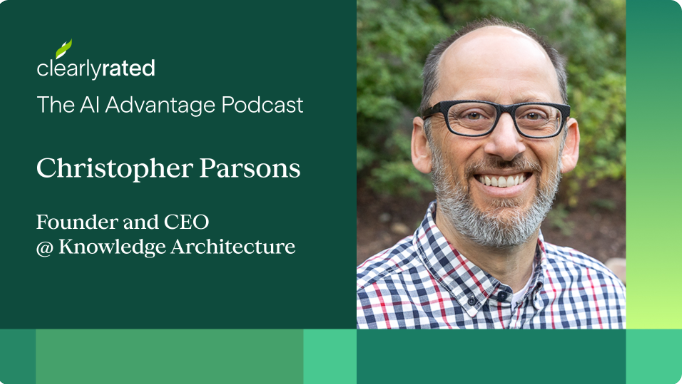
Why Knowledge Management Is the Next Advantage in AEC
Knowledge Architecture founder and CEO Christopher Parsons recently joined host Baker Nanduru on The AI Advantage to discuss how knowledge management has evolved and why it is becoming essential to realizing the promise of AI in AEC firms.
In the conversation, Christopher traces the evolution of knowledge management through three eras: the digitization of KM 1.0, the social knowledge-sharing of KM 2.0, and today’s AI-powered KM 3.0.
While each era has made it easier for firms to capture and share what they know, AI represents a major leap forward. It allows people to retrieve, synthesize, and apply organizational knowledge in more personalized and context-specific ways. But AI can only be as effective as the knowledge and processes a firm has actually codified.
The discussion goes well beyond technology. Christopher explains why culture—particularly psychological safety and a willingness to share knowledge—remains the most important variable in knowledge management. He also explores why firms often hit a wall as they grow, especially when they continue trying to operate an 80-person firm using the systems and habits that worked when they had 30 people.
Christopher and Baker also examine the “expertise paradox”: AI is especially powerful in the hands of experienced professionals who have the judgment to evaluate and improve its output, even as many of those same experts approach retirement. That makes capturing expertise, developing emerging professionals, and creating systems for continuous learning increasingly urgent.
The episode closes with a practical playbook for AEC firms. Start with real business pain, not technology. Find an executive sponsor who personally uses and understands AI. Treat knowledge and learning as a dedicated, properly resourced business function, not something people are expected to handle in their spare time.
If your firm is exploring how to scale expertise, improve onboarding, prepare for generational transition, or turn AI experimentation into meaningful business value, this episode offers a practical place to start.
Knowledge Architecture founder and CEO Christopher Parsons recently joined host Baker Nanduru on The AI Advantage to discuss how knowledge management has evolved and why it is becoming essential to realizing the promise of AI in AEC firms.
In the conversation, Christopher traces the evolution of knowledge management through three eras: the digitization of KM 1.0, the social knowledge-sharing of KM 2.0, and today’s AI-powered KM 3.0.
While each era has made it easier for firms to capture and share what they know, AI represents a major leap forward. It allows people to retrieve, synthesize, and apply organizational knowledge in more personalized and context-specific ways. But AI can only be as effective as the knowledge and processes a firm has actually codified.
The discussion goes well beyond technology. Christopher explains why culture—particularly psychological safety and a willingness to share knowledge—remains the most important variable in knowledge management. He also explores why firms often hit a wall as they grow, especially when they continue trying to operate an 80-person firm using the systems and habits that worked when they had 30 people.
Christopher and Baker also examine the “expertise paradox”: AI is especially powerful in the hands of experienced professionals who have the judgment to evaluate and improve its output, even as many of those same experts approach retirement. That makes capturing expertise, developing emerging professionals, and creating systems for continuous learning increasingly urgent.
The episode closes with a practical playbook for AEC firms. Start with real business pain, not technology. Find an executive sponsor who personally uses and understands AI. Treat knowledge and learning as a dedicated, properly resourced business function, not something people are expected to handle in their spare time.
If your firm is exploring how to scale expertise, improve onboarding, prepare for generational transition, or turn AI experimentation into meaningful business value, this episode offers a practical place to start.

WEBINAR | Product Update: The Future of Synthesis
Featured Guests
Christopher Parsons, Founder and CEO, Knowledge Architecture
Webinar Summary
Over the last two years, Synthesis has evolved from a social intranet into an integrated knowledge, learning, and AI platform for AEC firms.
In this webinar, I shared the next phase of that evolution and demonstrated how new Synthesis LMS, AI, and integration capabilities are coming together to help firms put their knowledge to work.
We explored:
How the Search Connector API enables firms and technology partners to build custom connectors and bring more firmwide knowledge into Synthesis
How firms are using Synthesis Knowledge Agents across informational, creation-based, and process-based use cases
How the Synthesis MCP Server connects Claude, ChatGPT, Copilot, and other compatible AI platforms to a firm’s knowledge and learning foundation in Synthesis
How Assignments, Recommendations, and Notifications in Synthesis LMS will help firms deliver the right learning to the right people at the right time
How SCORM support in Synthesis LMS will allow firms to centralize access to courses from learning-content partners and the course-authoring platforms they choose
The emerging vision for the Synthesis Knowledge Marketplace, which will bring trusted industry expertise into a firm’s knowledge, learning, and AI ecosystem
This session is useful for current Synthesis clients, firms evaluating Synthesis, and AEC leaders responsible for knowledge management, learning and development, technology, AI, and digital transformation.
Enjoy!
Featured Guests
Christopher Parsons, Founder and CEO, Knowledge Architecture
Webinar Summary
Over the last two years, Synthesis has evolved from a social intranet into an integrated knowledge, learning, and AI platform for AEC firms.
In this webinar, I shared the next phase of that evolution and demonstrated how new Synthesis LMS, AI, and integration capabilities are coming together to help firms put their knowledge to work.
We explored:
How the Search Connector API enables firms and technology partners to build custom connectors and bring more firmwide knowledge into Synthesis
How firms are using Synthesis Knowledge Agents across informational, creation-based, and process-based use cases
How the Synthesis MCP Server connects Claude, ChatGPT, Copilot, and other compatible AI platforms to a firm’s knowledge and learning foundation in Synthesis
How Assignments, Recommendations, and Notifications in Synthesis LMS will help firms deliver the right learning to the right people at the right time
How SCORM support in Synthesis LMS will allow firms to centralize access to courses from learning-content partners and the course-authoring platforms they choose
The emerging vision for the Synthesis Knowledge Marketplace, which will bring trusted industry expertise into a firm’s knowledge, learning, and AI ecosystem
This session is useful for current Synthesis clients, firms evaluating Synthesis, and AEC leaders responsible for knowledge management, learning and development, technology, AI, and digital transformation.
Enjoy!
Webinar Timeline
Product Roadmap
00:00 Introduction to Synthesis: 2009 - 2024
05:17 Integrations: Search Connector API
08:32 AI: Synthesis Knowledge Agents
16:15 AI: Synthesis MCP Server
24:11 Synthesis AI Ecosystem: Search + Knowledge Agents + MCP Server
25:24 Q: How is the Synthesis MCP server deployed?
25:58 Q: MCP server effectiveness vs messy data?
27:38 LMS: Assignments, Recommendations, Notifications
35:55 LMS: SCORM Courses
43:34 LMS: Synthesis Knowledge Marketplace
Q+A
52:20 What content stays in Synthesis vs. Microsoft 365?
53:01 Is there duplicate content between Synthesis and M365?
53:21 Can LMS courses use private YouTube, Vimeo, or Stream videos?
53:57 Can courses be built from existing Synthesis pages or documents?
54:29 Why adopt Synthesis with a strong Microsoft 365 environment?
54:53 How close is the LMS public beta to the real thing?
56:02 Will assignments support the lesson level?
56:16 Can we review completed-course analytics by team?
56:25 Are there permission levels for LMS analytics?
57:16 Are assignment notification frequencies customizable?
57:51 Can recommendations be driven by agents or skill gaps?
58:39 Will there be support for xAPI course materials?
58:56 Knowledge foundation first or AI layer first?
1:00:01 More filters for LMS transcript and analytics?
1:00:32 Can courses be made private for sensitive content?
1:00:59 Will there be private learning paths?
1:01:14 How soon will these updates ship?
More Case Study Webinars
View Upcoming Events
How Greenprint and MBH Turn AI Experiments Into Business Transformation | Nicole Chavas and Hillary Thompson
In this episode of the Smarter by Design podcast, I’m joined by Nicole Chavas, President and COO of Greenprint Partners, and Hillary Thompson, Principal at MBH Architects, for a candid conversation about what they are learning as they turn AI experiments into meaningful business transformation.
Both Nicole and Hillary are senior leaders who are also personally building agents and redesigning workflows, which gives them a close-up view of not only what the technology can do, but what it reveals about their firms. Again and again, they have found that building with AI exposes the same underlying questions: What does good look like? Is this actually our standard, or just what we happen to do today? Is the knowledge documented clearly enough to use? And are we redesigning the work itself, or simply bolting AI onto an existing process?
One of the clearest lessons is that scalable transformation often means going smaller, slower, and together. Nicole describes initially trying to move quickly, work largely on her own, and use agents to redesign entire business processes at once. What she learned was that proposal development and project management are really collections of interconnected subprocesses, and that lasting change requires a different approach: involve the people doing the work, break the system into smaller pieces, focus on the highest-impact opportunities, define what good looks like, redesign each subprocess for an AI-enabled way of working, and then train the firm on the new process.
Hillary describes a parallel journey at MBH, where rapid prototyping with firm leaders through an “agent charrette” surfaced her leadership team’s dreams for AI-driven business transformation. Rapid prototyping then exposed the undocumented processes, conflicting standards, duplicated effort, and poor data quality standing in the way of their dreams. In that sense, AI serves as an organizational mirror because when agents struggle, they often teach you something about the business.
But process redesign is only part of the challenge. The other major constraint is change capacity. Nicole and Hillary are both operating in environments where the technology is improving faster than their organizations can realistically absorb change. They discuss experimenting with “good enough” solutions, following the energy of early adopters, sharing successful use cases between peers, building trust with skeptics, and giving leaders closer to day-to-day project work permission to control the pace of change.
The goal is to build a trusted core of people at their firms who can experiment, interpret what is changing, and act as a kind of shock absorber for the rest of the organization. This helps the firm move fast without forcing everyone to experience the full chaos of living at the bleeding edge of the AI frontier.
The throughline is that AI itself is not the point. It is an increasingly powerful catalyst for redesigning the business around the fundamentals AEC firms have always cared about: high-quality work teams are proud of, profitably run projects, happy clients, and engaged employees.
I think you’ll love this one.
▶ Watch or Listen
Watch or listen to this episode via YouTube, Spotify, Apple Podcasts or wherever you get your podcasts.
📺 🎧 YouTube
📺 🎧 Spotify
📺 🎧 Apple Podcasts
In this episode of the Smarter by Design podcast, I’m joined by Nicole Chavas, President and COO of Greenprint Partners, and Hillary Thompson, Principal at MBH Architects, for a candid conversation about what they are learning as they turn AI experiments into meaningful business transformation.
Both Nicole and Hillary are senior leaders who are also personally building agents and redesigning workflows, which gives them a close-up view of not only what the technology can do, but what it reveals about their firms. Again and again, they have found that building with AI exposes the same underlying questions: What does good look like? Is this actually our standard, or just what we happen to do today? Is the knowledge documented clearly enough to use? And are we redesigning the work itself, or simply bolting AI onto an existing process?
One of the clearest lessons is that scalable transformation often means going smaller, slower, and together. Nicole describes initially trying to move quickly, work largely on her own, and use agents to redesign entire business processes at once. What she learned was that proposal development and project management are really collections of interconnected subprocesses, and that lasting change requires a different approach: involve the people doing the work, break the system into smaller pieces, focus on the highest-impact opportunities, define what good looks like, redesign each subprocess for an AI-enabled way of working, and then train the firm on the new process.
Hillary describes a parallel journey at MBH, where rapid prototyping with firm leaders through an “agent charrette” surfaced her leadership team’s dreams for AI-driven business transformation. Rapid prototyping then exposed the undocumented processes, conflicting standards, duplicated effort, and poor data quality standing in the way of their dreams. In that sense, AI serves as an organizational mirror because when agents struggle, they often teach you something about the business.
But process redesign is only part of the challenge. The other major constraint is change capacity. Nicole and Hillary are both operating in environments where the technology is improving faster than their organizations can realistically absorb change. They discuss experimenting with “good enough” solutions, following the energy of early adopters, sharing successful use cases between peers, building trust with skeptics, and giving leaders closer to day-to-day project work permission to control the pace of change.
The goal is to build a trusted core of people at their firms who can experiment, interpret what is changing, and act as a kind of shock absorber for the rest of the organization. This helps the firm move fast without forcing everyone to experience the full chaos of living at the bleeding edge of the AI frontier.
The throughline is that AI itself is not the point. It is an increasingly powerful catalyst for redesigning the business around the fundamentals AEC firms have always cared about: high-quality work teams are proud of, profitably run projects, happy clients, and engaged employees.
I think you’ll love this one.
▶ Watch or Listen
Watch or listen to this episode via YouTube, Spotify, Apple Podcasts or wherever you get your podcasts.
📺 🎧 YouTube
📺 🎧 Spotify
📺 🎧 Apple Podcasts
📚 Show Notes + Resources
Books
Tharp, Twyla, with Mark Reiter. The Creative Habit: Learn It and Use It for Life. Simon & Schuster, 2003. Referenced for her "banker's boxes" system for tracking ideas she's not actively working on.
KA Connect Talks
Leonard, Dorothy. "Deep Smarts and Core Capabilities." KA Connect 2017. Referenced for the "critical knowledge transfer" cohort project.
Milton, Nick. "Lessons Learned from Lessons Learned." KA Connect. Referenced for the "lessons learned databases are where knowledge goes to die".
📃 Episode Transcript
This transcript was lightly edited for clarity.
Chris: Nicole and Hillary, welcome to the Smarter by Design podcast.
Nicole: Thanks for having us.
Hillary: Yeah, thank you so much for having us here, Chris. I'm especially excited to be here alongside Nicole.
Chris: Yes, you are two of my favorite people. I'm glad that we have connected you and now we're doing this together. It should be a lot of fun. Maybe both of you could start by telling us who you are, about your firm, and then maybe most importantly, how you ended up being the person in your organization who is not only leading AI and business transformation work, but personally building AI agents and workflows.
Nicole: Great. Wanna start, Hillary?
Hillary: Absolutely. I'm Hillary Thompson. I am a principal at MBH Architects. We are about 275 people spread across six offices in North America, India, and, most recently, the UK. We do a variety of different work types, anything from multifamily, retail, labs, and much, much more. My seat covers brand communications, knowledge, and data strategy currently.
I'm not coming at this from a technology background. I'm coming at this from the perspective of watching really smart, really talented people face a great deal of friction in their everyday work as they do these really complex, amazing projects. My work in brand communications has led me into every corner of how the firm is operating today.
And the longer that I've looked around, the more obsessed I've become with answering that specific question of why are all these talented people reinventing work that we've maybe already done, or hunting for information that already exists? So AI has turned out to be the next natural step in that same question, watching how knowledge and work move through our organization.
Chris: I love that. How about you, Nicole?
Nicole: Great. I'm Nicole Chavas. I am president and one of the co-founders of Greenprint Partners. We are much smaller than Hillary's firm. We are 30 people, 12 years old. And so we grew from 10 to 30 in the last few years, which for us is a huge amount. We're a sustainability-focused urban planning, civil engineering, and landscape architecture firm based in Chicago.
Most of our work is public work, so most of our clients are municipalities, park districts, school districts, counties, that sort of thing, which really shapes the type of work that we do, the clients that we work with, and the nature of our operations. Government brings with it its own complexities, as does having three different practices, which are all relatively similarly sized, all working together in a very interdisciplinary way to achieve our goals.
And that brings a lot of complexity with it that I've had to navigate. As the co-founder and effectively the head of operations, I've been building from day one. I am not an operations person by background, and I started Greenprint relatively new to the AE industry, so I was always trying to figure things out as I went.
I built all of our systems, our hiring practices, our proposal development process. Every process that Greenprint does, I had to build at some point, steward, and hopefully hand off at some point. And so AI is just the next thing for me to tackle. Every year there's something new for me to tackle—knowledge management, learning and development, and now AI—that I have to figure out how to bring our firm along with.
But the benefit of being a small firm and being that sole decision-maker is when I see something cool that I think can help our company, I get to be the one to say, "We're gonna do it. Let's do it." So that has me really excited about all the things that are at our disposal right now.
Chris: Could you tell us, Nicole—there've been some funny jokes over the last year and a half I've been getting to know you, like you're a one-woman human knowledge management system, or at one point it was Nicole LMS. You were these systems before you had these systems.
And can you just talk about the change from being the human knowledge and learning management system to actually building systems for the company?
Nicole: Yeah. So when we started out, we were three, and then five, and then eight, and when I was building our systems and helping design the firm, I built my own knowledge throughout all of that. So even when I had systems that I was asking people to use, I was still the most knowledgeable person about how those worked and what they meant for the company.
And so over time, I still had the biggest picture, the deepest knowledge about everything the firm did, and there was nothing easier than asking Nicole the question to get the information you needed. And so even as I started doing my best to document things, to try to build training, to try to pass things off, there was still a lot of friction for folks to try to figure out how to get those.
Okay, which Google Drive folder was that in? Which training said what? It was still the fastest way to get information was to come to Nicole, the human knowledge management system. And that worked for a while because I had the answers, they were quick, I'm very accessible, and so I was able to keep doing that even as I kept trying to document.
But we just hit a point when we'd gotten to, like, the 20-person staff. We were hiring new people who were starting from scratch, and that was just not gonna be sustainable anymore. I really had to find a way to truly move that knowledge into something more centralized that people could access that wasn't so reliant on me.
Chris: Yeah, that makes sense. And Hillary, I know that your intranet is called Archie, and there were iterations of Archie before you started using Synthesis, but how did you get sucked into it? Was there a moment where you're like, "Oh, I personally can help elevate the way that our company's thinking about knowledge and learning?"
Hillary: Oh, absolutely. In my day-to-day work, as I mentioned, I do a lot of digging into every corner of the firm, and I realize more and more how undocumented a lot of our practices and processes are, how siloed they were across studios, and how lots of different teams were doing things lots of really different, interesting ways, and how much value there was in bringing that all together.
And the latest generation of Synthesis is absolutely supercharging that now, with the AI capabilities built in.
Chris: Yeah. But maybe we'll start there. Firms getting started with AI in general, but more specifically agents—their eyes get super big and they're like, "Oh my gosh, I could do everything. I can change all the ways that we're working." But then they hit a bit of a downshift, like, "Oh, but where do I begin? Do I have the knowledge I need in order to be able to build these agents?"
And I'm curious, as you've been doing your initial work—you're both in the private beta for the Synthesis knowledge agents—how did you start figuring out what problems or what opportunities you were gonna go after in terms of building agents?
Hillary: I think the most obvious answer is probably frequency times pain, right? If you're looking at a problem, something that happens 50 times a month and wastes 10 minutes every time is gonna beat something that's mild and happens twice a year. But for me, there's also a different layer worth considering, to really understand what the possibilities were and how they fit into our workflows.
For me, it was really important to start with something that I knew super well. I've personally touched thousands of proposals in my time at the firm. So it was one of those things where I knew the pain points, I knew the data, I knew where the information lived, and I had a team that I knew would really adopt it and iterate on it and come up with new ideas about how it could be better.
So that was a really natural place for me to start. I knew I could socialize it, and also important, I knew I could analyze the results myself, which really helped.
Chris: Trying to streamline somebody else's work that you don't know as well.
Hillary: Yeah, exactly. And quickly it became a matter of, is it faster and better for me to do this, or is it faster and better for me to build an agent to maybe do this and have it be a repeatable piece of infrastructure for us?
Chris: What was the first one you built where you're like, "Oh, I see how this is gonna change the way I'm working"?
Hillary: I think three or four years ago, when we all started using the chatbots, it was like, well, anyone can do this. So what edge is it giving me in my work specifically, if everyone across every firm is doing this? And it was the first time that I built something that answered questions using our firm's knowledge, rather than the public internet, that I was like, okay, this is not just a productivity tool or something that's gonna give me a one-time answer.
This is infrastructure for our team. It's gonna change the way that we actually work. It's chatbot as helper versus agent as infrastructure.
Chris: So maybe another way of saying what you said is the differentiator is gonna come because your firm is differentiated in your knowledge and your approach, and the technology's neutral. It's what you know and think and how you talk about the world that's different.
Hillary: Precisely.
Chris: Okay. What about you, Nicole? Did you have a light bulb moment for you?
Nicole: Well, I went through a journey. 'Cause I'm a builder, and I get so excited, and I love to learn. So these agents come out and I'm diving right in, and I wanna solve the biggest problems that we have, as opposed to exactly what you said—where are the places where pain times frequency could actually make a difference now, in a simple way that people can understand.
So I went too far, and I was like, what are the biggest problems? Where are there huge gaps in what we do that are so hard we've never tackled them, that maybe this agent can solve for us? So just as an example, in our proposal development process, one of the challenges that we have is that we tend to jump right in. It's like, okay, there's an RFP out, let's jump in and start writing the proposal, and we don't take enough time up front to do the real strategy, which takes a lot of knowledge, internal and external. What is our client intel like? What do we know about this client? What research can we do—by reviewing their meeting minutes and their board meetings—and pull it all together to say, "Here's what their needs are. Here's what Greenprint has to offer. Here's our win themes." And we tend to just be like, "Okay, we gotta start writing this proposal to get it out." And so it's, oh God, I'm gonna solve that with this magical agent. It's gonna surface all of that, and it's gonna create a strategy brief that's gonna bring us all together...
And what I realized was that was too much to try to do with one agent, even though it is addressing a big problem. What it really taught me was that I was trying to build a new process, create a new standard, and agentize it all at the same time, 'cause I wanted to solve the biggest problem first, and that biggest problem was just a blue ocean of challenges that needed to be overcome.
And so that's when I was like, okay, stop. This was good for me, I learned a ton, but I needed to step back and think more like the way Hillary is thinking about it—truly, where is there something that is causing a lot of pain but could be more simply addressed.
So, for example, an agent I'm working with our marketing team on is one that can simply customize our project summaries for proposals. Talking to my marketing coordinator, she does this every week: she takes our boilerplate summaries, there's an RFP, and she's the one who tries to figure out how to customize them so that we're speaking to what the client's needs are by showcasing our project work.
That's simple. It's something she's doing. It's annoying, and an agent can absolutely make that a streamlined process. So I'm learning about where to focus my energy on the agents that can get the most bang for the buck, really clear the way to better outcomes for everybody, and have people feel like they understand how to use them and they're getting the benefit from it.
And I'll tackle those bigger problems first, before I start throwing agents at them.
Chris: So there's kind of like frequency times pain, maybe divided by achievability.
Nicole: Right. Yeah.
Chris: Like that—there's this, to get to the right score. On the achievability side, though, Nicole, just to follow up on that: did you feel like that was more the achievability of what the technology can do, or the achievability of people's ability to change their processes that fast? Where was the problem?
Nicole: Yeah, no, the technology can do it, and I still see this future strategy brief creator agent, but the steps that needed to happen before that were, one, defining the standards for what it looks like to do that, and then two, actually engaging our staff—the staff who work on proposals—around collaboratively agreeing on those standards. And then creating the processes for how that fits into our proposal workflow.
And so once I've done that work, which is really change management work, which has nothing to do with AI agents—although I am doing it knowing where I want to go is that an agent can help—that all needs to be done first. Then, when we roll out an agent that can do this for us, everyone's gonna be like, oh my God, yes, this makes so much sense.
So it really needs to be staged out, and that takes longer. But the outcomes I just know are gonna be better.
Hillary: I think you have to add one more into that equation, which is repeatability.
Chris: Interesting.
Hillary: Because some of what you may perceive as the more low-hanging use cases—things that are easier for us to immediately solve—those are often the things that you can repeat across many, many different types of work. And you're also building trust, because you have something that people are telling stories about, that is working well. You have people saying, "Oh, this is how we're using this, and this is how it's changing my daily workflow." And so you get the start of that kind of internal marketing piece happening.
Chris: Do you have an example in mind, as you were talking about the repeatability?
Hillary: Yeah. So we have really grappled with the idea of a detail history library forever, and there's a big debate about what exactly we should have and what we shouldn't have, as far as people copying things. So one of the things that the marketing department has done now is create a precedent library for marketing work, which allows the team to explore the last 10 years of graphics that they've created, so that it's not a matter of, "Hey, do you remember that one thing that we did for that one thing back then?"
It's asking an agent that will pull up the five different examples that we've had throughout history, as context. And so that's something that's now super repeatable—to the detail example of, if you wanted to have a library of these documents for context and precedent, that's something that we could really easily create in the same model.
Chris: So, establishing some of these patterns of combining knowledge and process in an agent together.
Hillary: Yeah.
Chris: Cool.
Hillary: And knowing when to use the raw and when to use the curated.
Chris: One of the things, Nicole, coming back to your example—actually, I think this is gonna bounce back and forth—the taking on something that's too big, or at least too big for now. I think you said, I'm gonna take on the proposal process. But I think what was implicit in what you were saying is there's actually no one proposal process. It's actually dozens of small processes that are stitched together to go after a proposal. And it sounds like teasing apart the sub-processes and trying to improve those will then add up to a better proposal process than trying to just build the Rube Goldberg mousetrap machine that does everything in one shot, that'll just fix everything.
Nicole: Mm-hmm. Yeah, I think that's exactly right. I think there are some little small processes at the firm that could be really easy to tackle, but then there are these big ones that are multiple processes—and for us, I think that's project management and proposal development, the two things that really drive our business: winning work and managing projects well. Those are really a whole spectrum of processes.
So I really had to sit back and break down the entire length of the process into sections, and the handoffs between them, to really think about where we're doing well now, where I should just say that's a standard—we have processes in place, but did we ever really say they're the standard of good, or did we just say this is our process? And that's kind of what it—
Chris: This is what we're—
Nicole: Process. Yeah, exactly—it's what we're doing, but I don't think we ever had that question of, is this the best, that we wanna enshrine as the way, versus this is our process for now 'cause we have to do proposals. So really, it's funny, I came to this being like, "I'm gonna make all these agents," and I actually haven't built a whole lot of agents, 'cause I actually had to step back and map out our processes and help me really understand those, and make sure that I had shared understanding with our team before getting to that agent part. It's really helped me slow down a little bit and try to be more effective in how I plan to build, so when I do build, it's gonna be that much more valuable, and I can bring my team along better in the process.
Chris: How does your team feel about... I'm trying to think of how to phrase this question. I've been the person that's like, "I see the future, I'm gonna go call out all the processes, then we're gonna fix all the processes," blah, blah, blah. And it's like sometimes people are like, "Yeah, but I don't want that process changed right now. I know it, I'm doing the thing." Can you talk about that human piece? 'Cause sometimes those are processes that you're not necessarily doing—it's somebody else's work—and you're redefining what good looks like for their work.
Nicole: Mm-hmm. Yeah, that's been a learning lesson for me too, because I think for me, as the chief operating officer and a builder, I love to learn, I love to build, but most of all I want to make other people's work easier. And so sometimes I jump into, "Well, I'm gonna fix these processes for you 'cause I wanna make... And I'm not gonna bother you with it. I just wanna fix it and then have it help you, and I don't wanna bother you 'cause you're so busy." I'm doing it 'cause I wanna save people time, but that's not actually helpful. I need to really understand where their time's being spent, where the real hiccups are, and then map that onto my understanding of where I'm seeing the gaps in the quality of our proposals or in project management—places where it's not really delivering the results we want it to.
So I do have this full vantage point of where things aren't working, and ideas about how to address those, and best practices from the industry that I'm using to help think about how to reshape things. But then I need to come back. I need to take that and really sit with people and understand their day-to-day and where their challenges are that are maybe inhibiting them from being able to get to that next level.
How can we clear that stuff out first? Then they can start thinking about these bigger-picture ways to improve processes, and I can help them connect it to all of that.
Chris: Hillary, have you had any similar... You're both people I consider tip-of-the-spear people, right? But then you need to turn around and bring people along. Did you have any similar challenges, in terms of getting far out ahead of your team?
Hillary: I've been working with a really great group of leaders here who are highly motivated in this area and really into experimentation. I think in general, bringing humans along in change management can be so arduous, especially across the length of architectural projects. But I feel like we have this moment right now where AI is still a little bit magic to people, and people are really excited about it.
Chris: Not work yet, it's just magic still. Yeah, right.
Hillary: But it certainly has exposed a lot of gaps in processes, and a lot of places where a human has been quietly patching over the missing pieces, the missing standards, with good judgment. But AI has really exposed—if I have instructions to follow this implicitly—what's missing.
Chris: Yes. Meaning like you could have a checklist with seven steps, but those are just the high-level steps, and humans are filling in 7A, 7B, 7C, all the other—
Hillary: Exactly. But you also have this rare moment—we've all written instructions, we've all written emails, right? You're like, "Maybe 50% of people are gonna read this," and 10% are gonna make it to the end of this email or instructions or follow it to the letter. But you also have this motivation moment where you're writing instructions for something that is gonna follow those instructions to the letter. So it's also a different moment in that way, a different motivation in that way.
Chris: I had never put that idea together. People may or may not read the instructions you give them on how to do the project, but the AI will, and that's both good and also it's gonna read everything that you said or didn't say.
Hillary: Yeah. The instructions have to be of a different quality, and your processes definitely have to patch in those places where they've missed stuff previously.
Chris: I'm glad we're talking about this. I feel like inside firms there's a spectrum of the AI-is-magic spectrum. I mean, I think even the most knowledgeable person that works in a foundation lab still says, "We don't know exactly how this works, but it's amazing," right? But there's a continuum of, "No, it knows everything, it can do everything, it's all-knowing, it's AI." And the other end, they're like, "Eh, it's probabilistic, and we know how it works."
And I'm curious, as you try to communicate about the need to change processes and capture knowledge and get more intentional about documenting what good looks like—have you found people who don't buy that? Who are like, "But AI should just be able to figure it out. Why are we spending all this time writing this down? We have this super intelligence in our company now."
Hillary: Oh, I think almost the opposite. There's still a skeptic group that's like, "AI is not gonna figure this out. AI is gonna get this wrong." And those people are right, right? AI is not getting everything right today. Those people absolutely belong in this conversation and need to keep telling the firm that the human being must remain in the loop.
You are ultimately responsible for these drawings and your work product, not this system. And I think the balancing of those two things is really good. I recently turned my focus to—I guess you'd call it—putting a fence up. Like, when you have a dog and you don't have a fence, you have to walk the dog on a leash.
I think when you put better guardrails in place, when you put a fence up, you can let the dog roam free. I just recently turned my focus from, yeah, we have this AI policy that we've had for years and years, to, let's write something a lot more practical that tells people what they can put where, so that they can go wild on these tools and start using things.
And that also balances the worries of the skeptics a little bit with the people who are highly motivated to do something but maybe need to be cautious about putting the right thing in the right place.
Chris: So, in my understanding, Hillary—it sounds like you have more of the skeptics than the over-optimists, in the population that you're talking to about this change with, or do you just have both?
Hillary: I think the skeptics are just louder in a lot of cases. The people that are really into it are quietly working away, and "look at this cool thing that I did" occasionally. The skeptics are maybe like, "Be careful, be careful." They're the ones a little louder in the room. I don't think that we have more—I think it's probably less skeptics than we do people who are excited. But I think it's the people who aren't saying anything that you really have to worry about bringing along.
Chris: How about you, Nicole? How are you thinking about that, in terms of the different cohorts or communities of archetypes of people, as you're thinking about the change management that goes along with the building?
Nicole: Yeah, it's interesting. We started engaging the staff around this two years ago now—we wrote our first responsible AI policy just to lay down some ground rules. It was such a hot topic. You could kind of start seeing... And this was, I think AI's gotten so much higher quality since, but this was kind of the earlier ChatGPT days, when everything felt even more generic, and people could really see it in Slack—it'd be like, "Oh, that's so obviously a Chat..." You could see people were testing things, and people were feeling uneasy about it. There were a lot of questions.
So we have an annual staff retreat, and we dedicated a day to AI, so we could surface from everybody where they were excited, where they were concerned, and get a sense of where people were at. We could see the people who were super jazzed, but I'd agree, it was more skepticism. But I think that went a long way in building trust with the team, us saying, "Look, this is new. Everything's changing. We're exploring it. We will always stay committed to our values. We have created a responsible AI policy, human in the loop. We stand behind our product. We will disclose," those sorts of things.
And then, as the tools got better and we got better at using them—particularly around what Hillary said, using it to harness our own knowledge as opposed to just create generic content—people started to see that. Our reporting got so much better, because it got more finely honed on what actually matters. Our ability to better tell our story in a way that's compelling to clients, because we're able to use AI to help us make connections.
I think people could start to see those benefits and realize, oh, this could actually be useful. So we had a bit of a natural experiment recently to test where people are at with that: we use Claude, and I decided to get Claude Teams for anyone who wanted it. It's opt-in, and I'd say about 35% to 40% of our team opted in to that next level. Everyone can still use Claude Free, subject to our policy. But for the people who are ready to go in and really test out the next level, it was just available. And it's really interesting to see which teams were the ones to jump on it and which were not.
And I'll say the folks in the most technical engineering roles were the least likely to jump at it, and the ones in the more creative roles, or the more engagement roles, or the broader client-facing roles, were the ones to jump on it—because they could see how it could help them with contract management, how it could help them build a plant library, how it could help them synthesize research more effectively for planning efforts.
And that's helped me see, outside of my own little box of how I use it, how our teams are using it. So I beg them to show me the things that they're building, so that I can learn from them as well. It's very much—we're open, experimentation is welcome. We have a tool that's enterprise-level now, but no one's being forced to do anything.
Chris: That's super helpful. So, going back to frequency times pain times repeatability divided by achievability—this is gonna be our running bit—there's a question I know you talked about earlier: the technology can do it, but I'm thinking about that group that opted out, Nicole, and that's not unusual. I've heard this across other engineering orgs too, where maybe those people tend to be somewhat skeptical just as a breed, and/or the technology in that specific instance isn't as far along as it maybe is in some of the other ones, and maybe it's those two things combined. You're nodding, for those who are listening.
And I'm wondering, what's the mindset? Is it, you know what, it's 2026, we're at the beginning of this thing, who cares, we're gonna move on and make improvements elsewhere, and maybe when we come back people will be more excited about jumping on? Maybe the tech will be better? I'm curious how you're thinking about the uneven adoption of AI within the company.
Nicole: Yeah, I think that's it. I think it's about how it—beyond just basic chatbot stuff. I know everyone's using chatbots for something or other in simple ways, honestly just as an advanced search. So I know everyone's doing that as a baseline, but for many people, the free version works just fine. They don't need to go beyond that.
I think it's a mix of them not seeing, in their day-to-day, how something more sophisticated than the basic search really helps them do their job better—relative to the people who do see, "Oh my gosh, thanks to this, I can synthesize this information very quickly in service of moving a project forward."
So I think it's that. I do also think, and this is a challenge for me too, until you see someone do something cool, you don't even know it's a possibility. And it's also about time and capacity. One of our landscape architects—she's one of our most gung-ho, and she has better skills than I do—she's building out this plant library, thousands of plants that we're assessing to choose for different projects, and she's got them all categorized by the sunlight they need, when they bloom, all these different facts, type of soil, and it's this really interactive visual library that she built entirely in Claude.
I'm sure the engineers could use something like that, but they're not thinking about it. They don't know it exists. They aren't thinking about how to do it themselves. So figuring out how to get more skill-sharing across the team, where they can show each other these things and help each other out—that's something I'd like to do more of: create more spaces for our team members to come together and share their creativity and see where it can add value, versus me saying, "Here's a cool thing. Don't you see? Don't you want to use the thing?"
Chris: Mm-hmm.
Nicole: So that's where I hope to get to, as this becomes—well, nothing's ever gonna become—we always joke that everything's always in beta, so we'll be in beta forever, but as it becomes a little less beta-y and a little more day-to-day,
Chris: Whatever comes.
Nicole: Yeah, exactly.
Chris: It's been a minute, Hillary. Let me step back. I agree that people need to see that something's possible, and I guess the more it's their work, the example they see, and the less translation they have to do, the better. But in your language, I think it was, I'd like to do more of this, but it also doesn't sound super urgent—like you don't need to be in a rush, and if they're not ready yet, that's fine, we're still learning. Is that true for you too, Hillary? Are you taking your time with some of this transformation work?
Hillary: Yes and no. I have been taking my time, but I typically lean towards more cautious and measured in my approach to things. And with this, if I could give my earlier self, months ago, some advice, it might be: start faster, start sooner, move faster. And just know that when you hit a roadblock, it's probably gonna be solved within weeks, it's gonna be different. The pace of things is just moving so quickly now that I'm trying to be less of myself with this, more in experimentation mode. I think also the build time is so reduced now that there's not so much investment in trying things. Getting a proof of concept out doesn't require you to have everything perfect in the background—just knowing that it could work if it's something that's gonna hold value to your work.
Nicole: I think that's a really good point too, just as our teams get more sophisticated, 'cause I've been feeling that way too. I don't wanna release anything unless it's the perfect agent that I've tested. But when I sit down with my marketing coordinator, she gets it, and so it's, oh, if it's 80% good, but then she has the judgment to take it to the finish line—well, let's solve 80% of her job. I don't need to make it perfect for her, and we can iterate on it together.
So how can I be okay with rolling things out that are good enough, and trust my team, or give them the guidance that it's not perfect, you should look out for these things, but here's how you can take it to that next level, or we can iterate on it together, and enable more of that experimentation and testing collaboratively.
Hillary: Yeah, different approaches for different people though, 'cause you also have people where trust is a ledger, and you really need their first experience with agentic AI to be positive and valuable. And then you have the people who understand it, have the vision for it, and you can show them 80% and they will take it to 150.
Chris: This feels like a bit of a tangent, but I've been hearing, in some of our clients talking to their leaders, a theme over the last six or 12 months that I just wanna test with the two of you—and it may be that you're not seeing this at all, and then we can move on, or even cut it—that the pace of change just keeps accelerating. Hillary, you shared that even for you personally, it's like, I need to let go of some of my ways of working in order to be in this moment and take advantage of it. But there's some pushback—some of the firm leaders I've heard back from, some of their staff saying, "There's too much change. Things are going too fast. We need things to slow down, no more change." And they're like, "I don't know what to tell you—this is the least disruptive it's ever gonna be." Again, we don't know that, it could very well just keep continuing.
And so people's willingness to pick up their pace, or become a little more good-enough versus perfect—is that it? Are those conversations happening in either of your firms, around who we need to become as people in this new era?
Nicole: That is 100% a challenge we're having, and we talk about it every day—how much change there is, how challenging it is, and how our team is feeling the pressure of all that change. But we can't control everything. I think we can do a better job. There are some things we could let go. I think we need to prioritize where the change truly needs to be. But we're all in the pressures of change. The world is so different, and I think it's gonna be a hiring criterion in the future for staff to be flexible and able to manage change.
I think we've lucked out in that that's always been something we've looked for, because the nature of our work—working in sustainability, across these different practices—things change a lot. Our clients are changing a lot. Working in government in this current environment, things are changing a lot. So if you can't be flexible with how the winds change, it's hard to work in this field. We've always kind of looked for that, but now it's like times 100. So even our most flexible people are feeling this whiplash. I don't have the answer, but it's top of mind, and I'd love to get the community helping figure out what it looks like to address this in a sustainable way and bring teams along.
Hillary: I think here at MBH, it's maybe more about segmentation and platform fatigue—having to know which platform to go to to get information, or there's this new platform where you have to enter all of your milestone dates, or something else where you have to do your resource planning. There are just so many different spaces where you're now entering data. I think the wonderful thing about what AI will do for us is it allows us to actually unite all of those sources in the future, and use all of the information that's already in disparate places. So I think connectivity will help with that.
But also, the wild thing about AI right now is that when we're talking about the future, we're talking about three months from now, not five years from now. It's kind of, it's here, grab on, because we have to go at this speed now.
Nicole: I was gonna say, it's really hard for me, 'cause when I see a better solution, I wanna put in the better solution. We have this conversation where I'm like, I think we should do it this way—yes, we were doing it this way, we were testing that out, that's not working, I think we should do it this way. Or, I shouldn't say it's just me and my whims, but we learned something from trying it this way that's telling us we should actually do it this way. And then it's like, yes, that would be better, but is it gonna be too much change to then tell people we're changing it to that?
So there's actually this weird thing of, we know that will actually be better because we learned so quickly by doing, but then we're asking people to change again. This is silly stuff, but—meeting cadences. We keep trying to figure out the right meeting cadence to get the right people together in the room to share the knowledge when it's needed. And we keep trying to figure out the best way—when should we engage on Slack versus in person? We keep changing things around, and we learn every time better ways to engage with our team, but that shapes the way we think about doing it differently. But then people just have no idea what's going on.
Chris: So it's like, if this change could make us 30% more efficient, but it's gonna cost us 25% to do the change management, is it really—
Nicole: Yeah. Or do we lose some trust, like, "Oh, they're changing it again," even though... Yeah, exactly. It's this calculation that we have to do.
Chris: So frequency times pain times repeatability times—
Nicole: Loss of trust.
Chris: —loss of trust might. Yeah, carry the two. All right.
Hillary, you did something in the nexus of things we're talking about—doing a design charrette with your leadership team around starting to help them envision how agents could work and what that would do for them. Can you talk about that charrette a bit?
Hillary: Yeah. So we had that full spectrum of AI knowledge in the room, from skeptic to people using it at a pretty impressive level. Everybody brainstormed individually what agent they would want as part of their work—I gave them five minutes to do it, so they could just come up with as many as they could. Then I put them into smaller groups to discuss those things together and come up with what they thought would be the most valuable for the firm.
And reading through people's individual answers, it felt a little bit like people putting their work dreams on paper without really any expectation that they would ever become a reality in many cases. It surfaced a lot of really real problems that people are facing in their daily work, a lot of really good trends for knowing where to build. So that was week one. Then, between week one and week two, I built three of the agents that different groups had come together and agreed on. And that was what really changed the conversation. It became not this abstract thing, or some distant promise, or faraway work dream—that was when people were like, "Whoa, that quick?
Chris: Mm-hmm.
Hillary: That came into reality that quickly?" So the tone really flipped, and then people in the room, instead of debating the value of AI in an abstract way, started asking really specific questions about how they could apply it to their work. It was like they suddenly went from spectator to co-author in that moment. And if there's one thing I could stress to anybody doing this, it's bringing those real working examples as fast as you can.
Chris: To show the prototype of the work dream.
Hillary: Yeah, absolutely. It doesn't have to be fully baked. That said, I do think having one thing that's pretty well along—pretty fully baked—at least, is good to show them, so that you get that trust going.
Chris: How much context did you need to give them to be able to have those conversations about what an agent is and how it works? Did you give them any, or did you say, "There's this technology that can make your work dreams come true. Go think about what your work dreams are"? How did you...
Hillary: I guess maybe a 10- to 15-minute spiel, introducing the difference between an AI chatbot, agentic AI, Synthesis AI search, Synthesis knowledge agents. Gave them a brief overview, and then also a kind of check chart—this does this, this doesn't do that—so that it was easy to follow along. And then I intentionally left it kind of open, 'cause I wanted the creativity and the possibilities to come.
Chris: You didn't try to give them, "These are known limitations of the tools today." You just said, "Go, go do it. Write..."
Hillary: Yeah. 'Cause that's also how we're gonna figure out what the future is—without the limitations in place. What would you do?
Chris: When you went away and prototyped the workstream pilots—I'm guessing that, back to Nicole's point from the very beginning, you didn't necessarily have all the standard, well-documented processes of how things work, or all the knowledge or documentation you needed to build them. So did you fake some of that in order to show them the prototype of how it would work? How did you navigate that?
Hillary: So, let's see. In one case, I approached one of the teams and said, "I've been hearing that you have this document where you've gone through this set and written down everything that you look for when you're checking this particular set of drawings. Could I have that document? And can I also have some documents that you've checked previously?" In some cases I just got a very small sample set. In another case I already had a good-sized sample set, and it just really worked out that that was what people wanted for that particular topic.
Because I work across the entire organization, I have a lot of knowledge of where different things live and who is doing what, so it wasn't terribly difficult for me to source the things that I didn't have. And then, in the case of that last agent, I made sure it was something I had already been working on for a considerable amount of time and had kind of perfected, and I could show them many, many different conversations with the agent, to show them this isn't smoke and mirrors—I'm using this every day, and this is how it's working.
Chris: Did showing them those prototypes build any buy-in for the change management you'd have to do around documenting their processes more thoroughly, to build some of those other dreams? Did that connect the dots for people—like, "Oh, I want that, but in order to get that we have to do the knowledge and process piece"?
Hillary: At the end of the second session, someone in the room actually said, "It sounds like we need a lot more documentation to make these work." I think I stood up at the end and was like, "There it is." So yeah, building the agents became an organizational mirror. It exposed the undocumented processes and undocumented knowledge.
The conflicting standards—that's actually a fun little agent I've built now, to compare standards across the firm and show everyone how different they are. Duplicated work, poor data quality. And helping people understand that if an agent is struggling, it's teaching us something about our business, not about the AI, probably.
Chris: Hmm.
Nicole: That’s so profound. I feel like the idea that we had to go to AI to learn about our own gaps and our own way of doing business. That idea of AI as the organizational mirror really resonates with me. Because to try to tell the robot what to do, you have to be so precise, and then when you realize you don't actually have the right words to tell it what to do, and you're projecting your own things onto it, it really does highlight all those failures, and if you keep going, the agent itself will fail.
So I just did not expect that on this journey. I thought I was just gonna be building all these cool agents that were gonna solve everyone's problems, and instead it's actually just completely turned around and made us revisit the business and the way it's set up and designed, from back to the beginning, to take us to that future.
Hillary: Yeah, and it's funny, 'cause even in the things that we already had—like I mentioned, the set that had everything outlined for someone checking the set—it was like, are humans using this? Are we using this? But it goes back to the idea that AI is gonna follow the directions. It's gonna follow them meticulously,
Nicole: That's another thing that I've noticed too—we have had some standards, they're very important standards, and they may be completely unintelligible to anybody but the person who wrote the standard. One simple example of that is our writing guide, which our marketing team, the way we write needs to look exactly like this, AP style, it has this voice, and they spend too much of their time going back and fixing all of that. But they had, in the comments, our detailed writing guide, and now anybody can do it. That was one of the simplest agents I made: review this against our writing guide and fix it. And now marketing will never have to do that again.
So it's like we had the standard, but it was unusable for most people, and now it's completely usable, and no one actually needs to know the details of AP style to make sure we're aligned with the standard.
Chris: That's really interesting. So, better writing for the AI means better writing for the humans—but not just humans in general, the humans who aren't the subject matter expert who owns the thing. So you need to make it more democratically accessible.
I'm curious about this process. One of the things we've talked a lot about in the community is not only what good looks like being important for AI, but also for doing learning and development. If you don't understand how we do project management here, how could you teach it? The way you could is you'd teach the way Hillary does project management, or the way Nicole does project management, but not the way your firm does project management.
I'm curious if that convergence has hit your firms yet, where you're thinking about learning and development alongside AI, like there's a Venn diagram that connects all of it.
Hillary: I love a Venn diagram. Yeah, one of the things I think AI is going to do most for us—we're not there yet by any means—is connecting the just-in-time learning and the hour-long training and learning. Actually allowing people... Yes, they may have completed the training, they may have taken the test, gotten an A+, but three months from now, when they need that information, are they gonna remember it, or surface it, or remember where it is?
And now that content doesn't have to be separate from our L&D content. AI has united them and allowed people to find those snippets of information in their day-to-day real work, that they can connect back to the learning and development, and that's gonna be pretty amazing when it comes into reality here.
Nicole: Yeah, I think for us—project management, obviously, is really important, and the ability to think about higher-quality project management processes and higher-quality learning and development, someone's gotta be accountable for that. And as we've heard, I do too much, and I can't—I'm an inch deep, a mile wide. So I think at the end of the day, to get to that, it can't just be me. One of the things we did last year was actually tap one of our practice leads to take on a hat where she's the vice president of practice operations. Over our three practices, she's responsible for project quality, setting our project management standards, and making sure everyone's adhering to them across the practices, 'cause that's exactly what's happening—each practice had their own way of doing things. This is the challenge of three co-equal practices doing different things, but there are things we should all be doing.
So that's step one—having someone responsible for that, who felt accountability for it and committed to making a change. Then there were two sets of what good looks like that had to happen to get to better project management processes that people are trained on and actually adhering to. First was having her revisit our standards, our processes, and refresh them—she did that by interviewing all the staff, collecting feedback, and then doing that refresh. The second was a training, which also has a what-does-good-look-like for how training is designed and delivered, which was also new to us.
Chris: Right. Very meta.
Nicole: The idea of what good looks like for a process like that, I feel really confident in, but what good training looks like was very new to me. It honestly wasn't until joining this community—having the idea that I have this great LMS at my disposal, and learning about adult learning principles, and hearing how other people were structuring trainings in terms of length and course content—that made us completely rethink what a good training is. Historically, our trainings have been very much, slide decks, here's the process, screenshot, do the thing, okay, now you've been trained.
So we had to do the same thing. What does a good training look like? It's based on these adult learning principles. Here are our ground rules. A course should be this long. It should have this mix of optional and required content. There should be a fun homework item in the middle. It should have a quiz. There should be expert interviews in it that keep people engaged. It shouldn't be more than an hour. Those sorts of things are our new standards, and she, along with some team members, was able to build on that—the output is so good, and I had nothing to do with it. Maybe that's why it's so good.
So it was these two-step what-is-a-good process to get to these higher-quality trainings that we're starting to see leading to higher-quality project management effort. It's really exciting to see how that all plays out. It's all related—the processes alone aren't enough, the training's not enough. It has to be a fully thought-out approach to improving the quality of our work and getting to better budgets, better schedules, happier clients.
Chris: I mean, the phrase that's running through my mind as you're telling this story is—just even for your example, Nicole, at Greenprint—redesigning proposal process, redesigning project management, redesigning the way that we learn. In a couple of years, will there be anything left from... Do you know what I mean? Are we redesigning our businesses from the ground up during this transformation?
Nicole: Uh-huh. Yeah, I think so.
Chris: And it's interesting that—I'm curious on the project management piece, 'cause we talked about the proposal one, trying to redesign the sub-processes versus the whole thing. And when you were focused on project management, which is also, like, proposals, that's a big bucket of things.
Nicole: Did you, from a training perspective, go after it on specific subsets of project management first? Are you tackling sub-processes first? That's exactly right. When you actually map out all the phases of project management, there's contract scoping and contracting, there's the launch process, there's the monthly project management maintenance and processes, and then there's closeout. We decided to focus on monthly project management, 'cause that's the bulk of the effort—that's what people are spending most of their time on. And that's where we saw a lot of opportunity for improvement: a way to get higher-quality data, better elevate problem projects that need to be addressed, and get to real consistency in the client experience.
And then from there, I think it'll be project launch and contracting, to an extent—although contracting's good enough now, I'm not as worried about that as the monthly client experience and how well we know our budgets. So it was basically looking at all the sub-processes and focusing on the one that was the highest impact, that people spend the most time on, the most repeatable—it happens every month, as opposed to every time a project launches. It just felt like the most necessary to focus on.
Chris: It looks like Hillary's about to say something, but I can't tell if she is, 'cause I have a follow-up question, but I could see you calculating, so I didn't wanna jump in.
Hillary: Now please, please ask your follow-up question.
Chris: Okay. I wanna stay with the redesign. This is like outside-in, what I think I'm hearing. On one stream, we're rethinking proposals piece by piece for an AI world. In another stream, we're rethinking project management piece by piece, but more from a how-do-we-train-people world. But is the opposite also happening? When you're thinking about the proposal piece, are you also thinking about how we're gonna train people to do proposals? And when you're doing the project management piece, is there an AI component—how do we agentify some of this project management work?
So are you thinking about learning and AI at the same time in both streams?
Nicole: Absolutely. We approached them from different locations on that spectrum, because I think we started with learning on the project management side, and then we were like, "Wait, we need to clean up these standards first." And we used AI throughout the whole way—to write clean, clear standards, SOPs, and design the training, all that sort of stuff too. So AI was used all the way, but now, because we have this refreshed set of key templates and key processes, I see the future plug where the AI agents will help.
Chris: Mm-hmm.
Nicole: And so then, with proposal development, I started with agents. I was like, "Oh yeah, agents are gonna fix all of this." And then I was like, "Oh wait, we need to address what good looks like." So now I'm nailing down what good looks like—that's gonna help refresh our processes, and now I'm gonna do the same thing I did with project management. We're gonna get those trainings, and now I've got a template that really worked for project management that I'm gonna bring to proposal development, to bring that same perspective.
So I entered both of those streams from a different part of it, but the end result is gonna be the same: clear what good looks like, clear standards, really good processes and templates, and then AI agents that can plug on to improve those processes for everybody.
Chris: And then potentially training. Yeah.
Nicole: And then more training. Yep, just constant.
Chris: Yeah, that's it. But the what-good-looks-like is the gateway to have those options.
Nicole: If that's not there, the whole thing falls apart.
Hillary: I got stuck on the word redesign there for a second.
Chris: Is that where you went, before, when I saw you? Yeah.
Hillary: Yeah, I was really thinking about the word redesign, because... the way that we're getting there is redesigned, for sure—overhauled. We were swimming there before, and now we're in an airplane. But I don't know that the destination is that different. I think that the possibilities have unlocked what we always knew to be true, who we always wanted to be, what we always wished we had time for—it's suddenly coming true.
With L&D, all of a sudden we have all of these capabilities at our disposal that make it easier for people to impart that knowledge without so much effort, and to make that super scalable across a much larger organization than it used to be. I think we always knew that we wanted to have these standards. We wanted to teach people these standards. We wanted to be the best project managers that we could possibly be. We wanted everybody to do it roughly the same way, with their own twist. We just never had the time and resources before—now, with these new possibilities unlocked, it's like boarding the plane and getting there in two hours, instead of having to walk or swim across the ocean.
Nicole: That's so interesting, 'cause you're right. At the end of the day, what we're building these on are industry best practices. We're not reinventing how project management is done. We're just actually making it work for Greenprint—having it be clearly communicated, easy to actually execute, and training people on it.
I think about some of the parts of the process that AI is now helping us with that have always been best practices. In public procurement, you've got all sorts of publicly available data that could help you better understand the client, but in the past, some human was hunting through municipal board agendas to try to find insights into where their money's going, and now AI can get that for me in three minutes. All of a sudden, this thing that is best practice, but that no one except big firms with lots of human resources could do, we can do. We're actually able to do the best practice because, with the limited resources that we have, we can just do it so much faster.
And I feel the same way about Deltek reporting and all these things—as a small firm, it would just be frustrating that we couldn't get high-quality reporting, we couldn't do high-quality research because we didn't have the resources. Now we do, and we can actually do it.
Hillary: Yeah. And maybe the piece you're unlocking really is, people can now use that time for more creativity, more innovation. Maybe that's the real redesign—all of that other stuff that we've always had to do can now go to a greater purpose.
Chris: That's so interesting, I love this, and my mind was going the opposite. I got stuck on this—the destination's not that different. I think in all the examples you gave, that's true. But then, of course, I started trying to think of the devil's advocate case. One place my mind went—which I could still get spun around into arguing the destination's not different—I'm thinking, Hillary, of the story you shared with our community around your retiring CFO, the person who reviewed non-disclosure agreements, and we can get into the details of that.
The thing that happened is you were able to rapidly do critical knowledge transfer from someone who was leaving the company, which is something that—at KA Connect 2017, we brought in an expert in critical knowledge transfer, and she did a six-month project with four of our clients, and we all shared what we were doing. Some firms did some things, but generally it was like, man, that looks hard. It's hard to scale and hard to sustain, but it was the best available technique at the time. And I look at what's going on in our community over the last few months, and I'm like, "Oh, this is critical knowledge 2.0."
We're finally gonna be able to do these things we talked about doing. It could be possible that the firm doesn't have to keep learning the same lesson over and over again as the people switch. We can actually scale some of it—not all of it, obviously, people have 30 years of experience and reps and tacit knowledge—but the amount of knowledge we could potentially hold onto as organizations seems like a step change different. Otherwise, we would've had to relearn how to do these things all over again from the ground up when somebody leaves the company. Are you feeling that? I guess, Hillary, your company is older than Nicole's. Nicole, I don't know if you've been worrying about critical knowledge transfer with people leaving.
Nicole: I guess it's been more like scaling things from experts. We have a strong demand for a robot Jim. We didn't do a charrette, but on a monthly call I asked people to put in the chat: if you could have an agent, what would it do? And multiple people—Jim is our most experienced, 30-years-of-experience engineer—multiple people said, "I want robot Jim, so I can get into his brain."
Chris: What do they want out of his brain?
Nicole: They just wanna hear all of his stories—every project risk he's addressed, how he thinks about different challenges, how he works with clients, all the things they know he has and that they get to experience on the job, but not necessarily in this really focused way. And that's on my mind too—time is always a challenge, but at some point we need a structured interview series with Jim that can help share that knowledge with the team.
Chris: Have you told Jim that people want a robot version of him?
Nicole: Oh, yeah, he laughs. He's so modest—the answer's always, "Nobody wants that." And it's just, people are crying out for a robot Jim.
Chris: How about you, Hillary? Are you thinking about robo versions of your employees?
Hillary: Oh yeah, I've also approached someone about being a robo Kevin. I think he's coming around to the idea. One of the interesting things was, after Nicole and I had the session with our fellow beta testers of knowledge agents, and heard about robo Marty for the first time, that sparked a lot of ideas. And as I was talking to Kevin about robot Kevin, it occurred to me that robot Kevin could actually help Kevin be Kevin faster, because he's not typing the answers to the questions hundreds of times over history. Perhaps these things could actually help save our experts some time also, in being themselves and answering questions throughout the firm.
But I also think the really cool thing about the capabilities now goes back to the idea that we could have 10 hours of Kevin talking—and in fact, we have recorded all of his lessons from our corporate university over the past eight years. So we actually have hours upon hours upon hours of Kevin imparting his knowledge to people throughout the firm. We don't have to now go through 200 hours of footage, come up with the exact questions, and expect people to remember everything from them. We can put them all into a library, they're transcribed, people can ask it questions, we can have agentic Kevin answer those questions. And Kevin, luckily, will still be here for a long enough period of years to make sure that robo Kevin is answering those questions correctly for people.
So I think it's super exciting. Probably a little creepy, if you're the person who's gonna be agentified.
Chris: I've gone through the experience. There's a tool that came out called Delphi, which is meant for doing this more public-facing—it's for authors and people who get tons of email, and they're like, this thing could answer email for me. I was just curious to see how it works, so I gave it all my podcasts and newsletters and a bunch of stuff I'd written, and it was really good, but I spent a lot of time with it trying to find the holes. I'm like, "I don't think I've ever talked about this." So I'm trying to trip up RoboChris. It's a really interesting experience. I've heard that Epstein Uhen—shout out to them—is using AI Marty a lot to try to break it and figure out where there are holes in its knowledge.
So yes, if the person could be the... they realize it would help them if it were to work, but I think they'll also have fun trying to trip themselves up with it. So critical knowledge transfer is getting a whole new rethink. As you were talking, Hillary, I seem to connect some dots—did Kevin also run the Lessons Learned program at MBH?
Hillary: Yes. All of our retrospectives. Yeah.
Chris: So the... we had a—actually, was it the same conference? It was right in that neighborhood, either 2017 or 2018. We had a person, Nick Milton, well known for lessons learned and his thinking on that broadly, and knowledge management, not just for AEC. One of his key slides was, lessons learned databases are where knowledge goes to die, for the exact reason you just shared, Hillary. Who's gonna think, on their project, to go look at things with exactly the right question, pull the retrospective—that was so true. Except all of a sudden I'm like, "Is it?"
You've got a database of that, and you can search it in an unstructured—to geek out for my knowledge management people—semantic way, so you don't even have to use the right term to go back and pull the lesson. Maybe that wasn't a big waste of time after all. Maybe it was just that we didn't have the right technology to make that knowledge available.
Hillary: All those shoeboxes under the bed.
Chris: All the shoeboxes all of a sudden look really good right now. Yeah. Have you been thinking about lessons? Because I know you have a lot of lessons-learned content, Hillary. Have you been thinking about whether this gives that a new lease on life at all?
Hillary: Yeah, particularly around... well, lots of different ways. I think across projects, if we can socialize it properly, people will actually start to query those to understand how we've solved problems before. But I also see that more broadly, it can help us recognize greater trends across our projects—even cultural things, like where are designers feeling pain points, where are job captains feeling pain points that we need to adjust in our processes, or technical issues that are repeats, which inform our L&D strategy for technical content. It's gonna be so much easier to identify those trends across all of that content, and also reuse the things that are reusable on a project-by-project basis, and take them out of silos.
I don't know anybody who currently gets the lessons learned outside of their team, much less studio.
Chris: Mm-hmm.
Hillary: Making them more broadly available across the firm—sky's the limit there too.
Chris: Right. And you don't—'cause the old thing with the lessons-learned database, and why it was a broken idea, is they were usually a separate thing. As a knowledge seeker, you have to think, well, is there a lesson learned on this? Is there something in our learning management system? Is there something in our project archives? And I think the world we're building towards now is, I don't have to think about where the knowledge lives—I just have to have a good question, and bring the right intelligence to me, which also makes me think the adoption of such an approach feels a lot more realistic than it's ever been.
Hillary: Yeah, I completely agree.
Chris: Where do you think, for the two of you—what's next in the future? And by the future I mean three months. What are you gonna be working on for the rest of the year?
Nicole: Yeah, continuing to—I kind of mentioned this year was the year of focusing on our sales process and our project management process, and just trying to get them to the next level, and that starts with, what does good look like? What's the process, and then what's the training? That's gonna be a continual process that we continue, as you said—we've got sub-processes, so it's creating a plan for what a reasonable rate of rollout is for attacking each of those sub-processes and rolling them out. That's probably, with the change management side of things, gonna take a while—probably another year, to be honest, 'cause really, that's what's slowing it down, the change management to actually get people trained, adopted, all that sort of stuff.
And then I think the other thing is, actually really starting to measure the results. I keep building and building and building, and I don't wanna build for the sake of building, and I don't want people to constantly feel like something's being rebuilt. So I hope that we get things to a place of good enough where people feel like they understand it, and then we start to see—are projects more profitable? Are we getting better client satisfaction? Are we increasing our win rates on our proposals? Actually looking at the data to see if the investments we're making are getting the return we hoped they would.
And then I've been so focused at the business level—business development, project management—I wanna get into the practices and start getting into, what can we do for the engineering team? What are your challenges that I could really jump into? One, it's what I know, but two, I think we have to get that company foundation right—everybody has to be doing the same thing, sales has to be bringing the work in. Once I feel like that's in a good place, then I really wanna jump into the practices and be like, what are the things in how you deliver the work that I can help use all these tools to create new standards, develop better processes, and figure out how to create the kind of training that can support you all.
Chris: Is one of the metrics you're looking to measure employee engagement or satisfaction with the way their work is being done? Is that something you're thinking about too?
Nicole: We do an annual employee engagement survey, but I don't know that it really reflects this question of speed of change or AI. I think there are new questions we need to start asking that get at the modern workplace, the modern learning organization, to better get a sense of where they're at with that. So yeah, I think that might be due for a refresh in how—what kind of questions we're asking around that.
Chris: Yeah, 'cause I was thinking specifically about your proposal process one, and Hillary can speak to this in much more depth than I can, but from what I hear, that's not always the most fun process to work in. It can be deeply frustrating spending lots of time hunting for information, and even if it didn't necessarily move the dial on the win rate, if the people who work in marketing actually enjoy their jobs more, that feels like we've done something helpful.
Nicole: Yeah. Even just so much of the marketing team's job is bugging PMs for information, and nobody's happy. Marketing just feels like a nag. The PMs feel bad that they can't be helpful, but they don't have time for this, it's not a priority, and the information they're giving them is probably just, "Yeah, that's fine," as opposed to really thinking about, what's the best information I can tell you about this project that you can use for this proposal?
So those are the kinds of things an efficient AI process, that can pull all the knowledge we have about the project before even having to bother the PM, could empower our marketing team to feel like they can get the information they need first, understand it, write it in a way that's meaningful, and just get a check from the PM. And the PM can save time and only be brought in when we really need them to bring a unique perspective.
So that's a really good point—how can it truly make people's jobs better, and have them stop having to do the stuff that doesn't make anybody happy but is a requirement of being able to do proposals or project management? How can we make things easier for them?
Chris: Quality of life.
Nicole: Yeah, quality of life.
Chris: What are you thinking about, Hillary, for the rest of 2026?
Hillary: And on that note, quality of deliverable too. I thought it was gonna take us a long time to get to that place, but a week ago, I used someone's notes from a site visit, a project description from an RFP, and a bunch of past approaches that person had written, and it provided a pretty dialed-in starting place, to say, "Here, go. Hopefully that saved you two hours of figuring out where to start."
Nicole: And the other neat thing about that is it makes the PM feel seen. "Oh, you... yes, that is me, you guys have been listening to me, and I feel seen." It's a little bit validating to feel like you're doing the work and you don't need to repeat yourself.
Hillary: Yeah. And you are our client—we want to make things as easy on you as possible. I think for me—I don't know, I guess I'm gonna go maybe three, six, 12 months here. So three months: I talked about building the fence. I didn't know that I needed a fence until recently, which is—
Chris: All I can hear is When Harry Met Sally—am I the dog in this scenario? As soon as you started talking about the—
Hillary: I have to tell you, I really love my dog. I didn't know how much I needed this until recently, which is why I keep coming back to it. But you can't have people go free unless you've provided this safe zone to go free. And particularly within my firm, we have a lot of really sensitive information and a need for guardrails, and I think we're maybe moving more cautiously than we should through this process, because it's just not super clear what the parameters are.
So for me, the next three months is saying, "Fence is built. Go buck wild. Let's see what crazy, creative things people can start working on with that newfound freedom." In the next six months, I really want the use of our knowledge to take less intention. I think with how we're building things right now, there's still a great amount of intention involved in saying, "We've built this agent around knowing jurisdictional nuances, but I need to know that it exists, and I need to go to this place."
I want, ultimately, to feel like our knowledge is really deeply embedded in the workflow, and for agents to not just be somewhere that people go visit, but something that's able to surface and embed things in real time. I think that will be the ultimate success. I don't think that's actually realistically gonna happen in 12 months, but at the speed of AI, why not, right?
Chris: Yeah, I like that though. I mean—it's not a zero-sum game. You can move in that direction, towards knowledge being easier to use,
Hillary: Yeah, exactly.
Chris: Which I would argue we've been on that trajectory for the last few years as a community too. I keep calling it the golden era of knowledge management. At KA Connect last year, there was a funny moment, Nicole, where a couple of firms who were brand new to the community—somebody spoke up and was talking about how glad they were to be here, and somebody said, "Man, it's really like you're so lucky—you didn't have to go through the dark ages of knowledge management. You're just coming in after everything's been figured out. Lucky you." And I kind of get it. But I also feel like there's something in what you said, Nicole, and I wanna test this with you, Hillary: the last few years have also been pretty wild.
I think for people who like a lot of change, it's been exciting. But even for me personally, the pace has just gotten pretty insane. And there's something in the way you were saying it, Nicole—it's like we now know enough about the work that needs to be done that we can slow it down and be a little more intentional and not as chaotic, versus whipping around trying to figure out what to do in this environment. I love the way you planned it out—when we go after this process, we know we have to establish this, then we have to do the training, then we have to do the AI piece. Could 2027 be the year we see a little bit of calm restored, and get more intentional about how to build in this new era? I don't know—am I making that up?
Hillary: I've been working with a group of people to put everything into a tracker that lets us measure: is this an idea we should hold onto for when the technology is developed? Is this an idea we could build now? Is this something that's gonna have impact for our client? Is this something that's gonna have impact for us? It allows visibility across multiple teams, for us to see what each other are working on, and there's been iteration that's already occurred at a wild pace from that—that's really cool.
But the other thing is, it's allowed us to hold both things at once. If we only reacted, we'd just make today's processes slightly less annoying. But if we're too focused on the future, we're gonna either build things that people are not ready to adopt, or build things that the technology's just not quite there yet for, and maybe create some distrust that hurts us down the road. So I think you can have the wild and free and also the methodical and organized at the same time. You might think something is the greatest idea one week, and seeing it in the grand scheme of things two weeks later, you're like, eh, it's not really that good of an idea.
Chris: I think what you're also hinting at is—if I understood what you're doing with this tracker—it's also making things visible that we've said this is a good idea, but not today.
Hillary: Yeah, exactly.
Chris: One of my favorite books is a book called The Creative Habit, by Twyla Tharp, who's a choreographer, and the central conceit—the part of her book that stays with me—is that in her mind she's working on choreographing like 25 dances at the same time, but she's actually only working on two. She's getting paid to work on two. So she built a wall in her studio of banker's boxes for all of the future projects she's not actively working on. If she has an idea on one, she pulls it down, puts it in the box, and puts it back up on the wall.
Nicole: Interesting.
Chris: It has a home. She knows we're thinking about the thing, but she doesn't have to work on it today, and she can stay focused on the thing she's working on.
Hillary: And if it's valuable enough, you'll find it and pull it.
Chris: And valuable enough. That led me—I tried doing it with Evernote, and then I ended up using Trello. So I've built her thing in Trello, and I've got projects going out into the future—I've got a home to log all those things. When I decide to work on one, I open it up, and there are all these notes of ideas. Sometimes it's the same note six times over a period of months, that I thought was original each of the six times I wrote it down, right? So I feel like that part of what you're saying, Hillary, is, we can also start to say we don't have to do this all this month. There's time.
Hillary: Yeah. And also, with the speed of AI, you don't have to choose between your reactive and proactive things as much either.
Chris: Yeah.
Hillary: Budget- and time-wise, you used to have to very much choose, because making things was so slow. But now, yes, we can focus, but we can also do a couple of different things at once. We can work on the future and work on the now at the same time, which is cool.
Chris: Yeah.
Nicole: Something that was kind of an aha for us, again—and team structure is a big part of this too—we have a four-person management team: myself, our CEO, our now vice president of practice operations, who we just elevated, and our marketing director. So we've got practice operations, sales and marketing, and CEO and COO. We're all jazzed about AI, all excited about this work, but April, my CEO, and I are the ones who are a bit higher up—everything's exciting, we see the bigger picture down the road about what can be. Whereas my marketing director and our practice lead see that too, but they also have to deal with the day-to-day, and they're managing the teams who are managing the change.
So we had this agreement that, going forward, they can be the gatekeepers. We'll keep on innovating, we'll build the boxes and put them all out there, and they can be the ones to decide how to stage the rollout and change of these.
Chris: So you're the gas and they're the brake, a little.
Nicole: Yeah, exactly. 'Cause they have the best insight into where the team is, and their ability and capacity to absorb the change, facilitate the change—whether they're ready to let us push the gas a little farther, or we need to stop for a little bit. So giving them that permission to say, "I'm gonna stage it out this way," and it's a collaboration. We might push one way, they may push back. But having, feeling like they have ownership and the ability to say, "I wanna stage it out this way, we can't force this too fast," and the insights from the day-to-day work help shape that for us—I don't have that visibility anymore. Even going from 15 to 30 people, I'm losing touch with what's going on day-to-day. So I think setting those roles for ourselves is gonna be really helpful in properly staging out the work going forward.
Chris: I love that. Maybe to start closing on a what's-next theme—you're both aware that we have a Synthesis MCP server now that we just put into private beta. Nicole, I know you've been doing some stuff with it, and I wonder if we can talk about that for a minute, 'cause I think there's something very connected to the conversation we're just having.
Nicole: Yeah, I've been dying for this, so I'm so excited that it's live. We've been talking about how, with AI, we now have access to every knowledge container that we have. With Claude, we're connected to SharePoint, we're connected to Outlook, we're connected to our voice transcripts, we're connected to Slack. So our semi-organized SharePoint folders are accessible, our ethereal conversations are accessible. But until now, all of our standards and all of our most curated, highest-quality shared knowledge amongst the team has been in the Commons, and I've had to copy and paste that in if I wanted to take that as part of the bigger knowledge picture.
This is kind of the missing piece—now I can look at my entire knowledge base all at once. So I think the two highest-value things I'm pulling out of the Commons now, through my central... I don't even know what to call it.
Chris: Yeah, command center.
Nicole: Yes, the command center, exactly. From the command center is our standards. Before, I'd been copying and pasting our standards into things, and that's not good. Now I can just say, follow the standard from the Commons for this. And our project directory—the projects we have, going from Deltek to OpenAsset to the Commons, are our best projects. They all have project summaries, they all have data, and now I can just point to that and grab it all. Whereas prior to that, I was using kind of a poor man's version, where it would search SharePoint, which also has all sorts of data about our projects, but now I have the good stuff.
That's helped me build agents that can traverse multiple of those knowledge bases and the internet to answer questions or get to deliverables, and to have our standards, our projects, and our employee directory really connected to all of that has been the missing link.
Chris: You told me this use case in prepping for KA Connect, and luckily this podcast will come out after KA Connect, so there's no spoiler alert here—that's gonna be in your presentation around updating project descriptions by connecting all those systems. I wonder if you'd be okay to share.
Nicole: Yeah. So our marketing coordinator, as I mentioned earlier, the bane of her existence is trying to get PMs to review project summaries, update them, get the right content in. Even just from a quality perspective, it's fine—we have a boilerplate, a standard for what a good project summary is, how many words it is, the basic content it covers. But it doesn't have the wow—the marketing team can't find those wow things about a project that really sell it. Those are in the PM's brain. And when you ask the PM, "Hey, can you please review this, is this up to date?" they're not thinking about what's really exciting.
So what I'm building with her now is an agent that can pull all of our current project summaries and compare them against project notes in SharePoint and against Slack chatter, and elevate where things might have changed or where some really cool things came up that could take it to the next level. And the final output, for each PM, is just a list of projects that have changed and a redline recommendation. Our marketing coordinator can review that herself and see what she wants to accept, or if she felt like it captured it. And then the last piece is the PMs just do a final review and say, yes, that's right, or not.
So it's capturing things like, for example, an affordable housing site development project that currently just said, "We did this project, we did this site work, the project amount was this much, here's the roles we had." But we discovered through a Slack conversation that we had actually helped save the developer money and found a more sustainable solution to their drainage challenges. That's the wow stuff we want showing up in our project summary—we saved the developer money and found a more sustainable solution—and the current process wasn't even elevating that. We found it through Slack chatter.
Chris: 'Cause they had that conversation in the flow of work.
Nicole: Exactly, exactly. They were just talking about it. So it's streamlining a process, reducing the nagging, making things happen faster. The PMs aren't bothered as much, but it's also surfacing things that the previous way wasn't surfacing, because they happened ethereally.
Chris: So I wanna wrap by asking you both, wearing kind of two hats—one is leaders in your company who have also been building—what advice would you give to other leaders of AEC firms, in terms of why this isn't just something that the innovation team, or the IT team, or some of the emerging professionals who are super good with technology, should be doing?
What have you learned by being in the seats you're in, leading this work, that you think would be useful for other leaders to hear about?
Hillary: I think the first thing is, do not outsource your understanding of this. You do not need to be an AI engineer to build something for yourself, and even if it's something small, you'll learn a great deal in the process. As I said, the more I approach AI problems, the more I learn about the business. And for leaders, how valuable is that? The AI tool itself is very easy to learn—it's really not that complicated, it's essentially the same steps as giving directions to a human being. But what you will learn about your firm firsthand, and where to go, is so valuable.
And I think it allows you to start asking better, harder questions about your firm—about where you're losing energy, and where you can supercharge things. It's a tool to redesign how your work gets done. AI itself is not the strategy.
Chris: Right. I've been saying, I don't think this is AI transformation, this is business transformation powered by AI.
Hillary: 100%, 100%. And I guess the other thing I would say is, as far as the people you should pull in—pull in the people who are already asking, "Why do we do it this way?"
Chris: Yeah.
Hillary: AI doesn't need to be in the conversation. You already know who those people are. And then you have people who've been practicing this craft for 30, 40 years and are super adaptable. You know who those people are too. Pull them into the conversation, because they have the knowledge to transform. And even if AI scares you, the willingness to change is a great indicator.
Chris: I like what you just said—there's something bigger there. Is it possible that we don't need everyone to be as adaptable to change in the organization? Is it possible that if you get a core in the middle that can absorb some of it—be a shock absorber for the organization, take the first hit—and figure out how things settle down, maybe not everyone has to see all of the chaos all of the time. I think that was true for myself.
Nicole: I know who that shock absorber is on my team.
Chris: Yeah. Yeah. Yeah.
Nicole: Yep.
Chris: But even that four-person team you talked about, Nicole, that feels like part of the role of that team, right? You've got people on the team who are like, "No, this is fine, people will be okay with this," and others who are like, "No, this is gonna be really disruptive, we can't pull on this lever right now."
Nicole: Yeah, and it's built on a lot of trust, because we have to trust that they like our ideas, or are excited about us having ideas. They may not like all of them—it's not just like, "Ugh, that's— don't do that, don't do that." They genuinely think it's cool, interesting, see the value, and just not right now. So it is built on trust, to be able to have your big ideas and have people gatekeep them in a respectful, trust-grounded way.
Chris: Hmm. Do you have advice for leaders about business transformation powered by AI, Nicole?
Nicole: Yeah, it's interesting. This conversation has really had me reflect on—at the end of the day, it still comes back to the same business fundamentals we understand if our business is doing well. It's still the same metrics we look to, to tell us: are we meeting our sales goal? Are we hitting our utilization goal? Are we profitable? What are our multipliers? The metrics are the same, and they tell us how we're doing, and the best practices haven't changed. The industry looks to the same groups for best practices in project management, for best practices in proposals.
But for me, I've known those things, but I've been hampered by a couple of things. One is, as an operations person, I'm an inch deep, a mile wide—I know what I'm trying to get to, but I didn't have the skills to develop spreadsheet models, to build reports, or to navigate Deltek in the way I really needed to, to understand how to get the most out of our data, or to do the kind of research that was needed. So it was just too complex for me to feel like I could get from the work we're doing up to driving those metrics, and now I do. These tools are helping me get from where we're trying to go and business fundamentals, and do it faster, better, in the Greenprint way of doing it.
I think that grounding is really helpful for me, as somebody who gets excited by everything, to be like, what's the point? We're trying to do good by our clients, bring in business, keep our employees happy—that's what everything we do should be in service of, and there are decades of work saying what good work looks like, and we should build on that.
Chris: So are you saying—I like this—I think what you're saying is you feel empowered to get answers to the questions you really wanna know, because I don't have to go through someone doing a SQL export, then building a Power BI thing, and then hoping the product is able to actually visualize the things I wanna see. Now you're like, "I've got the data, I've got a question, let me just do my thing."
Hillary: Yeah. The decision has not already passed us by.
Chris: Right. And it isn't three months later, when I finally got the thing built and I missed the window. Yeah. Awesome.
Nicole: We can make decisions faster and get insights faster than ever before, and those are the two things that really hampered us—struggling to get enough information to have insights that can lead us to make decisions. And I finally feel like I have the tools and the insights to be able to do that.
Hillary: Yeah, decision quality, not just speed.
Chris: That's great. Well, Hillary, Nicole, thank you so much for your generosity and time, and for sharing very much in-progress work and thoughts, publicly, on YouTube, Spotify, Apple Podcasts, and wherever you get your podcasts. We appreciate you both.
Hillary: Thanks, Chris.
Chris: You got it.
Nicole: Thanks so much.
WEBINAR | Launching Synthesis @ SMRT
Featured Guests
Nicole Rogers, Senior Principal and Director of Architecture
Graham Parker, Knowledge Manager
Webinar Summary
What changed when SMRT Architects & Engineers implemented Synthesis wasn't just the platform. It was the mindset.
After four intranet iterations spanning nearly two decades — from hand-coded HTML to ThoughtFarmer to SharePoint — SMRT, a 130-person integrated architecture and engineering firm based in Portland, Maine, made a different kind of commitment. They decided that internal work is real work, that their firm is a worthy client, and then treated their Synthesis implementation accordingly.
Nicole Rogers served not just as executive sponsor, but as principal in charge. Graham Parker, who had already proven the ROI of data-driven process improvement on the accounting side of the business, moved into a dedicated knowledge management role. A project number was created in Deltek. Hours were tracked on timesheets. The implementation got the same rigor and attention SMRT gives its external clients and the results showed.
That investment didn't end at go-live. Nicole has continued to drive adoption at the senior leadership level because SMRT understands that launching Synthesis is just the beginning, not the finish line. Meanwhile, Graham has expanded his work into AI, helping build the digital knowledge foundation that makes tools like Synthesis Knowledge Agents and AI Search valuable.
Knowledge management can't be the ninth thing on somebody's to-do list in the AI era. SMRT's story is a case study in what happens when it isn't.
In this webinar, Nicole Rogers, Senior Principal and Director of Architecture, and Graham Parker, Knowledge Manager, share their firm's story — from the organizational shifts that unlocked knowledge management to a live look at where they're headed with AI and learning management.
We explore:
How treating the Synthesis implementation like a real client project changed the outcome
The change management and internal marketing work that drove adoption before, during, and after launch
How Nicole's continued executive sponsorship keeps the platform alive and growing past go-live
How and why Graham moved from the finance team to a dedicated knowledge management role
What it takes to build the digital knowledge foundation that enables AI agents to actually deliver value
A live tour of CALVIN, SMRT's Synthesis platform, and a look at their early work with Synthesis Knowledge Agents and LMS
If your firm has struggled to give its knowledge management program real momentum, SMRT's story offers an honest, hard-won perspective on what it actually takes: the right investments in mindset, people, process, and culture — alongside the right technology.
Enjoy!
Featured Guests
Nicole Rogers, Senior Principal and Director of Architecture
Graham Parker, Knowledge Manager
Webinar Summary
What changed when SMRT Architects & Engineers implemented Synthesis wasn't just the platform. It was the mindset.
After four intranet iterations spanning nearly two decades — from hand-coded HTML to ThoughtFarmer to SharePoint — SMRT, a 130-person integrated architecture and engineering firm based in Portland, Maine, made a different kind of commitment. They decided that internal work is real work, that their firm is a worthy client, and then treated their Synthesis implementation accordingly.
Nicole Rogers served not just as executive sponsor, but as principal in charge. Graham Parker, who had already proven the ROI of data-driven process improvement on the accounting side of the business, moved into a dedicated knowledge management role. A project number was created in Deltek. Hours were tracked on timesheets. The implementation got the same rigor and attention SMRT gives its external clients and the results showed.
That investment didn't end at go-live. Nicole has continued to drive adoption at the senior leadership level because SMRT understands that launching Synthesis is just the beginning, not the finish line. Meanwhile, Graham has expanded his work into AI, helping build the digital knowledge foundation that makes tools like Synthesis Knowledge Agents and AI Search valuable.
Knowledge management can't be the ninth thing on somebody's to-do list in the AI era. SMRT's story is a case study in what happens when it isn't.
In this webinar, Nicole Rogers, Senior Principal and Director of Architecture, and Graham Parker, Knowledge Manager, share their firm's story — from the organizational shifts that unlocked knowledge management to a live look at where they're headed with AI and learning management.
We explore:
How treating the Synthesis implementation like a real client project changed the outcome
The change management and internal marketing work that drove adoption before, during, and after launch
How Nicole's continued executive sponsorship keeps the platform alive and growing past go-live
How and why Graham moved from the finance team to a dedicated knowledge management role
What it takes to build the digital knowledge foundation that enables AI agents to actually deliver value
A live tour of CALVIN, SMRT's Synthesis platform, and a look at their early work with Synthesis Knowledge Agents and LMS
If your firm has struggled to give its knowledge management program real momentum, SMRT's story offers an honest, hard-won perspective on what it actually takes: the right investments in mindset, people, process, and culture — alongside the right technology.
Enjoy!
Webinar Timeline
Introduction
00:00 Welcome and Spotlight
02:29 Meet SMRT and Calvin
Launching Synthesis @ SMRT
05:13 SMRT’s 20 Year Intranet Journey
10:10 Why Synthesis Was (Finally) the Right Fit
12:12 Intranet Tour: Visual Identity and Design Strategy
16:19 Project Discipline and Design Framework
25:21 The Value of Posts
30:57 Driving Adoption Doesn't End at Go-Live
33:36 Leadership Adoption Playbook
35:57 Daily Email Promotion Strategy
37:03 Why a Dedicated Knowledge Manager Role Matters
38:50 What’s Next: Data and AI
Q+A
44:50 How did you approach governance?
46:48 Who made up the implementation team?
50:25 How is work in progress content prioritized?
51:46 Who adds tags and how much time does that take?
52:45 What are your thoughts on the LMS?
54:07 Does knowledge management create more or less work?
56:27 How do you break down silos with AI?
57:54 How are you measuring ROI on this project?
More Case Study Webinars
View Upcoming Events
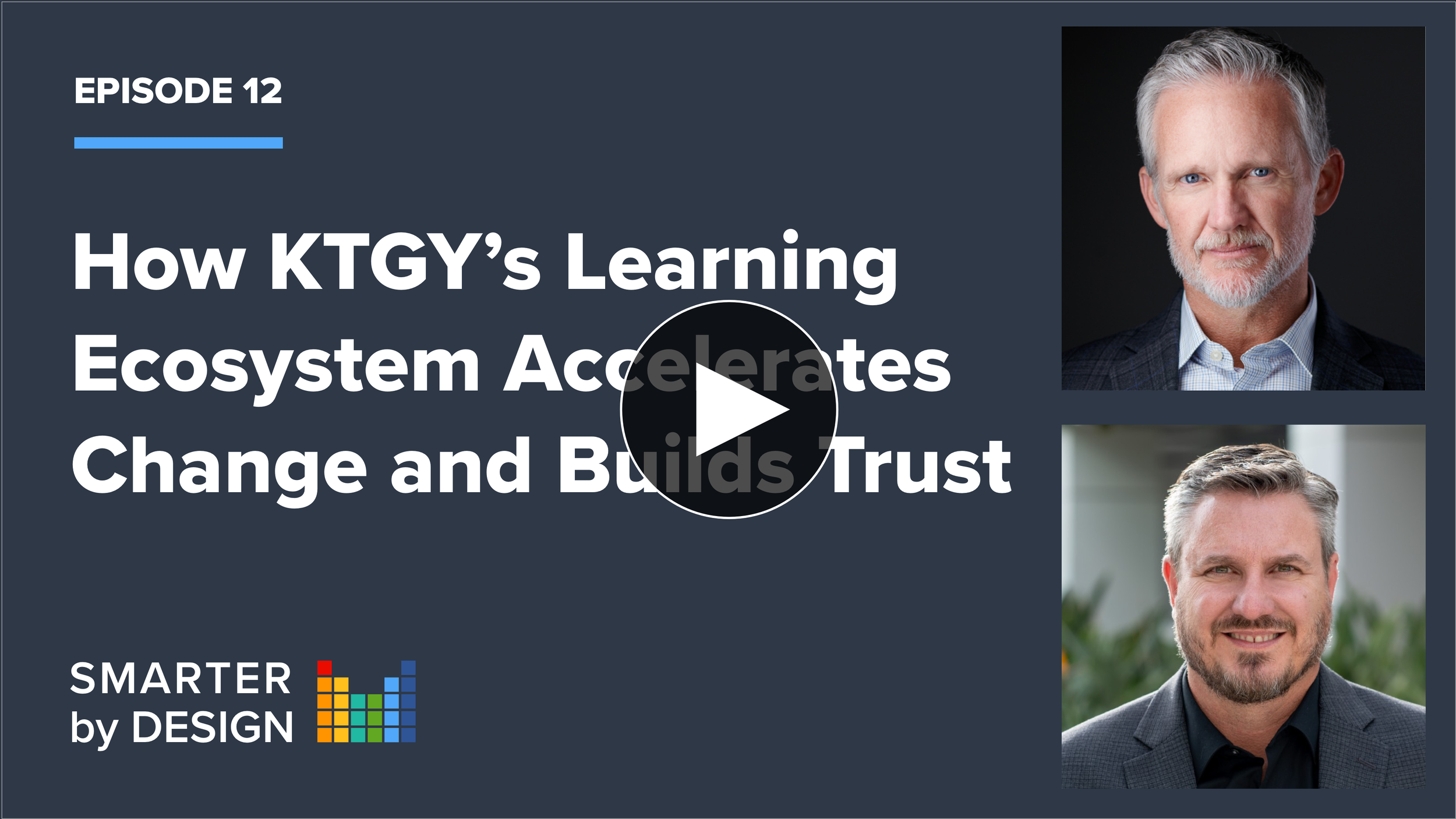
How KTGY’s Learning Ecosystem Accelerates Change and Builds Trust | John Robison and Donovan Helminiak of KTGY
KTGY was founded in 1991 with an ambition to build a firm that would outlast the people who built it. Six founding partners set out to create a firm which would endure from generation to generation — a firm whose culture, values, and capability would compound over time rather than walk out the door when any one person retired. What they couldn’t have anticipated is how deliberately, and how systematically, KTGY would eventually design its way toward that goal.
In this episode of the Smarter by Design podcast, I’m joined by John Robison, Chief Operating Officer at KTGY, and Donovan Helminiak, Director of Knowledge Management, to trace the evolution of KTGY's learning ecosystem and examine how it has become one of the firm's most consequential strategic investments.
The conversation goes behind the scenes of how KTGY built four key components of its learning ecosystem:
ELEVATE Leadership — a year-long, cohort-based program built to teach emerging leaders what great leadership looks like at KTGY
ELEVATE Essentials — a foundational knowledge program which grew from a pandemic-era intern series into a hybrid on-demand and workshop model open to the entire firm
ELEVATE Talent Management — a newer program targeting first-time people managers, focused on the day-to-day nuance of leading teams
FUEL — a grassroots mentorship community driven entirely by emerging professionals, deliberately mixing offices and experience levels to build connections that wouldn't otherwise exist across seven offices
The old apprenticeship model — learning one project at a time from the people around you — served KTGY well for decades, but is no longer sufficient for a firm with over 400 employees, seven offices, a generation of retiring principals, and a profession being radically reshaped by technology.
KTGY's answer has been to design something more intentional: a learning ecosystem where cohort-based programs, on-demand curricula, and grassroots community reinforce each other, and where building trust is a primary goal.
As we discussed in the episode, trust is the catalyst that determines how fast AEC firms can change and evolve. To move faster, means intentionally investing in building trust and KTGY’s learning ecosystem has proven remarkably effective at doing exactly that.
If you lead an AEC firm thinking seriously about what it takes to build a culture that connects distributed teams, and stays ahead of change, and endures across generations, this episode is an honest accounting of what that investment (and the returns) look like.
▶ Watch or Listen
Watch or listen to this episode via YouTube, Spotify, Apple Podcasts or wherever you get your podcasts.
📺 🎧 YouTube
📺 🎧 Spotify
📺 🎧 Apple Podcasts
KTGY was founded in 1991 with an ambition to build a firm that would outlast the people who built it. Six founding partners set out to create a firm which would endure from generation to generation — a firm whose culture, values, and capability would compound over time rather than walk out the door when any one person retired. What they couldn’t have anticipated is how deliberately, and how systematically, KTGY would eventually design its way toward that goal.
In this episode of the Smarter by Design podcast, I’m joined by John Robison, Chief Operating Officer at KTGY, and Donovan Helminiak, Director of Knowledge Management, to trace the evolution of KTGY's learning ecosystem and examine how it has become one of the firm's most consequential strategic investments.
The conversation goes behind the scenes of how KTGY built four key components of its learning ecosystem:
ELEVATE Leadership — a year-long, cohort-based program built to teach emerging leaders what great leadership looks like at KTGY
ELEVATE Essentials — a foundational knowledge program which grew from a pandemic-era intern series into a hybrid on-demand and workshop model open to the entire firm
ELEVATE Talent Management — a newer program targeting first-time people managers, focused on the day-to-day nuance of leading teams
FUEL — a grassroots mentorship community driven entirely by emerging professionals, deliberately mixing offices and experience levels to build connections that wouldn't otherwise exist across seven offices
The old apprenticeship model — learning one project at a time from the people around you — served KTGY well for decades, but is no longer sufficient for a firm with over 400 employees, seven offices, a generation of retiring principals, and a profession being radically reshaped by technology.
KTGY's answer has been to design something more intentional: a learning ecosystem where cohort-based programs, on-demand curricula, and grassroots community reinforce each other, and where building trust is a primary goal.
As we discussed in the episode, trust is the catalyst that determines how fast AEC firms can change and evolve. To move faster, means intentionally investing in building trust and KTGY’s learning ecosystem has proven remarkably effective at doing exactly that.
If you lead an AEC firm thinking seriously about what it takes to build a culture that connects distributed teams, and stays ahead of change, and endures across generations, this episode is an honest accounting of what that investment (and the returns) look like.
▶ Watch or Listen
Watch or listen to this episode via YouTube, Spotify, Apple Podcasts or wherever you get your podcasts.
📺 🎧 YouTube
📺 🎧 Spotify
📺 🎧 Apple Podcasts
📚 Show Notes + Resources
Behind the Scenes of ELEVATE: KTGY’s Professional Development Program — John Robison's KA Connect 2024 talk, a deeper dive into how the program started and why cohorts work.
📃 Episode Transcript
This transcript was lightly edited for clarity.
Chris: John, you are the Chief Operating Officer at KTGY. And Donovan, you are the Director of Knowledge Management at KTGY. You presented together at PSMJ's AEC TalentMAX 2026 conference in Austin this May, and the talk was called "Connect the Dots: The Evolution Toward a Learning Organization." What struck me about that framing is it wasn't just what you built, it was your story of how you got there towards being a learning organization and this argument that you made that you were always a learning organization, you just didn't know it. But through this journey, you gained awareness of the fact that you were a learning organization and once you gained awareness, you could make more choices more strategically and more explicitly, which is something we'll definitely dig into.
I want to walk through that story mostly chronologically, and we're going to talk a lot about ELEVATE, which is your professional development ecosystem and the three programs inside it. We're going to touch on FUEL, which is your mentorship community. And then I want to get into some questions toward the end around what happens when knowledge walks out the door, what does it mean to be a learning organization in a billable hour culture and where AI fits into all of this.
I want to start with KTGY. For the listeners that don't know KTGY, can you give us just a quick orientation? What does the firm do? What work are you known for? How many employees do you have? That kind of thing.
John: Sure. We are just shy of 400 people right now, with seven offices across the country. We are a design firm. We are architecture, interior design, branded environments, land planning. I think we're built originally on land planning and residential. We're known for residential—that's the bulk of our work. We were founded back in 1991 by six partners who came out of another firm. They wanted to build something that was generation to generation and long-lasting. So they built KTGY to do that. And I think that's important because that generation to generation ethos and the fact that we're a large firm now, that we’ve grown since 1991, comes into play when we talk about how hard it is to share knowledge across the company.
Chris: Yeah. John, you spoke at KA Connect 2024 about ELEVATE Leadership, your firm's leadership development program. And we'll link to that in the show notes. People should watch it. It's one of my favorite KA Connect talks of all time and I know a lot of people in the community feel the same way. But I wonder if you could just, in a shorter version, take us through the story of ELEVATE for people who haven't seen that talk to ground us in the ELEVATE Leadership program and how it got started, whose idea it was, what problem you were trying to solve, all those things.
John: Yeah, so I'm going to give all the credit here to Tricia, our CEO who was, I should say for the last 20 or so years, she's just stepping down now, but it was Tricia's idea. Tricia conceived of creating a program for leadership development and then brought me into it. I think what I mentioned earlier about this being a generation to generation firm is really the genesis of ELEVATE leadership. This idea that a firm should outlive the people who founded it, the people who currently run it. And that's important because so many of them have retired—in fact, all of the founders. So it wasn't really this abstract idea of creating a training program. It was quite existential. How does the firm live on? So we created something with the intention of being very purposeful about developing people who could carry the firm into the future.
Chris: I like what you're saying—how does the firm live on? Which I think is a really great big question. And I think what you're implying by the fact that you need a leadership development program in order for the firm to continue on, we need leadership, we need to translate the way that we think about leadership to make sure that that's where it starts.
John: Yeah, I think a lot of us could look around the firm and recognize that we have really good people. We have potential future leaders. That's easy to see and say, but are they ready to run the firm? Do they see themselves as the future leaders of the firm? Do they feel that they're equipped for it? So the purpose was about building that next generation and onward.
So the program itself, ELEVATE Leadership is a year-long program. It's a pretty immersive program. It consists of monthly virtual meetings. It consists of three in-person week-long sessions. There's tons of reading. There's a lot of homework. In other words, you're not just reading a book. We're getting back together and we're discussing the lessons learned in the reading. There's a lot of issue processing, a lot of personal discovery. It's a very intense, very immersive program. And it's built around a small cohort of 10 to 12 people at a time.
Chris: How do you.. I love this, thank you for the background. I'm thinking about this thing you said around future leaders. Do they see themselves as leaders? Are they ready? Was there a process of trying to put people into leadership who weren't ready or who didn't see themselves as leaders that was a defining moment for…? How did that it was time that what you were doing wasn't working to continue the firm going from generation to generation?
John: Yeah, I think naturally a lot of people will emerge in a firm as leaders and I think subjectively you can sort of see that people are right for leadership and people sort of know and that's where they want to gravitate toward. But there are a lot of other people out there who have high potential for leadership, but really may not be aware of it, may not know how to access it, might not even be raising their hand. And maybe they're under the radar. So I don't know that there was necessarily this immediate problem staring us in the face. This isn't working. In fact, I think the firm has grown considerably and done very, very well and that it's a generation to generation firm has created shareholders, partners year over year over year, right? So I mean, at this point in time we have two dozen, but probably had all 15 or more I would bet when we started ELEVATE Leadership. So I don't know that it was trying to solve for a problem other than is everybody aligned in what it means to be a leader and what will be needed to carry the firm forward and how do we make sure that everybody agrees what that is?
Chris: So it's interesting. Starting a program, because I've been pretty aware of what your program is, and I know how much goes into it and I know how hard it is to start one of those things and obviously sustain it. You overcame inertia to launch this program and you overcame inertia without a burning problem, right? So what do or maybe Tricia had a spark where it's like we really need to do something different than we're doing today in order for us to continue being successful.
John: Yeah, I would love it if she was here right now to answer that question. I can recall very vividly when.. So we were sort of talking about what would it mean to have leadership development? And we were meeting with various organizations, people who come in and do that for you. How can we sort of just level up leadership? Because we have a really good grasp on what it means to do architecture and design, right? But can we really name what it means to be a leader?
So how do we bring that in? And Tricia started talking about, well, doing it ourselves, right? Can we just build a program and do leadership development ourselves? Which at the time I thought was bananas because that just seemed like a tremendous amount of work.
I guess I also thought, well, if it was so easy, wouldn't everyone just be doing it? But she came back from this meeting one time she had with a client and it was at a lunch and she was talking about this with this client about creating a leadership development program because that client had done one of their own. And Tricia came back and she told me the story and said, " I mentioned to this person, gosh, that sounds like a, just a tremendous amount of your time." And they said to me, "Well, what's a better use of my time than creating future leaders?" So it was at that moment where she said, "We have to do this, this needs to be done. We need to know that we're ready to bring people to carry the firm into the future to bring them up."
Chris: What was it about what you were seeing out there in the market as potentially outsourcing or partnering that made you think it would be better to build it yourselves?
John: I don't know that at that moment I thought it would be better to build it ourselves. I put all my trust in Tricia. Kidding aside, I think there are some really great leadership development programs. There are some really great outfits out there. There are things that we had participated in, PSMJ, some of their programs being some of those. There's plenty of Carnegie Mellon or there's Stanford University. There are various programs you can use and they're all really, really good. What didn't resonate for us there is, we need you to understand and learn how we run the business as a firm. That doesn't mean like there's a blueprint and you have to necessarily follow it. But you have to understand the context, you have to understand the culture, you have to understand a bit of how we got here to get there. So what really made sense when we started talking about it was we could leverage the experts that we have in the firm to bring some of that to the cohort. We could leverage our experts in public speaking. We could bring that into the group and talk about it, how we do things at KTGY versus generically how leadership is done.
Chris: Was part of that like the attraction, like a forcing function to get you to articulate what good leadership at KTGY looks like?
John: For me, it very much was. In fact, I would say a lot of where my ideas are now some 10 years later have come from that exploration, that discovery of what does it mean to be a leader here.
Chris: I want to circle back, do a couple more things on this. You mentioned this idea that you can see people leading some of those people naturally rise up, but then there's some other people who may have capability who for whatever reason don't see themselves that way or aren't being seen that way. And what I'm inferring, and tell me if I'm off base here, but we had Jen Bennett, the CEO of Shive-Hattery, in the last episode talking about her leadership development program. And she personally did not see herself, she was a structural engineer, did not see herself as a leader because in her mind she had this externally planted idea of leaders being super charismatic and backslapping and the person that leaves the room and that. But like what she got told and when she got pulled into their leadership development program was there's a lot of different ways to lead. And leadership isn't just that externally facing charisma piece. Is that part of what you were getting at is that there are people here who are capable of being leaders that are in the typical cultural norms of what leaderships are seen as that we're missing out on?
John: Yeah, because I think when you talk about leadership just in the abstract, we all have our own understanding of what leadership means, but I think there's, without any more discussion around it, leadership has sort of a generic understanding. And yeah, a lot of that—charismatic and extroverted—I think becomes part of that package. When we start talking about what leadership means here, it has very little if anything to do with that part of the character. And it has everything to do with can you work through others? Do you see what's important right now and what's needed right now? Do you have the ability to say the hard things that need to be said? It's more about that and you start to understand that that really has nothing to do with whether you're an extrovert, an introvert, whether you're bold, whether you're shy, whether you're charismatic or soft-spoken. It has very little to do with that. So if you've always thought about leadership as that and we start talking about it as this, then you can recognize yourself in there.
Chris: Interesting. Yeah, I like that. I've got one more question.
John: And having come from there myself as a very, very highly introverted person, we're able to connect in a way with people very differently. And Tricia is on the spectrum more on the extroverted side. And so when we pair up and talk to people, there's really a nice dynamic there. But the number of people who have emerged out of our ELEVATE leadership program and other ELEVATE programs, who have sort of raised their hand and said, "I am an introvert too. How do I do this?" Has been really an eye-opener for us. And for everybody who's sort of in that same category of I'm maybe a little shy, I'm highly introverted, is leadership for me. And we talk about leadership in a way that has nothing to do with whether you're outgoing or not.
Chris: Yeah, and especially in an industry such as ours where it skews incredibly heavily introverted in AEC. So like if all you're doing is promoting extroverts, you've got a very small talent pool to pull from.
John: And look, they tend to be recognized a little more, a little sooner than an introvert, right? Because I'm a little more willing to jump in and brainstorm in a conversation, right? I'm a little more willing to think on my feet, right? Where the introvert is going to be a little maybe more analytical, a little more introspective. So they might not be as immediately recognized. And we do have a lot. And in fact, we begin ELEVATE leadership with some assessments. In addition to some 360s and some other things, we do personality assessments and that's part of it, understanding who you are. And we do that not just so you can say whether you're an introvert, an extrovert or whatever. It's really so that we can talk about here's who you are and here's how you show up and here's why that matters and here's how it relates to other people.
Chris: That's great. And then do you share that as a cohort with each other? Does everyone understand?
John: We do, in fact, there's a really long session that I lead on that and what it means to be wherever you are... We're currently using Myers-Briggs framework, but that's sort of not really super relevant. We just talk about—based on your preferences and how you tend to show up and where your strengths are— how does that relate to your position as a leader?
Chris: INTJ for you, John?
John: How'd you…
Chris: I don't know. Just a swing. Just a swing in the dark.
John: Very I, very T. Yeah.
Chris: I want to ask you one more question and then Donovan, I realize you're here. Hi, Donovan. If you think back on 10 years of ELEVATE leadership in terms of what this has done for KTGY as an organization and then also what it's done for individuals who went through the program, like what does success look like? What keeps you going?
John: Gosh, so there's a couple different questions, but I think.. So I'll start with what does success look like? I mean, certainly you can look at the like number of people through the program, number of people still with us today, et cetera. But I think a little maybe harder to quantify, would be my measures of success would be things like are those hard conversations, are they being had more often? Are they being surfaced sooner and with better candor? Are studios talking with more transparency and more vulnerability? Is the word trust being used a bit more? Does that culture of trust, is that felt more across the organization?
I think for me the leadership development program, while we talk about being a leader and such and the mechanics of running the business, et cetera, the discovery that happens of being vulnerable, of showing up as a trusted and trustful leader, I think is really to me where some of the metrics of success are. And am I hearing back from those studios that so-and-so is just showing up in a very different way now?
So I would like that to be the sort of metric of success. Look, we have a number of people who've gone through ELEVATE Leadership and are currently shareholders in the firm now. So yeah, we have a really good track record of I think elevating people in the firm. And that's necessary and that was one of the goals. But I would really like to say that the culture of the organization is very visibly changing.
Chris: I just wrote down your measure is culture. It's what it seems like you're saying. It's like you almost need an indoor air quality test, but for leadership and trust, right? That feels like you're trying to be like in the air, like in the day-to-day interactions as this is happening.
John: If we had a trust meter over the last 10 years, I believe that it has just incrementally climbed. And I would like to see that. And I would also like to see that whatever the firm needs in the future, the leaders are ready to respond to that, that they're not waiting to be reactive.
Chris: And you've also implemented a system for describing what leadership is at KTGY and for identifying and developing future leaders. So you've built a pipeline and a mechanism, right?
John: Yeah, and so for me personally, because it's easy to say it's very subjective and you'll know it when you see it. And I think there's some truth in it, it's subjective, right? Future leadership potential, there is a subjectivity, but I've created my own personal framework for measuring where the strengths are and maybe where some of the gaps are. And that helps me. And if I can use that and look at future leaders through that lens, that metric is very useful for me.
Chris: That's great. So Donovan, welcome. Director of Knowledge Management at KTGY. You went through this program. And I'm curious from your perspective, what was it like to be a participant or a cohort member in ELEVATE Leadership?
Donovan: Yeah, it was one part exciting and another part grueling and terrifying and survived it. But yeah, I mean, given the opportunity to be able to participate and be part of that cohort and knowing that the firm is investing in you to grow and they see that, right? It's like the validity of saying, "Oh yeah, you are a potential leader for this firm." And so it gives you that drive. Sometimes you sit in your seat and you're like, "Are they seeing what I'm doing? Are they recognizing the stuff that I’m bringing to the firm?" And being tapped and saying, "Hey you have the opportunity to apply." So that's actually how you do this, by the way.
You have to write a letter and tell them why you think you're someone that would be good for this program. And then there's a review process. And yeah, I think for me it was super exciting to just go through that. And one of the things that I appreciate is because it's led internally, it's not an external program. They're investing their time in it. The leaders are bringing everything to the table and saying, "Hey, this is what we want to see and this is how we want to see it. And this is where we want to help you grow." And so they're investing a lot. Not just the money side of things, but they're investing their time, their effort, everything. And that means a lot as a participant.
Chris: What did you learn about yourself in the program?
Donovan: Man, so a lot actually. If you ask anybody, they say when you start, you think of one thing about yourself and when you end, you're like, wow, okay. I definitely learned a whole lot more about myself and my own leadership style, knowing what tools to be able to use and the things, how to approach things like John was mentioning, having those tough conversations. I was one of those people that were like, ha I know I need to have this conversation, but I don't really want to have it. Is there a way to get around it? The typical. How do I get out of that type of thing. But now I have the tools to be able to have those conversations, have more confidence in doing so, which then builds the trust in our teams. And I think that's been something that has definitely resonated in the teams that I've been working with directly and indirectly. Yeah, I don't know. There's going through like this moment of, "Oh man, this is heavy." When you're going through it because you start to issue process. Like how do you deal with problems or issues that are happening? And you're working with a cohort who is also other leaders in the firm. So you're looking at them and saying, "Well, you're a leader, but why am I here?". So you have a little bit of that. I'm going on. I'm like, "Wait, what's going on here?" But then you start to realize we're all in the same boat. We all have the same feelings behind the scenes. Some show up better than others are covered up better than others. But I think it is definitely, you're starting to really realize that we're all in it together. We're very much learning together. We're growing together. And out of it, I mean, even to this day, we still, I've been out of it for what, three years? And our cohort still connects and talks and issue process. So it's not done at that time. You're done with the hard work of the program, but you're never done with the program, if you will.
Chris: By issue process, you mean I've got a dilemma. I want to pull in a couple people to help me think through it?
Donovan: Yes. Absolutely.
Chris: That's great. And before that, were you trying to issue process, so it sounds like that's something that's taught in the program. And so you were maybe trying to do it on your own without asking for help?
Donovan: Yeah, absolutely. Yeah, right. Because you don't know who to reach out to or who you trust to reach out to, right? To have those candid conversations about a challenge that you're having. Even admit that you have a challenge.
Chris: Yeah. Yep. That's great. Thank you both for introducing us to ELEVATE Leadership. I want to talk about the second piece of ELEVATE, which is ELEVATE Essentials. And I love this story. Well, I know the origin story. I'm not going to tell it. I'm going to let probably, Donovan, you tell that story. Yeah, so tell us what ELEVATE Essentials is, and then how it came to be.
Donovan: Yeah, so before I get there, I think John, there was an email that we were talking about earlier about there was a moment where our internship during the pandemic. And I don't know if you, John, if you wanted to touch that part of it and I'll carry on.
John: I'm happy to. In 2020, there were a lot of board meetings happening. I think almost weekly for a while. And there was some discussion around, oh gosh, I guess we're not going to be able to have summer interns because they can't be in the office. We're not going to be able to teach them how to do anything. It was an opportunity instead. It was an opportunity to say, "What if we completely reconsidered what it meant to be an intern this summer?" So I reached out to a whole bunch of people who had been involved in the summer intern program. We always have those people in the firm and asked them, "Is there anything you can do to turn this into a virtual program? Each of you have a subject matter you're an expert in. Can you bring that to them? And can we have a weekly virtual session or something?" So it all started in 2020.
Donovan: Yeah, and then naturally I got wind of it, said, "Well, that's really cool. You guys are doing this internship program and there's a bunch of leaders that are teaching a bunch of cool stuff and." And I said, "Why can't we have that?" And the rest of the firm started catching on too, right? They're like, hey, there's some really cool sessions happening. Why can't we have something like that?
John: Yeah, there was somebody on the intranet who said, "I wish I was an intern." And they were like a 15-year veteran and they said, "I wish I was an intern."
Chris: So what was so attractive about.. What were some of the sessions that were being taught that you felt like you were missing out on?
Donovan: Yeah, so just hearing from the architects. So actually I'm not an architect by trade so hearing from them on what does good design look like? And what does it matter to our firm? To, we had a gentleman doing smart goals, like just how do we actually talk about smart goals? We had a person talking about our culture and what that means and the history of KTGY and all those things. And then they got more into technical realms of like, this is how you do good technical design and what QA/QC means and what that process looks like. So we touched on a whole lot of areas. I mean, I think there were 12 sessions or something like that. And so you can imagine there was a lot of rich information that was happening where leaders were taking time to really articulate that topic and really explain it and engage the interns. And yeah, I mean, it was just a plethora of information and knowledge that was coming out of this that we're like, whoa, this is really rich. This could be really helpful for the rest of the firm. And so yeah, that's-
John: These things that you might learn over time osmotically or some other way, you'd learn them over time, but you wouldn't sit down with the purposefully being explained, right? How do we put together a set of drawings and why does this go there and that go there and the decisions we make. So you learn them over time, sure, but we like we sort of, I guess we codified it and presented it that way.
Chris: I mean, that's the parallel with the leadership development program already, right? What does good leadership look like at KTGY? What does good design look like? How do we set goals? How do we review drawings? And it's really in order to teach, you have to codify, right? And it forces you to do that.
Donovan: Yep, exactly.
Chris: So what happened then? So Donovan said like, you saw this was going on. People saw this on the intranet. You told John this is going, like how did you take it from being an intern program to being something other folks at KTGY could participate in?
Donovan: Oh, I pretty much beat down John's door and said, "Dude, we need to do something about this." Why are we putting on my KM hat, right? And say, well this is major for the firm. Other people are asking for it. 15-year-old veteran is asking, I wish I was an intern. We should be tapping into this. This is a prime example of taking institutional knowledge, people that are willing to even take the time to show it to an intern, would imagine if they did it internally with all of our own employees, right? And keep that moving and happening and showing that we not just at the leadership level, but also at any level, care enough to articulate who we are, what we do, how we do things, right? And I think that was definitely the catalyst for me. What got the spark for me to say, dude, this has to happen. This is essentially, pun intended, needs to happen for us. So yeah, and then John and I definitely had the conversations about what would it look like? How would it happen? Who's going to lead that? Because it is a daunting thing, right? I mean, you asked a group of leaders to do this for an intern one time, right? And it's like, okay, one and done. Great. Then it actually was happening a second time because we were still in the pandemic world and-
Chris: More interns though, second time?
Donovan: Yes, more interns. And so I think it happened like twice, right, John? Yeah. Yeah, and then as that happened, it was then, it was known, right? Like the second time around, those leaders knew what those topics were, who was in charge of it, like what they needed to say, and they refined that.
And so then I was taking it and saying, "Why can't we now produce that internally?" And let's just keep it going. And right now let's create that opportunity for others that may have never had the opportunity to learn about what design means, our culture and all the things and solidify that through our firm and bring that in. And so yeah, between my team and John, we just figured out what that would look like and then asked the leaders to lead that process and bring it together and continue what they've already been doing, but just now for internal employees. And we had a whole signup thing and we tried to keep it small enough so it wasn't like the entire firm going through it all at once. So that first pass, that first year, we were definitely like, let's keep it a little bit smaller so there was a little bit of a cap on how many people could actually attend the sessions. Just to make sure that it had some lesser impact on billable hours and all that fun stuff, but yeah.
Chris: So you kept it going as a live course, limited cohorts. Is that how you imagine it's going to continue? Has this ever become on demand? Like, okay.
Donovan: Yeah, no, we learned quickly that it's not sustainable.
Chris: What's not sustainable about it?
Donovan: Well, so if you're asking leaders, right, it's about 12-ish sessions throughout the year. And a couple of things were not sustainable, one was the leader's time, right? Like you're asking them to now commit twice a year possibly doing a session and life happens, right? Where they might have deadlines or whatever and there was a lot of jockeying — that was really, really hard. Actually, it was almost a part-time position for us to manage just those sessions and try to get it organized.
The other thing too was those leaders sometimes don't stick around forever. And so we knew that it was a live session, it wasn't being recorded, it wasn't being that. We weren't capturing it. It was happening when it happened. And then also if someone got hired two weeks after that one session they really needed, they had to wait a whole 12 months to get that session again. And by then are they interested or not?
And so all these things really dive started to think, how else can we position this? How else can we make this a sustainable process, but also easy enough where anyone in the firm at any time could learn how to do a goal or what does design look like for us? And what is it? So having it more on demand and that was the catalyst to that was like, how do we actually make that happen and convert those sessions into more of an on-demand type of approach? And we're in that process still. We're still building those things out. Yeah.
Chris: So like, I'm guessing, tell me if I've got this right or wrong. So while they were still live and you were capping the number of people who could attend, I'm guessing the primary audience was still more interns because you're going to have more than emerging professionals. That 15-year architect who wanted to be an intern still isn't getting access to it. But if it were made on demand, they could, right?
Donovan: Yes. Exactly. Exactly. And they don't have to go through the entire session. That was also the impact of this is, yes, it was created for interns to go through the end-to-end of all the sessions. What we also wanted to expose is, it's essentials, but you don't have to go through every essential. Like if you're not an architect and maybe you're just curious, sure. But smart goals, yes, we all have to do them. That's probably one of those ones that everybody goes through, but yeah, or as a reminder. So it depends on the thing. So it's not a mandatory end-to-end either. It's there for those who want it and need it at the time.
Chris: Right, and so just take me through the future. Like how do you think this translates on demand? Like do the courses, are they still taught the same way? Are you teaching them in a different way? Like what does that mean?
Donovan: No, that's why it's taken us so long because we are looking at it. I mean, when you have a captive audience for an hour, we were doing a virtual session, so everybody was on their cameras and you can show a screen and you can walk through and answer questions on the fly. The on-demand needed to be a little bit more structured at the beginning. So we're taking that and saying, okay, what is the core essence of the thing that you wanted to teach? And then make sure that that information gets out.
And now we're actually borrowing some ideas from other firms that have done this as well, is taking have that as on-demand, but then opening up workshops and saying, "Hey, if you want to continue the conversation around drawing and what that looks like from our perspective, there's going to be a workshop that this leader can hold maybe every other quarter or something like that." And so we're entertaining that thought about how that looks and how that structure translates into what the end result is when we want it to be, which is knowing how to do the thing and understanding how KTGY works and all that. So we wanted to take what needs to be taught and be explicitly on demand for those moments that they say, "I just need it now,". I wanted to understand and not wait another 12 months or whatever it is to get that information, but then have opportunities to still connect to those leaders in ways that are meaningful. 'Cause I mean, you do lose that if you put something on demand, right? There's a one-way street type of thing.
Chris: You're looking at like a hybrid strategy, right? So the core instruction is delivered on demand, but then somebody can get in, they can run scenarios or they can ask questions or.
Donovan: Yes.
Chris: That's great. Cool, John, what are your thoughts watching this essentials program from this virtual intern thing in 2020 to where it's headed?
John: Yeah, so as Donovan's talking, I'm sitting here thinking, "My God, I'm so glad we have Donovan here." Because it is so much and that somebody like Donovan is not only able to, but willing to think about how do you continue to move something like that forward, which is just Donovan's word, daunting. I think it's amazing. What started as how are we going to keep interns busy for the summer and give them a great experience? And now how can we teach everybody new to KTGY how we do things? And what's important to us is phenomenal. This whole workshop idea, which emerged in the last couple of years, it's like you can sit down on demand and learn what sustainability means for us and how we approach it. But there's so much more to it than that. And so now if you want to dive deeper, you can do a workshop with Megan and learn everything there is to know about it and maybe become an expert yourself, so.
Chris: One of the things I've heard from others in our community who are going down that same hybrid approach that you're talking about is that burnout thing that you brought up about the instructors. Like it seems like that goes away when you take this approach. They like doing the workshops, right? And the interaction and the discussion is just they don't want to just do the instruction delivery thing. Have you been finding that too?
Donovan: Absolutely. Absolutely. Once we told them it was actually our selling point for us to because they're like, "Oh man, do I have to do this again? Now I have to get in front of a camera and you're going to be forever whatever I say." But then yes. But imagine that you just do it once and then now you can have these sessions where now you're saying, "You've gone through my session, the on-demand session. Now we're just going to dive in and work through a design together or explore more options and really dive into it." And that's where they get excited anyway, because that's what they're in it for.
Chris: Yeah, they'll probably learn something more that way, right? Someone will bring up a question they've never been asked before or a project example that stretches them or something.
Donovan: Exactly.
Chris: John, is there a connection between ELEVATE Leadership and Essentials? Like do you have an essentials piece on leadership? Like how soon do you want to plant the seed for people that like leadership isn't only one way and this is how we think about leadership? Does that happen here or does that happen later in somebody's journey?
John: Boy, you got me thinking now. So certainly a little further into the journey, there is some discussion in ELEVATE Talent Management around management versus leadership. Does that happen in Essentials? I think there's hints of it when there's sort of like the meet the board moment Q&A with shareholders where you start to see no longer at such a distance what a leader is thinking about, what they're talking about, how they're showing up. But is there a direct, this is what the journey looks like and this is.. Actually, I quite like that question. It's got me thinking now.
Chris: I don't mean to create more work.
John: No, you just did, I think. Yeah, I apologize. Yeah, probably for Donovan-
Chris: Yeah, I was going to say, sorry, Donovan.
Donovan: Thanks.
Chris: All good. All good. You did a masterful transition there, John, about introducing ELEVATE Talent Management. So we talked to ELEVATE Leadership, we talked about Essentials. Let's talk about that third piece of the puzzle that you put in place. What is it? How did it get started? How did you know you needed it?
John: Yeah, ELEVATE Leadership, flagship program started plus 10-years ago. ELEVATE Essentials came out of 2020 and sort of emerged from there. Sometime in the last handful of years, there started to be this sort of a hint of a conversation around a sort of a missing middle in a way. And at about the same time, Donovan and his peer, Melissa, our head of HR, were in ELEVATE Leadership. And there was this conversation happening of we have these people who are managing on a day-to-day basis and what are we doing to equip them with those skills? And we had been using PSMJ's project management training program. We had done a little bit of our own training internally. We have what's called the Project Playbook, which is how you manage a project. But we hadn't really put a lot of time into what does it mean to manage people?
It is something that Melissa and I had talked about developing those soft skills and stuff, but there was an opportunity right there when.. Because with this new context that Donovan and Melissa had coming out of ELEVATE Leadership, not just the context of what does it mean to lead people to self-discovery, all that, but the context of this is how we do leadership development in the company, right? They'd just been a year immersed in this program.
I grabbed the two of them and said, "What if we did this at more of a management sort of precursor to leadership level? What would that look like now that you just went through the program? What would you have wanted to see in that program?" And thank goodness they had just gone through this program because between the three of us, we were able to craft out what's missing and what's needed and what would people at that sort of day-to-day level, right? ELEVATE Leadership is preparing people to lead the firm into the future, strategic, high level, right? Maybe become a shareholder even. Who knows? There's a whole lot of other people who are just trying to figure out how to navigate the nuances of managing people.
Chris: For like first-time especially, right? This is the first-time I've been responsible for other people.
John: Yeah, and why? Because I'm good at managing a project. Now suddenly I'm managing people. And some of those people being clients even, now I have to have hard conversations. So we were able to put together a curriculum that was.. And I do differentiate between management and leadership. So we were able to put together a curriculum that was focused more on this is what managing a team looks like. And this is what we would like you to know as a new or recently new people manager. And here's a toolkit that we have for you that is going to help you navigate that.
Chris: So it sounds to me like from what you just shared, in spirit, it's the same approach with cohorts and sessions to come together as ELEVATE Leadership it's just the focus is a little different.
John: It is. So the cohort aspect is huge. I think there are plenty of learning opportunities that don't require and maybe aren't even facilitated well by having a cohort. But ELEVATE Leadership is, I'm going to say the vast majority of its power is in the fact that you're in a cohort. So yes, we take that cohort experience because being in ELEVATE Leadership is not just about what you're learning, it's about an experience too. And we bring that into ELEVATE Talent Management. Now, so the spirit is the same. The content is maybe a bit different. And it means it's a larger class for a shorter period of time. So it's twice the size, half the time.
Chris: Okay. So 20 to 24 people in six months.
John: Correct.
Chris: Okay.
John: Yeah.
Chris: Why are cohorts so important and why are they so powerful? It seems like that's the secret sauce here.
John: Yeah, you can scale content, right? You can scale curriculum. You can't really scale hard conversations. You can't really anticipate that somebody's going to share something in whatever it is, issue processing. And another person's going to say, "That same thing just happened to me last month. And here's how I dealt with it." Or, "Man, I wish we were having this conversation then." Or you can't call bullshit if you're not in the cohort, right? And we'll do that. We'll say-
Chris: You can, but you're yelling at a screen or whatever. Yeah.
John: So it's really important to be able to be in that room and say, "I'm going to challenge you on what you just said." Or, "I need you to go deeper. I need to hear more from you." And to challenge each other that way and that I talked earlier about vulnerability and trust. That's where that comes from. That comes from those moments of those transparent moments that are very, Donovan, I think you used the word terrifying. Coming out of those moments better successfully is what builds a very strong, I think, vulnerable, transparent leader and that trust across the organization. So we have a tremendous network now of trusted leaders across the organization. We have between two ELEVATE Talent Managements. Coincidentally, the second cohort just graduated two weeks ago.
Chris: Do you run one a year or are you doing two a year?
John: We do them every other year.
Chris: Every other year, okay.
John: We alternate. We'll do ELEVATE Leadership, ELEVATE Talent Management. So we have five cohorts of ELEVATE Leadership, two cohorts of ELEVATE Talent Management. And it's a very strong network. Donovan said it, it doesn't end, they still.. I mean, they get together, they meet all the time. And they have a shared experience. So even if you weren't in the same cohort, you know what each other went through. You know what that other cohort, so you have a shared experience. So that shared experience really resonates across the firm with these people who are going to be carrying the firm into the future. So that. You don't really get out of sort of a one-to-many webinar classroom type scenario.
Chris: Have you had somebody go through talent management and through then leadership yet?
John: Yes.
Chris: I would assume they come in a little bit more prepared. Like they hit the ground running a little bit more if they've been through both, or is it totally completely different?
John: Nothing prepares you for ELEVATE Leadership.
Chris: Okay, fair.
John: It's pretty intense, I mean. So I would say this, while yes, they are similar in spirit and ELEVATE Talent Management maybe focuses on a little more sort of managing people than the organization. We do not demand the same level of transparency and vulnerability in ELEVATE Talent Management. ELEVATE Leadership is, you're pretty naked in there. So, yeah, it's an intense experience for many people. And the reading is considerably more. There's a lot more. Just the load is a lot greater on you.
Chris: That's really.. Sorry, Donovan, were you going to add something?
Donovan: No, I was going to say, and you still have your day job.
Chris: And you still have your day job. One last question on this one. Do you have a sense either tacitly or have you talked about when is this a thing that's one to many? When is this a thing that requires a workshop or a cohort? Like do you have a sense? Is it topically? Is it outcome? Like how do you think about when to do this and when not to?
John: I'm going to wait for Donovan to chime in there.
Donovan: I don't think it depends. Chris's quote. It depends on what we are trying to achieve. So I think when it comes to the ELEVATES, right, we've been talking about that. Those we do, they're cohorts for the leadership and talent management, but for ELEVATE Essentials, it didn't make sense because it's just information that people need to know. And we didn't want it to feel like it was exclusive. It was inclusive, right? So we wanted to make sure that everybody can feel included in learning whatever they wanted to learn, even if you're not an architect, like I mentioned before but understanding how architects work is a very valuable asset and understanding so we have a common language when we're talking to each other. And so those things to me were that's why we positioned it that way with essentials. So no cohort around that. But then yeah, when it comes to communities of things we haven't touched on it, but the FUEL, those are types of things where communities make sense in having some cohortness happening, if that's a word. But yeah, when it comes to, yeah, the ELEVATE, I guess, I don't know if there's anything else to add on that.
John: Well I think that the timeliness of information, right?
Donovan: Yeah, absolutely.
John: If I need to know something about the QA/QC process and I'm trying to hit a deadline for Friday, like I can't wait until my cohort meets next month. I just need to know this now. So some of the things, yeah, you can say, sort of say there are some check boxes and if it meets these criteria. And then a lot of them are sort of by feel like does this feel like it would be better served by having a group of people sharing it? And if so, who are you excluding if you do that? And is that okay?
Chris: Right. Yes, that all makes sense. Plus I would add just on the things that you've said and is connection between people one of the goals of this program because that sounds like that's very much one of the goals of talent management and ELEVATE Leadership. Well, you just mentioned FUEL.
Donovan: Yes.
Chris: What's FUEL?
Donovan: So FUEL to me is a community at first of people that want to come together and learn together. And we tie in that mentorship conversation around that as well. And one of the things that we are really excited about is it is its own entity, its own thing, because we didn't want it to be like this ELEVATE Learning and where it has a curriculum, it has a designed outcome. Whereas FUEL is nebulous. It's whatever people want to talk about from becoming a licensed architect to how do you work-life balance, to what does it mean to be even a leader in the firm?
Chris: So it's like bottom-up content topics, that.
Donovan: 100%, yes. And it's actually driven on purpose by those that are not leaders. So we actually create.. The way that's structured, we have a committee that's actually comprised of people that are very passionate about mentorship and learning that are new to the firm or are new into their role. And then we bring those together. So we have about eight people right now that are under our committee. And then we create a community around that of cohorts.
Chris: Mostly emerging professionals. Is that the primary target here?
Donovan: Yes, but actually we ask everyone. So anyone in the firm from the person that's been here for 20 plus years to the person that just started can all be part of these cohorts. And actually on purpose because behind the scenes mixed them up from different studios to different levels and we look at, we ask the question of what would you like to get out of it so we can group those types of people together for those types of conversations. And we bring them together and they're smaller.
So we have, I think that we had 80 people in our firm sign up this last time. And there are cohorts of 10 or less in each one to make sure that everybody has a voice in the conversation and we bring them all together and we lead there's always a mix of leaders and emerging professionals in that group. And actually it works great because then they ask a question, a leader can say, "Oh yeah, I've dealt with that." And I've had many leaders say, "Oh, I've actually learned a lot from our emerging professionals on certain topics and the ways they're doing it," so. And the topics are, nothing's off the table so it could be whatever they need to talk about like at that time. Mine just talked about soccer for about half the time.
So, but it was great because it got people talking that would never have talked to each other in our firm. So we have seven offices and this is something that's always been near and dear to my heart. It's like, how do we connect people that aren't sitting next to each other in their own cubes or in their own office or even in their own studio, right? It's how do we expand that out? And so we're very deliberate and not having the same people in the same office and all that. So they have an opportunity to meet somebody that was in our Irvine office, in our DC office, talking to each other and learning from each other. And also many times after these cohorts have changed or gone on, I hear all the time, "Oh yeah, I was able to talk to somebody over in that other," because we've had that connection already. Yeah, so it's creating those connection moments and common ground for having those conversations and learning from each other.
Chris: Yeah, how does this fit in your like view of KTGY as a learning organization, John? Like as we start going toward using that phrase, how does FUEL fit in around ELEVATE? Why is it not part of ELEVATE? Like how do you think about it?
John: Yeah, so it's probably, all of these things for me, they just sort of gradually emerged over time. And then to use Hemingway's quote sort of "First gradually, then suddenly," I realized there is an ecosystem happening here that just was sort of growing unbeknownst to me, but around me, unbeknownst to me, even though I was sort of immersed in it and quite a part of it. The genesis of FUEL is probably, it is the oldest of all of them. It predates all of them. But it has evolved like the others. It has evolved to something else since then. But it has evolved I think because of this willingness, ability to see ourselves as a learning organization because otherwise it's sort of, if we couch it the way I had back when it was originally conceived, it was just more training, just another training thing along with all the other training things we did. But because I'm starting to become more comfortable with this idea of a learning organization, I can see FUEL and anything else that might emerge later as simply part of that learning ecosystem. ELEVATE is not the learning ecosystem. ELEVATE is merely another one of those pieces in it. Now it may be one of the more, what, robust or-
Chris: Yeah, keystone whatever, foundational, whatever.
John: It may be the case and there's considerably more time and dollars invested in it, but that doesn't make it the ecosystem. That makes it an important part of the ecosystem. I would say unlike ELEVATE, which is always curriculum-based.. Well, ELEVATE Essentials, curriculum-based, the other two, talent management and leadership are very finite. There's a start date, there's a finish date. You must complete the curriculum, et cetera. Unlike those, FUEL is not. Neither is FUEL dictated really. It's very grassroots. It is of the people by the people for the people. But that makes it simply another means of delivering learning to people. So it's an equal part of the learning ecosystem. Right, it just sits next to ELEVATE and the other things that are part of that.
Chris: But it balances it, right? Because if you just had ELEVATE, you would miss out on some of these bottom-up topics or emergent ideas that people want to connect with. If you just had FUEL, then it would be pretty serendipitous. It's like, it's just random. Whatever people are learning about, like, who knows? And so by having both, you get the stuff that's intentional, but you also get, yeah.
John: So, look, when we put together a curriculum for ELEVATE. For talent management and for leadership, I know quite specifically what I would like you to get out of the program. And while we're open to feedback, and in fact, just in this last cohort for ELEVATE Talent Management, I pivoted a session based on the feedback. So it's not that it's dictated 100%, but look, I know generally what you're going to get out of the program. I honestly don't really know what everybody in FUEL wants, which is why I sort of don't.. Like Donovan and his peer in marketing, they provide leadership for FUEL, but it is also very self-run. Like what is it that you want to learn and know about? And you guys go ahead and do that. And we'll help you facilitate it in any way we can, but I'm not going to tell you what that needs to be. In fact, trying to do that some 12 years ago or whenever it started was a fail. I was like, "I got to get out of this process because I'm not really giving them what they want. So we'll let them run it."
Chris: Is partly why it's important for you two to be thinking about KTGY as a learning system or an ecosystem or a learning ecosystem, is that you don't have to put pressure on parts of it to become things that they're not. And you can allow different types of programs to emerge and flourish and compliment each other? Like I feel like that's what I'm hearing.
Donovan: Yeah, I think it gives us the opportunity to not be so rigid in the approach. We can explore and see what sticks. Because we don't have an L&D person that's directing or strategizing and figuring the whole thing out for us. We have to just go with the flow and see what's sticking, try it. The whole ELEVATE Essentials is exactly that. Maybe if there was somebody that was a professional in the realm and knew exactly like, no, that's not going to be sustainable, you might want to try a different way. But we're learning as we go and that's part of the whole adventure for us in this. And I appreciate it because it gives us an understanding of what is really important to the organization. Where do we put our effort because time is not infinite, right, for us. So we have to figure out where the most important thing is that we can help with the firm and grow in all of the things that we are trying to achieve from strategic goals to just community and growing our firm.
John: It's not KTGYU. And that's sort of purposeful because like sure, I think there are things we need you to grasp when you finish ELEVATE Talent Management. There are things we need you to grasp, but I don't purport to know all the things that you need to know or want to know to be a better manager or leader, whatever it is. So being part of a learning organization means I'm also learning. I'm part of that learning organization. I am not the dean of academics at the university that tells you what success looks like. I am learning right along with you. And like I said, I pivoted entirely one session for ELEVATE just a month or two ago based on the feedback I got and realized, okay, they're not getting exactly what they want. What can we do to help and deliver better content for them? Because I think being a part of a learning organization doesn't mean everybody necessarily says, yes, we are a learning organization. And I don't think everybody would. They don't have to. I think what it means is, would everybody agree that they're in a place where they can recommend changes, where they can talk about FUEL, here's what we want to learn. How can we get that? Instead of tell me what you need me to know and teach it to me.
Chris: Yeah, maybe a learning organization, not a training organization or something like that.
Right, I want to start moving towards a synthesis of ideas here. So at each level of ELEVATE, we've talked about KTGY figuring out how we do things here at KTGY. I think FUEL's an interesting wildcard in the mix in that it's like putting things on the radar that may not have been on the radar, but like, I want to go back to the thing you said, John. I want to look at my notes.
So generation to generation firm. So part of that is like we know that people are retiring and critical knowledge is walking out the door. And part of these programs are a response to that and that's not just a 2026 challenge, that's an evergreen challenge. I want to get into how you two are thinking about critical knowledge transfer and making sure that not only that the knowledge survives, but that the capability and the culture and the way that the firm thinks, like how are you thinking about knowledge transfer in that way?
Donovan: That's a loaded question. So yeah, there's a lot to unpack in that, but I think one of the things that we naturally, we look at, okay, who's the expert in the room? Who's carrying the weight of the answers of the questions that are being asked? And so that's where we start to focus on and they go, okay, it looks like they gave their notice or they're walking out the door or we just know that that's a high risk area. And one of the things that we try to do is like, okay, how can we help them give them the tools or understand the way that they should be sharing out, right? And some do it by sharing just respect of the craft, right? They do it, they've been doing it. Some of our leaders are born to just, here's how I do stuff. And they've been doing that with their teams and we're not really focused on them because they know their teams are doing well. They're going to flourish with or without the leader that's there already.
But the ones that are a little bit more like there's that expertise or that one thing that they always do really well that diffuse a client super-well and they just do it. We don't know how they do it, but they just do it. So how do they keep telling those stories and give them the microphone, the way to do it so that they can keep on sharing those things is what I'm trying to build out for them. But then also just where are those things happening where they're focused on the day-to-day and they don't always look up and say, "Hey, this is how I do things too," right? And so that's another area of focus for us is there's a person that does the one thing. And that one thing is pivotal for the entire firm to function in some way. And we all rely on that person, but if they win the lotto. They may not come in the next day.
Chris: Right, and they're busy doing the one thing.
Donovan: Exactly, so we don't want to necessarily derail them and say, "Okay, now you got to train a bunch of people that are not going to remember the thing because they don't do the thing.". And so how do we start tracking that? And so we're building out ways to start supporting that, that make it easier for them to be able to capture that knowledge so that when, if and when that information needs to be known, it could be easily accessed.
Chris: That's interesting what you just said. So if I heard what you just said right is, it's so funny because like so much of the discourse around knowledge transfer is, how do we get it out of Donovan's head and then scale it? But you're hinting that there are times where we want to make sure that we understand how Donovan's doing the work, but maybe it's not important to figure out how to transfer that knowledge right away because we don't need it or we don't need a second person doing this today. Did I hear that right?
Donovan: Yeah. Yeah, absolutely. Yeah. And it's something that we've been toying with in a sense of how do we account how do we make sure that the information is known or somewhere it can be found, but not impose a full thresh learning opportunity where we're teaching a bunch of people that might or may not ever do the thing, right? And that. So, that's really hard because how do you, then you just hope that they just stay in that seat forever.
Chris: Yeah, sure. But in another scenario, right, it might be that that person's actually a bottleneck and you want five people to be able to do the thing. And in that case, you want to scale their expertise.
Donovan: Exactly.
John: I think a lot about, especially lately, what does it mean to be in our industry, to be a practitioner in this industry in the future? Because, I don't know what it is, but I do know that it's not what it was. I know that the way I learned the profession, and I've been just about 40 years in this industry, the way I learned it and what I learned is it's not that. It's going to be different than that. And I think we are at a very interesting time one, in the industry, just what we see happening in the industry, across the industry in terms of consolidation, merging of services and service offerings. What we also see at this point in time with where people are doing the work, which isn't often shoulder to shoulder anymore.
And then specifically for us at KTGY where we are a generation to generation firm and now of the first 12 partners in the firm, two of them are left. One of them is actively winding down. So all of those things make me think a lot about what does it mean to be in this industry as a practitioner in the future and what do you need to know? And how do we get that information to you? Because it's one thing to say, look, so and-so is the expert on this subject matter and we got to figure out a way to share that knowledge with other people. And we've been doing that for a while now because we have seven offices. 20 years ago we had one. Now we have seven. So if somebody in DC is a subject matter expert, how do we make sure somebody in Oakland has that same knowledge, right? So we've been dealing with that, but I think it's even different now because the question is, well, is that knowledge important to that person right now? And will it be in the future? And all of those things that we've been holding onto as the things that are critical for our success as practitioners, is that in fact what is in the future? With all of the things, and I didn't even include in that list of things, the emergence of new technologies.
Chris: Look, we got to an hour and 11 minutes in without talking about AI, which is, I think we should all-
John: You said it first.
Chris: I think we should all take a little bow.
Donovan: Exactly.
John: Right, so all those things, I think, start to re-inform what does it mean to be a practitioner in the future and what do we need you to learn? And yes, that whole conversation of AI changing the how we get the work done is going to play a big role in what do we need you to learn now then.
Chris: So for the last.. So FUEL, I mean, you said fuel predated leadership. Is it 2015, 2010? Like just ballpark.
John: 14, '15, something like that.
Chris: '14, '15. So for the last 11 or 12 years, as KTGY has grown and added offices, like by adding in FUEL and leadership and talent management and essentials, you are recognizing that people, like all of that would've done at one point by learning by doing, right? And through working on one project at a time with a mentor, manager, whatever that is, and over time you hope there's osmosis and you learn the practice of architecture. So you've already recognized when you started adding these programs as like, we're not learning fast enough or well enough or all that. But as you're looking forward from 2026, John, when you say, "I don't think people are going to learn the way I am." Do you have any hypothesis, or maybe Donovan too, like how it's going to be different and is that a good thing? Yeah, does this keep you up at night worried? Or are you like, this is exciting actually because the practice is going to be different, or is it both?
Donovan: Yeah, I am worried and excited at the same time, which is interesting. So I'm worried that we're not going to get it right, but I'm excited that there's an opportunity to do something different that maybe will impact those that are becoming leaders and becoming the experts in their realm. I think that someone has taken 40 years to get to the position that they're in and know the thing that they know, it's going to be expedited for those that have been that journey is not going to take 40 years anymore or shouldn't take 40 years anymore. It's going to become so much faster.
And I think there's going to be this moment of time where it's like, I don't want to call it resentment, but it's going to be like, wow, it took me 40 years to get there and now you're taking only 20 years to get there. And how come? And I think that's exciting actually for me, that's the exciting part of it because I think now this industry is going to grow faster and have more opportunities than we've ever had before because of that shorter period of time of learning and understanding. But it needs to be done right and that's where it scares me too, is that what does that look like? And that's what keeps me up is like, what could that look like from the YouTube generation to the now AI generation, right, of people are just readily getting answers when they need it, how they need it, versus having to tap away working on a computer or even a drafting table and having someone look over the shoulder at that time, right? It's so much different in how fast someone can learn up if they choose to do so.
Chris: So there's this in the past maybe, just to overly simplify what you just said, like if I were going back 15 years, like the bottleneck in my accelerated journey, my ability to go fast and learn is maybe partly access to information. I just can't get to the things I need to know faster. And then also obviously organizational willingness to let people move faster. But now it's like the information isn't going to be the bottleneck. People are going to be able to get whatever they need on demand. It's this opportunity to get reps and practice and do this again and again on projects. So I actually learn the skill, haven't just watched a video on a skill. But they're going to feel like they've got.. Like their knowledge is out ahead of their.. Their information is out ahead of their knowledge in some ways. Which is out ahead of their wisdom. And I don't know. Is that making sense? It's making sense in my mind.
Donovan: Yes.
John: Yeah, I do think there are so many things that we have become good at as an industry, teaching and training that were necessary. And you could get those things to people when they needed them as they needed them, help them develop in their career. Some of those things I think are probably just no longer necessary. And that should be the case in any industry.
Chris: What's an example of something you used to do that we can just cast off?
John: Don't need to know how to construct a window schedule anymore.
Chris: Okay.
John: Just like 30 years ago I had to. I had to spend a lot of time laying out parking stalls, right? How do you get the most efficient parking lot out of this piece of land? That was necessary. You had to learn how to do that. I don't know that it's completely unnecessary. Maybe you need to get the basic concept of it, but a computer can do it way better than I can. So is that even a necessary skill?
Chris: Is that the best use of your human talent is to be able to, yeah.
John: If we were to presume all those things that we've always trained and you've had to learn are the things that you're always going to have to learn, if we presume that to be the future, well then that's the part that worries me. The part that worries me is we continue to make that assumption that the thing we learned is the thing that needs to be learned, when in fact I do think that the bar for some of those things continues to be lower, right? Whether it was because of AutoCAD or then because of Revit, or now because of automation and AI, the bar to some of those things, those entry things is much lower. So what does that mean? Well, I think that raises the bar for those value-add things. So those things that we didn't spend a lot of time learning.
Chris: Difficult conversations, building trust.
John: There you go. Right. Connecting with a client. Understanding your client's business even better, right? All those things that we didn't spend a lot of time learning, I worry that those things get missed because I don't know how the industry continues to evolve otherwise. And then I worry-
Chris: Wait, can you tell me about the worry, just for a second to click on that though. But you guys have put a lot of infrastructure in place to solve that. So are you worrying about the industry in general, but do you feel like, well, at KTGY, we've got talent management, we're thinking about leadership, we're thinking about being more intentional about those soft skills and those things than we've ever been. Or are you thinking, we're not even going far enough with that?
John: I always worry that there's more to do. I probably always worry that it's not enough. If I thought about, you asked me earlier, what would be a metric for success? I would think that we are developing practitioners who think and respond faster than actually the industry changes. Rather than, I think that we are, all of us as humans are behind it because we can't read every tea leaf, right? We can't read all the cups of tea. So I think we're sort of behind it. And so that worries me. It also.. It doesn't, like that we are solving it. Maybe I don't give ourselves enough credit and I'm guilty of that a lot. That we are cognizant of it, that we are putting effort into it is probably a lot less to worry about. I also worry, will we be able to attract as an industry, and maybe even as an organization, the people who are passionate about those things, about solving the problems in that way.
Chris: So someone that would've been fun to lay out parking stalls and optimize for that. Like, wait, I don't get to do that anymore, so.
John: Absolutely.
Chris: Yeah.
John: Absolutely. Look, I loved making chipboard and foam core models. But there's no need for that anymore. Would my 25-year-old self be as interested if I didn't get to do that? I don't know.
Chris: Where it's like the thing I'm rewarding out of. Yeah, clearly there's still going to be design and that matters. But so much of it is sitting with a client, hearing the unspoken needs that they're articulating and it's a lot more that that piece is going to be what's brought forward….
John: When I was 25, 30, we relied zero on data to inform design decisions. Well, and that was fun, right? Because you go, why'd you do that? Well, I did it because it looked cool.I did it because it solved this problem I wanted to solve, whatever. If the answer to the question is supposed to be because that's where the data led me, am I as excited by that? I don't know.
Chris: It's attracting different kinds of people potentially to the profession. Yeah.
One of my go-to quotes, and you two have probably heard me say it, is the Jeff Bezos thing around when he gets asked where do you think things are headed in the future? And what's going to change? He's like, "That's not the question I answer. I answer, what's not going to change?" And so like his example for Amazon, right, is like 10 years from now, do people want things to be cheaper or more expensive? Cheaper, we invest in cost. Like do people want their packages faster or slower? Faster, so we invest in speed. Do they want more selection or less selection? More selection. So we invest in assortment and availability.
And I'm curious as we're wrapping up this conversation, like I wonder if there's a.. it seems like whether you thought about it as a way to think about this question or not, like you've made investments in those people skills piece and judgment and trust. And that seems to be part of your thesis through your actions whether or not intentionally that's where you think some of the value is. And I'm curious if there are other areas, broad areas of investment where you're like, we don't know exactly what it's going to look like to be an architect in 2030 or 2035, but these things feel like they'll still be true. Therefore, we can invest in these things without having to know how the whole picture shakes out.
John: Well, look, I mean, I think I could use that entire framework, Bezos's framework for our clients. Do they want their projects to be cheaper? Or they want it faster or slower? They want it faster. Do they want more options or less options? They want more options. So, yeah, I think all of that, and I mentioned earlier the consolidation of the industry. I think we're absolutely seeing that and we're all seeing, every single one of us is seeing pressure on fee. I don't care if you wear the black cape in town, you're still seeing pressure on fee. And you may be the cat's meow, but that doesn't mean you're not competing on fee every single day. You may be able to charge a premium, but there's still pressure on fee, which means there's also a pressure on cost and costs aren't going down, right? Labor costs are going up, right? Rent, everything. Costs are going up. So that margin is going to continue to be squeezed. So in the future, do we want to do it for less or more? We want to do it for less. And do our teams want more vulnerability from their leaders or less? Do they want more transparency from their leaders or less? Do they want more honest conversations or fewer?
Chris: Are times going to be more volatile? Is change going to be faster or slower? Like it seems like all those things are true, which is I think underlying what you're saying, right? In turbulent times, you need trust more than anything.
John: Yeah, but you need trust more than anything. I was asked, I don't know. Look, many years ago, if you had a magic wand and you could wave it and tomorrow any one thing in the company would be different, what would it be? And my answer was and still is today, everybody would trust everyone implicitly. Because that gets you somewhere. That gets you somewhere fast. It gets you farther than not. And I don't know exactly what the industry looks like in the future. I just know it doesn't look the same.
Chris: If it's true, I mean, I'm agreeing it's true, but like let's say it's true that like costs, fees are going to go down, schedules are going to go faster, blah, blah, blah. What's the knowledge and learning response to that? Like how do you prepare KTGY to be successful in an era with smaller fees, faster schedules, et cetera, et cetera? Like what investments could you start making now in preparing the company for that?
John: Yeah, we'll see. And I don't know that that's such a like point in time question. I think that's something that just evolves year over year over year. I do, since you mentioned it, we do have a group of leaders right now, two groups specifically. One that is focusing exactly on, look, the truth is fees are going down, costs are going up. How can we.. We're not bad at what we do, but how can we get better at it? How can we deliver more for less?
We have a group of leaders who are focusing on exactly that question right now. We also have another group of leaders who are focusing on the question of the industry is changing. There are disruptions and there are innovations happening. Every weekend you read a new article about things that are changing and that are going to affect us. What are those things? Can we keep them on our radar? And do they need a response and do we have a response for them? So like I don't know that I can tell you this is the answer to that. I can say that if we have those leaders who are willing to get in that conversation, that sort of tiger team of people who are willing to get in the room and say, well, we can solve this problem, whatever it is, bring it to us and we'll solve it. With that ability to talk, like I said earlier, the leaders who can anticipate and respond to change faster than is happening around them.
Chris: There's this underlying thing in which you said and this is true for the whole conversation we've had. KTGY is investing in things that are important but not urgent. One day they're going to be urgent.
John: One day they're going to be urgent.
Chris: The old cliche. When's the best day to plant a tree? 20 years ago. Right? And the next best day is today. But you've planted some trees 20 years ago that are going to.. How far do I go with this metaphor? Provide shade. Yeah, I'll stop there. I'll stop with that, right? Yeah, Donovan, as you think about what's next from your lens in knowledge management and learning, what's got you excited about the next few years?
Donovan: Yeah, I mean, with the prospect of using AI in our own realm to be able to help accelerate and amplify what we've already been doing is going to be a huge part of this conversation I think in the next few years, even now, that's helping us. And I think that's going to be something that's going to be more present and more prevalent within our industry as we're starting to see the conversations are starting to wrap around that, right? And understanding, okay, what does that mean in the knowledge sharing and knowledge capture realm? And I think that's going to be very much a first and foremost conversation of what does that look like? How does that work? What does that mean? And what does that mean then to that emerging leader and what does it mean to one that is retiring? And how does that all connect in that conversation? And I think that's where I'm super excited about that part of it because I think there is some great opportunity and I think there's some great things that are going to happen around that for our industry that's large and KTGY has definitely taken that step.
Chris: That makes a lot of sense. So yeah, I keep coming back to this. I like what you said, John, also about KTGY moving fast in the industry. And that was echoed in what you just said, Donovan, and allowing your people to learn to move faster. But, connected to this other underlying theme of what we've been talking about, you can only move as fast as… the speed of trust is the limiter, right? So the more that you can increase trust, the faster KTGY can move and can meet that goal of being ahead of the industry.
Donovan: Absolutely.
Chris: That's great. Well, John and Donovan, thank you so much for your generosity and sharing all of your stories and insights, hopes, fears, anxieties, excitements about the future. This has been great, and I appreciate you both.
John: All right. Thank you very much.
Donovan: Thank you.
Modern Knowledge Capture: How AI-Enabled Teams Are Changing the Way AEC Firms Capture Expertise
I spoke at AEC Innovate last month about Synthesis Knowledge Agents and walked through several examples of what AEC firms in our beta program are beginning to build.
In the presentation I showed a contract and NDA review agent that could evaluate an agreement against a firm’s own standards and accumulated judgment. I showed a fee proposal agent grounded in how a firm approaches pricing and scope. I talked about proposal assistants that could draw not only on project information and boilerplate, but also on a firm’s own guidance for writing strong project descriptions and approach statements.
The agents were doing different jobs, but they had something important in common: they were all powered by their firms capturing some version of “this is what good looks like” from their experts.
After my talk, the CEO of one of our prospective clients came up to me and said he loved what I shared. The agents I showed seemed powerful and genuinely useful, and he could immediately imagine a whole collection of them his firm might want to build.
But there was one part he could not quite get past. Was he supposed to sit down alone and write all of those best practices from scratch? Were the people on his leadership team supposed to somehow find the time to document everything they knew before the firm could build useful knowledge agents?
The whole thing suddenly felt daunting and I saw his shoulders had slumped.
Seeing his reaction, I shared the behind-the-scenes story of how MBH Architects created their NDA review agent.
Before their CFO retired, Ryan McNulty, President at MBH Architects, made sure to get him in a room for a brain dump. Over the course of a few conversations, Ryan and his team walked through how he reviewed contracts, specifically NDAs. Which clauses were always unacceptable. Which ones the firm would negotiate, and under what circumstances. What unusual language tended to appear, and how the firm had learned to respond. Decades of contract judgment, compressed over time into instinct, were suddenly made visible.
They distilled those conversations into a set of NDA best practices. Those best practices now power a contract review agent. Any manager at MBH can upload a new client NDA, and the agent can go clause by clause, identify potential risks, explain its reasoning, and suggest a response based on the firm’s own accumulated judgment.
The CFO had not sat down alone with a blank page and written the definitive guide to reviewing NDAs. Ryan and his team had partnered with him to draw that knowledge out through conversation, examples, questions, and iteration. AI could help accelerate that process even further.
The CEO’s reaction was immediate.
“Oh my gosh. I didn’t even think I could use AI that way. It's so obvious now that you are saying it.”
Between the people on his marketing and operations teams, the experts throughout the firm, and AI, he could imagine capturing a great deal of this knowledge much faster than he had assumed.
Building useful knowledge agents no longer felt out of reach. What had changed wasn’t the technology, it was his mental model for knowledge capture.
He had been imagining an expert alone with a blank page.
But there’s a better way.
I spoke at AEC Innovate last month about Synthesis Knowledge Agents and walked through several examples of what AEC firms in our beta program are beginning to build.
In the presentation I showed a contract and NDA review agent that could evaluate an agreement against a firm’s own standards and accumulated judgment. I showed a fee proposal agent grounded in how a firm approaches pricing and scope. I talked about proposal assistants that could draw not only on project information and boilerplate, but also on a firm’s own guidance for writing strong project descriptions and approach statements.
The agents were doing different jobs, but they had something important in common: they were all powered by their firms capturing some version of “this is what good looks like” from their experts.
After my talk, the CEO of one of our prospective clients came up to me and said he loved what I shared. The agents I showed seemed powerful and genuinely useful, and he could immediately imagine a whole collection of them his firm might want to build.
But there was one part he could not quite get past. Was he supposed to sit down alone and write all of those best practices from scratch? Were the people on his leadership team supposed to somehow find the time to document everything they knew before the firm could build useful knowledge agents?
The whole thing suddenly felt daunting and I saw his shoulders had slumped.
Seeing his reaction, I shared the behind-the-scenes story of how MBH Architects created their NDA review agent.
Before their CFO retired, Ryan McNulty, President at MBH Architects, made sure to get him in a room for a brain dump. Over the course of a few conversations, Ryan and his team walked through how he reviewed contracts, specifically NDAs. Which clauses were always unacceptable. Which ones the firm would negotiate, and under what circumstances. What unusual language tended to appear, and how the firm had learned to respond. Decades of contract judgment, compressed over time into instinct, were suddenly made visible.
They distilled those conversations into a set of NDA best practices. Those best practices now power a contract review agent. Any manager at MBH can upload a new client NDA, and the agent can go clause by clause, identify potential risks, explain its reasoning, and suggest a response based on the firm’s own accumulated judgment.
The CFO had not sat down alone with a blank page and written the definitive guide to reviewing NDAs. Ryan and his team had partnered with him to draw that knowledge out through conversation, examples, questions, and iteration. AI could help accelerate that process even further.
The CEO’s reaction was immediate.
“Oh my gosh. I didn’t even think I could use AI that way. It's so obvious now that you are saying it.”
Between the people on his marketing and operations teams, the experts throughout the firm, and AI, he could imagine capturing a great deal of this knowledge much faster than he had assumed.
Building useful knowledge agents no longer felt out of reach. What had changed wasn’t the technology, it was his mental model for knowledge capture.
He had been imagining an expert alone with a blank page.
But there’s a better way.
A Conversation, Not a Blank Page
The retiring CFO at MBH did not sit down alone in front of a blank document and write the definitive guide to reviewing NDAs.
Instead, Ryan and his team partnered with him through a series of conversations. They pulled up real examples of NDAs the firm had already reviewed and talked through what he had changed and why. They explored exceptions, asked questions, and surfaced judgment that, after decades of experience, had become almost instinctive.
From there, those conversations and examples could be shaped into something structured. The expert did not have to create a finished product from scratch. He could react to something concrete, clarify what was missing, and correct where his judgment had been misunderstood.
This is a fundamentally different ask than telling a busy expert to document everything they know on their own. It is also often a better way to capture expertise.
The longer someone has practiced a craft, the more their knowledge becomes invisible to them. They recognize patterns a less experienced person would miss. They skip steps because those steps have become obvious and embedded in their tacit knowledge. They know “what good looks like” without necessarily having articulated why.
A good interviewer can slow that process down by asking questions like: Why did you make that change? Would you always handle it that way? What would a junior person miss here? Can you give me an example?
The expert brings the expertise. The interviewer brings curiosity, and their relative naïveté can be an asset because it requires the expert to make their thinking explicit.
Increasingly, AI can help both of them. It can help an interviewer prepare questions, analyze transcripts, organize ideas, identify gaps, and turn raw conversations into useful first drafts. Sometimes an expert works directly with AI to capture their knowledge. Sometimes another person is much better at drawing the knowledge out of them. Most of the time, AEC firms use a combination of approaches.
The important part is that the expert doesn’t have to do this alone.
Introducing Modern Knowledge Capture
I have started thinking of this new approach as Modern Knowledge Capture.
Modern Knowledge Capture is a collaborative, AI-enabled approach to partnering with subject matter experts to surface, shape, activate, and maintain what they know as organizational knowledge and capability.
Instead of handing an expert a blank page and asking them to create best practices from scratch, Modern Knowledge Capture starts with the knowledge that already exists—in that expert’s head, in examples of their work, in conversations, recordings, documents, and other accumulated artifacts—and builds a process that makes their knowledge useful to others.
The subject matter expert remains at the center of the process, but they no longer have to do all of the work themselves. Other people can partner with them to surface what they know, shape it into something clear and reusable, and turn it into guides, learning experiences, knowledge agents, and other resources that can be put into the flow of work. AI can accelerate every step of that process.
The result is not simply a faster way to create documentation. It is a fundamentally different approach to knowledge capture.
The traditional approach treated knowledge capture as an assignment we gave experts. Modern Knowledge Capture treats it as an AI-enabled partnership we build around them.
Interviewers, Editors, and Producers: The Partners Behind Modern Knowledge Capture
At the center of Modern Knowledge Capture is a partnership between subject matter experts and the people who help capture, distribute, and maintain their expertise. I increasingly think of three roles as especially important: interviewers, editors, and producers.
Interviewers help surface what experts know through conversation, asking questions, revealing their assumptions, and drawing out examples and judgment that experts themselves may no longer realize need to be explained.
Editors help shape those raw conversations and materials into drafts of codified knowledge, practices, and processes, then work with the experts to clarify, correct, and improve them.
Producers help turn that codified knowledge into assets the rest of the organization can actually use, such as guides, videos, courses, knowledge agents, or some combination of them.
These do not necessarily need to be three different people. One person may play all three roles. AI can support all three. The expert may take on parts of the process themselves. What matters is that we are no longer assuming the expert must personally perform every step required to capture, shape, package, and distribute their expertise.
I am seeing versions of Modern Knowledge Capture emerge across the KA community. Here are just three examples of many:
At BA (formerly Boulder Associates), Todd Henderson has developed a repeatable practice of turning conversations with experts into shareable knowledge. One of his colleagues, Darci Hernandez, had deep expertise in the politics of healthcare construction in California. She knew she had something valuable to share, but also knew she was unlikely to ever find the time to sit down and write it all out. Todd offered a much simpler proposition: give him half an hour and just talk it through. He guided the conversation, asked questions, and drew out examples, then used AI to help turn the resulting transcript into assets the rest of the firm could use.
At Shepley Bulfinch, Jess Purcell and her team have been taking a video-first approach to capturing technical knowledge. For their Autodesk Construction Cloud (now Forma) learning series, the subject matter experts spent roughly two hours preparing and three hours recording. From there, other team members handled much of the editing and production, and AI helped turn what had already been explained into written summaries and detailed step-by-step guides. Jess estimates that producing equivalent highly technical documentation through a more traditional process could have required around 200 hours of subject matter expert effort.
At Lionakis, Kristina Williams and Laura Knauss are building a more intentional modern learning program in which a subject matter expert provides the core knowledge, while a learning coordinator helps turn that knowledge into presentations, edit the resulting videos, and draft lesson descriptions and course summaries using AI. Those materials can then become part of learning experiences that combine short videos, exercises, and live collaborative discussion.
The details of each firm’s approach to Modern Knowledge Capture are different, but the direction is remarkably consistent. Experts still provide the knowledge and judgment, while others partner with them to make that expertise accessible, useful, and easier to maintain across the firm.
Knowledge Doesn’t Have to Be Perfect to Be Useful
There is another old mental model I think we need to let go of: the idea that knowledge has to be complete before we can put it to work.
Knowledge management has often borrowed its operating model from publishing. Capture everything. Create the comprehensive guide. Review it carefully. Approve it. Launch it as a finished artifact.
This can make the work feel even more daunting. If the goal is to exhaustively capture everything an expert knows before anyone can benefit from it, the bar for getting started becomes impossibly high.
The first version of MBH’s NDA best practices did not need to anticipate every contract the firm would encounter for the next twenty years. It needed to capture enough of the CFO’s judgment to become useful. Once they had that foundation, they could begin testing it against real NDAs, see where it worked well, and discover where the guidance was incomplete.
This is another important principle of Modern Knowledge Capture: capture enough of what you know to make it useful, put it to work, and continue making it better as you learn more.
In a world where the half-life of knowledge is getting shorter, the goal becomes less about producing definitive artifacts and more about creating useful starting points that can evolve with the work.
Knowledge That Gets Used Gets Maintained
Putting knowledge to work also changes what happens to it over time.
One of the persistent challenges with knowledge management is that we can spend enormous energy creating something, publish it, and then watch it slowly become outdated. A document sitting quietly on a server may never tell you when something is missing, when the practice has changed, or when the guidance no longer reflects how the work is actually being done.
Knowledge that is put into the flow of work creates a very different feedback loop.
Once MBH’s NDA best practices were deployed through an agent, every new review became another opportunity to test the underlying knowledge. A new clause could expose a missing rule. An unusual situation could reveal that the guidance needed more nuance. The agent might even surface something more fundamental: a situation where the firm itself had never fully clarified how it wanted to respond.
Those moments create much better questions for the expert. Instead of asking, “What else do you know about NDAs?” you can ask, “The agent did not know how to handle this. What are we missing?”
The same thing can happen when knowledge becomes a course people regularly take, a guide powering common AI search queries, or another resource embedded directly into the way work gets done. People encounter the gaps. They ask questions. They provide feedback. The knowledge keeps generating signals about where it needs to improve.
And this is where interviewers, editors, and producers can continue to play an important role. Their work does not have to end when something is published. They can bring the right questions back to subject matter experts, refine the underlying knowledge, and keep the courses, guides, agents, and other resources built on top of it current.
In that sense, putting knowledge into the flow of work does more than make it useful. It creates the conditions for it to stay useful because it gets maintained.
Publication is no longer the end of the process. In Modern Knowledge Capture, putting knowledge into use becomes an essential part of how we continue capturing, refining, and maintaining it.
Start with the Passion Budget
If you're that CEO from AEC Innovate I mentioned earlier, this might be the point where a new worry creeps in. Even if you believe all of this, even if you can picture the agents you'd want to build, you might be wondering who on your team actually has time to partner with experts on knowledge capture.
For years, much of the best knowledge and learning work in AEC firms has been powered by what I think of as the passion budget.
Someone in marketing starts capturing project stories because they know the firm is losing valuable knowledge. Someone in design technology gets tired of answering the same question and creates a better resource. Someone in operations sees a recurring problem and begins documenting a better way to handle it. A project manager who loves developing people starts building training for the next generation.
This is how a remarkable amount of progress gets made, and I do not think firms need to abandon that model in order to begin working differently.
You do not need to build a large knowledge and learning team before you can start practicing Modern Knowledge Capture. The interviewer, editor, and producer roles I have described throughout this piece do not necessarily need to be new job titles. They may be played by people in marketing, design technology, operations, learning and development, or by a particularly curious and motivated practitioner who sees an opportunity and wants to help.
One person may play several of those roles at once. AI can help them move much faster. The important thing is that someone has enough interest, curiosity, and capacity to help an expert get what they know out of their head, shape it into something useful, put it into the flow of work, and keep improving it over time.
So start with the passion budget.
Find a problem that matters. Find an area where valuable expertise is trapped inside too few heads, where the same questions keep getting asked, or where the next generation needs to learn something faster. Give someone enough room to experiment and see what happens.
You may be surprised by how much one motivated person, working with the right experts and increasingly with AI, can accomplish.
Beyond the Passion Budget
The interesting thing is what happens when Modern Knowledge Capture starts producing meaningful results.
One useful knowledge agent reveals three more opportunities. One successful learning experience exposes an entire body of expertise that could be captured next. One expert realizes they no longer have to personally answer every foundational question, and starts seeing other places where their knowledge could travel farther.
The question is no longer whether the work is valuable. The question becomes how much of it the organization has the capacity to do.
At this point, having knowledge and learning work remain the ninth thing on someone’s priority list starts to place a natural ceiling on how fast and how far the firm can go. There are only so many experts they can interview around the edges of another job, only so many learning experiences they can produce between other deadlines, and only so many bodies of knowledge they can help organize, activate, and maintain.
This does not mean every firm needs to run out and hire a full-time knowledge and learning management team. The next step may simply be giving an existing person more dedicated time. It may eventually mean creating a new role or building a dedicated team. Different firms will reach this point at different times.
But eventually, every AEC firm will reach the breaking point of relying on the passion budget for knowledge and learning management.
The pace of change is accelerating, the knowledge our people need is changing faster, experienced people remain one of our scarcest resources, baby boomers are retiring, and AI is creating new ways to make what those people know available to far more people, in far more situations, than was possible before.
As Modern Learning Organizations see this opportunity, they are realizing they want to move faster than the passion budget allows.
They are deciding that helping experts transfer what they know, accelerating the learning of the next generation, and turning individual expertise into organizational capability deserves more than whatever time their most committed people can find in the margins of their weeks.
They are investing in Modern Knowledge Capture to become smarter. By design.
Will you join them?
Inside Shive-Hattery's Leadership Development Program | Jennifer Bennett of Shive-Hattery
Jennifer Bennett didn't think she had what it took to be a leader. As a structural engineer coming up at Shive-Hattery, she assumed leadership required a natural charisma she didn't have. In 2007 she was invited to participate in the firm's Leadership Development Program and changed her mind. Today she's President and CEO of the 750-person, 18-office architecture and engineering firm, and she runs the program herself.
In this episode of the Smarter by Design podcast, Jennifer takes us inside how Shive-Hattery’s Leadership Development Program actually works: the cohort structure, the Socratic teaching method, the five curriculum pillars (business acumen, negotiation, high-performance teams, culture and values, emotional and social competence), and the real strategic projects each cohort tackles over their 15-18 months together. She also shares how she builds the trust a cohort needs to succeed and how the program itself is evolving as she brings her executive team in to teach modules so the firm can double how many future leaders it reaches each year.
At its core, Shive-Hattery’s Leadership Development Program isn't just about developing individual leaders — it's about teaching people to lead change in a way that's consistent with Shive-Hattery's culture and to carry that culture forward as they rise. That's part of a bigger act of stewardship. Shive-Hattery is a firm with more than 125 years of history and Jennifer sees investing in future leaders as central to how the firm sustains, evolves, and grows for decades to come. Past leaders invested in her generation; now it's her generation’s turn to pay forward.
If you lead an AEC firm or are thinking about what it takes to build a leadership culture and an enduring firm, this episode is for you.
▶ Watch or Listen
Watch or listen to this episode via YouTube, Spotify, Apple Podcasts or wherever you get your podcasts.
📺 🎧 YouTube
📺 🎧 Spotify
📺 🎧 Apple Podcasts
Jennifer Bennett didn't think she had what it took to be a leader. As a structural engineer coming up at Shive-Hattery, she assumed leadership required a natural charisma she didn't have. In 2007 she was invited to participate in the firm's Leadership Development Program and changed her mind. Today she's President and CEO of the 750-person, 18-office architecture and engineering firm, and she runs the program herself.
In this episode of the Smarter by Design podcast, Jennifer takes us inside how Shive-Hattery’s Leadership Development Program actually works: the cohort structure, the Socratic teaching method, the five curriculum pillars (business acumen, negotiation, high-performance teams, culture and values, emotional and social competence), and the real strategic projects each cohort tackles over their 15-18 months together. She also shares how she builds the trust a cohort needs to succeed and how the program itself is evolving as she brings her executive team in to teach modules so the firm can double how many future leaders it reaches each year.
At its core, Shive-Hattery’s Leadership Development Program isn't just about developing individual leaders — it's about teaching people to lead change in a way that's consistent with Shive-Hattery's culture and to carry that culture forward as they rise. That's part of a bigger act of stewardship. Shive-Hattery is a firm with more than 125 years of history and Jennifer sees investing in future leaders as central to how the firm sustains, evolves, and grows for decades to come. Past leaders invested in her generation; now it's her generation’s turn to pay forward.
If you lead an AEC firm or are thinking about what it takes to build a leadership culture and an enduring firm, this episode is for you.
▶ Watch or Listen
Watch or listen to this episode via YouTube, Spotify, Apple Podcasts or wherever you get your podcasts.
📺 🎧 YouTube
📺 🎧 Spotify
📺 🎧 Apple Podcasts
📚Show Notes + Episode Resources
Books
The Advantage: Why Organizational Health Trumps Everything Else in Business — Patrick Lencioni
The Leadership Pipeline: Developing Leaders in the Digital Age — Ram Charan, Stephen Drotter, James L. Noel, and Kent Jonasen
First Among Equals: How to Manage a Group of Professionals — Patrick J. McKenna and David H. Maister
Emotional Intelligence: Why It Can Matter More Than IQ — Daniel Goleman
What to Make of a Life: Cliffs, Fog, Fire and the Self-Knowledge Imperative — Jim Collins
Another Way: Building Companies That Last — Dave Whorton with Bo Burlingham
📃 Episode Transcript
This transcript was lightly edited for clarity.
Chris: Hello, and welcome to the Smarter by Design podcast. I'm your host, Christopher Parsons, founder and CEO of Knowledge Architecture. Our guest today is Jennifer Bennett, President and CEO of Shive-Hattery. And our topic is going deep inside Shive-Hattery's leadership development program.
So here's what I find interesting about Jennifer: she didn't think she actually had what it took to be a leader. As a structural engineer coming up at Shive-Hattery, she assumed that leadership required a natural charisma that she didn't have. But in 2007, she was invited to participate in the firm's leadership development program, and that changed her mind. So today, she not only runs the leadership development program, she leads the firm.
In this episode, Jennifer takes us inside how Shive-Hattery's leadership development program actually works: its cohort structure, the way she uses the Socratic teaching method, the five curriculum pillars — including business and financial acumen, negotiation and high-performing teams, and culture and values, emotional and social competence — and the strategic capstone projects each cohort tackles over their 15 to 18 months together. She shares how she builds the trust a cohort needs to succeed, and how the program is evolving as she brings her executive team in to teach some of the modules, so the firm can double how many future leaders it reaches each year.
At its core, Shive-Hattery's leadership development program isn't just about developing individual leaders. It's about teaching people to lead change in a way that's consistent with Shive-Hattery's culture, and to carry that culture forward as they rise through the firm. That's the bigger act of stewardship she talks about.
Shive-Hattery is a firm with more than 125 years of history, and Jennifer sees investing in future leaders as central to how the firm sustains, evolves, and will grow for decades to come. Past leaders invested in her generation; now it's her generation's turn to pay it forward.
So if you lead an AEC firm, or are thinking about what it takes to build a leadership culture and an enduring firm, this episode's for you.
Okay, so Jennifer Bennett, President and CEO at Shive-Hattery, on Inside Shive-Hattery's Leadership Development Program.
Here we go.
Chris: You are Jen Bennett, President and CEO of Shive-Hattery. It's an architecture and engineering firm with over 700 people across 18 offices. You've led the firm since 2020. And the thing I've noticed is that you're doing something very few CEOs in our industry are doing — or maybe any industry — you're personally running your firm's leadership development program. That's what I want to dig into today. But before we get there, for folks who aren't familiar with Shive-Hattery, how would you describe the firm? The work, the culture — if you were talking about Shive-Hattery at a barbecue, how would you tell people about it?
Jennifer: Sure. All right, well, 50,000-foot, high-level overview: as you said, we're around 700 people, 18 offices across the Midwest. We actually started in 1895 as a single-person civil engineering firm here in Cedar Rapids, Iowa, and have grown. We grew mostly as an engineering firm for most of our first hundred years, added architecture in the '80s, and now today we consider ourselves big A, big E. We're about half architecture, interior design, landscape architecture, and half mechanical, electrical, structural, civil, land surveying — so a pretty good, well-balanced, integrated firm.
We started and grew in the Midwest, and over the last five years have been diversifying into different geographical markets, from five or six offices to 18. We work in a variety of different markets, primarily concentrated in commercial, industrial, public infrastructure, public buildings, and higher ed and healthcare.
Chris: How long have you been with the firm?
Jennifer: I started at Shive-Hattery in 2003 as a structural engineer. That was my plan, that was my growth path. I really loved my clients, taking care of my clients, taking care of their projects, and had joined the firm knowing this is a place where I could do that, and do that with some autonomy. That's when I started.
Chris: How did you get from a structural engineer who just wanted to take care of clients and design projects to being president and CEO?
Jennifer: I think, honestly, fairly reluctantly. What we call people leadership, positional authority leadership, was not something I originally thought — number one, I'd be good at; number two, I had the patience for; and number three, really didn't see as something I would enjoy doing. That first turn from individual contributor to really leading a small group of people happened within a few years of me getting here. I did that very reluctantly, almost voluntold — we don't do that anymore. But I'm very achievement-oriented, and I threw myself into it, thinking, I am not going to fail at this.
At that point I participated in our leadership development program, run by our president at the time — it was two presidents ago — and threw myself into really growing. What I found was that I really loved helping people develop, and that the impact could be far greater multiplied that way. So that was my leadership journey — it started there, I think. Each position I've approached since then, a little less reluctantly but more planfully.
Chris: So there's so much there. It sounds like the language you're using — from individual contributor to people manager — sounds like it's coming from a leadership pipeline book, is that right?
Jennifer: Yes, yes, we do use that one.
Chris: We'll get there later. Okay, that sounds familiar to me. When you got voluntold that you were going to move away from being an individual contributor, what was the part you didn't think you'd be good at, or didn't want to do — and how did you get convinced that wasn't true? Or are you still feeling nervous about whatever that was?
Jennifer: No, that's a great question. I think our leadership development program really opened my eyes. I came into leadership thinking you need a certain level of charisma and influence, and I really saw my role as more of a boots-on-the-ground partnership, relationship role with our clients. Our LDP — I'm going to call it LDP for brevity — really helped open my eyes to that.
Chris: Is what you're saying — there was a model of what a leader looks like in your head, and you didn't feel like you matched that?
Jennifer: Yeah.
Chris: Yeah.
Jennifer: I really prioritize quality of life and really enjoyed the role I had. So there was probably a little bit of, do I want to do something I'm not sure I'm going to be good at, and mess up a good thing here. A little personal growth.
Chris: So some of it was, am I charismatic enough — do I have that “natural-born leader” thing? But then also, do I want to work as hard, or give away as much of my life to work, as it seems like I'd have to as a leader?
Jennifer: Yes — to something that's more unknown. It's a personal risk-taking endeavor, right?
Chris: So I'm inferring that you now believe there are different types of people who can lead, with different styles. And do you still have a personal life? A balance, as a leader?
Jennifer: I do. I do.
Chris: Let's talk about different types of people who can be leaders. How did that door get opened for you? Did you meet someone through the program who led in a different way? Did you read about something? How did you start figuring out you could have a different style than the one that had been in your head going in?
Jennifer: I think it was the idea — and we'll talk about this as the program goes on — of emotional competence, emotional intelligence. Very eye-opening for me. Just the understanding that leadership, good leadership, can be learned — that it's a journey we can all decide to go on. It isn't some natural, innate ability that some are born with and some are not. If the heart and mind are willing, good leadership can be learned.
Chris: What is good leadership?
Jennifer: Oh. (chuckles)
Chris: Sorry, we're not going to warm up at all — we're just going to get right into it.
Jennifer: Oh, I think it's complex. Our emotional competency, emotional intelligence journey is a great part of being a great leader — learning to really listen, and, at least in our culture here at Shive-Hattery, to lead through strong relationship building. That's primarily the method we use. Yes, there are many different leadership styles. I think one of the things we need to learn in our leadership journey is how to keep however many leadership styles you subscribe to — Daniel Goleman, for example, uses six — all in your tool chest, and be able to pull them out. But I believe the one that works here, and in most professional service firms, is an affiliative, relationship-based leadership style that can be learned. It takes time. It takes a lot of one-on-one time.
Chris: Did you feel like you already had some of that, and just didn't realize it was a leadership building block — or did you have to really develop a bunch of new skills?
Jennifer: I believe that one is my natural leadership style, so it comes easy to me. Democratic — and sometimes pace-setting. I can use that one a little too often. It comes very naturally to me.
Chris: Wait, hold on — what does it mean to use pace-setting too often?
Jennifer: That's, let's get moving, let's drive, setting schedules, just keeping the pace of movement.
Chris: You mean if it's too fast for the firm's metabolism, or you haven't brought people along enough before you set a tempo?
Jennifer: Exactly that one. That's where I can err pretty easily.
Chris: What does it mean to lead a firm of 750 people that's big A, big E? What's uniquely hard about that, do you think?
Jennifer: I don't know that there's any difficulty, at least at this point, in leading a firm that's big A, big E. I think the challenge today comes through the fact that we're relatively fast-growing and expanding our locations. So the challenge today is connectivity — keeping a one-firm feel — and the travel required to do that effectively when we bring on, whether it's a completely new office or a firm by acquisition, and onboard them into our culture, helping them feel very soon that it's “us” and “we,” not “us and them.”
Chris: Yeah.
Jennifer: So that's a big challenge.
Chris: I'm glad — okay, that's great. Let's use that context. Thank you for diving right in. As a way to talk about the leadership development program, maybe we can start with how it works today. What is this thing you've been doing?
Jennifer: Okay, so our leadership development program — I'll go over the mechanics of it. It's a 15- to 18-month-long program. We meet quarterly, and today I lead every session. We meet quarterly in one of our offices — we rotate around our offices, and try to pick offices the cohort is in, so at least one person doesn't have to travel during that session. We meet for two days at a time.
In advance, we read two to three books ahead of the session. I send out some questions a month or two before we meet — just thought-provoking questions we use during our time together as a framework for discussion. Then we'll discuss the books we read and how they apply to Shive-Hattery — things we aren't doing that maybe the author suggests. Some of the books are thought leadership pieces, which are great: pick up a thought, chew it up together, examine it from every perspective, decide what fits and what doesn't fit for us, and move on. It's a very effective way I've found to really look at our culture of leadership, which is really what ends up being the culture of the firm. It's a great way to preserve and drive your firm culture.
Chris: This is 10 to 12 people per cohort, something like that?
Jennifer: It's 10 to 12 people per cohort, yes. And I've been running, recently, three cohorts at a time since we meet quarterly — it's one meeting per month for me.
Chris: Yeah.
Jennifer: So I can get three cohorts going, which gets, you know, 30 people. Two days a month, plus reading time and plenty of time thinking.
Chris: Are we talking about you, or the cohort members?
Jennifer: Me — hopefully both.
Chris: Hopefully both, right. So for two days, you talk about books?
Jennifer: Yeah, talk about the books and how they apply, talk about Shive-Hattery, and it ends up being a discussion.
Chris: So if it's three books, you'll do book one in the morning, book two in the afternoon, and day two—
Jennifer: Yes.
Chris: Do you do that all as a large group, or break into small groups? How do you navigate that?
Jennifer: We do not break into small groups — I will say we have begun to. Our past president introduced a leadership project that the class would work on together and present at the end of the class to a board, which was our president. Today, we do a class project together. They get it on their first meeting day and present it on their last meeting day. It's usually something out of our strategic plan — a real-life issue at Shive-Hattery — and we want them to apply what they're learning, and present, as if they were the CEO, how they'd solve it, to our senior leadership team. Our past president would use a Harvard Business-type case study, which was also very effective, but we've got all these great minds in the room — why not work on one of our own internal issues?
Chris: So you can have three of those projects going concurrently.
Jennifer: Yep. And they do break into small groups sometimes, working on that project on the side — but for our two days together, no, it's all together.
Chris: Are they working on that project outside of the quarterly meetings too?
Jennifer: Yeah.
Chris: So how do you start? What does meeting one look like?
Jennifer: Okay, so meeting one starts with the history of the program — why we do it, why it's important to Shive-Hattery. We talk about management versus leadership. This is not a management program. This is not a program on how we run the firm, or on measuring our KPIs and pushing on a number to get a result we want. It's really about leadership — how to create and lead change at any level in our organization.
This is not a program for only people with positional authority. People in our leadership program come from all walks — they may start and finish their career here as client leaders or technical experts, or people with positional authority. We don't value one type of leadership hat over another at Shive-Hattery; we need them all to be healthy and resilient. So that's what we do — we teach how to effectively lead change in our organization while preserving our culture.
We talk about why they were chosen for the class, and there's a promise: by agreeing to participate, you have to prepare, prepare, prepare. Read or listen to your reading assignments. Think about the questions. Come prepared to discuss. This isn't you coming to listen to Jen talk for two days — I actually do very little talking. I ask questions, and if they start to go off, I'll ask another question. It really is teaching through the Socratic method, and it works really well. People prepare and read, then come together to discuss what they're reading with some guiding questions. It's just a really powerful way to discover and grow.
Chris: Have you given them questions to think about how to apply that reading to Shive-Hattery in advance?
Jennifer: Yes.
Chris: Okay.
Jennifer: The questions are really tailored to, okay, this person said this — do you agree? If so, how does it apply to Shive-Hattery? That kind of flavor, really tailored around our firm.
Chris: Can we get an example of a book you've taught multiple times, and the kind of questions you might ask them to think about?
Jennifer: Day one, we almost always read The Advantage for session one.
Chris: The Advantage, Patrick Lencioni, yes.
Jennifer: He has a concept in there — he introduces the “first team” concept. First team applies to multiple levels of the organization. It's the idea that your first team is the team you're on, not the one you lead. To really have a healthy organization, your alignment and loyalty need to be to the team you're on. We cannot have leadership teams that come together, discuss something as a leadership team, and then go back to their individual teams and say, “This is what we discussed as a leadership team, but we're going to do this instead,” or have some other message.
One of the rules for participation on that team is an agreement that, hey, we might disagree — we're going to get that out on the table, and eventually we need to align around a decision. Even if we're still in disagreement, we're going to align as a team. That's one where I might ask, what's the first team? Who's the first team at Shive-Hattery? Often I'll get, “Well, that's our senior leadership team.” Then we're able to talk about their individual roles and the teams they're on, and what that means in their role.
Chris: So if I'm the marketing director, for example, my first team is—
Jennifer: The team I lead, right?
Chris: The team you lead, right. And so my fidelity has to be to that leadership team, so that when I go back to marketing, they're hearing the same messages that HR is hearing and that IT is hearing.
Jennifer: Yes. And we're not building silos in our own team. Does that make sense?
Chris: It does.
Jennifer: It's been really important for us as we grow. But that's one example that takes an idea that's easy to visualize at the top of an organization, and takes a little effort to get down into how it applies to me, in my role, as a leadership development program participant.
Chris: What are the kinds of things people learn about the company through this program that they didn't know coming in? The way you described it, people are coming from all different levels and teams within the organization — what does this do for them in terms of helping them learn how Shive-Hattery operates?
Jennifer: I'm going to do a deep dive into our culture here. This was my third firm. When I came here, there was a noticeable difference in how we lead — the autonomy provided to our staff to make their own decisions, to create their own career path. It can be a bit of a culture shock for somebody coming from a top-down organization, or one that puts an ultimate value on people who bring in work. This is a very different culture here.
It was quietly, over a period of time in LDP, that eventually I thought, I get it — I connected.
Chris: Through taking LDP, or through teaching it?
Jennifer: When I took it, in 2007.
Chris: When you took it, yeah.
Jennifer: I'd been here four years and knew enough to know this is different. I wasn't sure it impacted me very much, because I was off doing my own thing. But it was different, and I didn't understand it until I made the connection through time in LDP — I get it now, I get the culture, and I get why this is important to the long-term health of our company, and why this is a great place to grow my career. Prior to that, this was probably more a career/job — give and take.
Chris: You didn't know this was your forever home at that point.
Jennifer: Yes, yes. This is it, and this is why we are the way we are, and why we do things a little differently. It all started clicking into place. So it's maybe a little hard to understand, but that was the big lightbulb moment for me.
Chris: Do you feel like, once you had that lightbulb moment — it took you four years to get to that insight. Do you think you could get other people to that lightbulb moment faster, without going through LDP? Or does it take this kind of deep immersion with potential leaders to get there?
Jennifer: I'll answer that two ways. I think it's easier to onboard a brand-new grad — someone who's never been in a professional service firm workplace — and have them get it, than it is for somebody like me, who'd spent time in two other firms with very different, but similar-to-each-other, cultures. I thought that's just how engineering firms run, and that's how you're successful at an engineering firm. I needed to relearn some of that, and I didn't quite understand why until the leadership development program.
So we do prioritize people coming in with some experience who are likely to be a leader somewhere in our organization — we'll put a priority on new acquisitions and getting them enough of that culture.
Chris: By prioritizing that, I'm assuming you mean getting them into a cohort as soon as you can.
Jennifer: Yes, yes.
Chris: I was going to ask about how cohort selection works. So we know there's a slight bias toward getting someone into the Shive-Hattery way as soon as possible if they've learned another way of doing things elsewhere. How else do you pick? How do you get to the 10 to 12?
Jennifer: They're nominated by their leaders to our leadership development program. A nomination goes in with a little bit about them — why they're nominated, where they're at — that's all from their leader. I can look at all the demographics, and then I get to really craft these cohorts. There's a little bit of art to it, a little bit of matchmaking. There's a little bit of grouping people who need time on similar things — maybe a group of brand-new positional authority leaders, people who've just made that first turn or will soon — and we'll spend more time on coaching, mentoring, one-on-ones.
So we craft those by role, and then I look for diversity — one of the things we look for is relationship building across the cohort. It's an incredibly powerful team that forms, and usually sticks together long after the class ends. So we try to build that from across the organization, different locations, but with similar-enough roles that we can gear the content to what they're doing or may do soon.
Chris: That makes sense. How far ahead do you plan your cohorts? What's your backlog look like? I'm assuming there are more nominations than slots.
Jennifer: Oh, there are. I start planning a new cohort about six months in advance, because I want the invitation to go out four or five months before we might start. It's a time commitment, and they have the ability to say no. I lay out the time commitment, and tell them not to participate if they really can't commit the time. Sometimes people take us up on that — usually one in every cohort will say, “I just had a new baby,” or “There's stuff going on with my clients, I can't pick this up now, please ask me later.” Nobody ever says no, not interested — but I do get “ask me again later, when I have more time.” So I like those invitations going out four or five months in advance, giving them a month or so to consider, then booking the first meeting time three months in advance. These are very busy people — it's a very difficult group to schedule if I get any closer than that.
Chris: Is there any responsibility on their end to apply and say why they want to do it? Or is it, “We picked you, here's the time commitment, are you in?” Is there any part of them closing you on the idea that they're a good candidate?
Jennifer: It goes both ways.
Chris: Yeah.
Jennifer: It goes both ways. I get asked about it all the time, and then I'll follow up with their leader and say, hey, is this a good candidate? Not now, wait a little bit, what do you want them to work on? So certainly people can ask, and I'll follow up on that. I can't, with 24 to 36 people going through every year—
Chris: Yeah.
Jennifer: —get everybody in.
Chris: Yep. The five topics — this is what I have in my notes, tell me if I've got it wrong: introduction to leadership, business acumen and financials, building high-performance teams, culture and values, and ESCI and crucial conversations. We touched on introduction to leadership a little. I'm interested in the business acumen and financials piece, because on one hand you said this isn't an operational program, but on the other hand there's a topic that's business acumen and financials. How does that fit in?
Jennifer: Sure. Our CFO joins us for half of this session — we're really blessed with an amazing CFO who's not just all about the numbers, but we do share financials pretty widely in our firm. He starts with, this is what our financial statements look like — you've probably seen these, either on a screen or in hard copy — and goes through what everything is. But really, it's not about “here's what our metrics are” and “here's how utilization impacts the firm.” It's about, okay, what do we do with this? What do we do as leaders with this information?
I'll use utilization as an easy example — I hope we're all moving away from hourly work, but it's such an easy one because it's really easy to manage: you get a report, you see utilization's off, you tell people they need to be more chargeable, and you'll get a short-term bump. You can manage that number and improve the metric. But you're not really solving the problem, and you're probably creating additional problems — making people feel like they're measured by numbers. What does a new grad think when you say, “You've got to get your utilization up,” when they have little control over their workload? So it's really about, okay, what should we do with that? How does this impact our long-term decision-making, rather than “I need to do better next month”?
And Jake just opens himself up for questions — it's really an “ask Jake anything,” and it gets into all kinds of things, like what we're looking for in our employee owners, our shareholders, how we reinvest our profits to reinforce culture and create longer-term resiliency. So beyond the mechanics of business and financials, it's really, okay, we have all this information — what should we do with it?
Chris: In order to lead change at Shive-Hattery while also preserving the long-term culture.
Jennifer: Yes.
Chris: But this is the money piece of that.
Jennifer: Yes, yes, exactly.
Chris: What books do you read as part of business acumen and financials?
Jennifer: Oh, there've been several. I'm test-driving another one right now — I can't think of the title, it's written by a CFO in an AE firm and I can't think of her name right now. We did read one called Financial Statements — I won't tell you who wrote it, because we dropped it from our curriculum, it's just very dry. Instead, we don't do a lot of reading for Jake's part — we do a lot of definitions, defining what we mean by GAAP, work in progress, the way we value our projects month to month. That kind of definition-type stuff, then we do Jake's session.
On business acumen we also get into negotiations, so we may read two books that are favorites: You Can Negotiate Anything and Getting to Yes. Both are really centered around relationships. In our industry, we're not negotiating with terrorists — we're negotiating with clients, with each other, with people we want to be in relationship with. So it gives us a perspective: let's make this about relationships and not about winning a position. We'll read one of those books — they both do a great job giving a lot to talk about.
Chris: What surprises people about the negotiation piece — the new people coming through the program?
Jennifer: I think people fear negotiations, maybe because what's taught out in the world today is more positional negotiating — that we must win, we must win our position. I think what's eye-opening is that this is just an extension of the relationships we already have — it's about finding a solution together, not winning our position. I'm not doing this justice right now, but I think that's the eye-opening part. It takes the fear out of, “I know how to talk to my client, I know how to talk to people I work with” — this is just a continuation of that conversation, not—
Chris: They may feel like they have to play hardball, win at all costs.
Jennifer: It kind of takes that off. Both books do a great job giving scenarios and techniques that make it a little easier. And it's eye-opening that we negotiate every day, when stakes are low and when stakes are high — every one of us negotiates.
Chris: At home, at the office.
Jennifer: Yes, yes — and it's something we can all work on and get better at.
Chris: When you went through LDP, was this part of your program too?
Jennifer: No, no.
Chris: Did you add it?
Jennifer: I did.
Chris: Why did you add it?
Jennifer: That came out of assessing our leadership pipeline every year to make sure it's healthy — okay, who do we think are our potential positional authority replacements, who might our next president or COO be, who might our next group leaders or studio leaders be — and then assessing their skills. Negotiation was one that came up quite frequently: “This person needs to focus more on negotiation.” We realized it was a gap in our leadership development program, so we added it.
Chris: So interesting. How do you know somebody needs to focus on negotiation? How does that show up?
Jennifer: If they don't push back on clients. If we see some not-great contracts start to pop up, with things in there that shouldn't be. Or you just get a sense, talking one-on-one with an employee, of how much pushback they're giving in negotiations day to day, or how comfortable they are talking to a client about something difficult.
Chris: They ask someone else to do it for them, instead of doing it themselves.
Jennifer: Yes.
Chris: That's so interesting. Correct me if I'm wrong, but I think what I just heard is: in your mind, we've got the future of the firm at all levels — a bench-depth chart of who's going to fill these roles over time — and their aggregate strengths and weaknesses. You bucket them into cohorts with similar struggles and challenges, and customize the curriculum in each cohort to plug those holes. Am I close?
Jennifer: Yes, I think you're close. When I say customized curriculum, the basics are pretty consistent — we might just emphasize one thing more than another, depending on the perceived skill sets already in the group.
Chris: Fair. Let's talk about building high-performance teams. What's a high-performance team?
Jennifer: Okay, so we read—
Chris: I'm trying to get a mini leadership development program for myself in here. (chuckles)
Jennifer: Well, a high-performing team trusts each other — they have a relationship with each other, and they trust. Trust isn't something we earn from a baseline of zero; it's something you can whittle away at, but high-performing teams start with trust. They have no fear of conflict — and I don't mean the kind of conflict where two people are beating their chests. A high-performing team is one where everyone around the table is comfortable sharing ideas, questioning ideas, being vulnerable with each other, and discussing things they disagree with.
But to do that, the foundation is that relationship — I can tell Nate I don't agree with him, because I know he trusts me, trusts my motivation, and knows where I'm coming from. So for high-performing teams, I think the foundation is relationship, trust, and then not fearing conflict with each other. And, you know, subscribe to The Five Dysfunctions of a Team—
Chris: Another Lencioni situation, yes.
Jennifer: I promised you the LDP program isn't all Lencioni, but those are two frequent flyers.
Chris: Can we stay on this for a minute — the idea is these folks are going to take these ideas back to their team. Many of them belong to more than one team. If it's a new team that hasn't worked together before, how do they build that relationship and trust on a new team?
Jennifer: Well, we model that on day one at LDP — we attempt to strip off the surface we all put on, and really get into, okay, this is who I am, this is what made me. I start that. We spend most of our first day on long introductions, our backgrounds — I go back, and most people go back to their childhood. The goal is to really get at what drives you, what makes you you, what gives you the perspective you have. It's absolutely fascinating, and it's vulnerable, and there's usually—
Chris: What you're afraid of, things you've had to overcome, that kind of stuff.
Jennifer: Yes. And I model that by modeling the vulnerability myself — this is what I struggle with, this is why — and talk about my own leadership journey and what I'm still learning. Then we go around the table, and we have dinner together after every day one. It is incredible how—
Chris: It's an emotional day.
Jennifer: Yes, it's incredibly emotional. But it just cements the team together. It's a good example of what we can do on any new team — maybe not to that extent, but, hey, before we start on this new project, let's get to know each other a little bit.
Chris: That's great. Now I know why you start with The Advantage in the course. For people who haven't read it — this is an exercise our leadership team actually went through together, reading the book and implementing the whole process. We spent, I think, four hours doing that exercise you just described, and it's eye-opening. I learned things about people I've worked side by side with for a long time — including my brother, who's in the company — that I'd never heard before, going through that process.
Jennifer: It is amazing. It is amazing.
Chris: Culture and values — is this specifically Shive-Hattery's culture and values and how that applies, or is it culture and values more broadly?
Jennifer: Both.
Chris: Okay.
Jennifer: It would be impossible to separate the culture and values discussion from our specific culture and values. The books we read really support the culture we work hard to grow and maintain through our growth — which is, we talked about this a little already, the autonomy we're offered here, the trust we put in people.
I'll talk about our people values for a moment. We have people values — I can't take credit for these, the leadership team many generations ago created them. I think they've been our people values for 40 years. They're timeless, and they're an agreement on how we're going to treat each other in our firm. The idea is that we need to create a great workplace for each other, and how we treat each other is a big part of that. We spend more time together, often, than we do with our families, and we have to have some ground rules on how we treat each other.
So these are our people values — they overflow into our clients, but the idea really starts internally. We're going to treat each other with uncompromising truth. We're going to lavish trust on each other — start with full trust buckets, not “my trust is something you have to earn.” We mentor unselfishly — we are a learning and teaching organization. This has been one of our core values for 40 years. In many firms, knowledge is power — if you have knowledge, you have the power, and it inadvertently creates a knowledge-hoarding culture. In our firm, mentorship and teaching are the power — that's what gets recognized, that's what gets the added value. At Shive-Hattery, knowledge hoarding is one of the things that will get you on a performance improvement plan, for sure.
Chris: Let me drill down on that, because that's obviously — now you're in a subject area where we could go sideways for a while, but just at a high level: if you're either knowledge hoarding, or not mentoring and teaching when you're in a role where you should be, is that something we track and make sure you're doing?
Jennifer: Absolutely.
Chris: Okay.
Jennifer: We track it, and if it's not happening, we deal with it. It's not just if you're in a position where you should be doing this — this is a shared agreement across the firm. Everybody should be mentoring somebody, and everybody should be sharing their knowledge. Even somebody who's one week in has something to teach somebody. It's about creating a great work environment, but also, we cannot move on and grow in our own careers if we're not teaching somebody else to do what we're doing today. We're going to get stuck, or we're going to end up adding hats onto our current role and burn out.
So it's a very important people value for us. They all are — being receptive to new ideas regardless of their origin, taking personal risks for the good of others and the company, sticking our necks out a little. Yes, Jen, you never thought of being a people leader before, but maybe you should stick your neck out.
Chris: But your company needs you.
Jennifer: Yes, yes. Stick your neck out a little and try it. It's okay if it fails — take a little personal risk, learn something new, try something you didn't think you might want to, take advantage of an opportunity in front of you, even if you're not sure.
Chris: That sounds interesting.
Jennifer: Yeah. Giving credit where it's due — that goes along with recognition. Being honest in all dealings — a little different from truth and trust, but it's integrity, basically. And putting the interests of others above ourselves. So those are our people values, and our leadership development program is really built around them as central to our culture.
Chris: And getting into examples — probably you personally, but also others, when they've seen that, or not seen it, in themselves or other people.
Jennifer: Right.
Chris: Yeah. If you had to guess, what are the three words you use most in the leadership development program?
Jennifer: Well, I talk about it a lot as a journey, because it can be eye-opening for people—
Chris: Becoming a leader is a journey?
Jennifer: Yes. Learning to be a great leader is a journey — it's a path that really doesn't have an end. There's no “I've arrived, I've learned all I need to learn.” This is a journey, so we talk about that a lot. We also talk a lot about delegation and teaching. I think what holds people back most often is not knowing how to delegate effectively while still providing a safety net for the person you're delegating to, and accountability—
Chris: You mean, I don't want to be accountable for somebody else's work if I let go of it.
Jennifer: It's easier to do it myself.
Chris: It's easier to do it myself.
Jennifer: It takes more time to teach and train — all these things we use as excuses not to take the time to teach somebody else how to do something. And that really stifles our own personal growth, especially our leadership journey.
Chris: Have you had people go through the program and realize they actually don't want to be a leader — they want to be an individual contributor? Or would that have been caught before they got in? I'm thinking some people might hear this and think, “Actually, I want the opposite of what happened with you — I want to be a structural engineer, I like doing the engineering work, I don't want success through others. This is what I want to do.”
Jennifer: Yeah, definitely. This leadership development program isn't about developing people with positional authority — it's more generic. So my response would be, that's great — you still need to lead in your position as a structural engineer at Shive-Hattery. There will be a time you're called on to lead something. It might be a client project — you can use these skills in anything. It might be something the structural engineering group does as a discipline—
Chris: Some kind of new standard, and they want you to lead it.
Jennifer: Yes, absolutely. This is really about how we change. Although we have groups with positional authority, and we might tailor some content to that, this is really about raw leadership, not the mechanics of leading people.
Chris: I'm going to follow that thread a bit. If everybody at Shive-Hattery might be leading at some point, it'd be better if they knew what it was to be a leader. At what point is this a universal skill you're trying to teach the whole company, versus getting to 36 people a year?
Jennifer: That's a great question. I haven't seen data on this — there's probably some out there — but somewhere between... cultural change happens when 15 to 25% of your firm are on board. You can grow and maintain a culture if it's already in 15 to 25% of your firm. I think there's some truth to that — as we onboard and grow people, we model leadership and how to lead change at all different levels. We model skills like emotional intelligence, emotional confidence. They become so ingrained in the culture that people decide pretty quickly whether they're going to fit or not.
For new grads, it becomes part of their learning journey in the culture of the firm — what it means to be a consultant, architect, or engineer. What we find is, when we bring in a new grad and maybe they test the waters five or six years into their career, they often boomerang back quickly because of the difference in culture. So, to answer your question, I don't think you need to get every person through leadership development to have a huge impact on the firm. Now, many decades into this, we're seeing that.
Chris: So I think what you're saying is: let's say I've got a leader named Denise who's been through the program, and she's great. Someone named Chad is on Denise's team — he joins the company new, watches the way Denise moves through the company, how she interacts and treats people. By the time Chad's in a position where he may be leading, he's probably absorbed a lot of that, and realized that's just what it means to work here — that's how we operate.
Jennifer: Yes. And there are pieces of this we can put into onboarding — smaller chunks of the topics we cover in LDP, maybe introductory cultural onboarding pieces. That all helps with the company culture.
Chris: As you were telling that story, I loved what you said about the 15 to 20%. I believe it's true. I had this visual of you running the leadership development program like putting logs in an everlasting fire — you just want to keep it burning, and that's the culture of the company.
Jennifer: Okay, I see what you're saying — yes, I think that's where it's at today. We're in innovate-and-continuously-improve mode, building on the work of past presidents — we have a phenomenal program. I feel like I was given this gift, and the responsibility today is, okay, what does the new generation need? It's just a little bit of adjustment.
Chris: Let's talk about that. I know one thing you're going to be doing differently, going forward. When you took the program over from Jim Lee, were there changes you made immediately? I know you added the negotiation piece — were there other things? Were they doing one cohort at a time, and now you're doing three? What did you change?
Jennifer: It's a tough transition to describe. I transitioned to president in 2020, and of course we weren't doing in-person meetings — we didn't restart LDP until maybe midway through 2021. During my transition with Jim, our former president, the LDP program was put on hold for a little while, so I actually had him come back and help lead the cohorts we picked back up and restarted. I participated in those with him, but he really took the leadership on them — I wanted to observe how he ran them, so it created a better transition.
What I observed: Jim liked to group cohorts by generation. He thought you got good discussion — people of a similar generation had good camaraderie, which helped with team building, and it was an easier discussion. I changed that right away — I love the different generational perspectives in LDP. So that's one thing I changed; I went back to grouping more along roles and what people were dealing with day to day, to generate topics of discussion, and less about generations.
But I didn't change much beyond that. I'm reading and evaluating new books constantly, but The Leadership Pipeline has been part of our curriculum since I took LDP — it's an old book, but still really great. First Among Equals, written for the professional service firm, talks about making that first turn from individual contributor to, okay, now you're a leader — what does it mean to lead people—
Chris: Do you think that's the hardest turn? You've brought that one up multiple times.
Jennifer: It is the hardest turn, because it requires significant behavioral change.
Chris: Such as?
Jennifer: Delegation, number one. We observe this in many other companies too — as you grow in roles, you just keep adding hats on, and it eventually stifles growth, stifles opportunity, stifles your own personal growth journey. The time to learn that is really early — I believe it's year one. As a brand-new architect or engineer, you teach the intern what you know. But that's the hardest turn to make, because it requires: okay, my job now isn't all about projects, people, managing teams, and clients — it's about helping people accomplish their own personal and professional goals, helping them chart a career path that can be successful for them and for us, and really getting to know them. It's just a different level of operating.
Chris: Right — school, sports, anything else they've been rewarded for hasn't been that. It's been individual contributor rewards.
Jennifer: Exactly. So I believe it's the hardest turn, and the make-or-break turn.
Chris: It's an identity shift for a person too, right?
Jennifer: Yes.
Chris: Yeah. The fifth topic — ESCI and crucial conversations.
Jennifer: Yes.
Chris: For people who don't know what this is—
Jennifer: ESCI.
Chris: ESCI.
Jennifer: Yeah, the ESCI — the emotional and social competence inventory. We usually do this early on, in session two or three, because it's so impactful. Daniel Goleman has a lot of work on this — he's considered one of the thought leaders in the field, so I rely on his work a lot. We've read a lot of different books; I have a preference right now for Primal Leadership. He gets into the science of the brain a bit, which is good — I think there's a tendency to think of emotion as some kind of woo-woo thing, not a science, and our emotions are a science. He breaks that down and relates it to how we lead and what we can work on.
As part of that topic, ahead of discussing this learning journey around emotional and social confidence and awareness, we do a 360 evaluation. When we do it for LDP, it's a very personal journey — we don't usually share their results with their immediate leader, it's for their own development. We encourage them to share what they want to—
Chris: Do you share it with the cohort?
Jennifer: They share what they want to with the cohort. By that time, they're very open and vulnerable about what they share, and what comes out is that maybe two or three people need to work on the same thing, and they start to connect on those. It's really good.
It measures, at a high level: self-awareness, your emotional self-awareness; self-management, your adaptability — achievement orientation can still get in the way; positive outlook, which is super important; and social awareness — empathy, organizational awareness — and then relationship management. And I'm cheating, I'm looking at some notes here: coaching, mentorship, influence, inspirational leadership, conflict management, and teamwork. These are all evaluated through a series of questions. We hire an independent company to administer the 360 — both the person being evaluated measures themselves on these topics, and we encourage them to reach out to peers, mostly internal. I think internal is most effective — we put on our best face for clients, our coworkers see us all. (both laughing) Almost all. So peers and anybody who's a manager or supervisor, and then we come together and look at those.
Chris: Where do you think the biggest gaps are — patterns, since you've been doing this for years — in our industry, where people self-assess and the 360 comes back with a gap?
Jennifer: This might be Shive-Hattery, or it might be professional services generally, I'm not sure — because we tend to hire and retain people who fit our culture, so we might see similar gaps for that reason. But what I see common, in how people measure themselves versus how others measure them, is in influence. I think a lot of people come into this thinking an influential person is gregarious, extroverted, has some polished way of speaking — charismatic, polished, shiny people. That was eye-opening for me—
Chris: They're underrating themselves — their influence, relative to where their peers and leaders put them.
Jennifer: This happened to me. It's eye-opening that influence — being able to influence somebody — doesn't require polish or charisma. It requires authenticity, listening, relationship, and meeting people where they're at. So it's one we see often as a gap, and most often here we see people rating themselves lower than their peers and even their supervisors do. Every once in a while we'll see it the other way — I'm like, “Whoa!” (laughs)
Chris: But we tend to attract a humble crew into this industry.
Jennifer: Yes. A lot of humility here.
Chris: So with the implication that most people are underrating themselves, especially around influence — what do you talk about as a group? What do you do with that information?
Jennifer: Well, that's a great question, Chris. I think it's good to pick that up as a group and talk about it — talk about people who are influential in our own lives, the characteristics they had, and does that match your vision of a leader? We're doing all this reading about what leadership is and is not — does what you're learning and reading match your perception of what leadership is?
Chris: Do you all read Good to Great as part of this program?
Jennifer: We have — I've read Good to Great. It's a great book, but we don't teach it. I think it's getting a little dated, and has examples of so many—
Chris: Companies that aren't so great anymore, right.
Jennifer: Yes, so many of these — that's such a prevailing problem. John Kotter's A Force for Change used to be such a great leading-change book to read, and it's so outdated today, with companies that were once great, made great decisions, and then lost their way. Books become dated.
Chris: In there, I was thinking of the Level 5 Leader concept specifically from Good to Great — which is, I think, what you're describing: oftentimes they're not the people on the cover of Forbes or Fortune.
Jennifer: Right, right.
Chris: The new Jim Collins book is pretty good — I just read it last month. He's following pairs of people — two scientists, two artists, and so on — who were peers at the same time, and follows them through their lives, trying to figure out what makes people successful over a long horizon, keeping the fire burning. It's interesting — it took him ten years to write. I thought it was really, really interesting.
Jennifer: That one would be fascinating.
Chris: Yes, I'll put that on my reading list. Thank you. There's a lot in there.
This is great. I think one thing I keep coming back to as we're talking — I'm trying not to ask this in a leading way, so here's what I'm observing: this is deeply important to you, and you enjoy it. And it seems true that you see this as a big investment in the future of the company. So when people, inside or outside of Shive-Hattery, ask, “Jen, how are you spending two days a month on this as the CEO of this company?” — what do you say?
Jennifer: I get that question, and I get, “How much money are you spending on this?”
Chris: Fair.
Jennifer: Right. I think this is such a long-term investment in our culture and resiliency that I believe it's very important work for top leadership in the company. Now that we're decades into this, I believe it's driving a lot of our success — it's the foundation, and it didn't immediately bear results. We started this in the mid-'90s; we didn't see the kind of results we see today back in 2000. It took some time and effort, working through 12 people at a time, to influence and continue our culture.
So I think it's the work and responsibility of leaders, especially top leadership, to pass this on. One of the things we focus on in our culture is the idea that Shive-Hattery, and who we are, needs to exist for the next generation. The things we love and admire about this firm, we're pouring into this next generation, building them up. We've got a lot of love in our organization — I'll use that word — and with that comes some responsibility to pass on something pretty great to them, so they have the same opportunity my generation had.
And that's starting to go away in our world. There's more emphasis — I wasn't going to go there, but I am a little bit — I don't think all private equity is evil, but there's something happening to architecture and engineering right now where we're becoming very growth-for-growth's-sake focused, instead of growth-so-people-have-opportunity focused. It's really the financial end result, and it's having a huge impact on our cultures and how we're working, and eventually I think it's impacting our clients and the service we give them—
Chris: And the communities.
Jennifer: It's certainly impacting those too. And part of the responsibility today — and this isn't something Jim probably thought about, or Tom Hayden, the president before him — is building a resilient firm that can still provide the same opportunities for our team: the same autonomy, the same ability to build your own career path, the same ability to stick your neck out and try something, and it's okay if it doesn't work. It doesn't have to yield some short-term result — part of our responsibility is to chase long-term impact. That takes fortitude — it takes investment beyond our own generation.
Chris: There's a book — something like building an evergreen company, I don't think that's the exact title — by the founder of the Tugboat Institute, which I think you'd like. But I think the word you didn't say, but you're saying, is also about Shive-Hattery staying independent, right?
Jennifer: Yes, we're pretty fiercely independent right now.
Chris: Right — so in order to preserve the long-term sustainability, culture, and independence of the company, this is the kind of investment you'd make. If the plan were to get bought in five to ten years, you may not put money, time, and energy into a leadership development program.
Jennifer: Yeah. Why would we do this?
Chris: Right. To that end, I know you've made some recent changes to the program, and have thoughts about making it sustainable and able to evolve and grow. What's next for the leadership development program?
Jennifer: Oh, okay — this is a big change for me. We've grown quite a bit. When I became president in 2020, we were just under 400 people. We stayed pretty flat through '21 — we anticipated a big growth year during COVID, but it was pretty flat. Since then we've been growing steadily, and now, at the moment, I think we're 760 people, including interns.
This program isn't very scalable as it's currently structured. I'm maxed out at three cohorts at a time, which means I'm touching 36 people at a time, and I'm with them for 15 months — not very scalable. As we grow, and this is so important for our culture and everything we've talked about, we need to find a way to preserve this and still reach 15 to 25% of our firm. That means I can't do every session for every cohort.
So, in the classes actually starting Monday and Tuesday — the first cohort of next week — I'm kicking the class off, doing session one and session five, and we've got different executive team leaders pairing off to do sessions two, three, and four.
The thing I'm not looking forward to is that, through spending this much time with a group of people, I get to know our leadership pretty intimately, and I see the impact of those relationships years after graduation. So there's going to be a little less of a one-on-one connection. I have the fortune of spending day one with them, doing the getting-to-know-each-other exercise, and then session five, where we wrap up—
Chris: That's when they present—
Jennifer: —the capstone presentation, yes.
So I think the positives outweigh the negatives—
Chris: The positives for Shive-Hattery, but for you—
Jennifer: —the positives — this is back to the people value of sacrificing for the good of Shive-Hattery. I will get to know more people, right? Maybe not quite as deep a level. It's incredible how that kind of connection can drive performance — who we reach out to when we need to lead certain change. You get to know certain people, but now I'm not going to be the only one with that knowledge — we'll have six other leaders who get a taste of who these people are. I think it'll help drive better decisions on who we make owners, who we make leaders in different positions, another perspective on that. So I think the benefits are probably going to outweigh any hesitation I have.
Chris: How are you preparing the people who are leading it?
Jennifer: In our leadership team meetings, we're practicing — reading a book together and discussing the same questions we'll discuss with cohorts. What I had to really practice was not talking too much, and really leading through discovery, not through—
Chris: Giving the answer.
Jennifer: Yes — getting really good at asking questions, then reframing or redirecting the question. So we're practicing that, and I've gotten better at it over time, and they will too — they're trying something new, and they can hold each other accountable as they pair off, watching and giving each other guidance on how they're directing or reframing.
Chris: So is this an all-in commitment, or a “let's try it and see how it plays out”?
Jennifer: I think we've got to be all in on this.
Chris: There's no plan B?
Jennifer: Well, plan B might be a cohort staying with a smaller group of leaders, and me not being involved in every cohort — maybe just some. I'm hoping plan A works.
Chris: Okay. And if plan A works, how many leaders per year would you get through the program, versus 36?
Jennifer: I think we could easily do five or six cohorts that way.
Chris: Okay, great — so you double your throughput, roughly. That's great.
Have other CEOs or leaders at AEC firms asked you about this program, tried to implement it? What do you end up telling them — if they ask for advice, where's this going to go wrong, how do I make this go right?
Jennifer: I don't know... I can think of many leaders who've reached out for curriculum, for what we talk about, for the questions we ask. I don't know of any firm that's really implemented it — it's a big, scary investment. I had the advantage of saying this is three generations in, that I'm benefiting from — I don't have to make the initial investment, just the maintenance investment. But I'm certain that Tom Hayden, when he did his first class, didn't see the results of that in his presidency. It was an investment in the future, and that's really hard to do today, especially given the whole private equity conversation and the growth pace — even firms not in private equity feel like they need to keep pace with the private equity firms. It's really transforming the industry, making it a very difficult investment. I think it's easy for firms to send people to a leadership development training offered by one of the many consultants out there who'll train your leaders for you.
Chris: Why would you not do that, knowing what you know? What's the advantage of doing it internally?
Jennifer: I think leadership is so tied to your individual firm culture that if you disconnect the two, you end up with just the mechanics of leadership — the how-tos. You'll get the why one-on-ones are important, and the how-to, but you won't get the connection to your firm culture, and how you use that to create change in your firm. Your firm's leadership needs to make that connection. So I think the mechanics can be well trained elsewhere, but what's most difficult — the special part, individual and unique to every firm — is how that ties to our culture, and how we use what we're learning in our own individual culture.
Chris: I love that. So, above the waterline, we've been talking about the leadership development program, but there's a topic underneath that's been building — how to build a long-term, sustainable company and culture, and this is one of the tools in the toolkit for Shive-Hattery to do that. On the thing you brought up about that being hard in this environment right now — and maybe this is outside just leadership development — how is your team navigating that? Wanting to be long-term, reinvesting in the company, but also competing in a private equity space?
Jennifer: Oh, we have to continually remind ourselves why we're growing — our why isn't to be the biggest firm, it's not to compare ourselves to other firms. Our why for growth is to provide opportunities for our people, so they stay, so they don't have to leave to find opportunity. Because usually when people leave voluntarily, that's what they're leaving for — some opportunity they couldn't get in our organization. That's our primary reason to grow, so we have to constantly remind ourselves of that.
And then continually picking up our decisions and asking, is this good for the long term? Is this good for the long-term health of our organization? Is this the right decision today, and will it still be the right decision five, ten, twenty years from now? Those are harder to make. A good example is everything going on with AI right now.
Chris: Haven't heard of it.
Jennifer: No, none of us have. What are we going to invest in with AI, and what are we not? We're doubling down on relationships — I think relationships were number one 50 years ago, they're number one today, and I think they'll be even more important 30 years from now, as technology pushes against that. We're humans, made to be in relationship with each other, and we're doubling down on that — a lot of face-to-face things. This is face-to-face, not virtual.
Chris: The leadership development program, you mean?
Jennifer: Yes — those kinds of investments, where we're investing in relationships while also investing in automation and AI for some things.
Chris: Right, that's actually been one of my pet theories — I don't think those things have to be mutually exclusive. I think there are ways to implement AI that free up time for people to spend more time mentoring, in apprenticeship, with clients.
Jennifer: Yes, more time in the stuff we love.
Chris: More time in the stuff we love.
Jennifer: The creativity.
Chris: Yeah, it's actually a fun exercise to draw that line — the life of a project, what do you love, what do you not love, automate this—
Jennifer: Right.
Chris: Maybe this will be our last question. As you've been leading cohorts through this AI transition — and the PE transition, and probably a couple other things, tariffs, we could go on—
Jennifer: COVID.
Chris: How much COVID, how much do those issues of the day find their way into the leadership development program conversation, versus how much you're trying to talk about evergreen principles of leadership?
Jennifer: Oh, it's both.
Chris: Yeah.
Jennifer: Right? It's keeping the evergreen in mind while dealing with the day to day — that's kind of the whole art of leadership. So yes, we pick up all of those issues. I don't know that we've talked about COVID in the last few cohorts, but it was a big topic at the time. Private equity is a big topic today, as people learn about it and want to know if they should have a position on it, why we are the way we are—
Chris: People, meaning people going through the program. I've got the CFO and the CEO here, so now I get to ask my question.
Jennifer: Yes, a lot of private equity discussion today.
Chris: Interesting. Well, Jennifer, thank you for being so generous with your time and sharing this. I think people will want to learn more about your program. I hope we see more AE firms find a way to stay independent and evergreen, and build long-term — that's something we share a passion for. It's the kind of company we're trying to build, too. I feel like we have a strong affinity for firms trying to do the same thing. Thank you for talking so openly about that, and what you're building.
Jennifer: Yeah, I'm happy to share. Reach out if you'd like more information on the program.
Chris: Is LinkedIn probably the best place to get in touch with you?
Jennifer: LinkedIn is great. I'll have to put a note on my calendar to check it regularly — I'm terrible.
Chris: That's hilarious. Okay, fair enough. Awesome — well, thank you again, Jennifer.
Jennifer: Thank you, Chris.
WEBINAR | Synthesis Knowledge Agents: Live Demo + Insights from the Private Beta
Featured Guests
Christopher Parsons, Founder and CEO, Knowledge Architecture
Webinar Summary
Knowledge agents are emerging as one of the most promising applications of AI for AEC firms—helping teams accelerate learning, scale expertise, and streamline workflows.
In this webinar, Christopher Parsons, Founder and CEO of Knowledge Architecture, will provide a live demonstration of Synthesis Knowledge Agents, showing how agents are created, refined, and deployed to solve real business problems.
Along the way, Christopher will share what we're learning from firms participating in the Synthesis Knowledge Agents private beta, highlighting the patterns and strategic insights emerging from early adoption.
We'll explore:
A live demonstration of Synthesis Knowledge Agents, including how to create and refine agents from scratch
Real-world examples spanning informational, creation-based, and process-based use cases
The progression from informational AI assistants to workflow-transforming knowledge agents
The common characteristics shared by firms making the fastest progress with knowledge agents
How firms are capturing and structuring knowledge to power more capable agents
Where knowledge agents are headed and what that means for AEC firms
This session offers a practical look at how knowledge agents are evolving and what early adopters are teaching us about the future of AI-enabled work in AEC firms.
Enjoy!
Featured Guests
Christopher Parsons, Founder and CEO, Knowledge Architecture
Webinar Summary
Knowledge agents are emerging as one of the most promising applications of AI for AEC firms—helping teams accelerate learning, scale expertise, and streamline workflows.
In this webinar, Christopher Parsons, Founder and CEO of Knowledge Architecture, will provide a live demonstration of Synthesis Knowledge Agents, showing how agents are created, refined, and deployed to solve real business problems.
Along the way, Christopher will share what we're learning from firms participating in the Synthesis Knowledge Agents private beta, highlighting the patterns and strategic insights emerging from early adoption.
We'll explore:
A live demonstration of Synthesis Knowledge Agents, including how to create and refine agents from scratch
Real-world examples spanning informational, creation-based, and process-based use cases
The progression from informational AI assistants to workflow-transforming knowledge agents
The common characteristics shared by firms making the fastest progress with knowledge agents
How firms are capturing and structuring knowledge to power more capable agents
Where knowledge agents are headed and what that means for AEC firms
This session offers a practical look at how knowledge agents are evolving and what early adopters are teaching us about the future of AI-enabled work in AEC firms.
Enjoy!
Webinar Timeline
Synthesis Knowledge Agents
00:00 Welcome and Introduction
02:29 The Agent Capability Spectrum
06:55 Product Demo: Overview of Synthesis
09:28 Level 1 Demo: Informational Agents
18:31 Level 2 Demo: Creation-Based Agents
23:34 Level 3 Demo: Process-Based Agents
29:22 Building an Agent Live
35:06 Agent Analytics & Feedback
36:27 Insights from the Private Beta
40:37 The Case for Leaders Building Agents
41:41 What's Next: Agent Analytics, Search Connector API, Synthesis MCP Server & Semi-Autonomous Agents
Q+A
50:39 Will there be any standard agents or agent templates released by KA alongside the functionality?
52:04 How does the agent access specific project details? Does this data need to be included in the project data in OpenAsset/Deltek?
52:26 Do agents employ computer vision in any capacity for visual items? For example, can I upload a PDF set and have it checked against symbology and other standards?
52:59 If an end user creates an agent, can a global admin or agent admin consume it and make it a global agent?
53:29 Are there templates for agent output like the NDA comparison table so they always come out the same?
54:11 Can we configure agents to also search Autodesk Revit help or other software?
55:59 Are there costs associated with these features?
55:17 Are the agents available under the basic AI search offering?
55:30 Can the L&D assistant create true/false or multiple-choice questions with correct answers based on a learning course to create an assessment?
56:14 Can we create a content governance assistant?
56:28 Are documents uploaded to an agent viewable to KA?
57:01 Can we disable certain users from being allowed to build agents?
57:24 Is there a suggested preferred order of operations between setting up agents and developing LMS if we're not yet part of the LMS beta?
58:36 How are knowledge agents changing what companies decide to put into their LMS? Will the LMS eventually become obsolete?
59:46 As these agents mature, how do you prevent memory staleness, and how do you handle controlled writeback so the system stays trustworthy without polluting the source of truth?
1:01:05 Where does the cost of tokens reside?
1:03:09 Is there persistent conversation knowledge for users and teams — in other words, memory for users or projects like Claude or ChatGPT?
1:04:32 Can agents access content optimization and analytics?
More Case Study Webinars
View Upcoming Events
Better Learning Starts with Clearer Goals | Jackie Baxley of HRP Associates
In this episode of the Smarter by Design podcast, I’m joined by Jackie Baxley, Principal and Practice Leader for Environmental Health, Safety, and Sustainability at HRP Associates. Jackie has spent years helping HRP evolve from a more organic, apprenticeship-driven learning culture into a more intentional learning organization that thinks carefully about competency, capability, incentives, mentorship, and organizational performance. Her perspective is shaped by the realities of consulting work, where the product is ultimately the people themselves.
One of the central ideas Jackie returns to throughout this conversation is that not every learning experience is trying to accomplish the same thing. Organizations often get into trouble when they fail to define the actual goal upfront. Is the goal simply communication? Awareness? Skills development? Demonstrated competency? Different goals require different approaches, different investments, and different ways of evaluating success.
Jackie walks through the practical frameworks HRP uses to think more intentionally about learning design, including her “inverted pyramid” model of communication, awareness, training, and competency, as well as the EDGE framework: Educate, Demonstrate, Guide, and Evaluate. We explore why awareness is not the same thing as competency, why repetition matters, how HRP approaches skills validation and quality audits, and why some learning experiences work best asynchronously while others must remain in person.
The conversation also explores the operational and economic realities of learning inside consulting firms. Jackie discusses how HRP has worked to remove the stigma around training and development by redesigning incentives, rethinking billability, and treating learning as a strategic investment rather than overhead. We also discuss HRP’s evolving employee lifecycle programs, their growing focus on soft skills and management development, and the challenge of building deeper organizational capability without turning learning into bureaucracy.
If you lead an AEC firm, manage teams, oversee operations, or are thinking about how to scale expertise more intentionally inside your organization, this episode offers a thoughtful and highly practical conversation about designing learning around real outcomes. A conversation about clearer goals, stronger capability development, and building modern learning organizations that keep getting smarter, by design.
▶ Watch or Listen
Watch or listen to this episode via YouTube, Spotify, Apple Podcasts or wherever you get your podcasts.
📺 🎧 YouTube
📺 🎧 Spotify
📺 🎧 Apple Podcasts
In this episode of the Smarter by Design podcast, I’m joined by Jackie Baxley, Principal and Practice Leader for Environmental Health, Safety, and Sustainability at HRP Associates. Jackie has spent years helping HRP evolve from a more organic, apprenticeship-driven learning culture into a more intentional learning organization that thinks carefully about competency, capability, incentives, mentorship, and organizational performance. Her perspective is shaped by the realities of consulting work, where the product is ultimately the people themselves.
One of the central ideas Jackie returns to throughout this conversation is that not every learning experience is trying to accomplish the same thing. Organizations often get into trouble when they fail to define the actual goal upfront. Is the goal simply communication? Awareness? Skills development? Demonstrated competency? Different goals require different approaches, different investments, and different ways of evaluating success.
Jackie walks through the practical frameworks HRP uses to think more intentionally about learning design, including her “inverted pyramid” model of communication, awareness, training, and competency, as well as the EDGE framework: Educate, Demonstrate, Guide, and Evaluate. We explore why awareness is not the same thing as competency, why repetition matters, how HRP approaches skills validation and quality audits, and why some learning experiences work best asynchronously while others must remain in person.
The conversation also explores the operational and economic realities of learning inside consulting firms. Jackie discusses how HRP has worked to remove the stigma around training and development by redesigning incentives, rethinking billability, and treating learning as a strategic investment rather than overhead. We also discuss HRP’s evolving employee lifecycle programs, their growing focus on soft skills and management development, and the challenge of building deeper organizational capability without turning learning into bureaucracy.
If you lead an AEC firm, manage teams, oversee operations, or are thinking about how to scale expertise more intentionally inside your organization, this episode offers a thoughtful and highly practical conversation about designing learning around real outcomes. A conversation about clearer goals, stronger capability development, and building modern learning organizations that keep getting smarter, by design.
▶ Watch or Listen
Watch or listen to this episode via YouTube, Spotify, Apple Podcasts or wherever you get your podcasts.
📺 🎧 YouTube
📺 🎧 Spotify
📺 🎧 Apple Podcasts
Episode Resources
People & Experts
Kent Jonasen — CEO, Leadership Pipeline Institute
https://www.leadershippipeline.com
Books
The Leadership Pipeline: How to Build the Leadership-Powered Company — Ram Charan, Stephen Drotter, James Noel
The Specialist Pipeline: Career Development for Technical and Professional Specialists — Kent Jonasen, Stephen Drotter, Aigerim Edwards
📃 Episode Transcript
This transcript was lightly edited for clarity.
Chris: You are Jackie Baxley, Principal and Practice Leader for Environmental Health, Safety and Sustainability at HRP Associates. It's a multidisciplinary environmental and engineering consulting firm serving both public and private sector clients. You and your firm are in the LMS beta for Synthesis.
What drew me to you and made me want to invite you on Smarter by Design is how thoughtful you've been in terms of crafting your firm's approach to learning, and especially, we're going to spend a lot of time here, being very explicit around the goals of learning, what good looks like, measurement, competencies, being precise around language.
Something I've learned from you is an emphasis on the difference between organizations that hold learning events and ones that build capabilities. We want to dig into that today, but I'd like to get started with a sense of HRP and then your role at HRP. So if you could give us a picture of that, that'd be a good place to start.
Jackie: Yeah, great. And thanks, Christopher, for having me on the podcast here.
So my role at HRP as the practice leader, as you said in your introduction, is both an inward-facing role and an outward-facing role. Inwardly facing, I'm looking at our team of practitioners relative to environmental health and safety compliance and sustainability. Those practitioners are working with our clients to understand their regulatory footprint, to understand maybe what gaps they have in their regulatory programs, and to help them fill in those gaps. So I work with our practitioners to ensure skills development, professional development, and quality assurance and quality control tools. That's the very inward-facing side of my role.
And then the outward-facing side of my role is also doing all the same things that our practitioners are doing — helping clients understand their risk, navigate their risk, and design sustainable programs to mitigate compliance issues that might surround the stakeholders.
Chris: If you were to try and take a guess at how you split your time between internal and external, what do you think it would be?
Jackie: Oh, goodness, pick a week — they can be very different. There are some weeks where we maybe have a big project that involves a lot of oversight from a level such as mine, and so there are some weeks where it could be upwards of 75% of my time outward-facing. And then similarly, there could be some weeks where the external stakeholders are being managed and controlled perfectly well within our team, and I'm not having to be brought in on higher-level consulting needs or issues. And then I'm primarily working on our controls and protocols, improving those, and just building sustainable operations within our practice.
Chris: Where did that passion for learning and building — you're doing knowledge management, right? You may not call it that, but I watch a lot of what you're doing, doing knowledge management, doing learning and development, even though you're not a knowledge manager or a learning and development person. Where did that interest come from, and how soon did you start doing that kind of work for your company?
Jackie: So I've been in the practice leader role maybe about 10 years, give or take — I should probably know that better than I do. I started with the company as a practitioner, as what we now call a senior consultant, worked my way through project management, and have been in the practice leader role, we'll just say 10 years. Learning management is consulting, honestly. We don't make a tool, we don't make a part, we don't make two-by-fours — our product is our people. And so our people need to be well-versed in understanding the regulations, well-versed in understanding how those regulations apply differently to different types of clients, maybe different industries, even different states and municipalities sometimes. Learning is critical in consulting because if you're not constantly learning, then you're not providing the best advice for your clients and your stakeholder group. So I wouldn't say there was a moment that the interest became peak or prime or essential, as much as it's always been baked into the cake.
Chris: I like what you said — I think that's true for all AEC firms. We work with a lot of companies, and so I spot things that are outliers. Some of the things I think I've noticed about the way that you're working: there's the kind of oldest way we've learned in our industry, through apprenticeship and learning by doing and shadowing somebody — they're there to catch you when you fall and give you slightly harder assignments. I'm sure there's plenty of that happening at HRP, but there's also this much more intentional, organized approach to making sure people consistently get information. When you stepped into the role as a consultant, was it already heavily organized and intentional like that, or is that something that's changed?
Jackie: I would say it has significantly changed, largely because our company has changed. I started my career in industry — about the first third of my career I was in industry, as an environmental engineer in the textile industry and then the chemical industry. The last two-thirds of my career I've been in consulting. When I first started with HRP, we were a smaller company, so our infrastructure was smaller because we were smaller. Our infrastructure has really expanded and evolved. To speak to the platform we use from Knowledge Architecture — we call it HIKE. So if you hear me say HIKE, I'm talking about our Knowledge Architecture platform. It's an acronym — I think it stands for HRP Information Knowledge Exchange, but I think we were just trying to find a word that had an appropriate acronym.
Chris: That's very common — people start with the word and work backwards.
Jackie: Right, exactly. So when I say HIKE, I'm talking about our Knowledge Architecture platform. I started in 2007 at HRP, and in 2007 we had an intranet platform that grew and evolved and got unwieldy over time because it was very organic — you just added to it as opposed to taking anything away. We used that system for a long time. And then we started to engage with Knowledge Architecture, and we had this whole wonderful rollout plan, and then the pandemic hit, and we were like, we can't wait, we need to make sure we have all of this. So our infrastructure has really evolved over the last six or seven years with the platforms we're using with Knowledge Architecture. We always had the same information — it was just harder to find.
Chris: Right.
Jackie: So remind me what your question was, 'cause I got all—
Chris: No, no, that's fine. I think there's the technology and the infrastructure, but there's also a mindset. As an example, you've shared this inverse pyramid that you use when thinking about training and being clear about what we're doing it for — is it for awareness, communication, or competency? What are we trying to do? And you've actually got competencies mapped out for your people, which I do want to get to. That's a level of sophistication that not all firms get to, and it goes well beyond technology.
Jackie: And to be clear, we're not there — we're still very much on our journey, on our road. Just so anybody out there doesn't think we're so much farther ahead than other folks — we're just getting caught trying, that's where we are right now. There's aspirational, and there's actual, and we're somewhere in between right now. We have HIKE, where we have our written protocols, our programs, our procedures, historical training, information. And then, what you were speaking to, our inverse pyramid — I brought that into our vernacular mainly from my experience working with ISO management systems. ISO management systems are something we help our clients and stakeholders with, whether they're seeking ISO 14001 certification for an environmental management system or 45001 for an occupational health and safety management system. That inverse pyramid is the way my mind works — I'm an engineer by education, I need to see things sometimes to understand them. So that inverse pyramid is what I've baked into a lot of our consultation relative to management systems, because if you look at the ISO 14001 platform, for example, it speaks very specifically: your environmental communication needs to address X, Y, and Z, or be based off of X, Y, and Z; your awareness needs to include this; your competency needs to address that.
So I created that pyramid initially as I was doing training for our stakeholders, and then I realized, hey, what's good for our clients is good for us as well, and started baking that into our internal communication relative to our training and competency program. So, if I can describe what we mean by the inverse pyramid: it's a pyramid, upside down. At the bottom, the small tip, is communication. Communication can be a one-and-done — I've communicated X to you, you've communicated Y to me. It can be a single point in time.
Chris: As an example, this would be: there's some new law or new regulation, and everybody needs to know about it. It could just be, send it out.
Jackie: Yep — we've told you. The regs say we need to tell you X, Y, and Z; we're telling you X, Y, and Z. It can be a single moment in time. Maybe there's some back and forth, maybe some interaction, but it can be as simple as, "regs say I have to communicate, we've communicated." Regs say I have to send this message to this organization, we have sent that message. So communication can be looked at as potentially a one-and-done situation — it can almost be a check-the-box exercise. It doesn't necessarily matter if someone understood it or not, you just have to show that you did the thing.
Chris: Correct — you have been communicated to. Whether you absorbed that communication, that's awareness.
Jackie: And so that's the next tier on the pyramid — awareness. If somebody needs to be aware of the communication, there may be some degree of remedial action based off of that communication, and that's only going to be accomplished with repetition. So awareness is built on repetition. If we want somebody to have more than just "communicated, check the box" — if we want them to have a baseline of knowledge with maybe some type of remedial action — that's going to be built by repetition. It might be multiple communication events, different types of communication. Maybe we say it first in an all-hands meeting, and then at HRP we have weekly communication flyers that go out to everybody on Monday — this is what you need to know for this week at HRP. That also gets posted on HIKE. We might reiterate it in weekly team meetings, and then post it on the next month's health and safety newsletter. So awareness is repetition. Normally we might have a drive this month to communicate something and drive that awareness, and three months from now we'll probably come back and circulate on it again, because awareness is just repeat and repeat and repeat — and normally in a lot of different styles, because some things are going to hit some people and not others.
That's the second tier of our pyramid, awareness. The next tier is training. With training, you're normally imparting some type of skill — that's going to be more detailed than awareness, a little more involved, more attention to detail, more structured. And then competency is the top of the pyramid, the widest part. That has demonstrated skill and awareness, and it builds over time — you're going to get that from communication, from awareness, from training, from all the things.
I'll give you an example I commonly see when working with clients and stakeholders. Employers need to make sure their employees are aware of the hazards of the chemicals they work with — that's under the OSHA Hazard Communication program, which requires training and information. One of the elements of that program is that employees need to have access to what's called a safety data sheet, which is specific to a chemical and tells the user what the health hazards are, the physical hazards, and what personal protective equipment they need. Here's a very practical example of the breakdown from communication to awareness to competency: employers are really good about telling employees, "Hey, you need a safety data sheet, it's located on SharePoint." In an audit, I'll interview employees — "Where do you get a safety data sheet?" They say, "Oh yeah, we go to SharePoint." So there's been that communication—
Chris: So you're validating that the awareness has happened.
Jackie: Correct — they're aware the safety data sheet is on SharePoint. When I ask them to pull up a safety data sheet for a chemical they're using, they can't do it. So that's an example of where awareness still isn't enough. They're aware it's on SharePoint, but they don't have the skills to access SharePoint — there was a different level of training that maybe broke down, or they don't have the competency to actually access it. They need to physically be able to access the safety data sheet. That's an example of where the awareness worked really well, but the training piece — the skills that are further communicated, "this is how you access SharePoint, here's the training video if you forget" — is where we just see people freeze. "I know it's on SharePoint, I can't even tell you how to get to SharePoint." So there's a competency that breaks down.
Chris: That's really good. Going back to the bottom of the pyramid — on the communication side, it's not necessarily audited or followed up to make sure it worked, but when you get to awareness, it sounds like there's some level of wanting to sample, or at least see if the awareness activity is effective. And when you get to training versus competency, do you audit differently for each, or is competency the result of the training being successful?
Jackie: I'm going to answer your question, but I'm going to go back a second. You mentioned earlier that I harp a lot on why we're doing the training. I think "training" is an overused word — why are we imparting information onto our stakeholders, whether it's training, awareness, communication, whatever — and what do we hope to gain? Go back to what we learned in elementary school: the who, what, when, where, why, how. We need to understand the who, what, when, where, why, how of that content. And if it's mission-critical — if the skill, the content, the information is mission-critical — then there's got to be a skill check, a competency check. That's different for different things.
I'll give you an example from my role as practice leader: we have a quality management system, as I imagine many organizations do. We do annual training in our quality management system, awareness campaigns throughout the year — don't forget this, remember this — and we check competency by doing quality audits every year. What we find in our quality audits — any findings — we then look at the root cause of why this aspect keeps getting missed, or this detail isn't quite where we want it to be. So we're gauging competency through auditing in that example, and then doing a root cause analysis.
Chris: But you're auditing the end product — you're not auditing whether the person learned this. It's, did it show up in the work?
Jackie: We're auditing the process and the end product. Because hopefully, by auditing the process, if we see something's not effective, we can go back and identify why — is our training not effective, is our communication not effective, are the processes too cumbersome? And we can tweak and constantly evolve. So an audit is a great example of a competency check. Just normal quality assurance and quality control in a business like ours, where our people are our product, we're gauging competency throughout key milestone aspects of any particular project. If we're reviewing a milestone and the report isn't forming the correct conclusions, we can see — whether it's the hands-on learning, the mentorship, whatever we've done to build that skill — we're not done yet. So in that milestone review, instead of just handing back a red-lined, bleeding document, we sit down: "this is why I said this, this is why I did that, do you have any questions?" We also have a peer review aspect in our quality program. If an error makes it through a scope of work — went through peer review, got to the manager review, and there's that error — we sit down with both the preparer and the peer reviewer, because it went through two passes, two people, so folks learn it that way. That's embedding the mentorship. But again, it's that competency check, baked in throughout — but it's at the top of the pyramid because that's your goal, to gain competency.
Chris: Right. But it's interesting, because I think a lot of times, at least for me, I'd just assume the competency check is on the person — but you're really looking at whether HRP learned this. You're auditing the organization as a learning organization, in a way.
Jackie: Yeah, because that's our innovation. In consulting, innovation is learning. If we were making a part, a widget, innovation would be improving that widget — reducing the calls, reducing the waste, adding bells and whistles. But in what we do, innovation is in the individual, not in the product. And that's only accomplished with learning and development.
Chris: Are there areas where you're not just doing competency checks on the org — where you're actually looking, "this person needs to learn this thing, we put them through training, we did whatever the thing is — can they repeatedly do it?"
Jackie: Correct, absolutely. And this is, again, that line between actual and aspirational — we're working toward a more defined and regimented checklist of that skill demonstration. It's been a little parochial to this point.
Chris: Meaning by office?
Jackie: By office, by individual, by team. And we want to avoid the pot roast problem. If you don't know what I mean by the pot roast problem — it's an old story about a newly married couple. I'm going to say the husband is making the pot roast, since my husband's a better cook than I am. He takes the pot roast and cuts an inch or two off one end and the other end, and cooks it. After doing this for years, the wife finally asks, "Why do you always cut that off? What are you doing?" And he says, "Because that's how my mom always did it." So they call the mom, and it turns out it's because her pan was too small to fit a pot roast — they always had to cut off the ends for it to bake.
That's the problem with parochial training — bad habits filter through, old habits filter through, and it's not the best anymore. So something we're moving toward is a more defined checklist built off what's called the EDGE method. I can't take credit for it — I first learned about the EDGE method when my son was in Scouts. EDGE is an acronym: Educate, Demonstrate, Guide, Evaluate. In our skills competency checklist, there's an education piece — what we'd traditionally think of as training, whether it's a recorded presentation or reviewing a standard operating procedure. Then there's the skills demonstration piece, and we'll have people who know the skill well enough to be the demonstrator — certified demonstrators, if you will, educators, however we want to call them — so we're not cutting off the ends of the pot roast, but actually doing the best practice of the day. There's a series of: you watch me do this, now I watch you do this, I stand back and see if you can do it without my assistance, and you graduate up to that within an evaluation period to make sure bad habits haven't crept back in.
The reason I say this is kind of aspirational is because it's difficult — in consulting, some of what we do is very skills-based. You've got to do a slug test, which is very skills-based, and then—
Chris: Can you tell us what a slug test is, so we have that as an example to work through?
Jackie: I don't actually know exactly what a slug test is, because that's in the environmental practice — but it's used in groundwater sampling. I can send you a YouTube video.
Chris: That sounds great, I'd love that.
Jackie: Yeah, so it's some kind of sampling of water to evaluate toxins or something like that — what my colleagues in our environmental discipline do. It's fresh in my mind because we just did slug test training. I'll give you an example of how that works through the EDGE method: we have a video on how to do a slug test, which we use for our own people and can also use for other stakeholders — it's on HRP's YouTube channel. Then there's the skills demonstration piece — education, videos, training, in-person training, and then skills demonstration out in the field with a colleague.
Chris: Okay, so before you go out in the field, you watch the video.
Jackie: Correct — if you've never done this before, before you go out in the field and work alongside this person, watch this video first. That's very tangible, skills-based — you know how to do it or you don't, it's very tactile, with equipment, versus knowledge-based. In the compliance world — which I know more about — we're reading and understanding and applying regulations. That's not something I can show you. It's not tactile. We can read a regulation together, talk about what it means, but how it gets applied at a customer site, in an industry, in a different state or municipality, it's all going to change.
Chris: Based on the specific conditions of that client?
Jackie: Correct.
Chris: So then you do case-based scenarios or simulations so they can apply it in different situations?
Jackie: Right, right — we can say, "okay, you're using this product instead of this product." That's more knowledge-based versus skills-based, and the approach is very different. It's going to be a lot easier for us to build that skills checklist with the EDGE method in our more tactile disciplines, where we're out in the field doing groundwater sampling or bellying a well. It's going to be a lot more wiggly relative to regulation, because you've got federal, state, and even municipal regulations — you've got to blend all of those and apply them to the client's scenario. It takes a lot more collaboration with your peers and subject matter experts to understand all the nuances of application.
Chris: I'm trying to put myself in the position of the evaluator. In the first example, where I'm in the field watching somebody, I can literally see the movements they're making.
Jackie: Correct.
Chris: Whereas in the compliance world, I can't see what's going on in somebody's head — I can't see the wheels turning.
Jackie: Correct, which is why in some of our practices — the compliance practice — our quality management system and quality assurance and quality controls are critical to evaluating employee development and training.
Chris: Because you can't see into the process with that kind of granularity, you have to evaluate the outputs — that's your way to do it.
Jackie: With the quality assurance and quality control, we have tools on the front end to lead and guide, and tools on the back end before it goes out to a client.
Chris: Yeah, that's interesting. One thing you've said to me is that training as a word gets a little overused. What do you mean by that?
Jackie: I think because we all have a preconceived notion of what training is — sitting in a classroom, or sitting in front of a self-guided online module. If you look up a dictionary definition of training, it's normally going to speak to skills — the process of learning the skill you need to do a particular job. I think it's just a catch-all when we're talking about imparting knowledge. Sometimes training of a skill is appropriate, sometimes education is appropriate — and is education and training the same? I think in a workplace setting they're used interchangeably, but back to our skills demonstration — training is really skills demonstration. Education is what builds our team in the compliance world. We have to educate them on the regs, educate them on how to apply the regs, have this series of hypothetical conversations — well, what if this, what if that — to truly educate the person to be a subject matter expert in a particular regulation or topic. And then some aspects will be very skills-based, where training is involved, especially when we're talking about calculations along certain lines. I think communication is overused, training is overused — which is why I think if we focus less on the words and more on the who, what, when, where, why, how, and develop a program around that.
Chris: I think what you're saying is, people hear different things when you use words like training and communication, and if you haven't articulated the goal — your hopes and dreams for what this thing will accomplish — then who knows how you'd know if it's successful?
Jackie: Correct. And it's also important to recognize that training sometimes has a negative connotation in a consulting-type space — a lot of times it's looked at as overhead. But it's really vital — the imparting of knowledge and development and skills is how one innovates in a consulting arena, in a services arena. We're not going to innovate a regulation, but we're going to innovate on how we understand and apply it, and we do that through the imparting of knowledge, skills, and competencies. But a lot of times, when you're in a space that sells hours, some individuals will hear the word "training" and their mind will immediately go to overhead and unbillable hours.
Chris: Let's say there are three buckets of people: firm leaders, project managers, and the people working on the projects. Who's worried about training in that scenario?
Jackie: I think everybody is worried about training in a different way. If you're a team member, more at the entry level, where your learning curve is rapidly going up, you're going to be thinking about training as a vital part of your career growth, your knowledge, your competencies.
Chris: But are you worried about the billable piece of that for the team member?
Jackie: Correct. And then — I'll come back to that. If you're a project manager, and your metrics are on your time, on your team's billable charge rate, you might be hesitant on training because, sure, they need to know it, but if they have all this overhead, that might look bad on you, because your team's TU is low that particular month. If you're at that managing director role, responsible for staff development and competencies within a practice, you see it as vital — essential for the sustainability of that practice. And then at the executive level, it depends — if you're the financial officer, you're going to be looking at billable rates and all that. I think there are paradigm shifts that need to occur sometimes. Training is not a four-letter word, and skills, education, whatever we want to call it, isn't bad — we just need to be smart about it.
What I mean by that is — your people are your product. I started my career in industry, and in industry, there are value-added costs and non-value-added costs, depending on whether that cost is captured in what you're selling. When I was in industry, as an environmental engineer, I never touched the product at all — I was non-value-added relative to pricing that item. In consulting, we have to look at the cost of training as value-added — it goes directly into your product. So I think it takes some paradigm shifts within organizations. Not saying we've mastered it, but we've made great strides looking at it in a different direction. We've done a couple of things over the last few years. If you're being trained in a skill, educated in a regulation, any imparting of knowledge that's contributing to a project, you put that time onto the job that's benefiting from that skill—
Chris: So, I've never done a slug report, I need to do one for this project, I need to get trained—
Jackie: Watch this 30-minute video—
Chris: —and then I'm going to bill it to the project.
Jackie: And I'm going to bill it to the project. And what's super important for any clients listening — billing means it's assigned to your job. Billing it to your job does not mean that cost actually goes to the client.
Chris: Doesn't mean it's going on the invoice.
Jackie: Correct. But we can't even make that determination if it's not going to the job. So we're capturing a more representative picture of what it truly cost us to do our work. If somebody's out on a job site, in that early phase of EDGE, where they've gone through the education and are now in the demonstration phase, shadowing somebody — even if we budgeted the job for just one person out in the field, and now we have two — there was a time we'd say, primary person bills it to the job, secondary person bills it to training, which is overhead. Now we have them both bill it to the job, but the client still only sees what was in our budget, what was in our quote. On the financial side, we see the true cost of our business, the true cost of our project — we're not hiding things in overhead anymore. That was one switch we made.
Chris: But that gives the person who would be the demonstrator — maybe they do it a little more slowly because they've got that person with them — the freedom to do that, because their project isn't penalized.
Jackie: Correct, nobody gets penalized in that situation. The project manager doesn't get penalized for having a team member with a lot of overhead that week. The client doesn't get penalized by having to pay for two people where we said we'd only send one. Nobody gets penalized. So it's one of the steps we've taken to remove that stigma from training.
Chris: The other penalty could have been that the team member just doesn't get taken along.
Jackie: Correct — and then you don't have somebody you need. We're seeing positive aspects of just that simple shift. There could be companies out there that's what they've always done, but that was a shift for us. We documented it, standardized it, made it consistent, communicated it over and over, so there's that awareness piece — everybody knows what to bill it to. And we're very intentional: if something needs to be billed to overhead that's not related to any project, we say, "bill this to the training overhead job number."
Chris: So just general development for a person, not for a specific project.
Jackie: Correct, exactly. Maybe we have a new procedure at HRP and need to train everybody — that's not going to one job, so that goes to our training overhead. The other thing we've done that's also really good — and this is a nuance in consulting — very commonly, an employee is only paid overtime if it's more than 40 billable hours in a week. So somebody could work a 45-hour week, with 39 billable and six not, and just get their standard paycheck for that week. Below a manager level — not for managers and above, but at that critical piece where people are developing skills — you get paid for every overtime hour. That's because we have a lot of resources, a lot of "here is the water, all you need to do is drink," and we wanted people not to perceive being penalized for taking that drink. Why would somebody work a 48-hour week when they're not going to get paid for eight of those hours? We want people to take accountability and responsibility for their professional development and training. If somebody works an extra hour because they heard a colleague talking about a project they don't know much about, and they want to go on HIKE and learn more about it so the next time it comes up they can raise their hand — we want to encourage that. So that's the other thing we did to remove the stigma of training: our consulting teams get paid for every hour of overtime, not only if it's billable.
Chris: That's great. It feels like, going back to our different stakeholders — team member, project lead, managing director, executives — we all agree that developing our people is important.
Jackie: Correct.
Chris: But the old system just had different incentive structures for different members of that group.
Jackie: I like to use the term false roadblocks.
Chris: False roadblocks, yeah.
Jackie: I mean, why is this roadblock here? Let's remove it — it adds no value. There's stigma, misperception, wrong incentive structures, whatever it is.
Chris: This may fall somewhere on the aspirational-versus-actual spectrum, but I want to talk about competencies for a minute, because it's something I think bedevils a lot of firms — sounds great in theory, but in practice, how do you actually define competencies for different roles, and where do you even start? To the extent you've gotten traction on this, I'd love to hear your process and experience.
Jackie: It's difficult. I wish I could tell you we've got the secret sauce — I love talking to other companies about how they gauge this. We work with technical people, and technical people like numbers, so where we can have measurable key performance indicators, we try to. But then there's the balance of whether something is a leading or lagging indicator. Time utilization is a perfect example. If somebody's TU was really low last week, there's nothing I can do about that — that's a lagging indicator, I can't go back and put more billable time on their calendar. But it can still be informative — maybe our scheduling isn't as detailed as we thought. And it connects to these skills, this competency — what if their TU was low because all the work we had last week, they couldn't do? Why couldn't they do it? Why haven't we trained that person on that?
So we have skill matrices — this person can do this, this person can do that. It's a little subjective, and that's where engineers and scientists get squirrelly, because it is subjective. But we know folks' performance indicators, and we're always trying to match the right person to the job based on their skills and competencies. Where we can't use somebody on a job, and that's the only person available, that's a lagging indicator telling us we weren't proactive enough on the front end to build a deeper bench.
Chris: You got exposed.
Jackie: Yeah, right. And sometimes we're just busy all over the place — we're training our children next, sometimes it's just busy. But yeah, those lagging indicators can help inform where we need to build skills and competencies. Do we have a good handle on defining those? We have a handle — is it the best handle? I don't know, that's something I'm always looking for. We've gone different directions — "how many years have you been doing this" — but maybe they've worked on one project a year for five years; is that really five years of experience, or five projects over five years? So we've looked at years of experience, number of related projects, played around with a bunch of different approaches.
Chris: But you're inferring competency through experience, versus — like in the slug test — actually auditing it.
Jackie: Correct. As we go toward that onboarding skills matrix, it'll be more quantifiable — "this person can do this." But it's not bulletproof. At this moment, somebody can do the skill, they've gone through the process, the checkoff, the sign-offs, they've got it. But what if that person doesn't get assigned to a project requiring that skill for four years?
Chris: Yep.
Jackie: Do we need to go back? That's where the details get in the way.
Chris: So you almost need a re-certification, without turning it into a crazy bureaucracy.
Jackie: Correct, exactly. That's the piece we haven't fleshed out yet — baby steps. Step one: what are the skills we're going to develop this program around? Step two: develop the program for each skill. Step three: implement it. Step four is the maintaining piece.
Chris: Right.
Jackie: And that's going to be step four from now.
Chris: Don't let step four get in the way of making progress on steps one through three.
Jackie: Right, exactly. So we're just trying to get caught trying right now as we work toward it.
Chris: It's interesting — so many firms struggle with this. I don't know if anyone's got it licked. If you do, please email us at smarter@knowledge-architecture.com and tell us your secret. But there's also an assessment challenge — just because you can do it today doesn't mean you can do it four years from now. I'm assuming there's another one: it's easier to assess whether someone is competent at a slug test versus giving and receiving feedback, which is more of a soft skill.
Jackie: Right.
Chris: As you're getting caught trying up the hill, are you making progress by focusing on the ones that are easier to observe, or are you going after the harder ones too?
Jackie: I'd say we're doing all of the above, and going about them very differently. There are the skills and competencies of the craft — what we're doing for a client. Can you do a slug test? Can you write an SPCC plan? Can you do this training for this client, this OSHA topic? That's the craft. And then there's what you're speaking to, the soft skills — working with others, working within a team, meeting deadlines, meeting expectations, setting expectations. We have this mantra: set expectations, meet expectations; if you identify a deviation, communicate that deviation, reset the expectation, and meet the new expectation. Things always come up, but you've got to communicate that.
Two years ago, we developed an internal training program we call the employee lifecycle. It starts with onboarding and goes all the way through exit. It's relatively new, so we're shotgunning it out. It includes employees who are zero to one years in, who go through a program called HRP 101 — the basics of consulting. What is this business and industry you've gotten yourself into? What do we mean by billable time? What do we mean by communications? Why are deadlines important? Why is that billable hour important? Welcome to the world of consulting, welcome to HRP. It's only in person — we do not let people connect in remotely. It's at our corporate headquarters in Connecticut.
Chris: Who does it?
Jackie: We do it internally — I'm one of the teachers. There's a team of us, a diverse mix, about five people on that training committee. We divide and conquer, and get feedback from those who go through it — what did you like, what did you not like, what did we spend too much or too little time on. It tweaks each year based on that feedback, plus trends we're hearing from managers.
So the employee lifecycle goes from HRP 101 — we have a 401 in there too, but we're shotgunning it. We initiated HRP 101 in 2024, implemented HRP 201 last year. 201 is for those folks roughly three to five years in — past the 101 level, maybe on the cusp of being promoted from associate consultant to consultant, or consultant to senior consultant, or the equivalent on the business support side. 201 gets more into the details — how the sausage is made, walking through budgets, profit and loss, why and how we organize budgets. There's a bit more career development there too. We learned it was premature to jump into career path planning at the 101 level — they're still figuring things out.
301 hasn't launched yet — that's for team members about to go into a manager role, or newly in one. And then there's one beyond that, which we're calling the concierge program, for our project managers specifically — launching this year.
Chris: Why is it called a concierge program?
Jackie: I have no idea — I wasn't involved in that brainstorming. I think it's because a concierge gets you things on-demand that you need in the moment.
Chris: Right, exactly.
Jackie: So instead of having an HRP concierge at the front desk you go to, it's more of a collective of all the managers, with some specialized tools we're working on — HIKE is really crucial for this. New managers will be placed with more developed managers — we have tangible metrics for our managers, and a new manager would have a buddy who's a high-performing manager. I'm being a little wiggly with this because we're in process — 2026 is our launch.
Chris: It's kind of a community of practice plus pair mentorship.
Jackie: Correct — partnership, mentorship. Concierge.
Chris: My godfather was a vascular surgeon in a teaching hospital, and we've talked about that a lot — how it's like, "I haven't done this procedure in a while, could I get another person in here to consult, get a second set of eyes?" Some knowledge that can help, even if it's not a person.
Jackie: Yeah — "I've got to have this difficult conversation with the client, is there a manager who's been in a similar situation, can we do some role-playing?" We practice on that.
Chris: Sure.
Jackie: So we're developing that, and we're growing at HRP. The launch of these programs really highlights the soft skills, the managerial skills, the teamwork and cross-team skills. It's a little bit more weekly because you're talking about soft skills, but one of the things that's been critical so far is that it's got to be in person — you've got to know the people you work with, trust the people you work with.
Chris: These different programs — like a week? How long are they?
Jackie: A day or two — concentrated.
Chris: Yeah, but you want to build connection within these cohorts as part of the goal.
Jackie: Exactly. We try to schedule the 101 class right before our holiday party. Currently at HRP, if you work here, you and your spouse can fly to Connecticut for the holiday party, covered by HRP — we have a travel stipend so everybody can participate regardless of office. So 101 happens around the holiday party, and there's a big annual meeting at the same time, so people get immersed in several aspects of our culture all at once. The 201 is similarly scheduled around a couple of big activities, so it further meshes folks into our structures.
Chris: That makes me think — one of the big conversations in our LMS beta is, just because you can make it digital doesn't mean you should, and navigating when to do which. This sounds like — I'm inferring — the goal of 101 is more about culture, immersion, and connection than the actual literal knowledge transfer in those sessions.
Jackie: A hundred percent, correct. And you're right, there's definitely a place for the digital aspect — that comes back to knowing the what, the why, doing the who-what-when-where-why-how. And if the digital platform makes sense based on those considerations, great. We're part of the beta of your LMS, and that's going to aid in many of our trainings where it's the education piece, building the awareness, tracking who's actually done it. It scratches an itch for several of our topics, but it's not going to be appropriate for all of them.
Chris: Absolutely. I'd even think there's some things in 101 and 201 you cover in person — again, the goal is connection, not competence — but maybe people need it again six months later, and from a recall perspective it makes sense to also have it available digitally.
Jackie: Correct, correct.
Chris: You started by talking about the two hats you wear, internal and external focus. What does it feel like to be pulled between those two areas? What are the challenges of developing people while also serving clients, and how do you navigate that tension?
Jackie: I'd say it's a healthy tension, not an unhealthy one — because if there wasn't an aspect of my job where I was still interacting with clients, how would I know how to develop our people to better interact with them?
Chris: If you're not up on the mountain anymore, how do you know?
Jackie: Right, right. There's a reason why in the A&E industry we call it "practice" — it's always evolving, and the issues front and center in our clients' minds when I entered consulting almost 20 years ago are very different from the issues front and center today. If I didn't dance on both sides of that line, I think it would be very difficult to do the job. I think where the tension becomes unhealthy is — and I'm sure every company struggles with this — we try to highlight, only work on something that only you can do. If you're working on something you can push down to team members so they can get more experience and sharpen those skills, push it down. If somebody else in the organization can do it, you have to ask yourself, are you being a good steward of the company's time?
Chris: Man.
Jackie: And oh my god, that's the hardest thing — I bomb at it sometimes. It's human nature, you focus on what needs to be done, not on whether you should be the one doing it. That's where the tension becomes unhealthy — when you let the client side drive your task instead of remembering, yes, I'm here to serve the client, but am I the right person to serve this, or do I need to push it down to somebody more in the practice? Is there going to be somebody better for this job, not only because of the client but because of the organization? It's not important that I know how to do this — it's important that our team knows how to do this. Sometimes you just get so busy that momentum or inertia takes over, and you've got to stop it and push down as much as possible. That's an integral part of anybody's training program — push down work, don't push up work. We don't need to develop the folks already in the leadership chairs — we need succession planning. We need to always be thinking, who's the next person going into that project management role, that practice leader role, that other role? And if you look around and there's nobody there, that's not an indication that your staff isn't good — it's an indication that you haven't developed your staff. And that only happens by pushing down work. That's where the tension becomes negative — when you get focused on the task and not the goal.
Chris: I just interviewed Kent Jonasen for episode nine — he's part of the Leadership Pipeline Institute, and they have two books, the Leadership Pipeline and the Specialist Pipeline. I'd really recommend both. The thing he talked about that you just touched on is, when you move from leading yourself to leading others to leading leaders, there's a whole series of turns you need to take in your career, and most companies don't talk about the loss — how much that job is going to change. You got kudos, feedback, more pay because you got really good at doing this thing; now in this new job, you have to start almost from scratch, because that's not your job anymore — your job is to get other people good at doing that thing.
Jackie: Correct — it's the disease of taking your last job with you as you go up. You've got to do the job you have, or the job you want, not the job you had.
Chris: As we get toward the end here, I'm curious — you've hinted at some of it — what are your hopes and dreams for learning and development at HRP? If we're talking in two or three years and you've had a great run, what's different?
Jackie: Magic wand moment — I would love to see that skills development program in action. We've identified, across all our practices and disciplines, whether business support or technical, fully fleshed out: you're entering this role, here are the five things you've got to be able to do in the first year, here are the seven things in subsequent years. We've got that rolling, certified trainers, evolving, growing.
Chris: And you have a system to keep track of it too?
Jackie: Correct, correct.
Chris: That's something you've told me is so challenging — to keep track of all that.
Jackie: Correct. Once we have that, we'll have a good handle. We're still at a size where we know who has what skills and competencies — my practice has roughly 25 people, so pretty easy to keep a handle on. Company-wide we're 135, 140, technical and business support combined. Even at those numbers we have a good handle, but we're growing, and there's going to be a point where it's not sustainable to just say, "oh yeah, I know so-and-so" — we need the infrastructure in place. We're developing that structured checkoff process and documentation, because at some point we need to be able to pull up a database and see — we might remember two of the seven people with the skills off the top of our heads, but we need that visual. I envision pulling up on HIKE the skills matrix: we have this job in this location requiring this many people — let's pull it up. We've got these seven people we can send, these three people still building their competency, let's pair this person with that person for the project so we can build them up. It's going to be a lot less subjective because it'll be right there in front of us.
Chris: Versus going off what's in people's heads and trying their best.
Jackie: Correct — or sending this person because they happen to be in that office, whether they're the right person or not. So looking into the future, magic wand moment, I'd love for that to be our reality. And from a business continuity and sustainable operations standpoint, it's also going to highlight where our weaknesses are — where we have a thin bench, where we've got just one person who can do something. If it's a mission-critical task, we'll be able to easily and visibly share with leadership, hey, this is mission-critical, we only have one person who can do this, we need to invest in outside training. There's some cost there, but when you have it all in front of you, it supports the decision-making process and helps identify risk, identify opportunities, and form a more sustainable organization.
Chris: I'll circle back to the beginning, where you said people are the product and learning is the innovation. The scenario you just described is a form of product management — you're able to visualize it, see your strengths and weaknesses, rather than what people are carrying around in their heads, and make investments accordingly. I love that. Jackie, thank you so much for coming on and spending time with me.
Jackie: Thanks for having me.
Chris: This is really interesting, and I'm looking forward to watching this journey evolve at HRP.
Jackie: Yeah, great. Well, you're all a part of the journey too. We're really excited about the LMS and using that to help us get to that next level.
Chris: Amazing. All right, thank you.
Jackie: Yep, thank you.
Why Firm Leaders Should Build Knowledge Agents
Before their CFO retired, Ryan McNulty, President at MBH Architects, made sure to get him in a room for a brain dump.
Over the course of a few conversations, Ryan and his team walked him through how he reviews contracts, specifically NDAs. Which clauses were always unacceptable. Which ones the firm would negotiate, and under what circumstances. What language a client should be expected to provide. What unusual clauses tend to appear, and how the firm has learned to respond. Decades of contract judgment, compressed over time into instinct, were suddenly made visible.
They distilled those conversations into a set of NDA best practices. Those best practices now power a contract review agent. Any manager at MBH can upload a new client NDA, and the agent goes clause by clause, marking each one high, medium, or low risk, explaining the rating, and suggesting a response. Expertise that once lived in one person’s head is now available to everyone in the firm, consistently, at any hour.
The technology mattered, of course. But it was not the only thing that made this possible.
What made the agent valuable was the judgment behind it. Someone had to understand that NDA review was important enough to improve. Someone had to know which expertise mattered. Someone had to help extract that expertise from the head of an experienced leader and turn it into guidance an agent could actually use. Someone had to see that this was more than an interesting AI experiment. It was a chance to take a recurring business process and make the firm’s best thinking more available, consistent, and scalable.
As we have been working with AEC firms in the Synthesis Knowledge Agent private beta, I have found myself coming back to a simple observation: the firms getting the most traction are having their firm leaders build agents themselves.
That distinction matters because high-impact knowledge agents are not created from AI enthusiasm alone. They are created when people who run AEC firms begin to personally and viscerally understand how agents can improve work that matters.
Before their CFO retired, Ryan McNulty, President at MBH Architects, made sure to get him in a room for a brain dump.
Over the course of a few conversations, Ryan and his team walked him through how he reviews contracts, specifically NDAs. Which clauses were always unacceptable. Which ones the firm would negotiate, and under what circumstances. What language a client should be expected to provide. What unusual clauses tend to appear, and how the firm has learned to respond. Decades of contract judgment, compressed over time into instinct, were suddenly made visible.
They distilled those conversations into a set of NDA best practices. Those best practices now power a contract review agent. Any manager at MBH can upload a new client NDA, and the agent goes clause by clause, marking each one high, medium, or low risk, explaining the rating, and suggesting a response. Expertise that once lived in one person’s head is now available to everyone in the firm, consistently, at any hour.
The technology mattered, of course. But it was not the only thing that made this possible.
What made the agent valuable was the judgment behind it. Someone had to understand that NDA review was important enough to improve. Someone had to know which expertise mattered. Someone had to help extract that expertise from the head of an experienced leader and turn it into guidance an agent could actually use. Someone had to see that this was more than an interesting AI experiment. It was a chance to take a recurring business process and make the firm’s best thinking more available, consistent, and scalable.
As we have been working with AEC firms in the Synthesis Knowledge Agent private beta, I have found myself coming back to a simple observation: the firms getting the most traction are having their firm leaders build agents themselves.
That distinction matters because high-impact knowledge agents are not created from AI enthusiasm alone. They are created when people who run AEC firms begin to personally and viscerally understand how agents can improve work that matters.
From Executive Sponsor to Leader-Builder
Executive sponsorship matters. It gives agent-building visibility, permission, resources, and organizational gravity. It helps signal that this work is connected to the future of the firm.
And executive sponsorship for knowledge agents becomes even stronger when it is grounded in firsthand experience.
A firm leader can sit through a demo and understand that knowledge agents are powerful. They can attend a meeting and understand the features and benefits of knowledge agents. They can hear a report from a knowledge manager, innovation leader, or technology team and understand that progress is being made.
The deeper shift happens when a firm leader begins building agents themselves.
That experience changes the quality of the questions leaders ask. They begin to see how much depends on the clarity of the workflow, the quality of the knowledge, the precision of the instructions, the strength of the examples, the usefulness of the feedback, and the judgment of the people shaping the agent over time.
Leaders see why the first version of an agent is rarely the final version. They see where the agent is powerful, where it is fragile, and where the underlying knowledge is not yet clear enough. They understand how important it is to make “what good looks like” explicit enough that an agent can reliably hit that quality bar. They see that building the agent often reveals something about the business process itself.
The act of building agents is often quite illuminating for a leader. It shows the firm where its knowledge is clearly documented and where it is tacit. It shows where standards are well documented and where they live mostly in people’s heads. It shows where workflows are repeatable and where they depend on exceptions, judgment calls, and local habits.
By building agents, a firm leader can personally experience what it feels like to have a tedious workflow streamlined enough that it saves them time and cognitive energy, and what it feels like to empower others in their firm to take on tasks which they were previously bottlenecking. In other words, they understand the personal leverage agents can create for themselves and the ability to make firm processes more scalable and efficient.
That’s the great awakening. The enlightenment.
It has to happen directly. It can’t be experienced vicariously.
The Catalytic Effect of Leaders Who Build
When firm leaders build agents, something changes in how they see the business.
They begin to notice high-impact opportunities that were previously hidden inside familiar work. A proposal process becomes a chance to improve win strategy, strengthen project descriptions, create more consistent messaging, help younger marketers learn from stronger examples, and reduce the review burden on principals. A project kickoff becomes a chance to help teams start with more context, fewer blind spots, better access to precedents, and a clearer understanding of the client, project type, risks, and lessons learned. A learning workflow becomes a chance to help subject matter experts turn their expertise into repeatable learning experiences that support career development, onboarding, project delivery, and succession planning.
This is the catalytic effect of firsthand experience.
Once a leader has personally built and refined an agent, they are no longer waiting for someone else to explain the opportunity. They begin to see it everywhere. They can look at a recurring workflow, a slow review process, a knowledge gap, a training need, or a recurring judgment call, and imagine how an agent might help the firm accelerate learning, scale expertise, or streamline the work.
That imagination matters.
The most high-impact agent opportunities often require someone who can connect the technology to the deeper levers of the firm’s operations. A person close to one task may see how to make that task easier. A firm leader can often see how improving that task might change the way a whole team, department, practice, or office works.
And when that leader has built something themselves, they bring a different kind of credibility to the conversation.
They are not simply encouraging people to experiment. They are speaking from lived experience. They know what it feels like to move from doing a task manually to building an agent that can support that task repeatedly.
That makes them force multipliers inside the firm.
They can sit with another firm leader and help them see a workflow differently. They can help a subject matter expert recognize that the knowledge in their head should become a reusable capability. They can help a team move from a narrow productivity idea to a more meaningful business outcome. They can help people expand their imagination for what agents can do because they have already gone through that shift themselves.
This is where leadership becomes especially important.
The goal is not only to build a few useful agents. The deeper opportunity is to help the firm develop a new way of seeing its own work. Where is expertise trapped? Where do people repeat the same explanation, review, or decision-support process over and over again? Where could better knowledge support improve quality, reduce friction, accelerate learning, or help people operate with more confidence?
Leaders who build agents are better equipped to ask those questions.
They bring altitude, because they understand where the firm is trying to go. They bring proximity, because they have worked directly with the medium. And they bring credibility, because they have experienced the process of turning knowledge work into reusable capability.
That combination is powerful.
In a sense, they become player-coaches: still close enough to the work to understand what needs to improve, but experienced enough with agent-building to help others imagine what could change.
Which Leaders Should Build First?
The best place to start is usually with the firm leaders who already care about making the organization smarter, more consistent, and more scalable.
For many Synthesis clients, that may be the executive sponsor who already has a vested interest in knowledge management, learning, operations, or firmwide improvement. That person has often already seen the importance of getting the firm’s best thinking into the flow of work. Knowledge agents give them a new way to act on that conviction.
In other firms, the right leader may be the person who is constantly pushing for better ways of working. They notice broken processes, recurring bottlenecks, and places where too much knowledge lives in too few heads. They are often drawn to the non-urgent but important work of improving the business itself. They care about today’s deadlines, but they are also willing to step back and ask how the firm could work differently, better, a year from now.
These leaders tend to have a builder’s mindset.
They want to understand the source of friction in the business, remove or mitigate it, and create something more durable in its place. They see the value in turning a repeated explanation into a reusable resource, a recurring review into a repeatable process, or one person’s judgment into a capability that can help an entire team.
These leaders often make the best early agent builders.
They have enough authority to connect the work to meaningful business outcomes, enough proximity to understand where the friction lives, and enough curiosity to imagine a better way forward. They are already working on the business, not just in the business. Agent-building gives them a new medium for doing that work.
So if you are trying to decide where to begin, look for the leaders who are already trying to make the firm smarter by design. Give them firsthand experience with knowledge agents. Let them build around work they understand. Let them feel the leverage for themselves.
They are often the people best positioned to help the rest of the firm see what is possible.
Leaders Do Not Have to Build Alone
Getting leaders building does not mean asking them to carry the entire agent-building process by themselves.
In fact, one of the most useful things a leader-builder can do is help assemble the right supporting cast around a promising high-impact agent.
A subject matter expert may need to clarify what good looks like. An AI specialist may need to sit beside that expert and help translate tacit judgment into instructions, examples, test cases, and feedback. A knowledge manager may need to identify, clean up, structure, or maintain the knowledge the agent depends on. A governance lead may need to help determine when the agent is ready for broader use. A change manager may need to help the agent move from available to adopted.
The leader who has built firsthand is better equipped to understand what kind of support agent building requires.
They can see when a prototype needs a subject matter expert. They can see when the real issue is the knowledge base. They can see when the agent needs better test cases, clearer ownership, or a more thoughtful rollout. They can see when a promising tool is ready to become part of a workflow, and when it needs more refinement before it should be widely used.
That judgment is hard to outsource completely.
It comes from being close enough to the building process to understand what makes an agent useful.
The Deeper Opportunity
The more I work with AEC firms on knowledge agents, the more I believe the technology itself is only part of the story.
The deeper opportunity behind high-impact knowledge agents is to identify repeatable knowledge work, clarify what good looks like, connect that work to trusted knowledge, and create reusable capabilities that help more people operate with the benefit of the firm’s best thinking.
This is knowledge management becoming more operational, learning becoming more embedded in the flow of work, and expertise becoming more scalable.
This is how leaders use AI to transform their businesses. This is why leaders should build agents.
They do not need to build every agent. They do not need to become the firm’s AI expert. But they do need enough firsthand experience building agents to recognize the opportunities that matter, ask better questions, support the people doing the work, and help other leaders understand why this is worth taking seriously.
A firm can begin with curiosity. It can begin with a knowledge manager, an innovation leader, a practice leader, or a motivated practitioner experimenting with a workflow they care about. These people are essential. Many of the strongest early ideas will come from people who are close to the work and eager to make it better.
But if knowledge agents are going to become part of how an AEC firm improves the work that matters most, at least a few of their leaders need to step into the agent building process early enough to develop their own judgment.
Leaders need to know what it feels like to turn a task into a reusable capability. They need to see how much the agent depends on the quality of the firm’s knowledge. They need to appreciate the human work required to test, refine, govern, and operationalize it.
Most importantly, they need to see the business differently.
Because once a firm leader builds a useful agent, the question changes. It is no longer only, “How can we use AI?”
It becomes, “How do we want our firm to work differently now that I see what’s possible?”
And it is why, if firms want to build high-impact knowledge agents that move the needle, they should get their leaders building.
Why Every AEC Firm Needs a Leadership and Specialist Pipeline | Kent Jonasen of the Leadership Pipeline Institute
In this episode of the Smarter by Design podcast, I’m joined by Kent Jonasen, CEO of the Leadership Pipeline Institute and co-author of the third edition of The Leadership Pipeline as well as author of The Specialist Pipeline. Kent has spent decades helping organizations rethink leadership development, succession planning, and the challenge of scaling expertise inside complex companies.
His work starts from a deceptively simple premise: leadership is not leadership.
Each transition—from leading yourself to leading others, leading leaders, leading functions, and eventually leading an enterprise—is fundamentally a different job that requires different skills, different priorities, and even different values.
But this conversation goes far beyond leadership development.
Many organizations unintentionally build systems where leadership becomes the only visible path for growth, recognition, and advancement. Specialists—deep technical experts, practitioners, strategists, and problem-solvers—often feel forced toward management roles simply to continue progressing in their careers. Over time, this creates frustration, weak leadership transitions, and the gradual loss of highly valuable expertise.
Kent and I explore why organizations need both leadership pipelines and specialist pipelines working together. We discuss:
Why leadership transitions so often fail
The hidden importance of discovering and aligning with your “work values” in career progression
Why many specialists feel alienated inside traditional organizations
The difference between knowledge experts and knowledge leaders
How companies accidentally push people into management roles they never truly wanted
Why specialist career paths need more than just new titles
How dual leadership and specialist pipelines create healthier long-term organizational design
Along the way, we connect these ideas directly to architecture, engineering, and construction firms, where specialized expertise is often the core engine of competitive advantage. From healthcare planners to sustainability experts to technical design specialists, many AEC firms are wrestling with how to scale expertise, accelerate development, and reduce dependency on a shrinking number of senior experts.
If you lead an AEC firm, oversee learning and development, manage technical teams, or are thinking about succession planning and long-term capability building, this episode offers a powerful framework for rethinking how careers evolve inside organizations. More importantly, it raises a deeper question: what if building a stronger company starts not just with developing better leaders, but with designing better systems for developing expertise itself?
▶ Watch or Listen
Watch or listen to this episode via YouTube, Spotify, Apple Podcasts or wherever you get your podcasts.
📺 🎧 YouTube
📺 🎧 Spotify
📺 🎧 Apple Podcasts
In this episode of the Smarter by Design podcast, I’m joined by Kent Jonasen, CEO of the Leadership Pipeline Institute and co-author of the third edition of The Leadership Pipeline as well as author of The Specialist Pipeline. Kent has spent decades helping organizations rethink leadership development, succession planning, and the challenge of scaling expertise inside complex companies.
His work starts from a deceptively simple premise: leadership is not leadership.
Each transition—from leading yourself to leading others, leading leaders, leading functions, and eventually leading an enterprise—is fundamentally a different job that requires different skills, different priorities, and even different values.
But this conversation goes far beyond leadership development.
Many organizations unintentionally build systems where leadership becomes the only visible path for growth, recognition, and advancement. Specialists—deep technical experts, practitioners, strategists, and problem-solvers—often feel forced toward management roles simply to continue progressing in their careers. Over time, this creates frustration, weak leadership transitions, and the gradual loss of highly valuable expertise.
Kent and I explore why organizations need both leadership pipelines and specialist pipelines working together. We discuss:
Why leadership transitions so often fail
The hidden importance of discovering and aligning with your “work values” in career progression
Why many specialists feel alienated inside traditional organizations
The difference between knowledge experts and knowledge leaders
How companies accidentally push people into management roles they never truly wanted
Why specialist career paths need more than just new titles
How dual leadership and specialist pipelines create healthier long-term organizational design
Along the way, we connect these ideas directly to architecture, engineering, and construction firms, where specialized expertise is often the core engine of competitive advantage. From healthcare planners to sustainability experts to technical design specialists, many AEC firms are wrestling with how to scale expertise, accelerate development, and reduce dependency on a shrinking number of senior experts.
If you lead an AEC firm, oversee learning and development, manage technical teams, or are thinking about succession planning and long-term capability building, this episode offers a powerful framework for rethinking how careers evolve inside organizations. More importantly, it raises a deeper question: what if building a stronger company starts not just with developing better leaders, but with designing better systems for developing expertise itself?
▶ Watch or Listen
Watch or listen to this episode via YouTube, Spotify, Apple Podcasts or wherever you get your podcasts.
📺 🎧 YouTube
📺 🎧 Spotify
📺 🎧 Apple Podcasts
📚 Show Notes + Resources
📃 Episode Transcript
This transcript was lightly edited for clarity.
Chris: Kent, you are the co-founder and global CEO of the Leadership Pipeline Institute, which describes itself as the official research institute and global provider of solutions based on the "Pipeline" books. So you sit at the intersection of leadership development, talent, succession, and organizational capability. Many people know you for your book, "The Leadership Pipeline," and from your organization's book, which is now in its third edition.
What I've liked about it — I was introduced first by one client, and then a second client, and then a third client told me about that book — it helps firms think systematically about leadership transition and what it means to take on each of those new roles in leadership. But you've written a follow-up book called "The Specialist Pipeline," and that's what we want to dig into today, talking about winning the war for specialist talent.
For our industry — architecture, engineering, construction — these firms are full of deep specialists. They're healthcare experts, sustainability experts, lab planners, data center experts, bridge engineers. I can keep going on and on, hyper-specialized. So, the challenge that we face in our industry is scaling that specialist capability fast enough to reduce dependency on a small number of experts.
We've got a bunch of folks retiring. We want to accelerate the development of the next generation. We want to preserve quality and stay competitive in this really fast-moving environment. So, I'd love to start, if we could, with the Leadership Pipeline Institute and who you are, and just give us grounding. Why are you writing about the leadership? Why are you writing about specialist pipelines?
Kent: Well, I got exposed to the leadership pipeline concept back in 2004 — so that's twenty-two years ago. I was, at that time, deputy head of human resources in a large international container carrier company, Maersk. And we had all kinds of leadership development initiatives. We had leadership competence models and so on, everything you want to have, but it was hard for us to measure real impact on what we did. Behavioral change — that was hard for us, and we were not happy about that because we actually had solid funding in our company. Compared to other human resource functions, we were well off in terms of business support to what we did.
We came across the leadership pipeline concept, and when we grasped it, when we started translating it into our reality together with one of the authors, it actually turned out to be a huge success moving that into the company. Implementing it in terms of a framework and in terms of our development strategy, how we develop leaders. And it was those four years implementing that in Maersk — or spearheading the implementation anyway, but hands-on — that inspired me to reach out to one of the authors of the Leadership Pipeline book and then start up this company. So back to your question, that's where it came from, the leadership pipeline idea.
Chris: So, you liked the author's book so much that you thought there should be a company around it to help deliver the message to more companies. Is that right?
Kent: Yes. Well, Maersk at that time was about 100,000 people and 15,000 leaders. We were looking for an external provider where we could just plug and play the leadership pipeline. But the three authors, they were executive consultants, so they didn't have a company that could support developing 15,000 leaders. They did executive work, design work, and so on. And my idea was, when I started working with it, we had to develop our own solutions attached to the pipeline. The business idea was just: I think that the leadership pipeline concept is an evergreen.
And the other thing is, wow, if I could have had a white-labeled solution that I could just plug and play and customize instead of building everything from scratch, that would have been very attractive for us at that time as a company. So, I had the idea it must be attractive for everybody else, too. That's how the idea was found to found this company.
Chris: That's a classic entrepreneurial story.
Can you, at a 50,000-foot level for people that haven't read "The Leadership Pipeline" and aren't familiar with it, what is "The Leadership Pipeline"?
Kent: So really, the leadership pipeline — if you understand two things, then you appreciate the entire pipeline. So it's a two-hundred-and-eighty-page book, but there are only two things you need to appreciate, then you get it all. One thing is: leadership is not leadership. The other thing is: whenever people move from one leadership role to another, they go through a transition. They need to go through a transition, not just in skills, but in skills, time allocation, and work values.
So let's take number one. How often have we heard somebody ask the question: Is she a good leader? Is he a good leader? Are they a good leader? But that's a totally wrong question, and that's where everything goes wrong in any company. That's when you ask that question because you're implying that leadership is leadership. But the leadership work to be done in a leading others role versus a leading leaders role, versus a leader of a function, versus a business leader, versus an enterprise leader, and whatever leadership levels you have, is fundamentally different. It's like two different jobs. It's like going from leading others to leading leaders — it's like going from operations to sales. Of course you bring some experience, but it's a total new job.
This is where many companies — this is the key reason for many companies finding us interesting. That's when we share these simple stories about what happens in a company when you just talk about leadership as leadership, and all of a sudden, they see themselves, all the challenges they have in development, in succession planning, in leader-led development. They just see it coming out.
So that's one thing you have to appreciate: leadership is not leadership. The work to be done for leading others, leading leaders, functional leader, and so on, is fundamentally different. Now, when people then move from one role to another — first from employee to leading others, then to leading leaders — you need to support them in adjusting their skills, time allocation, and work values.
Chris: Your skills, your time. What was the second one?
Kent: Time application. And let's spend a couple of minutes on this because it's basically the same — when we start talking about specialist pipeline, it's not just a follow-up book, it's pretty much a twin book.
Anyway, the transition. So skills everybody can appreciate: "Oh, I need new skills." Okay, great. But more important, the time application. There are things you need to stop doing, start doing, and continue doing. And most often it's the stop doing that's tricky for people, because the things you have to stop doing are the things you like doing. Those are the things that have brought you success. It's probably the things that caused you to get your promotion, and now I ask you to stop doing it, or at least do less of it.
Chris: Yeah. As an example, Kent, what's something that you commonly see when someone moves from employee to leading others that they just won't let go of?
Kent: Well, for instance, you can take a sales manager. Sales managers are quite typical here. So a salesperson becoming sales manager — they tend to stick to their clients. They don't want to let go of their clients. Really, your role is now to make your best client somebody else's best client. But how do you convince a salesperson about that? And even if they keep clients, that's also fine, but start bringing your team members. Don't go out with your best buddy friends in the different client company. No, you have to at least bring somebody so they can learn from you in those meetings, and you have to bring somebody so you give them feedback on how they behave. The leading others should never do this alone. But okay, keep some clients, but bring people. But it's like, "I got my old group of clients, we used to do this, we used to do that, we have known each other for four years." Yeah, but now you're a team leader.
Chris: A very close friend of mine did exactly the thing you're saying. They went from the best salesperson to becoming the sales manager, and they hated it because they thought, "I'm still going to be selling, but now I get more money and I get more responsibility." But ultimately, they didn't want to do that job, and they went back down to becoming a sales leader again because they realized that transition wasn't for them.
Kent: Micromanagement, the same. I'm used to being in control of all my output. When I become a team leader, I'm not in control of all output because there are other people delivering output. But to stay in control, I start micromanaging.
Chris: Versus finding success through others — that's what you have to learn how to do.
Kent: Yeah. And not because I'm a bad person — I'm just a human being.
So leading others to leading leaders — that's also a terrible situation because even if you've become a good enough leading others, you learn how to coach your specialist, develop your specialist, assess performance. But when you become a leader of leaders, you have to start selecting leaders, developing leaders, assessing performance of leaders. So you see, a specialist by heart and mind can actually go far as a team leader, as long as they lead specialists. But if you promote them into the next level, everything falls apart. Because what they do good enough here, they're not supposed to do up there at the leading leaders level.
And this is the challenge when you're not differentiating. Then my question — you can ask the company. You see a lot of companies, you see a lot of executives. Try and ask them: "When you got your first leading leaders role, who set leading leaders right? When you moved from leading others to leading leaders, when you got that job, who sat down with you and told you, 'Okay, this is a total new job. This is what you have to stop doing. This is what you have to start doing. This is what you need to continue doing. By the way, here are the new skills you need. Here's the time application. This is what you need to value to be successful.'" And everybody will say, "No one."
Chris: No one.
Kent: No one. And by the way, myself inclusive. I got this book in 2004, as I said. It was my head of talent reporting to me, coming back from a conference in the US saying to me, "Hey, Kent, I think you should read this chapter about being a leading leaders."
Everything I could do wrong, I was doing wrong, and all the consequences were described in this little chapter of 20 pages. But I looked at it and said, "If just somebody had told me that, then at least half of it I could get right. I'm not perfect. Maybe I could even get to 75%, but half of it — if just somebody had told me, 'Hey, Kent, by the way, it's a different job you're going into.'" In my mind, I'm just leading more people. So it was not a new job — I was just leading more people.
Chris: So you saw it as scaling but not transitioning, in your mind?
Kent: So if you can appreciate: never ask the question, is she a good leader? But ask the question, is she a good leading others? Is she a good leading leaders? Is he a good functional leader? Then you have come far. And if you can then appreciate that when people make this move, they fundamentally need to change what they work, what they value, what they like doing.
Chris: They have to change that and adjust that, otherwise they're not gonna like their job. So they have to change the skills, change how they spend their time, but then also the work values piece — what they like, how they determine their value — is that what that means?
Kent: What they value doing. What do you like doing? So if you can't change that, when you become the sales leader, a good day for you in the job is not when you close a deal. The best day on your job is when somebody else closes a deal. But if you can't make that transition in how you value things, then you're never going to be a successful leading others.
On the other hand, if you can change that, guess what? Then you'll spend tons of time developing people, selecting people, assessing performance, all the people stuff. You'll spend a lot of time on that because you truly value when it's your direct reports who are successful in closing a deal. But it's just a simple example. The same thing for leading leaders — they have to value leading through another layer. They have to value not being out in the front line. Instead of missing being out in the front line, they have to value, "Wow, I'm not in this hectic front line anymore. Now I can step up and lead through four other team leaders."
But most leading leaders feel frustrated sitting there because they're taken away from the real action.
Chris: They miss being on the court playing. They miss being an athlete actually playing. Now they're layers back in the management of the team. What's a really good day for somebody leading leaders? What does that look like?
Kent: Yeah, here we go. So leading leaders comes home from work, and then the spouse will ask, "Oh, did you have a good day on the job today?" And this leading leaders will respond, "Yeah, you know what? I was part of two significant decisions today, and there's a good chance that one of them can get me fired." Can you feel it? That's a good day.
Most leading leaders cannot feel that. Trust me, when I'm talking to them, they say, "What?" I say, "Yeah, but think about it. You know that you are part of making decisions." "Yes, of course." "But why would you ever be part of making a decision where there's no risk? You can delegate that to other people." So a good day for you is when you are only part of decisions where there's a risk. I was just stretching that risk a bit, but the core point is: delegate all decisions where you're quite certain what the answer is, then let somebody else decide there. You should be part of decisions where there's uncertainty, where there's a risk, where we could be wrong. That's where you step in and become part of the decision-making. But if you don't really enjoy that and love that, if you prefer the other types of decisions where you know you're right, then you will end up delaying decisions that are tricky.
Chris: So you're the wrong person for the job because you're not comfortable with putting your name on a risky decision.
Kent: True. You may even want to delay it until circumstances make the decision for you. And this is what slows down execution in a company. So the leading leaders play a key role in speeding up or slowing down execution in a company.
So one thing is the leading leaders themselves, but another thing — when the company starts looking at why they would need a leadership pipeline — is that it's also a performance pipeline, it's also an execution pipeline. It's about how do we get things done at the different layers in the company? How do we touch each other but without overlapping each other? And how do people understand what is my role in getting things done and executing the strategy? That's the key to success for a company. But anyway, you asked what the leadership pipeline is all about. It's about appreciating that leadership is not leadership, and there's a transition to be made in work values, time application, and skills — with work values being the most important.
Chris: Work values — of the three, that's the most important one? Because that will determine how you spend your time and the skills you develop?
Kent: Yes. You can go out and interview 10 — let's say you talk to an HR person in a company and say, "Hey, could I talk to 10 leaders that you say aren't really coaching leaders?" "Yeah, here you are." So you get 10 leaders, and then you ask them, "Do you think it's important to coach?" "Yes." "Do you know what coaching is?" "Yes, that's asking questions instead of providing answers." And now you start wondering, why did this HR person send them to me? I asked for somebody who didn't coach. They have the skills. They know what it is, but they're not using the skills because they don't find value in asking questions. They find value in answering questions. They don't find joy in asking clever questions. They find joy in knowing better, knowing more, hence being able to answer the question. That's what makes them feel, "Wow, now I know why I'm the leader." So that's why work values are more important than skills. Because you may have the skills, but if you have not adjusted your work values, you're likely not gonna use them.
Chris: It feels like this is a diagnostic. Like, I now understand — I can see people in this pipeline and understand why things aren't working because that person in that role doesn't value the thing, therefore doesn't spend their time building the skills. So there's a realignment that happens once you can see this model. But then going forward, it gives you language to talk to somebody who wants to now lead others or someone who wants to lead leaders, and be able to say, "This is what you're going to have to value. This is what you're going to have to start. This is what you're going to have to stop." Are you sure you want this job? And also, am I sure this person can do this job? Am I close?
Kent: Yeah. You're putting the words very well here. Could you envisage a company without a finance architecture, without a finance ledger, without a cost budget process, without a capital allocation process, without currency exchange rates? Of course we couldn't. We've known for whatever 50 years we need ERP systems. Why? Because it allows us to talk about money in the same way. Now, what the leadership pipeline does, it provides you with this talent ledger. Later, we talk about specialists — when you combine these two, you have a talent ledger. So now you have a common way of talking about things.
Think about it: if you called one of your colleagues somewhere in your company and asked, "Hey, I'm looking for a leading others for a role over here. Would you have anybody who's ready for that?" And they say, "Yeah, I have two people." Can I trust you? Not that you're lying to me, but do we have the same exchange rate? In finance it's nice having currency exchanges — you know what a Canadian dollar versus a US dollar versus a euro is worth. But do you know what a leader versus a leader is? Do we have the same way of assessing what good looks like? This is what the leadership pipeline provides you with — this people leadership ledger, a clear performance portrait for each leadership layer in the organization.
Chris: I love that. And it makes me go back to the very first thing you said, which was when you were in-house in HR, you had a bunch of budget, you were doing things, you had support, and yet you had no way to measure if you were being successful. So, given that you had budget, support, and programs, why did you feel like you needed to make a change?
Kent: It was two things, two main things. First of all, we were growing significantly year by year at that time in Maersk, and in spite of all this support to development and so on, we were unable — at least we struggled — to develop a sufficient number of qualified leaders to keep up with the business growth. Most often when we were looking at new positions, we didn't have three candidates, we had one candidate, and we had been looking for that candidate. We managed to always fill jobs — we didn't use search companies much — but it was one candidate every time, and that's not good enough. I think an HR function should also be measured on always having three candidates ready.
Chris: Three internally developed candidates, you're saying?
Kent: Yeah. If you want to go external, do, but do it by choice, not by need. That's a relevant KPI for an HR function, I think. Anyway, we put that on ourselves. The other thing was all that training. When we looked at performance reviews on leadership, we had a distinct leadership performance review alongside the business objectives performance review. But when we looked there, it's not like we could see that these people who had been on our training programs performed better than those who had not been on the training program. We couldn't get a causality between sending people to training and them ending up performing better as leaders. And that tells us something — the leadership programs are not working, in my opinion. Because people going through the training should statistically improve more than the rest over time. We couldn't see that when we measured it. The programs were highly popular, great scores, high NPS scores, and there were many good things in them, but the outcome was not there.
That's what I, together with a couple of people in our corporate HR function, decided to change. We didn't come up with a solution. And then by chance, this book ended up on my table, and that turned out to be the one thing. I would say it's not like we stopped everything we did, but it's like we got these fundamental transition programs in place, and by helping people make the true transition, it actually increased the value of all the other training. Because they had been trained in a lot of things, but they didn't use it.
Chris: So when you say leadership is not leadership, I'm inferring that those programs were a little bit more one-size-fits-all — somebody learning how to lead leaders getting the same materials as somebody leading others.
Kent: Yeah. And now, knowing better, I can still feel bad about telling the story from then. We had programs based on titles.
Chris: Manager program, general manager program, director program, VP program.
But guess what? Our title structure was based on a salary benchmark system — using Mercer, Hay, and so on, these job grading systems that are used for salary benchmarking. It gives these grades, and it's so easy to attach a title to grades, and then it's so easy to attach training to a title. But Mercer and Hay have developed a great salary benchmarking system, but they have never claimed it's going to translate into a great leadership development system.
Kent: They have never claimed that. But that's just what many HR functions — including us at that time — did, because it seemed right. It was easy to explain. But the problem is, on this director program, there would be both individual contributors, leading others, leading leaders, and maybe an organizational manager. And when you start mixing so many leadership layers, you have to chunk up to make it relevant to everybody. Train them in their exact job because we have different jobs. So you chunk up and you make the training more general, high level. You make it case-based and simulations instead of really training people in the job to be done. So that's what we did. High-rated programs, but the impact was not there. And that's what you can change when you start saying, "No, let's take 20 leading others. Let's take 20 leading leaders and train them in the job to be done."
Chris: Because we can start with values, and then you can work all the way backward because it's the same for everybody versus a mixed group. I love that.
Development of the Specialist Pipeline
Chris: Let's talk about the leap into the specialist pipeline — where that came from. First of all, thank you for being willing to talk about some of the things that you weren't doing well and the things that you improved. I don't think you were alone in doing some of those things — obviously you've built a company around it. I love that the seed of the idea for the company came from this experience. I'm wondering if you have a similar seed for the idea for the specialist pipeline.
Kent: Yeah, that's an equally terrible experience. In 2004, I get exposed to the leadership pipeline book. We get excited. We do our work together with one of the co-authors at that time, and everything is ready to go to executive decision in 2005. Let's roll out the leadership pipeline concept and these programs and so on. But at that time, as I said, Maersk was a container carrier company — actually, Maersk was a conglomerate. There was something called Maersk Oil and Gas, something called Maersk Contractors, and then multiple other companies. It was a true conglomerate. And then the two CEOs — the CEO from Contractors, they're renting out drilling rigs in the oil industry — they said, pretty much using these words, "Now we again launch a big initiative for leaders. What about our specialists?"
That was in 2004. And Chris, think about it, many companies are not even saying that today. They said that in 2004. At that time, it was very annoying for my agenda. Today, I can appreciate they were way ahead of their time.
Chris: It was annoying because you're like, "Hold on, I'm still trying to get this leaders thing right. What are you talking about specialists?"
Kent: Yeah. But they said that, and it was discussed, and we were sent out and told, "Look, you have to come up with some kind of a solution for specialists too, before we launch this leadership thing."
Chris: Was it a similar challenge — like with leaders, it was hard to fill roles internally, and it was hard to know if training was working? Was that their concern about specialists?
Kent: No, it was the same, but they were even more bold. So listen — two stories. One of them said, "Look, Kent" — I remember it like yesterday, sitting at that meeting, because we were pretty much thrown back one year and it took a year before we could move on with the other project. Anyway, they said, "Look, Kent, any leader who leaves my company, I can replace them tomorrow. And if I can, then I can just merge two departments — the business goes on. But I can name frontline experts and specialists in our business — if they don't come to work tomorrow, the project stops. You have to understand they are a bit more important to me." And then in another business unit they said, "Oh, that's a good point, actually. If we took one of our big countries, Netherlands, the country manager didn't come to work tomorrow, the business would just continue."
And there was a discussion — how long could this person stay away? Six months? And the business would continue.
Chris: It would just have momentum, like systems and all that kind of thing.
Kent: Yeah, containers are booked and the schedule for vessels is already in place, so business is moving. There's a management team taking care of things. Fine, they don't do a new strategy, but business would keep moving. And then he said, but at the same time, the person responsible for stacking the containers on the carriers — if that person didn't come to work one day, then nothing would happen. Everything would stop, and that's very costly having carriers just waiting to be loaded. So they could see the same point. And they also chipped in and said, "Yeah, we have this senior specialist in ship paint," and they started talking about how if he could be part of developing and improving the ship paint, then maybe the vessels could be in water one more year without being taken out for repair and maintenance. That's millions of dollars saved. If you can get a better paint, you can lower the friction in the water, you can save fuel — billions of dollars. So they all of a sudden agreed, "These specialists are important, so Kent, go back and come up with something."
Anyway, we went back, our team, and after having sewn our wounds, we started the work. And our first take was, what if we could just do a specialist pipeline? But we didn't know if we could, of course. So we went out and interviewed both specialists and executives and so on, and it actually — I learned so much about specialists at that time, and I got really excited about specialists. So we came up with a model for how you could actually have a specialist pipeline and a leadership pipeline and so on. Guess what happened then? The decision was: we start with the leadership pipeline, and I never heard back on the specialist pipeline.
Chris: Because it just took too much time or it was too...
Kent: Yeah, no, it was done. It was ready also. But the decision was, should we do both? No, let's start with one thing, and let's start with the leadership. And then the next two years when I was there, I didn't hear back. Nobody called me and said, "Okay, now it's time for specialist." It just moved on, and that's what often happens. Anyway, I left Maersk in 2008 to start up this company. Of course, the first two or three years were quite tough because of the debt crunch in 2008. I started up this company in May 2008, and in September, everything stopped in the market when Lehman Brothers went bankrupt.
Chris: I started mine in February 2009, so I understand your story quite well.
Kent: How about that? Anyway, then in 2014, 2015, some of our leadership pipeline clients started bringing up, "What are we gonna do with the specialists?" And they talked to us about it because we were successful with what we did on leaders, and they couldn't find other vendors who had some great concept. I said, "Well, we don't have a concept. We have some thoughts of course, because it's not like I forgot what I learned in Maersk about specialists." But then we teamed up with six large international companies and said, "Look, we don't have what you're asking for, but we can develop it. And I want to write a book about it — a specialist pipeline book." And they said, "Yeah, but we can't wait five years." Then we need to be part of it — you need to test it out as we go along because right now we have nothing, so whatever you come up with is probably better than what we don't have.
So we had the opportunity to start working with companies even though we had not tested these training programs or this framework anywhere else — whereas that's what our clients would expect on the leadership pipeline, where we come with so much experience.
Chris: Can I stop you there for a second? So you had an idea for a specialist pipeline. There was the leadership thing, that's what you executed at Maersk. Then you started the company, and you were doing leadership from 2008 to 2014, 2015. Did at some point your mind say, "Let's bring this specialist thing back"? Like, "No, there's a market — people are coming to us for leadership." Can you talk about that a little bit? It seems like you had an insight that you just put on the shelf for almost 10 years.
Kent: Yes, I did. Because we started up Leadership Pipeline and that took off, and that's where we built a solid business. But then our clients started discussing with us what we could do for the specialists. So it was the clients who started asking us, and eventually I said, "All right. Let's give it a shot."
Chris: What were you hesitant about?
Kent: Because when you run a business, you have a business model, you have a product. A completely different production line. It's like in the old days with producing wind turbines — when they were smaller, you could produce two megawatt or four megawatt, but they're actually two different things. You need different factories. You build up a parallel business — and why do that? There's a billion-dollar market for the leadership pipeline. Why then start focusing on another product? Because you're really stretching your resources and your time. That was my hesitation, from a pure running-a-business perspective.
Chris: So why do it?
Kent: There were two things to it. First of all, discussing it in our company, we got convinced that we would actually stand stronger by having this twin product because many companies were already doing a lot in the leadership arena. Many companies already worked with Leadership Pipeline, just not with us, because the book came out already in 2001, so it was already adopted by a lot of companies on their own or with help from other consultancy companies. So they didn't feel they needed us for that. Our way into these companies would be through the specialist pipeline, and the business idea was that when they saw how we worked with the specialist pipeline, they'd realize they weren't really harvesting the leadership pipeline, and then they'd work with us on that too. That became the business idea.
And then on the professional side — at that time, I was not part of the Leadership Pipeline book personally. I was only invited into that in 2020 or so.
Chris: The third edition?
Kent: Yeah, the third edition. So this was also my opportunity to take some of my knowledge and broaden it out to people. I remember Stephen Drodla — he said to me the first time I met him, one of the co-authors of the Leadership Pipeline book: "Kent, when I wrote that book together with the two others, I thought if just one person would buy it and really get something out of it, then I'm all happy." And I was inspired by that thinking — that writing a book is really about taking a lot of your own knowledge, putting it in a book, and then other people will get access to that knowledge, and they can get a better life, a better career, create a better life for specialists in this case. I got consumed by that idea. That was the professional perspective why I ended up as a CEO saying, "Yes, let's spend time on this." And then there was also the commercial aspect of it.
Chris: And you take a little bit of joy from putting some risk into the business?
Kent: When I got six companies to sign up immediately, I didn't really feel there was much risk. The only risk I had was the opportunity risk in terms of spending time on A instead of spending time on B.
Chris: Exactly.
Retaining Specialists
Chris: So I'm guessing — because when you were describing the title-based training, you described a scenario where at director level it might be an individual contributor, it might be somebody leading others, it might be somebody leading leaders — is part of the reason your clients pulled you into this because they had similar challenges? Like, "Okay, we know what to do with the leaders that are in this room, but what do we do about that director individual contributor? How do we develop them?" Is that part of it — because you're only solving half the problem with the leadership pipeline?
Kent: Yeah. The challenge that companies faced, and that I got exposed to, is that specialists and experts feel alienated. Why are they alienated? Because leaders get it all. Leaders get training, leaders get bigger titles, leaders go to offsites, there's an annual executive leadership summit — there are all kinds of things for leaders. Specialists feel alienated from that perspective. Now, some of those specialists just stay alienated, but others decide, "I don't want to be alienated, so I'm going to pursue a leadership role." But that may not be good — not for them, not for the company, not for the team that they're going to lead. But it's the only way they see a possible career in the company. The only career path they can see is either a project manager role or a formal people manager role. So that's what they're gonna pursue.
Another thing is that many specialists would in exit interviews say, "Well, I just..." "Why are you leaving?" "Because I don't feel I develop here in the company." "Okay, but you're leaving for another job that is the same as the one you have here." "Yeah, but it's in another company, so at least I learn something from that."
Chris: Hmm.
Kent: But that's a very bad reason for a company to lose a person.
Chris: The person stacking the containers leaving for that reason — that's a big problem.
Kent: If at least they got double salary — okay, fair enough, good luck with this job. But going to pretty much the same salary, pretty much the same job, just in a different place — come on, stay here. So companies are experiencing these challenges. And then I want to supplement it with one of the stories also outlined in the Specialist Pipeline book. As part of the research I did where I spoke to hundreds of specialists in connection with writing the book, one of the questions I always asked was, "Think back to the last time you got a new title." "Okay." "What was different in your job the day before and the day after?" Nothing.
And here's the point. What does it mean to make a career? Because many companies say, "But we have a career path — we have a title framework for the specialist." Yeah, but you don't have a career just because you get new titles. Making a career is getting an adjusted job, a new job, a revised job, a more stretched job, getting exposed to new things. That's making a career. So making a career is not just getting new titles. People may be happy the day they get them, but then the day after: "I now got a new title, and then what?"
So that's my point. When you create a career in the leadership pipeline, it's very clear: individual contributor becomes leading others — new job. Leading leaders — new job. Functional leader — new job. It's very visible. But if you don't have something similar on the specialist side, just a title structure, they don't look at that as a new job. That's what's missing on the specialist pipeline side. That's what we were asked about. Can we do something like that? And we said, "Maybe," because we didn't want to create an artificial pipeline that by design had to match the leadership pipeline thinking.
Another interesting story — I was sitting in a company where we had implemented the leadership pipeline, and at a lunch with about 15 HR VPs, one of them asked me, "Hey, do you have something that can help matrix managers?" And as a good consultant back in 2011, you say, "Yes." And then you ask, "So what is a matrix manager for you?" And it turned out a matrix manager in this company was somebody who was product responsible. It was a 30,000-person company, with 200 people who owned certain products — they had many products — and they were supposed to drive the success of these products across geographies, across the value chain, across whatever. And I said, "Okay, so they're sitting there alone, but that's more like a specialist role, isn't it? An expert role. It's not a leadership role." "No, that's right," he said, "but we cannot attract people to the job if we don't call it matrix leader or matrix manager." So there you see —
Chris: So they have 200 people in that product team, but they don't directly lead them?
Kent: No. Those 200 people are not people managers. They own a product portfolio that they have to take care of and push the success of across the world. But the point is they are probably knowledge experts or knowledge leaders, or something in between, if we take the specialist pipeline terminology. But they couldn't call it that because it was so unattractive in this company to pursue a specialist career that even though it's a very attractive job in many ways for some people, they wouldn't take it if it was associated with being a specialist.
Chris: So it's like respect, pay, all those kinds of things just don't compete.
Kent: I would say respect, because pay — moving in there from a leadership role, you could maintain your salary. It was more the respect. But if you make a drawing of the leadership pipeline, how cool is it to move from leading leaders to individual contributor? Visually, it's not cool.
Chris: 'Cause you're going —
Kent: Downwards. Yeah.
But if you then make this drawing of the two pipelines next to each other, it becomes visible — moving from a leading others role into a knowledge leader role can be a promotion in terms of impact, in terms of complexity. But if you don't have this drawing, then visually it's not attractive to move from a people manager role to a specialist role.
And going back to your very first words in our conversation — this thing about making that attractive for specialists and grooming specialists through the specialist pipeline. What we have experienced, definitely in Europe, is that people have to stay in the workforce longer and longer. There are so many people who, when they get to their mid-50s, may have been people managers for many years. And of course I can't put everybody into one box, but when they get to the mid-50s: "I've been a people manager for 20 years. I actually like the company I'm in, I like my colleagues, I like what I'm doing, but I've had enough of leading other people." Having these conversations about non-performance, salary, all the HR stuff — "I'm done with that. If I could just do what I'm good at." But for them to move over to a specialist role, you need to make it very, very explicitly attractive to do so. Because what we have experienced is that people who do it at that age, they do it by moving to another company. Why? Because then it's not a visible demotion. But inside their own company, they feel it's a visible demotion. People will start talking: "What went wrong? They must not have been a good leader after all." But if you move to another company, you don't have that conversation because you've never been a people manager there. But I don't want to lose this talent. And if you don't want to lose it, you need to make being a specialist attractive.
Levels in the Specialist Pipeline
Chris: Let's talk about that then. Let's talk about the steps up the specialist pipeline so we can start figuring out how the two things come together. What's the equivalent of an individual contributor at the bottom, then it goes to being a knowledge expert — what are the different levels?
Kent: And here's a story I would like to share, one that impacted me a lot and that I've used in many companies who are going down the wrong street. When we started working on this specialist pipeline in Maersk, I was in Maersk Oil and Gas talking to the chief operating officer. And, naive and unknowledgeable about specialists as I was, I started talking about specialists — they hired a lot of PhDs — so I said, "So they come in as PhDs, and then they are specialists, and then..." Then he stopped me. He said, "Kent, stop. You don't get it. You're not a specialist just because you have a PhD." I said, "Okay," but he said, "Yeah, he knows something about something, but then he starts working in our company, and that's when he starts learning about real life and how to apply that PhD knowledge and so on." So the first two years, a PhD in our organization coming directly from university — they are not a go-to person. They do work, and they do important work, and we pay them well, but they are not go-to people. It's not like other people come to them and ask, "Hey, can you help me here?" Because they don't have the bandwidth to support other people — they're still getting their hands around their own domain of expertise. Then, after a couple of years, some of them will become go-to people because they develop a sufficient knowledge and understanding of their domain of expertise and how it's applied across the company. They become someone that people like to come to. I say this is the first specialist level. He pretty much drew the specialist pipeline for me.
The story he told me about specialist journeys and how it works — it's 80% of what you find in the book. He really inspired this. Of course, I didn't know that at that time, because at that time it was one story. But when I then started testing that story up against hundreds and hundreds of other specialist careers, it became visible.
And here's the point: when are you a specialist? Most companies — 70% — of all their people are employees, professionals, associates, whatever you wanna call them. They're not people managers, but they're also not specialists. The worst mistake you can make if you want to make it attractive to be a specialist is when you say, "Either you're a people manager or you're a specialist," because then you've diluted the entire term. Apparently you're a specialist as long as you're just not a people manager. Of course you're not. You have to deserve your right to be named a specialist.
This is actually a tricky point for many organizations we've worked with, because they say, "Oh, but then we have to go out and change that. We've been saying this for 10 years." Yeah, if you want to make it attractive being a specialist. And by the way, it's not true — you're not a specialist just because you're not a people manager. You're an employee, or whatever you wanna call it.
So the first step in the specialist career is when you get your hands around the domain of expertise and start supporting other people. What could that be? An obvious example: in human resources, you have recruiters — people who spend most of their time on recruiting, doing interviews, all kinds of things. There may be a little team taking care of a certain geography of the business. Inside a team of four recruiters, one of them turns out to be smarter than the three others. One of them turns out to have a deeper understanding of the process. One of them turns out to really dive into it and grasp all the tools and processes.
And one day, the team leader goes to that person and says, "Hey, Christopher, I'd like to make you a knowledge expert." And you say, "Okay, what does that entail?" Well, that means that besides doing recruitment as you do today, we need to take out some of your time — you need to spend that time supporting the other team members. I'm still the people manager, but from a pure technical perspective, you need to support your colleagues. You become the go-to person for them. When they're in doubt about how to interpret a psychometric profile, they come to you. When they're in doubt about how to apply a certain recruitment tool or process, they come to you, not me. I can now spend more time on people leadership because I've pushed some of the technical leadership down to you.
This is how you use specialists at the lower level — you make them go-to people for their nearby colleagues and peers.
Chris: Is that person also building tools and processes, or is that a higher level up?
Kent: It would normally be a higher level up. They are doing continuous improvement, and they make sure that — let's say you work in a certain geography or certain part of the business — you find a way of applying company tools in a clever way. For instance, if you have a tool that requires strong internet access when you assess people, there will be certain countries where you can't be sure there's power all the time. So if you operate in those countries, you need to find different ways of applying those tools. But you don't invent new tools — you apply them cleverly wherever you work. You do continuous improvement. You feed back to corporate: "Hey, there's something here not working. There's something here I believe could be better."
Chris: They would involve you in pilots of testing new things to see if it's gonna work, that kind of thing.
Kent: Yeah, exactly. Because as you allude to, the next level — the knowledge leader — in this case within human resources and recruiting, that would be the person who actually designed the recruitment processes. This would be the person who selects and figures out what assessment tools should we be using. That's what they do. This is also the person responsible for pushing these tools out in the organization and getting people to embrace and apply those tools the right way. That would be a knowledge leader doing that.
Chris: So could we go back to our sales example? So you've got this person, let's call her Denise. She goes from being a really great salesperson — my options without a specialist pipeline are to become the sales leader, so I have to lead others. Or in the specialist pipeline, she could become like a sales specialist — start being the mentor and the go-to person for other salespeople, but not be responsible for employee reviews, that kind of thing. But then over time she could develop the sales playbook, the sales training, that kind of intellectual development.
Kent: Yeah. There's a sales process, there are sales tools, there's a pipeline system — Denise is the go-to person. So when new people are hired to the sales team, the people manager will say, "And by the way, if you have any questions about X, Y, and Z, you go to Denise. Ask her, not me. I'm your people manager. Any technical questions about our sales tools and processes, go to Denise." And Denise's performance is also measured not only on her own ability to apply these tools, but also on how well her colleagues are applying them. And this truly marks a new job — moving from being a salesperson to being a knowledge expert means you're not just held accountable for your own sales, you're also held accountable for other people applying the sales tools correctly. That truly marks a new job, and that's my point in giving people a new title. A new title is just a new title. Here, I'm changing the job fundamentally. You now create results through other people.
Chris: Okay.
Kent: You are held accountable for other people doing things right. And some specialists will say, "But it's not my fault if they don't ask me." Yes, it is.
Chris: Hmm.
Kent: What? Yeah. You have to market yourself in the team. You have to make yourself available. You have to make it attractive for people to come to you.
Chris: Yes.
Kent: This is, by the way, one of the most provocative sessions we have when we train knowledge experts. They really feel, "No, people must come to me." And we say, "No, you must make yourself attractive to people. You can't just sit there and be frustrated that people don't come to you. Do something about it."
Chris: How does a knowledge leader make themselves more attractive so that people come to them?
Kent: Knowledge leaders normally work across the organization, not just with their immediate peers. If you have a knowledge leader in sales processes, or take a knowledge leader in safety — they develop the safety processes, they develop the training, they do all kinds of things. But the knowledge leader in safety is going to be measured not just on the quality of the products they develop, but actually on whether people are using them, whether people are taking the safety training, whether they are passing it.
And of course the knowledge leader would say, "But how can you hold me accountable for people doing what they're supposed to do?" I say, "Well, if you're a knowledge leader, that's what it's all about. It's not just about the activity — it's about the result of the activity that you're held accountable for." So the knowledge leader has to get out and build alliances in the organization. They have to make sure that in each of the five regions, I need to find a counterpart there that I work through, because I cannot be everywhere. So I work through counterparts. On each of the drilling rigs, I work through a person there because I'm not on the drilling rig. I've just developed the processes and the tools, and now there's a dedicated person on each drilling rig in our company who makes sure it's implemented and cared for every day. So I need to build relationships because I need people to dedicate time to what's important for me. I need to be good at building trust, building relationships, and — here's one of the work values that's important — they need to value not being the one getting praised for the success.
Chris: Mm-hmm.
Kent: Because when you work through influencing other people, you need to give the credit to all these people. That's how you win them over. But then you cannot take the credit afterwards. You need to always give credit to those people who are doing things for you that they didn't have to do. They could have done something else. But you need to value that, because if you value too much that it's you who are being praised, then you cannot win people over and get them to work for you — because you're only influencing them. You don't lead them. You don't have any power. You need to get things done through influence. This is a key thing for knowledge leaders, and this is a big deal when we train them on how to step into that job.
Before I said what's the bigger deal on the knowledge expert — this is the bigger deal on the knowledge leader. Because they say, "Kent, you're telling me I should be held accountable for things that I'm not in control of." And I say, "Yeah. What's the nature of being a knowledge leader?" And then they say, "Well, would you rather only be held accountable for small detailed things?" And then they say, "No, no. The other job is more exciting, isn't it? Because now you're influencing results throughout the organization and not just within your tiny little area." And of course, this is what makes this job interesting. But it comes with different accountabilities, and it's a tricky job. It's a big job being a knowledge leader, like it's a big job being a leading leaders.
Chris: Can you help me square the circle? So we have Denise who decided to, instead of leading others in sales and becoming the sales manager, become a knowledge leader. And let's say Kent actually takes the job — he wants to become a sales manager, so he's responsible for leading others in sales. Both of them are accountable for the people on the sales team's performance. So how does that work? Which part is the sales manager who's leading others responsible for, and which part is Denise responsible for as the knowledge leader?
Kent: So we have a team leader. There are four salespeople, and one of these salespeople is Denise. She's now a knowledge expert — not a knowledge leader, because then she would probably be sitting in the corporate sales function and not out in the sales team.
But let's take the sales team. The team leader is held accountable for the consolidated result of the team.
Chris: So like whatever the profit, revenue target — holistically, did they hit their number?
Kent: Now the team leader says to Denise: besides doing sales yourself, you need to spend 20% of your time supporting three other people. Of course, I lower the sales revenue number for you because you have less time, but then I add this other part, whereas the other three are only held accountable for a certain sales revenue.
My role is just to increase sales in this team, and I've decided as a team leader I can increase sales even better if I take some of the functional support and training and push that down to a person. And I know that Denise will find this attractive because she's looking for a career opportunity. She wants to grow, but I can't grow her by giving her my job — but I can grow her by creating this knowledge expert role. Later on, she might still prefer a team leader role, or she may prefer a specialist career.
But here's the key point: this is a key thing about the specialist pipeline. It allows leaders to dynamically grow specialists in everyday life, even without getting permissions from somebody, without having a budget. They can look into their own team and say, "Hmm, maybe we should organize ourselves this way so we have some knowledge experts." They can do that if they want to and if they believe it adds value.
Now, when Denise is promoted into a sales knowledge leader role, she's probably taken out of this team and put into the corporate sales function. Now she will be developing sales processes, deciding what kind of sales pipeline system should we use, and so on. But here's the thing — we want to do corporate analysis on sales activities, but that requires people to correctly input data out in the front line. So Denise is now accountable not just for deciding on tools, but also for ensuring they're being used. She has to get out there and convince people, sell the concept.
Chris: All the different sales managers — she has to persuade them to use the CRM or follow the new playbook or whatever the thing is.
Kent: So she has to understand how to drive change. She has to understand stakeholder management. On the one hand, she needs deep expertise in sales, but she also needs broad expertise — a T profile — in terms of how do I get things done across the organization? And knowledge leaders will normally end up spending half of their time just getting things done. That's why some knowledge experts say no thank you to a knowledge leader role.
Chris: Because she's not selling anymore, right? She's gone to the corporate sales function, so she's not doing the thing that brought her joy in the first place.
Kent: No. Some find that very attractive, others do not. But that's the same — some would like to be a leading others and then move to leading leaders, but most leading others don't want to become leading leaders. There's nothing wrong with that. That's the nature of the game.
Then, a knowledge principal — the higher level — what makes the difference there? I have not come across a knowledge principal in a sales function, so I need to jump into another function. Let me go back to safety. I know that many of your colleagues would appreciate that.
Chris: Absolutely.
Kent: So I'll give you an example. We work with a drilling company — they rent out drilling rigs. And they said, "We would like to have a knowledge principal in safety." The first question from my side is, "Okay, but is it a strategic position?" And they say, "Yes, it is. And here's the point, Kent — we can win market shares if we do better on safety than our competitors. If we can increase the threshold for how well your safety numbers could be — for instance, lost time accidents — then we could actually influence the industry, and then our buyers of our services would start increasing their demands, and our competitors would be in trouble."
So they set out on a journey: "Over the next three years, we want to improve our lost time accident numbers and a couple of other safety numbers so we are number one in our industry. And when we're done with that, we're gonna start influencing the industry through different organizations so that we bring our competitors in trouble." Now, this is really a solid strategy. And this is an example of safety becoming a competitive edge.
So to be a knowledge principal, you have to represent something that could become a competitive edge for the company. Maybe it never will, because you don't know what your competitors are doing. But you make bets. You make bets as a company: "This is where we want to be better than everybody else." And then you invest, and hopefully some of it will materialize over time. And this is where knowledge principals play a key role. You will find them in many different functions. I haven't seen them in sales, as I said, but I've seen them in most functions.
Chris: Just to jump in — so the bet is: if we don't make any changes, we're at a level four in terms of safety. In order to get to a level seven to create differentiation, that means creating and disseminating new knowledge that we don't have today. So it needs a principal-level person because it's a strategic objective to develop the organization.
Kent: And I did once meet a knowledge leader in the sales function who strived to be a knowledge principal. One of the things he said to me was that the way our sales process was made stronger than everybody else's. And I said, "Can you give me an example?" He said, "Yes. For instance, when we are part of tenders" — this was inside renewable energy — "we bring 20 people together. They work maybe two months on this tender together and put in all the resources. We send in the tender, and then we win or we lose. Guess what, Kent? If we lose, then we get together and really discuss why we lost. But now it gets better — and this is where we do something I know our competitors are not doing: when we win, we also get together and discuss why we won." And his point was, we can learn as much from why we won as from why we lost, because we need to do more of those things in the future and not forget doing the things that caused us to win. He said, "I've been in other companies. I know they're not doing that."
But you see, it's a specialist who very purposefully sits down and says, "I want to do something better than our competitors." It's not just by chance or by seniority. Making it to knowledge principal is about having deep knowledge, but also: am I able to use that knowledge to build a competitive edge? That's the knowledge principal level.
Now, that's what the book outlines. Of course, when we work with clients, they have to customize this — decide, are we three levels, four levels, two levels, and so on. I have to say though, after having worked with it now since the book came out three years ago, it does seem that these three levels work very well. And then you can stretch one level a little up or down inside the company in terms of when you break into each level.
Chris: Do you have to have a knowledge principal in a function? If there's not one in safety or sales, you'd still have knowledge leaders and knowledge experts, but they would report up to somebody in a different... How does that work?
Kent: Specialists don't report to each other, because then they would be building a hierarchy.
Chris: Okay.
Kent: A knowledge leader doesn't have any reports. Remember, Denise — when she moved into the sales knowledge leader role, she was pulled into corporate.
Chris: Sure. But who does Denise report to as a knowledge leader?
Kent: She probably reports into maybe the chief commercial officer, or the head of sales, and she's just responsible for the sales processes and tools. Others are responsible for maybe strategic client management, others for whatever. So she may report straight into the chief commercial officer — that's not that common for a knowledge leader. A knowledge principal could do so. But then the chief commercial officer may have five people below them, and she reports into one of them.
Chris: But the head of sales is a leading leaders person, right? They do have direct reports. But this fictitious company just doesn't need a knowledge principal — a knowledge leader is enough in this example, maybe?
Kent: Because the company has to decide how they want to compete in the market. And each function has to decide: do we want to make a bet in our function on building something unique? And if you have it within a function, it's not just, "Oh, she's a knowledge principal in sales." No, she's probably a knowledge principal in sales processes or sales tools, because sales is a broad thing.
If you take human resources — there's actually a quite interesting example. In human resources, you can have a knowledge principal, but they could have knowledge principals in multiple different things: talent management, leadership development. I work with a bank — they promoted somebody into a knowledge principal role in diversity.
Chris: Mm-hmm.
Kent: And their logic was this: they had looked at the market, maybe together with McKinsey or whoever, done a strategy, and part of that strategy was figuring out who their most profitable clients were and what that client picture was gonna look like in the future. What they figured out — this was eight years ago — was that private banking clients were where they made the most money. So they wanted more of those. What they also figured out was that the fastest-growing group of people was actually wealthy single women.
Chris: Mm.
Kent: Wealthy single women. So they said, "Okay, so we should expect to have more and more single women as clients. But are we sure our bank is organized the right way? What does that mean?" They looked at their top 200 managers and said, "Among our top 200 managers, 80, or 82%, are men. If we just take these two distinctions — and there can be more — are we sure we're gonna make the right decisions in the bank if we want to attract a group of people who are not male, who are female?"
And they said, "We don't know, but we think maybe we should have a better balance." Just to pick on these two, there needs to be a better balance, otherwise we're concerned we're gonna make the wrong decisions, and then we can't attract this client base. So they said, "Diversity is important." And when they moved into the diversity agenda, it was not due to political reasons or to look nice. It was a pure business reason: "We need a better balance diversity-wise in our top 200 executives."
Then they promoted somebody to the knowledge principal role and said, "You need to drive this agenda." And she reported directly to the chief HR officer. Not only that, she was present at board meetings every time — she was often called directly to the CEO because this was a strategically critical move they were making. She was not a knowledge principal in human resources — she was a knowledge principal in diversity, who just happened to be working in the human resources function. There can be knowledge principals in all functions, but it has to be an active decision that we need one, we want one. It's not just there.
Applying the Pipelines in Professional Services and AEC
Chris: So in our space, in professional services writ large — but in architecture and engineering specifically — you oftentimes find principals at market sector levels, and then principals within disciplines, so it could be structural engineering or architecture or something like that. But a lot of times it feels like... and we have a seller-doer model here, right? Where the client wants to meet with the most knowledgeable expert, but it's also the person doing business development, and also the person overseeing the projects. How have you seen professional services organizations try and tease apart that kind of leading leaders/leading others from the knowledge principal role in a way that makes sense for them?
Kent: The most common thing I've seen is creating center of excellence areas. So they call it center of excellence, and this is where they place knowledge leaders, knowledge principals, whatever — they place them there. And then they are available to the commercial team.
Chris: Right. But they don't have that day-to-day billable pressure of selling work and getting their time cards in and being 90% utilized, because they're in a center of excellence trying to raise the boat for others. Is that right, or not necessarily?
Kent: Some of them will normally still have, typically, 80% billable that I see in most companies. They need to be on projects.
Chris: Mm-hmm.
Kent: But in this case, they have to dedicate time to both maintaining their domain of expertise and being available to the salespeople. And this is where they get stretched, right? Because salespeople want to bring them all the time, but it doesn't add to their billable hour thing. But I think everybody in project organizations gets stretched due to this billable hour thing. There's a good reason for having these numbers and KPIs and billable hours — nothing wrong with that — but it is just the nature of the game. You get stretched.
The one thing that we often see compromised in this case is that they don't find time to maintain their domain of expertise. And that's actually a problem for the company, because they have a knowledge principal today, but will they in two years?
Chris: Is that because they lose the domain because they aren't working on enough projects, or because they aren't doing enough continuous education and learning and research and blue-sky thinking? Where does it happen?
Kent: It's the latter. They're too billable.
Chris: Yeah.
Kent: They'll bill up 80 hours, and the salespeople are just pulling them out, and it's hard to say no, and it's always a very important deal — which it is. So it's hard to say no, and they always have to cancel, "Okay, but then I have to cancel this conference on Friday." So it always gets canceled.
They don't go. And to be a knowledge principal also means you have to invest a lot of time in things that you don't know if they're ever gonna make an impact. You will go to conferences about things that are not directly relevant to you but are adjacent — because real innovation comes when you cross different domains of expertise. You need to get out and meet people who represent different domains.
I have an interesting story in the book about a British hospital. There's a person responsible for premature-born kids. What happens there is you have a small room with about 12 people, and the woman would come in and give birth under critical circumstances — it's not normally planned. It's something that happened, and then you do it. So there are two lives at risk, everything has to happen in 15 minutes, and so on.
To fast-forward, this person tried to go everywhere to get inspiration on how to improve — not because they had many casualties, but just to get better and better. In other hospitals, they couldn't learn — "We do it the same way." Continental Europe, the same way. Finally, he ended up at Formula One in Monaco. Did you see that coming?
Chris: No, I did not.
Kent: But have you seen them when they change tires?
Chris: The pit crew — it makes sense now that you say it.
Kent: 12 people, or 14 — a lot of people. If they do it wrong, somebody's going to get hurt. And the doctors in the surgery room can actually get hurt too.
And think about it — in a Formula 1 team, there are maybe 12 people working down on the ground, but there's another 20 or so sitting up there monitoring with hundreds of cameras what's going on, because they need to improve by 0.001 seconds to get the world record. They evaluate after every race — what can we do differently? They invent things. So they offered this hospital a pro bono visit to come and set up around the team — they put up glass walls, put their people around, and asked the women giving birth, "Are you okay with having 50 people sitting there looking?" And those who were okay with it said fine. And after that, the Formula 1 team could go in and say, "Look, you need to make different color markings on the floor, because you're running around in there. You can only walk there. You should stay within the blue area. You don't have to move into the red area, so why are you doing that?" "I don't know." "Yeah, people walk around. Don't walk around — stay within your color zone." And: "Oh, no, you have to put it like this on the table because you always grab it like this with your hand. If it's turned a little, it takes too long."
So they went in and did that pro bono. But it's an example — who gets allowed and finds time to go to Formula 1, of all the knowledge principals you know? Nobody. But that's where they had a huge breakthrough in how they did things.
So anyway, it was a long story, but I think sometimes things are better illustrated with a storyline. Companies, if you want a competitive edge, you need to invest in either maintaining it or developing it. It seldom comes by chance. You create it on purpose. But then you need to purposefully invest time and money. You need to promote people into this knowledge principal role and give them the responsibility. You need to work on this over the next one, two, three years, and then hopefully you get better than anybody else.
Chris: And you need to protect their hours — because they're pulled not only into billable work, but also into business development, like you said, and then also into innovation. So it's like... help them not be pulled too thin. You're short-changing your future by over-optimizing for the present.
Kent: Yeah. But here's the thing. One of the reasons this keeps happening the wrong way is because you don't have the specialist pipeline. You don't have a structured way of having this conversation. Because if these people — these knowledge principals who are supposed to develop or maintain a competitive edge — are not considered as such, then they are just billable-hour assets.
Whereas if we think about this from a strategic perspective, these professional services companies would all agree it's all about having and building competitive edges. They would agree to that. But if they don't have a strategic, systematic way of doing that, then it normally starts happening by chance. This offers at least one leg on a four-legged chair to be more purposeful in building competitive edges. It doesn't solve it, but it offers one leg.
Chris: Yeah. What you just said is why I was attracted to your work, and the second I heard of this book I bought it instantly. Before we even had the podcast, I knew if we did it, I would want to bring Kent on. We named the podcast Smarter by Design — it's exactly what you're saying. This is a design, this is a business design opportunity, and not relying on chance. I think that's great.
Strategic Implementation and Looking Ahead
Chris: I want to go a few more things before we wrap up. I want to go all the way back to your container stackers and ship painters that you mentioned — the ones where if they don't show up on Monday, the company's in trouble. What does a firm that has gone down the specialist pipeline path do better with that? How is it better, having gone through the specialist pipeline?
Kent: It wasn't done back then, so I don't have a real-life example from that. I'd actually like to share a real-life example from another company, if that's okay.
You have a large manufacturing company. They have a CTO. This company has worked with the specialist pipeline for about eight years or so — it's fairly anchored in the organization. The CTO reports directly to the CEO. The CTO has eight direct reports. Four of them are knowledge principals — meaning individual contributors, knowledge principals — and four of them are leading leaders. He has a total organization of about 380 people, something between 350 and 400. Think about it — in such a big organization, normally all the direct reports are leaders who manage. Not in his part. He said, "No. I need the knowledge principals to report directly to me and be in our management team. They represent the future of this company. I cannot put them down reporting through multiple other layers. They need to be part of the management team."
Chris: Because their knowledge is so critical to our strategy.
Kent: But here's the point. One day, by chance, I ran into him during a lunch break, and he said, "Hey, Kent, do you have five minutes?" I said yes. He said, "You know, I have this one person — one of these four knowledge principals — and I have a challenge. I need these four people, but I have to keep paving the road for him. He's thinking, 'Okay, I'm done with my part.' But I say, 'No, you're not done with your part. It's about you integrating with all the other functions in the company, but you have to do that on your own.' He says there's resistance and it's not easy." I told him, "People at this level — I can have them reporting to me, but they have to be able to work very independently. They need executive presence and they need to know how to get things done. And they need to value that they're not done when they're done — they're done when the company's done." But he doesn't get it. What can I do for this guy? Because I really think I'd like him at this level, but if he doesn't improve, I need to put him under another leader.
And here's the point of this little story: because he purposefully worked with the specialist pipeline, he can distinguish. He can say, "Okay, I have these four people, they're knowledge principals, they can be here, but I need to hold them accountable. I cannot be pulled down to do their work — they need to do their work."
Chris: Yeah, right.
Kent: And that's the point. In the specialist pipeline, if you train people to step up in their role, you can actually elevate them hierarchically. Because today in many companies, specialists are hierarchically pushed down — their real impact is not mirrored by who they report to. They could be elevated up, but many leaders don't do it because they feel, "If I have them reporting to me, I need to spend too much time. I need to have one-on-ones twice a week because they're individual contributors." No, they're knowledge leaders. You need to meet with them every two weeks, but you need to train them to operate independently and hold them accountable for doing so.
But if you don't have these two mechanisms — training them to do so, and making it visible that they're supposed to do so — if you don't have transition programs and specialist portraits, then you can't do this.
And back to the question of what are we actually doing with the leadership pipeline — we only do two things. We've specialized in helping companies design the leadership and specialist portraits, and then the transition programs that help people step up. This is why working with the specialist pipeline is much more than "oh, we finally have some training for the specialist." You do also have that, but it's the strategic impact it can have over time on how you organize yourself, how you run your business, where people are located in the hierarchy. But it takes this focus — otherwise they keep being pushed down in the hierarchy.
Chris: So when you get brought in to do consulting work — you do training, you can customize it for them — but ultimately at some point you have to take their org structure, the way they make decisions, map it to the specialist pipeline, customize it to their language, and help them define what it means to be accountable as a knowledge principal, what are the different values you need to have, how should you spend your time, what are the skills. Is that what implementation looks like for you working with clients?
Kent: It very much is. And the key to success for us — and maybe for all consultants — is we have to work with the company where it is. We cannot come in with all our high-flying ideas and thoughts. Well, we can do that in a value proposition speech, but after that it normally starts with: okay, let's get the basics to work here. Today you're organized the way you are — now we build it around that. But then when they get more comfortable with things, that's when they can start elevating. That's when they can start really harvesting from the investment they've made in building this concept into the organization. But we always start working with companies the way they are. We don't decide whether they need knowledge principals — they decide whether they need knowledge principals. But we introduce them to how to think about it.
And therefore, the specialist pipeline concept will support a company in doing this strategic capability building. One thing: "This is where you are today. We've mapped your organization. Where do you want to be three years from now? Where do you need to be? And if you want to move from here to here, think about how long it takes to develop a knowledge expert into a knowledge leader." And they're gonna say, "Well, at least three years." Yeah, think about that. When do you need to start? Tomorrow. Or yesterday.
Chris: The best time to plant a tree was 20 years ago, and the next best time is today.
Kent: One of the most strategic decisions you make — those are people decisions, because it takes so long. Going back to my money analogy: money is easy. You call a bank or you have a credit line, you take $10 million, withdraw them, put them into the company, and they work effectively from day one. But people — it takes time before they work effectively. And if you then want to develop them to another job, that's gonna take another one, two, three years. It's such a strategic piece of work.
Okay, now I get excited. This is what keeps me excited about doing what I do, because I know when I'm sitting with these organizations, I'm opening up a door for them to see: we're not appreciating how strategic this is. The reason we keep failing, the reason we keep not getting the results we want, is because we don't have these basic frameworks in place that can help us have strategic conversations about leaders and specialists. This is where I feel I'm making a difference when I'm sitting with these companies.
Chris: If you had your choice — and maybe the answer is it depends — would a company work on leadership pipeline first, then specialist pipeline, or work on them both at the same time? What do you think the optimal way is for a company to think about this?
Kent: I always say to companies it's about finding a sweet spot. A sweet spot in terms of what is the easiest thing to get implemented quickly so you get a win. Some companies will say, "Okay, we have a huge engagement problem — should we just do something about our leading others?" Other companies will say, "We actually have a frontline leader program, but we've never thought about leading leaders as a distinct thing — let's do something there." Other companies would say, "No, now it's finally time. The specialist area is where people are screaming for a solution, even though we need all the other stuff too." So I normally say to companies, "Let's talk about what your sweet spot is."
Chris: Both in terms of the biggest need, but also the thing where you're most likely to move the needle. Is it also possible to start within just one function — like mechanical engineering or healthcare — versus trying to build an architecture for the whole company all at once?
Kent: Yes. Actually, the specialist pipeline — contrary to the leadership pipeline — often starts having a home in a function.
Chris: Okay.
Kent: Yeah. There's a functional head who says, "I need this." They have budgets —
Chris: Someone hands them the book.
Kent: Yeah. And then they start. But what we do when we work with that function is we don't go in and design a purely functional approach. We design an approach that can afterwards be spread out to the rest of the company, so when other functions mature and build interest, you can just scale it into them too. And we always say that to the functional manager: "Look, we don't want to sit here, build a little solution for you, charge you $50,000-$70,000, and then move to the next function and do the same. We create a solution that is good for you but can also be scaled in the rest of the business — that's also in your interest, right?" But it often starts in one function — mechanical engineering, R&D, supply chain — those are maybe the three most common functions it starts in.
But here's why — and now we're back to why specialists are somewhat alienated in companies. Leadership normally starts in corporate and then is spread out. Why? Because all these companies with 3,000 or 4,000 or more employees have a head of leadership development. Now my question to you is: do they also have a head of specialist development?
Chris: No.
Kent: Why not? Because it's not considered equally important. If it were, it would be there.
Now, in all fairness, because I'm being a little harsh — 20 years from now they will, because then the specialist pipeline book and books like it will have made it totally normal. Because 50 years ago, all companies didn't have a head of leadership development — 50 years ago, leadership development was considered a cost. Today, I would say 50% of the companies we work with don't consider it a cost — they consider it a necessity to run a business. The other 50% still consider it a cost. Same thing with the specialist pipeline — 20, 25 years from now, you'll start having that anchor elsewhere.
And just to give an example: today, thousands of people end up on our website because they search for "leadership pipeline." But people don't search for "specialist pipeline" because they don't know it exists. It has to mature. It's an educational process for companies.
Chris: Actually, that leads me to two final questions.
The first one is: the book came out a few years ago, first edition. And I think every author I've ever talked to has a trepidation about it — once the book is written and published, you've learned something a week afterwards and you want to rewrite or change something. What have you learned since you published the book that, if you were to do a second edition, you would add or change? What are the big things?
Kent: So first of all, it's a very good point. I spent six years on the research and then another two years finalizing the book — partly because I'm running a company as CEO on the side, but mostly because I want to write a book that doesn't have a one-year life, but has a 10-year life. And how can it? Take the Leadership Pipeline book. If I were writing a book about a certain leadership concept, it could die tomorrow — maybe that concept just wasn't important anymore. But the Leadership Pipeline book doesn't do that. It writes about the work to be done. And 50 years ago, a leading others selected direct reports, developed direct reports, drove engagement, delegated, set direction — and they're also gonna do that 25 years from now.
Chris: Yeah.
Kent: So since these two books are focused on the work to be done, that's first of all what keeps them alive, but it's also why it's good for a company — you implement this and you don't have to change it every two or three years, because the work to be done doesn't change. The context you do the work in might change, but not the work to be done.
Chris: You can implement radical candor or how to do difficult conversations, but that's a way of doing the work, not the work itself.
Kent: And then it's business goals instead of business objectives. Then it's KPIs instead of goals. Then it's ADKAR. There are different models and things you like, but the work to be done doesn't change.
I had a funny question the other day. I was doing an executive session for about 40 people in a defense company, and one of them asked me after three hours, "So what about the generational thing? I'm 55," he said, "but I have leaders in my part that are 27, and I often get challenged about generational differences. But you have one model. Is it different depending on that?"
I said, "Look, next time when you sit with this leadership portrait for the leading others, anybody 27, 24, or 32 years old can say to you, 'Hey, I belong to a different generation.' And you can say to that person, 'Good for you, but this is still the job to be done.' You can be generation X, Z, or Y, but as a leading others in my department, you're supposed to select good people, develop people, assess performance, set direction, drive engagement, build the team. This is the work to be done."
So it's generationally neutral. And it's culturally neutral because I know for certain, working all over the world, that leadership style has to be different — even in the US across states, and obviously China, Denmark, France, Germany, and so on. The leadership style is different, but the work to be done is the same. The leading others is supposed to do the same work, but you need to do it in different ways, of course, depending on the culture you work in and how experienced your team is. But the work to be done is still the same. And that's why it's a very powerful infrastructure to have in your company.
Chris: That makes a lot of sense. I love that.
Kent: Now back to your question — what would I do differently?
Chris: Thank you for helping me do my job.
Kent: So right now, nothing. But we keep doing research, and let's see five, six, seven years down the road. There's no chance there'll be a new specialist pipeline book from my side three years from now.
Chris: That's great. How — so if people want to learn more, obviously they can go to your website, they can read the two books — "Leadership Pipeline," "Specialist Pipeline." What else? If I'm a CEO of an architecture and engineering firm, or a COO who thinks this could be relevant, or I'm a functional leader in one of those teams, what's the best way to engage with your company and your ideas?
Kent: If they want to engage with us, they just reach out via our website. If they want to do it on their own and say, "Let's give it a shot and then maybe later get some support," then I would say: identify somebody inside the organization or function who can become the knowledge leader in the specialist pipeline — meaning they start diving into it. Because the book itself is very operational, so it actually provides a lot of operational help, and you'll also find resources on our YouTube channel — especially there — that can further help you. We do author talks frequently that you can get invited to and so on.
We have a business, so yes, we like people calling us, wanting to work with us. But from a brand perspective, we also need a lot of companies working with this concept without involving us, because otherwise we can never broaden it out to all those people who deserve to experience the value of it.
Chris: Well said. That's very generous of you to think of it that way. And you're very generous to have spent the time with us and our community and our listeners. I'll thank you on behalf of them. This was wonderful, and I hope very useful and eye-opening for a lot of people.
Kent: I get totally excited when I talk about this. So thank you very much for inviting me.
Chris: That's evident. All right. Thank you, Kent.
Kent: Thank you.
Agent: One Word, Very Different Meanings
Over the past year, I've had countless conversations about AI agents across the AEC industry — with clients, partners, peers, and practitioners at every level.
I keep noticing we're using the same word to describe wildly different systems.
Sometimes "agent" means an informational chatbot that can answer questions using firm knowledge. Sometimes it means a workflow assistant that helps generate proposals. Sometimes it means a system executing repeatable business processes with minimal human input. And sometimes it means fully autonomous systems coordinating multiple specialized agents across an entire operation.
That ambiguity matters. The way a firm should approach an informational agent is fundamentally different from how it would approach a fully autonomous system operating across multiple workflows. The technical requirements are different. The governance requirements are different. The trust, risk, and organizational implications are different. And yet most conversations about AI agents flatten all of this into a single category.
Autonomous vehicle companies solved a similar problem. Rather than debating whether a car was "autonomous" or not, they introduced a spectrum of capability levels — a shared language for discussing current capabilities, where they were headed, and what human oversight was still required along the way.
That framing inspired me. So I started sketching something similar for AEC: not a single definition of "agent," but a spectrum of increasingly capable systems — each with different strengths, risks, requirements, and use cases.
I've been calling it the Agent Capability Spectrum.
Over the past year, I've had countless conversations about AI agents across the AEC industry — with clients, partners, peers, and practitioners at every level.
I keep noticing we're using the same word to describe wildly different systems.
Sometimes "agent" means an informational chatbot that can answer questions using firm knowledge. Sometimes it means a workflow assistant that helps generate proposals. Sometimes it means a system executing repeatable business processes with minimal human input. And sometimes it means fully autonomous systems coordinating multiple specialized agents across an entire operation.
That ambiguity matters. The way a firm should approach an informational agent is fundamentally different from how it would approach a fully autonomous system operating across multiple workflows. The technical requirements are different. The governance requirements are different. The trust, risk, and organizational implications are different. And yet most conversations about AI agents flatten all of this into a single category.
Autonomous vehicle companies solved a similar problem. Rather than debating whether a car was "autonomous" or not, they introduced a spectrum of capability levels — a shared language for discussing current capabilities, where they were headed, and what human oversight was still required along the way.
That framing inspired me. So I started sketching something similar for AEC: not a single definition of "agent," but a spectrum of increasingly capable systems — each with different strengths, risks, requirements, and use cases.
I've been calling it the Agent Capability Spectrum.
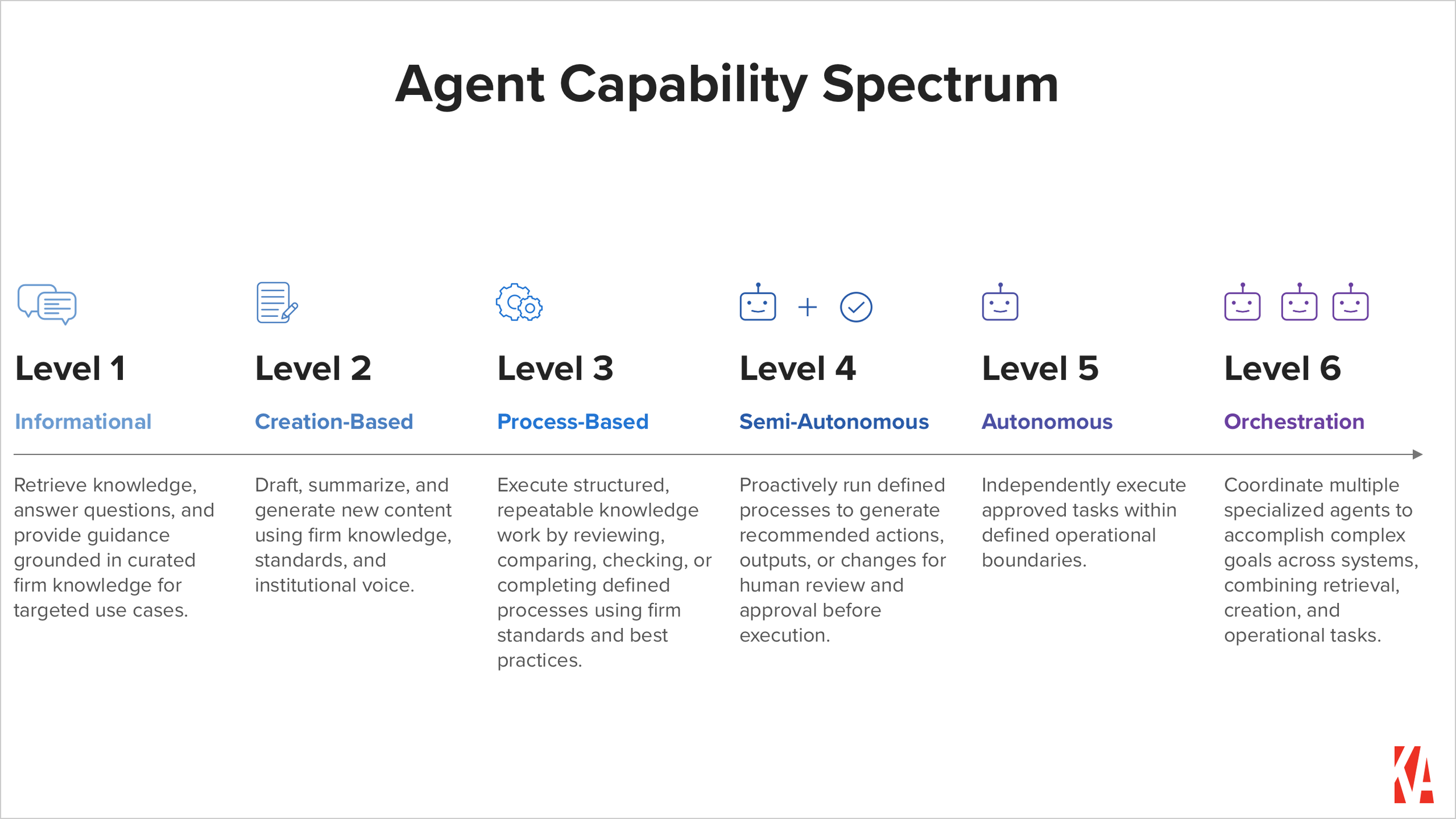
As you move from left to right across the spectrum, the role of human oversight changes. The operational implications become more significant. And perhaps most importantly, the nature of the knowledge required to make agents effective begins to evolve.
At the lower end of the spectrum, firms are often working primarily with existing institutional knowledge: standards, policies, project histories, technical guidance, lessons learned, contact information, and documented processes. In many cases, that knowledge already exists inside intranets, learning management systems, project databases, and other digital platforms. Agents help make that knowledge easier to access, navigate, and apply.
As organizations move further across the spectrum, the challenge becomes less about simply retrieving knowledge and more about operationalizing expertise.
A Level 1 informational agent may primarily need to answer questions about what a firm’s standards are, where information lives, or how a particular process works. A Level 2 or Level 3 agent, however, needs to understand what good looks like.
If an agent is helping draft a proposal, what makes a proposal strong? If it is helping review a fee structure, what are the red flags? If it is helping generate learning objectives, what defines a well-written learning objective? If it is supporting QA/QC workflows, how does the firm evaluate quality, consistency, completeness, or risk?
Those answers often live less in formal documentation and more inside the judgment and experience of subject matter experts.
As firms move from informational agents toward creation-based and process-based systems, they increasingly have to capture not just facts and processes, but evaluation criteria, workflow logic, operational expectations, and definitions of quality.
AEC firms are experimenting with agents in many different ways across many different platforms, and the landscape is evolving incredibly quickly. I want to be careful not to overgeneralize where the entire industry is with AI agents today.
What I can share, however, is what we’re seeing emerge inside the private beta of Synthesis Knowledge Agents.
One of the clearest patterns so far is that firms are overwhelmingly starting on the left side of the spectrum by building highly valuable Level 1, 2, and 3 agents.
Informational Agents: Making Institutional Knowledge More Accessible
The first category of agents we’re seeing firms build are informational agents: designed to help people find, navigate, and apply institutional knowledge more efficiently.
In many ways, this is the natural starting point for organizations beginning to explore AI agents.
Inside the beta, I’ve seen firms create agents that help employees identify relevant project experience, locate technical standards, answer software support questions, surface onboarding resources, navigate internal policies, and connect people with subject matter experts across the organization.
What makes these informational agents powerful is that they dramatically improve the accessibility and usability of knowledge firms already have.
That may sound simple, but the operational impact can be significant.
In many organizations, experienced staff spend an enormous amount of time answering repetitive questions, redirecting employees to existing resources, or helping people navigate fragmented systems.
Informational agents can help reduce that burden on subject matter experts while simultaneously making expertise more scalable and accessible across the organization.
One of the things I find particularly interesting about these agents is that they are designed around very specific use cases and tightly scoped areas of knowledge. Rather than searching across everything inside the organization at once, they can help narrow the signal-to-noise ratio around a particular topic, workflow, department, or business function.
For example, a Revit Assistant agent could be grounded in the firm’s Revit best practices, courses, and intranet posts. An HR Policy Advisor agent could be grounded in the employee handbook and benefits documentation. A Design Precedent Explorer agent could be grounded in the firm’s project directory and project sheet library.
That specificity can make the experience of using AI feel much more approachable for end users than general purpose chatbots or AI search interfaces.
With a chatbot or AI search, people may not know what kinds of questions the system can answer, or how to phrase requests effectively. Building agents around specific use cases helps reduce that ambiguity through clear naming, descriptions, starter prompts, and intentionally scoped knowledge domains.
We designed Synthesis Knowledge Agents to respond conservatively and stay closely grounded to source material. In addition, they can also be configured to escalate users toward human support when questions fall outside the agent’s intended scope or confidence level.
Informational agents provide a high-value and low-risk way to begin introducing your organization and your employees to AI agents.
Creation-Based Agents: Accelerating Knowledge Work
If informational agents are primarily focused on helping people find and navigate knowledge, creation-based agents begin helping people create new work products grounded in the organization’s expertise, standards, and institutional context.
This is where many firms begin moving beyond retrieval and into augmentation.
Inside the beta, I’ve seen firms experiment with creation-based agents that help draft proposal content, generate project descriptions, create onboarding materials, summarize meetings, develop learning objectives, write first-pass communications, and support a wide range of other knowledge work activities.
But there’s a catch—creation-based agents require capturing a different type of knowledge than informational agents.
With informational agents, firms are often working primarily with explicit knowledge: policies, standards, project histories, technical references, and documented procedures.
Creation-based agents require organizations to capture tacit knowledge: judgment, expectations, and definitions of what good looks like.
If an agent is helping draft a project approach, what makes a project approach compelling? If it is generating learning objectives, what defines a strong learning outcome? If it is helping write a proposal, what tone, structure, positioning, and strategic priorities should shape the output?
Building creation-based agents creates a powerful opportunity to make knowledge that was previously tacit, invisible, siloed, or unevenly distributed across teams explicit and shared. Once that knowledge becomes explicit, organizations can operationalize expertise far more intentionally and at greater scale.
That’s one of the reasons I believe these systems have the potential to become such important accelerators for both knowledge management and learning organizations over time.
Importantly, I don’t think the goal of agents is to replace humans. The strongest implementations I’m seeing are focused on helping people move through repetitive cognitive work more efficiently so they can spend more time strategizing, refining, evaluating, contextualizing, and improving the final result.
Creation-based agents are powerful tools to accelerate knowledge work.
Process-Based Agents: Operationalizing Expertise and Streamlining Workflows
If creation-based agents help accelerate knowledge work, process-based agents begin helping organizations operationalize how work actually gets done.
This is where agents start moving beyond generating outputs and into supporting repeatable workflows, procedural consistency, decision support, and operational execution.
Inside the beta, I’ve seen firms begin experimenting with agents that support proposal review workflows, check contracts for risky language, deploy QA/QC procedures, validate standards compliance, and other common AEC processes.
One of the most promising patterns I’m seeing is that these agents can help employees go much further on their own before needing escalation or executive intervention.
A project manager reviewing a fee proposal or contract, for example, can upload a draft to an agent to act as a second set of eyes: identifying low-hanging issues, surfacing potential concerns, checking alignment with standards, and helping them better understand where real risk exists before the document ever reaches a COO, operations leader, or general counsel.
That changes the nature of the workflow.
Instead of escalating every question immediately, employees can arrive at those conversations better prepared, more informed, and with a clearer understanding of both the problem and the potential solutions. Over time, that has the potential to accelerate learning, strengthen judgment, improve consistency, and in some cases perhaps even eliminate the need for a secondary review altogether.
But making process-based agents successful does raise several important questions.
If a fee proposal review agent is helping evaluate a draft submission, what exactly is it looking for? What are the common red flags? What differentiates a strong fee structure from a weak one? What issues should trigger escalation or additional review?
Similarly, if a contract review agent is helping analyze an agreement, how does the firm distinguish between preferred terms, negotiable concerns, and unacceptable levels of risk? Which clauses are considered standard? Which ones require caution? Which ones should immediately trigger legal, operational, or executive review?
At the risk of sounding like a broken record, successful process-based agents require firms to codify both their operational knowledge and their definitions of what good looks like.
And this is where things become especially interesting.
We’re learning from firms in the Synthesis Knowledge Agent beta that the potential time savings, quality-of-life improvements, and workflow efficiencies are often so compelling that experienced experts are more than willing to work alongside agent builders to externalize and operationalize their knowledge.
Watching that happen warms this long-time knowledge manager’s heart more than you can know.
The Next Frontier: Semi-Autonomous Agents and Beyond
Beyond informational, creation-based, and process-based agents, the spectrum becomes increasingly exploratory.
Exactly where the most valuable use cases for AEC firms will emerge remains an open question, and I suspect the answers will vary significantly across organizations, disciplines, workflows, and risk profiles.
But we can already begin to see some early patterns emerging.
One likely category is event-based agents: systems that respond dynamically when something changes inside an operational environment.
For example, when a new page, course, or knowledge asset is added to a knowledge base, a semi-autonomous agent might automatically evaluate whether the information duplicates existing content or introduces conflicting information. Rather than acting independently, the agent might then recommend updates, suggest edits, flag risks, or route issues toward the appropriate human reviewer for approval.
A second emerging category may involve more proactive or recurring “heartbeat” workflows. Instead of waiting for a specific event, semi-autonomous agents could periodically evaluate knowledge systems over time: identifying potentially outdated information, detecting stale content, surfacing underutilized resources, or recommending materials for archival, consolidation, or revision.
In some cases, organizations may eventually become comfortable allowing bounded non-destructive actions to happen automatically. Metadata classification, tagging, summarization, or categorization workflows are examples where automation may carry lower organizational risk than workflows involving archival and deletion of information.
And further across the spectrum, orchestration systems may begin coordinating multiple specialized agents together across larger workflows and operational sequences.
But I think it’s important to emphasize that much of this remains exploratory.
Right now, the overwhelming majority of the practical value we’re seeing inside our community is happening across Levels 1 through 3. And frankly, there is still an enormous amount of meaningful work to do there.
What feels increasingly clear is that the firms that will benefit most from AI agents are likely to be the firms that become best at identifying high-value use cases, codifying operational knowledge, and translating institutional expertise into systems that can repeatedly support better outcomes.
In many ways, that becomes the real organizational challenge.
Not simply adopting AI tools, but developing the people, processes, workflows, and operational discipline required to consistently put organizational knowledge to work.
The firms that do this well will likely become dramatically better at accelerating learning, scaling expertise, streamlining workflows, and helping their people operate with greater confidence and consistency.
I suspect the long-term story of AI agents may ultimately become less about artificial intelligence itself and more about how organizations learn to operationalize and distribute expertise at scale.
What do you think?
I'd love to hear where your firm sits on this spectrum and what you're learning along the way. The experiments, the friction, the surprises, and the concerns.
Please send your thoughts to smarter@knowledge-architecture.com.
WEBINAR | Designing Modern Learning Experiences at Lionakis and Fuscoe
Featured Guests
Kristina Williams, Design Technology Director at Lionakis
Brandon Norton, Senior Multi-Media Manager at Fuscoe Engineering
Webinar Summary
As AEC firms rethink how knowledge and expertise are shared internally, learning is beginning to move beyond traditional training formats. Instead of relying solely on live sessions or long recordings, firms are increasingly designing learning experiences that are shorter, more flexible, on-demand or hybrid, and accessible in the flow of work.
This shift is being accelerated in the Knowledge Architecture community by Synthesis, a platform built for Modern Learning Organizations, that combines intranet knowledge, learning management systems, AI-powered search, and knowledge agents to enable employees to discover and apply expertise exactly when they need it.
In this webinar, Kristina Williams, Director of Design Technology at Lionakis, and Brandon Norton, Senior Multi-Media Manager at Fuscoe Engineering, shared how their firms are designing modern learning experiences that take advantage of this new paradigm.
Each presented a case study of a high-priority learning experience their firm is building or modernizing—experiences designed not only for formal learning, but also to support self-directed exploration, knowledge reuse, recall, and AI-powered discovery through Synthesis.
We explored:
How firms are identifying high-value opportunities to modernize learning experiences
How learning content is being structured for both human learning and AI-powered retrieval
How on-demand courses and hybrid learning experiences are designed to support self-directed learning
What early feedback firms are receiving from staff using these new formats
Lessons learned from the first generation of modern learning experiments
What these efforts may mean for the future of knowledge management, learning, and firmwide expertise development
Each speaker shared a 20-minute case study, followed by discussion and open Q&A.
This session offered a practical look at how firms are beginning to redesign learning experiences for a new era—one where knowledge, learning, AI search, and knowledge agents work together to help employees access the right expertise at the right time.
Enjoy!
Featured Guests
Kristina Williams, Design Technology Director at Lionakis
Brandon Norton, Senior Multi-Media Manager at Fuscoe Engineering
Webinar Summary
As AEC firms rethink how knowledge and expertise are shared internally, learning is beginning to move beyond traditional training formats. Instead of relying solely on live sessions or long recordings, firms are increasingly designing learning experiences that are shorter, more flexible, on-demand or hybrid, and accessible in the flow of work.
This shift is being accelerated in the Knowledge Architecture community by Synthesis, a platform built for Modern Learning Organizations, that combines intranet knowledge, learning management systems, AI-powered search, and knowledge agents to enable employees to discover and apply expertise exactly when they need it.
In this webinar, Kristina Williams, Director of Design Technology at Lionakis, and Brandon Norton, Senior Multi-Media Manager at Fuscoe Engineering, shared how their firms are designing modern learning experiences that take advantage of this new paradigm.
Each presented a case study of a high-priority learning experience their firm is building or modernizing—experiences designed not only for formal learning, but also to support self-directed exploration, knowledge reuse, recall, and AI-powered discovery through Synthesis.
We explored:
How firms are identifying high-value opportunities to modernize learning experiences
How learning content is being structured for both human learning and AI-powered retrieval
How on-demand courses and hybrid learning experiences are designed to support self-directed learning
What early feedback firms are receiving from staff using these new formats
Lessons learned from the first generation of modern learning experiments
What these efforts may mean for the future of knowledge management, learning, and firmwide expertise development
Each speaker shared a 20-minute case study, followed by discussion and open Q&A.
This session offered a practical look at how firms are beginning to redesign learning experiences for a new era—one where knowledge, learning, AI search, and knowledge agents work together to help employees access the right expertise at the right time.
Enjoy!
Webinar Timeline
Introduction
00:00 Welcome and Speaker Intros
Lionakis
01:24 Firm Background
06:02 Boot Camp Evolution Timeline
10:03 A New Era: LMS, Short-Format Video, and AI
16:30 Courses, Learning Paths and the Live Watch Party
20:08 Expanding Beyond DT: Practice-Wide Learning
23:39 The Knowledge Coordinator Role
Fuscoe
28:45 LMS: The Full Circle Podcast Series
32:09 Design It Like a Product
35:58 Build It Like a Brand
40:25 Deliver It Like a Story
43:08 Structure It for Scale
Q+A
50:30 How much came from KA vs. the community?
51:57 Can you show the DT Boot Camp slide?
52:43 How do you think about quality in your content?
53:40 Did you prepare your experts for the videos?
56:17 What does "reboarding" mean?
57:16 Are you telling instructors about long-term value?
59:56 How did you get the resources you needed?
1:01:45 Big picture vs deep dive course effort?
1:05:30 How do you measure success?
1:08:30 How do you handle content that becomes outdated?
1:10:08 What advice do you have for LMS beginners?
More Case Study Webinars
View Upcoming Events
Leading a Learning Organization: Lessons from Angela Watson of Shepley Bulfinch
In this episode of the Smarter by Design podcast, I'm joined by Angela Watson, President and CEO of Shepley Bulfinch, a nationally recognized architecture firm whose work spans healthcare, higher education, and civic design. Angela leads with a conviction she traces back to her time teaching at MIT: that real learning doesn't happen through lecture — it happens through doing, through struggle, and through the kind of exploration that only comes when people are given room to fail safely and try again. That belief didn't stay in the classroom. It became the foundation for how she thinks about leading a firm.
Learning by doing is the foundation of how AEC professionals and firms develop. The problem is that great ideas stay trapped in pockets — one team figures something out, another team struggles with the same thing, and the knowledge never travels. Angela saw that dynamic playing out at Shepley Bulfinch as the firm grew into a national practice, work-sharing across five offices with project cycles too long and feedback loops too slow to rely on informal transfer alone. Becoming a learning organization became an operational necessity, but it turned out to be much harder than it looked.
The conversation traces the full arc of what that effort has looked like in practice and what Angela has learned leading it. Why it's so hard for subject matter experts to codify and teach what they know. Why the traditional apprenticeship model is breaking down as plates get fuller and mentorship gets crowded out. What Shepley Bulfinch learned from building Birdfeeder, their internal peer-to-peer learning platform — what worked, what was too ambitious, and what the firm is rethinking now. And why the harder problem isn't building a course catalog — it's connecting learning to where someone actually wants to go in their career.
The thread running underneath all of it is psychological safety. Angela talks about "Back to the Future," Shepley Bulfinch's reframe on lessons learned — a format designed to celebrate the imperfect and make it safe to share what went wrong. She reflects on what it took for her, as CEO, to model that vulnerability publicly, and why she believes culture is the soil in which any learning organization either takes root or doesn't.
If you lead an AEC firm, manage a team, or are thinking seriously about how your organization develops its people, this episode is for you. Angela offers deep insight into what's worked, what hasn't, and what is still to be figured out on Shepley Bulfinch's journey to becoming a learning organization.
▶ Watch or Listen
Watch or listen to this episode via YouTube, Spotify, Apple Podcasts or wherever you get your podcasts.
📺 🎧 YouTube
📺 🎧 Spotify
🎧 Apple Podcasts
In this episode of the Smarter by Design podcast, I'm joined by Angela Watson, President and CEO of Shepley Bulfinch, a nationally recognized architecture firm whose work spans healthcare, higher education, and civic design. Angela leads with a conviction she traces back to her time teaching at MIT: that real learning doesn't happen through lecture — it happens through doing, through struggle, and through the kind of exploration that only comes when people are given room to fail safely and try again. That belief didn't stay in the classroom. It became the foundation for how she thinks about leading a firm.
Learning by doing is the foundation of how AEC professionals and firms develop. The problem is that great ideas stay trapped in pockets — one team figures something out, another team struggles with the same thing, and the knowledge never travels. Angela saw that dynamic playing out at Shepley Bulfinch as the firm grew into a national practice, work-sharing across five offices with project cycles too long and feedback loops too slow to rely on informal transfer alone. Becoming a learning organization became an operational necessity, but it turned out to be much harder than it looked.
The conversation traces the full arc of what that effort has looked like in practice and what Angela has learned leading it. Why it's so hard for subject matter experts to codify and teach what they know. Why the traditional apprenticeship model is breaking down as plates get fuller and mentorship gets crowded out. What Shepley Bulfinch learned from building Birdfeeder, their internal peer-to-peer learning platform — what worked, what was too ambitious, and what the firm is rethinking now. And why the harder problem isn't building a course catalog — it's connecting learning to where someone actually wants to go in their career.
The thread running underneath all of it is psychological safety. Angela talks about "Back to the Future," Shepley Bulfinch's reframe on lessons learned — a format designed to celebrate the imperfect and make it safe to share what went wrong. She reflects on what it took for her, as CEO, to model that vulnerability publicly, and why she believes culture is the soil in which any learning organization either takes root or doesn't.
If you lead an AEC firm, manage a team, or are thinking seriously about how your organization develops its people, this episode is for you. Angela offers deep insight into what's worked, what hasn't, and what is still to be figured out on Shepley Bulfinch's journey to becoming a learning organization.
▶ Watch or Listen
Watch or listen to this episode via YouTube, Spotify, Apple Podcasts or wherever you get your podcasts.
📺 🎧 YouTube
📺 🎧 Spotify
🎧 Apple Podcasts
📚 Show Notes + Resources
Why Your New Engineers Look Lost for Six Months: LinkedIn article by Nick Heim
Amy Edmondson: A Harvard Business School professor and author whose research on psychological safety demonstrates how creating environments where people feel safe to take interpersonal risks—admitting mistakes, asking questions, and challenging ideas—is foundational to organizational learning and innovation.
Desirable Difficulty: Robert Bjork's learning framework showing that challenges that slow initial performance—like spacing practice over time, mixing related concepts together, and retrieving information from memory through testing—produce superior long-term retention and transfer compared to easier, more familiar learning methods.
📃 Episode Transcript
This transcript was lightly edited for clarity.
Chris: Angela, you are the president and CEO of Shepley Bulfinch. You went to KA Connect last year, you're coming again this year, you joined our executive workshop on Leveling Up as Learning Organizations, and you're keynoting at TalentMAX. So, you're clearly leaning into learning and development and knowledge management at Shepley Bulfinch in a major way, and I just want to start with why now? Why you? What's going on?
Angela: I realized teaching and learning is at the core of who I am as a leader, as a person. Curiosity has always been part of my life, and I've learned the most by being in the deep end of the pool. When I was teaching at MIT, I really started to understand how different people are, and how you can energize them through learning they're genuinely excited about. Without curiosity, none of that happens.
That was one piece of the puzzle. And then in 2020, when we rolled out our strategic plan trajectory, we put down a goal and said, "We are going to actually be a learning organization." We like the pieces about ourselves that are about learning, and we want to find a way to, not formalize that, but really strengthen that, and start to try and understand, well, what does that mean?
In a lot of ways, there was innovation happening, there was learning happening, but in different pockets. And the hard part is, if it's only in pockets, you don't have a learning organization—you've got an organization with learning pockets.
This idea of sharing learning, sharing knowledge, and folding that into how we do things better is this hurdle that I think defines a learning organization. And that's what we've been working on for the last 10 years.
Chris: When you were teaching at MIT— How did you learn how to teach? Had you taught before MIT? Did you come cold? What was hard for you? What did you learn about teaching?
Angela: Oh, wow. Oh, that's a great question. When I was in school, I was a teaching assistant, so a little bit rubbed off on me, but I was so young and I've… I gained wisdom and I paid for it with age. I was approached by a former professor of mine to teach in a design class or design studio, that was a mandatory studio within the progression of undergraduate design education at MIT. And he gave me an idea of what he wanted to accomplish and said, "Okay, go do something with that." And so I built this little mini curriculum, and I'd never really done it before, and this is very true to Angela fashion. I didn't go and read a whole bunch of books about how to teach. I just tried to think about, ooh, what are the things that you really need to learn?
What are the complicated things you need to learn? And I ended up with, actually, I think a lesson plan or structure that I'm still proud of today, that was very much about minimal instruction and maximum exploration and learning, and also setting it up in a way... And I didn't realize it until, sometimes when I reflect on this, I didn't realize how this shaped the things I do now.
It was basically a structure of four really short projects, and when I mean short, I mean two-week projects, and then one final one at the end. And each one of the four focused on a couple of things. One was very much a skill, tools kind of thing, and the other one was more thematic around a design problem.
So, designing an addition to the Philip Johnson house he did for himself as his thesis in Cambridge, and at the same time learning how to actually draw plans, sections, and elevations. You had to learn those two things in those two weeks. Quick intro and then just a lot of one-on-one critique.
Invariably, every student would do really well on one of these at least, and, eh, not so great on one of them. But what they got to do with the final piece was to do it again in a different setting and put the pieces together. So it was sort of about practicing the pieces in a safe way where you could fail—and we expected people to not be perfect—but then be able to take those learnings and actually fold them into this bigger thing, that then weighed much more than everything else. In a lot of ways, looking today at how I think about learning and learning by doing it’s very much about that. It's the experience of experiencing what it feels like when it's not going well, experiencing that thing you're bumping up against that you have to find a way around.
When you do that in theory, you have a very different way of absorbing and then being able to redeploy that kind of knowledge, than if you're absorbing it in a lecture format, and so that was pretty formative for me.
Chris: Yeah, I've come across the phrase desirable difficulty a bunch of times when learning about… so somebody has to reach or stretch. It's like weight training. You have to lift something heavier than you've lifted before in order to grow. Right.
Angela: Exactly. It has to be hard.
Chris: How many times did you teach this?
Angela: Oh, I taught that four years in a row.
The other really interesting thing that I learned was delegating. So I they asked me to teach this class in the fall, and then they asked me to teach the same thing in January in one month, basically for same number of credits, because they were trying to create this flow of students being able to take these classes while I was working full-time as I was doing this.
And I couldn't... I was like, "Well, I have to do something different about this January thing." And so what I ended up doing was, really working closely with two teaching assistants that I had during the fall, where I was there every time at class, and they went through the whole, the whole process.
We went through it together. And then in January, I let them drive more, and I would still come twice a week, and they were there five times a week.
Chris: Kind of quick intro lecture-y piece, and they would oversee the learning by doing. Is that how you broke it up?
Angela: That's exactly how it worked. And it was great because they learned, they learned to teach as well.
Chris: Hmm.
Angela: And, it was sort of my first really successful way of actually letting go of responsibility. It was very much about learning how to delegate, if we have to use that word. And actually, one of the teaching assistants I worked with back then is our managing principal today.
Chris: Interesting.
Angela: Yeah.Yeah, it's fascinating.
Chris: What happens when you say yes to things.
Angela: Yes, it does. It's scary, though. It's scary.
Chris: So Shepley does learning by doing. You have to. You wouldn't be in business if you didn't do learning by doing. You have these pockets of other learning happening, maybe vicariously learning through others or sharing project critiques or site tours and all those kinds of pockets. What was it that convinced you that learning by doing plus pockets of learning wasn't enough? What did you see not happening as a risk or a challenge, or what was the opportunity that you perceived?
Angela: Well, it's what was not happening. Some of these great ideas weren't making their way into all the teams. So some teams were struggling with things, and other teams were trying out new things and doing really well. And, I mean, the same thing is true about sharing of, of new insights, not just processes, but just new insights and just putting them somewhere. It wasn't enough. It's that learning by doing again, because unless people were really engaging with it, they wouldn't necessarily absorb it and they'd do it the way they'd done it the last time. So there was a little bit of that. It was both an opportunity, but also trying to just make us better at pushing forward and being a bit more innovative, too, in how we were approaching our clients and our project work.
We were just starting to, at that point, get into more data-driven design, both in master planning as well as around some of our areas of expertise in healthcare. So there was really a challenge of trying to figure out how to help people see what was even available and what others were doing in order to be better.
So it was kind of both.
Chris: What do you think the cost was of having— I've heard you use the word silos a lot, so having learning or knowledge trapped in silos. What was that— What was it costing Shepley Bulfinch? Or how was it holding you back? What were the signs that you could tell this was happening?
Angela: Well, people aren't developing as quickly as you might want them to because they don't necessarily have access to the same kind of things. And I mean, this is, this is the silo question, right? If you keep things in one place, they don't get the kind of exposure to other things that will help them get better.
That's true for teams, that's true for people.
Chris: So their development is kind of constrained by whoever their project manager or their team is versus what Shepley's learning.
Angela: Exactly. And then there's just plain information sharing. So at the time, we had people doing programming in completely different tools. Somebody was doing it in a database, somebody was doing it in an Excel spreadsheet. I'm not gonna lie and say that it's absolutely all standardized today.
It's not, because we have people and people have different ways of engaging with the tools. But there was no place... Not even there was no place, there were some places, but the systems were different, and the people felt pretty strongly about this thing that they had been working with for some time.
And that in itself is a silo, right? When somebody's committed to a tool or one way of working, and there are people that are learning how to do that that now follow that path, and then you've got another path going on the other side. I think it's not necessarily a bad thing to have parallel paths, but you have to have the ability to experience both so that you can either choose which one's the best one for the right situation, or you could even be somewhere in the middle and take pieces of each.
And that, to my mind, is also a way of learning and actually evolving. So that's also, I think, part of what a learning organization does. It doesn't just sit on its tools, it actually tries to better them all the time. And I think that feeling of being stuck in certain places is probably something that generally we were experiencing at the time, which I think is why people generally embrace this idea of investing in learning.
Chris: There's a guy I follow on LinkedIn named Nick Heim, who wrote a really good piece this week on being a young engineer early in his career. He told the story of working on three different projects, where each project manager had a completely different system for how to organize drawings, how to do communications.
And so he's constantly context switching between which part of the organization he's learning their different systems. And just, take that across all of the employees having to learn all these different systems. On one hand, you wanna have intellectual freedom to figure out a localized tool that works for you. On the other hand, is the cost that all these other people can't move between projects efficiently, and does that kind of demoralize them to have to start over every single time?
Angela: Right. Exactly. Well, and with that also comes sort of the expectations that people have, right? So the expectation that, well, in order to forge a path here, you have to specialize or you have to commit to this thing or the other thing. It's that sort of, that choice— The perception of having to make these choices, that these things are mutually exclusive as opposed to meldable, matchable, combinable and that you can evolve them, right?
So yeah, it's a balance. It is a true balance because I think if you, if you just stick to one thing and you don't change it, the world around you is gonna change because nothing stands still. So we have to change with it, and how that change happens and where we go with it actually becomes vital to how we progress both as individuals and as organizations. And so what are the right conditions to make that happen, right? And I would say that the right conditions aren't to do it always the standard way, but the right conditions are also not to work in complete chaos where there's no way that we can actually harness some of these resources and learn from each other and be better together, right? Because that's the whole point.
Chris: Right. Why else would you have an organization? If you're not gonna learn from each other, then why are you a company? Why aren't you just individuals working on projects?
Angela: Yes, exactly. That's exactly it. And for us, I mean, our mission vision is— the first word in it is “together.” That together we design places or design a better future. And basically, it is about that interdependency and collaboration and the fact that you're not doing any of this by yourself. And that's where I think learning— that there's a learning piece in that too, that is really about how people have to learn how to work with each other in an effective way and learn that they're not always competing with each other. And our world is a pretty competitive world out there.
Chris: Mm-hmm. Yeah, it's interesting. I think two things. One that I'd like to talk about is Shepley kind of becoming— It has been a national practice for a while, but becoming more and more of a national practice over time, and I'm wondering how much of an impact that has had on placing a premium on learning from, going across silos and learning from the best of what Shepley's doing to help synthesize that and try and make that as much of the standard Shepley way as is responsible.
Do you feel like that's true? Do you feel like the kind of work-sharing and national practice was part of that, or is that unrelated?
Angela: I think it's related. I don't know that we were that clear-eyed about it, or that deliberate about it. And actually, it's sometimes hard to sort of figure out which one's the chicken and the egg. But, the fact that we are working across all states or most states, and we're 200 people.
Chris: Right. Meaning you only have five offices. And combining, making hybrid project teams across offices…
Angela: Yeah. We have to stretch, and in order to stretch, you have to share and accelerate the learning. 'Cause if you're only doing it on one project at a time, a project cycle is at best three years,
Chris: Yep. The feedback loop is pretty slow.
Angela: It's really slow. And the bigger the project gets, the slower it is, and they're getting bigger out there.
So I think the two are very much related. I don't know which one came first, but I think the realization is that they are absolutely connected, and the only way that we can stay flexible and be the kind of culture we want to be and perform at that level, that connection and that learning and that sharing and that collaboration has to happen.
Chris: It's interesting. There's this very invisible through line that I think is pretty subtle, but once you see it, it's kinda hard to unsee it. Meaning if you start— Every firm is doing— There's a maturity model to it, right? Every firm is doing learning by doing, and I think every AEC firm I know does a level above that where they vicariously learn through others.
They talk about their projects, "Hopefully this was useful." But then that next step to, "This is the Shepley way," we're gonna codify what we've learned across all of these different healthcare projects or higher education projects, that's a step towards “Now we can actually teach it.”
We have to codify it first before we can scale that learning across the organization. Otherwise, what are we teaching? Just whoever randomly happens to show up and teach project management is just gonna teach it the way that they do project management or the way that they do programming and whatever tool they use.
And I'm wondering if that has been— 'cause I've watched Shepley on that trajectory towards a little bit more of the Shepley Way. Has that been difficult culturally with a bunch of cr… yeah, okay.
Angela: Yeah. I mean, it's difficult because you listen to… it is really difficult when you're really good at something to codify it. That process is hard because we've learned it through doing, so we know how to do it, but we don't necessarily know how to explain it.
Chris: Yeah, it's all tacit knowledge and intuitive and yeah.
Angela: It's really difficult.
And so, we have this learning platform called Birdfeeder, and we've been encouraging people to teach. It's peer-to-peer learning and teaching. And, well, teaching, first of all, is hard because it's a little bit scary, but it also involves that codification barrier. So how do I describe this thing that I do? With-without saying, "Well, you do..." And, and some people will say, "Well, you do this, and you do this, and you do this," or, "I do this," or, "You should do this." And that's sort of mandating a process.
Chris: Right. It's hard enough to think about how I work, and then I'm gonna tell you not only is it how I work, but it's how we should all work.
Angela: Yes, exactly. And not everybody works the same, and not all our clients are the same, and not all our projects are the same, right? So there is this translation that has to happen that takes it from the very specific experiences that I have to a sort of systematic approach that you can now overlay onto different situations.
And then teaching how to overlay that onto different situations is a whole other element of all of this, right? So it's this nested thing that happens, and it's... it can be really daunting And so I think, it takes time for people to put together a class on library design. What's important? Where do I start? What are the basic things? What are the things I don't even think about because they're like breathing or putting one foot in front of the other when I'm walking? I don't have to think about that. But somebody who's never done it before has to think about it. So there are pockets of things that are very much procedural, and then there are things that are very much situational.
Chris: Right.
Angela: Just like anything.
Chris: How are you helping... I'm presuming the answer. I was gonna go to law school and didn't go. I would've been trained out of that by the time I got through it. Are you helping... let's say I'm that library designer, and I'm nervous about it.
I don't know how to tell people what I do. How do you... Can you help them? Is that something you are trying to do? How do you help somebody figure out how to teach library design? Or are they thrown into the fire like you were at MIT and just figure it out?
Angela: There's a lot of swimming in the deep end of the pool that's going on. I think it's really an opportunity for us to actually focus on that. I'm really glad you asked that question because it's something I've been struggling with and we've been struggling with. How do you teach people how to teach? 'Cause it's a whole other skill. And, something we've been trying to invest in, but it's been difficult because it doesn't really sit squarely in our area of expertise, so it sits a little bit beyond that. And, we're not a huge firm, so we don't necessarily have... We're not so big that we could have a full-time teacher or somebody who would manage this whole system.
Chris: Instructional designer, kind of like somebody that... Yeah,
Angela: Exactly. And the other thing we've been trying to avoid is to make it such a structured sort of curriculum that then can't shift and you can't just go say, "Hey, I wanna teach this class on mid-century modern library renovations."
Chris: Mm-hmm.
Angela: Right? And then there has to be this review process of, "We don't know if you can do that."
So there's a nimbleness that I also don't wanna lose.
But I think it's, how we help people do that is something that came up during our symposium, our level up workshop, and, there was a really great conversation about that that I, that I took away with me to think about, and you're bringing that back to the surface again. I think it's helping people have Empathy? And I'm just - literally thinking about this a little bit off the top of my head.
Chris: Mm-hmm.
Angela: Because in order to teach, you sort of have to have empathy. You have to be able to think about what the position is somebody else is in and what their viewpoint is and what they need in order to take the next step, right? Which also fundamentally is a major building block of leadership in general. It's not about what you need anymore, it's what others need.
Chris: Right. so I think an implication of if people can— You said that kind of that skill set is outside a little bit of the core expertise, but if people can learn it, it might make them better project leaders, client-facing business developers, whatever the things are.
Angela: Exactly.
Chris: Do you think that the hard part, we kind of talked about at least two things.
There's probably more, but like one is codifying what I actually know versus, okay, I know what it is that I know. I know kind of the structure, how do I actually communicate in a meaningful way? where, where do you think is harder for your team to... what do you think the bigger barrier is? Or are they the same?
Angela: Knowing what I know or codifying what I know?
Chris: I'm kind of putting codifying what I know and knowing what I know together, but then how do I actually teach it in a meaningful, engaging way that sticks and that people will learn from?
Angela: Definitely the latter I think is harder.
Chris: Hmm.
Angela: I think it's harder, because how do you put people into a mindset that is a learning mindset?
Chris: Right.
Angela: People need to want to learn. They need to want to learn from that person. They need to want to learn that thing, right? So if they choose to learn or engage with a subject rather, I'm just gonna call it that, then you've already overcome a barrier because they're already open to absorbing…
Chris: You're getting at learner motivation. Right, and then how do you— And do they wanna learn it today? If you're teaching them about programming, but they're deep in construction administration, why am I learning about programming today?
Angela: Right.
Chris: Come back in six months when I'm on my next project.
Angela: Right. And then there's the just in time, too. Well, I have this problem right now, how do I find a solution? How do I figure this out, right? And this is where being able to just go and ask somebody is an incredible thing, which is I think what a lot of people miss actually about being in person.
They can't turn to that person anymore. But the flip side of that is that person that you may need may not actually be in your geographic location. They may be somewhere else, so you're still gonna have to get to them in a different way. So I think our world's become really, really complicated with all of those aspects of it.
Chris: I think this is where, I mean, from my perspective, having worked in knowledge management for 25 years, this is where AI is making a huge impact, right? Is just-in-time knowledge because Angela's busy, because Angela's on PTO, because Angela's on a client site, because Angela's... Whatever the thing is, I just don't wanna disrupt her.
Can I find it self-serve? Not saying we don't want people talking to each other. That's not what I'm saying. But it feels like there's another variable in the mix now that hasn't been in the mix before.
Angela: Yeah, it's another dimension in a lot of ways, right?
Chris: I wanna click back to the thing you said around, let's imagine you've asked this person to teach this course called Library Design Fundamentals.
So that's one thing. You do a lot of library design, so that makes sense. But then someone else wants to— I can't remember the exact example. I actually wanna teach a thing on mid-century modern learning design in the Southwest, something, something, something. Which to me, it's like there's a core curriculum versus an extracurricular/enrichment thing, and it's like how do we do— I think how do we do both is what you're saying.
And my observation, I don't know if you feel like this is true at Shepley, has been firms are actually really good at the latter. It's like, Denise is super excited to teach this mid-century library whatever, so who's gonna stop her from doing a lunch and learn two Thursdays from now? But then putting together the actual library design foundations, that's a different level of impact, but then also work… but then also weight that somebody's carrying 'cause this is gonna be impactful.
And so a lot of times that thing doesn't happen. Is that ringing true for you?
Angela: Yeah, it takes much, much longer, A, to convince somebody to do it, and B, to actually put it together. And I think it's also— sometimes what really helps is to not have one person do it, to have two people do it together or three people do it together because it makes the lift easier. There's just more… You're in it together, right? You're exploring something new together, trying to teach this thing. So we've got several of these classes that are part of Birdfeeder that are the 101s or the introduction into, whether it's library design or something else. And they took more time, and they often exist in installments.
And we record all of it, so they're given live, and then they're recorded and transcribed and are available. So their content is available, and people will listen to the recordings. But it makes me also think about needing to redo those at certain intervals because things change—although the fundamentals of library design probably don't change as quickly as some of the more, not idiosyncratic, but more specific things. But it's also an opportunity for people who are becoming experts in that area to teach a version of that course
Chris: To become TAs like your people….
Angela: Yeah. exactly.
So that reminds me, we probably need to do that again. But those then form the core of things that you need to know if you want to be in library design, or probably the core of something you should know if you're just in higher education design, because libraries in higher education are sort of a core of what higher education is too, right?
So it's a multifaceted thing. And defining the... We tried to define that with what we called the bullseye.
Chris: Okay.
Angela: The things that absolutely... The really, really basic things that everybody needs to know. And these things are as basic as, well, how do I do my expenses?
Chris: Across markets, across all the— everybody.
Angela: Yeah, and things that seem just like, really? But when you're starting fresh, when you're brand new and there's, yes, there's onboarding, but there are things that you need to know, right? So it's from the very tiny little mundane thing to maybe some more important things, and then getting to the core that actually has to do with doing the work, with working with others.
And that can include things like, specifics on, say, library design or specifics on how do I plan a project? How do I manage a project? And some of that stuff we can teach in-house, but there are also resources sometimes you need to bring from outside in order to do that, because we're not experts at everything.
I think architects, designers are... We are really good at a lot of stuff. We are really good at putting pieces together, connecting the dots, solving problems. I don't think there's anything architects and designers love more than solving a really amazing problem. But there are some things that, challenges, to your point, like teaching, that people have been thinking about for a long, long time.
There are resources out there, and I think it's just as important to reach out there, find those resources, and then bring them back in. And that's something, frankly, that we have not done as much of as I would like us to, and we're working on getting better at that and being a little bit more focused and structured.
Chris: Partnering.
Angela: Peer-to-peer, but there's partnering.
Chris: Yeah.
I wrote a piece this week about apprenticeship, and I've been hearing so much over the last two years that apprenticeship is dead and COVID killed it, and now there's no more time to look over everybody's shoulders like we used to and all this kind of thing.
The point of view I took is that it's evolving. And one of the ways that I think I'm seeing it evolve is those kinds of things, not necessarily the expense report, but the next layer out in what you described, which is how do we do programming? How do we do a schedule, door schedule?
How do we create a budget? How do we do library design? A lot of that was pushed out to the apprenticeship model. Really, all of the how we work and how we work with others was kind of pushed down to project teams in the past. And what I feel like I'm seeing firms wanna do is take some of that burden off of the project teams to do the foundational “here's how we work,” both from a relieving the burden perspective, but then also from a standardization and quality and consistency perspective.
Do you feel like that was kind of— Am I onto something with this?
Angela: Yeah. Yeah. I mean, it's something that we want to do because we're also finding that people are really stretched thin there. It's harder for people to find time for some of those in-between things. There seems to be more and more on people's plates, and so they're looking to the firm to help with that, right?
To take some of the stress of having to manage some of those things off of people's plates.
Chris: Meaning, so Angela, just to, so as an example, let's say I'm managing a project, I just get Sarah assigned to me. Sarah's never done a door schedule. In an optimal world, I'd slow down, I'd explain why they're important. I take her through some different examples, give her an exercise. She tries it. I mark it up. But that's the part where it's like, "Meh," just do that thing. Just go and try something, and then show me what you did, and I kinda corre... people are so fast, they don't have the time to slow down and really give people the big picture. Is that what you're experiencing?
Angela: It's harder for them. I think they still want to, and they still explain, but I think it puts so much stress on them because now all this other stuff that they committed to doing they're gonna have to do after instead of maybe reading to their kids. It's the kind of things that you give up because I think people are so committed to the work that they're doing and they're so committed to the people around them that those things are happening, but the plate's getting fuller and fuller, and it's becoming harder and…
Chris: And things aren't coming off of it.
Angela: Things are not coming off of the plate, and I mean, that's a whole other thing we should be learning how to do, right? To not let our plate overflow, which is also a really hard part. It's one of the early learnings that I think we don't do that well in our industry or have not historically done that well because many of us grew up with a myth of the overworked, always working.
We live architecture, we live design, we live our job, when in fact, yes, we do because we think about all those things even when we're doing other things. But we need to make room to have a space to mentally zoom out in order to be able to actually focus on others.
Chris: I really love that you brought that up. I hadn't connected that dot because I think this is a Shepley movement, but I think this is across the industry.
I think there's this... in our first episode of the podcast, Dan Hottinger said this thing. He was at dinner with his, his son, he's like a teenager, and he was saying, because he was kinda, he was getting a little complain-y, which isn't very much like Dan, but he was letting it out a little bit, and he's like, "These kids, they're gone at, they're doing 40 hours. They think they're gonna learn how to become an architect. When I was their age, I was staying nights, I was doing weekends." And his son said to him, "Just because your life sucked, theirs has to, too?" And I'm like, "Perfect." But I think that the idea to try and design better jobs and better relationships with work is happening. And so it's interesting...
If you can kind of visualize the model, if that's a constraint that firms are trying to design in to not burn people out and overwork them, then what gets cut? Something has to give. It's simple. And so we don't want it to be mentorship and learning and development, but that's a very pragmatic thing for me, the project manager, to cut, even though I don't want to, but I'm not gonna not deliver my client their project, right? I have to do that. And if I'm not gonna burn the midnight oil, is that what gets short-changed is the development of the next generation. Maybe this is partly why firms are picking up that mantle a little bit saying, "Well, no, no, no, no, that is not a good thing. That is not a thing we want to cut."
But maybe it's not true that you should also have it on your plate, if that makes sense.
Angela: Yes. You know, the thing that kept going through my head as you were speaking, and we have these conversations a lot about how there's so much on our plate, what are we gonna stop doing? If we're gonna start this other thing, what are we gonna stop? And then the question I always ask is, well, is it stop or is it slow?
Chris: Mm-hmm. Hmm.
Angela: There’s a range. There's a spectrum that you can work within. And I still remember a colleague years ago, saying to me that she was doing too much and working herself into the ground, literally, and got sick. And she told me what her husband said to her, and she says, "Well, I have to do these things."
And he goes, "Yeah, those things are still gonna get done. They're just gonna get done differently." And that stuck with me. This is more than 20 years ago. That statement stuck with me because if we can't do it one way and it's, and the plate is growing, what if we do it differently?
Can we think about different ways of defining what I have to do to be involved with? I think we find this and we're working, I think we're constantly working through this, but people... And I love the fact that our whole team is so incredibly responsible. I couldn't do what I do without them because things happen no matter what happens.
Things get done, which is incredible. And I think with that also comes a sense of incredible responsibility of getting it really right. And I know I have some of that too, that sort of perfectionism of if I can make it better and better and better, I'm gonna keep messing around with it and making it better and better and better, right?
Chris: The project's done when the budget runs out or the timeline. Yeah.
Angela: Mm-hmm. Yeah. That's... are there other ways of doing that? Not to do it not as well. That's not what I'm saying at all.
Chris: Not to lower your standards.
Angela: Right. But, and this is where it starts to get a little scary, like how can we delegate differently? Can we share responsibility differently? Do I have to do all the one-on-one conversations with my whole team?
Do I have to have that many, quote-unquote, "direct reports," or can we find a different way without inducing too much hierarchy, which is true in teaching and working and all of those things? A way that we put responsibility for leading and guiding and teaching on the folks in the earliest part of their career.
Chris: Right. I mean, you get at something that's so important to how I've seen firms attack… again, let's say that Sarah's the subject matter expert in library design, and we've asked her, maybe like you said, we've partnered her with two other people. But still, if those three are the subject matter experts,they have a hard time remembering what it was like to not know what they know, and so partnering them with more emerging professionals to help them.
"Wait, wait, I don't understand. You just used this acronym. I don't know what it is." Someone that can, really kind of pull it out and slow them down and have a conversation around the work and then figure out... Again, that you can try and have the empathy, or you can have somebody that's actually in that position right now kind of as part of that learning design team.
Angela: Yes,
Chris: And what I've also s- there's this kind of… I like when you said Shepley doesn't have to know everything, we can partner. But then even within that, the subject matter expert can partner either with an emerging professional or, and I've seen Shepley do this well, the knowledge and learning management team, whatever that means.
That might not be like FTEs or fully named people, but like Jess Purcell and your team, your director of design technology shared some amazing work at KA Connect last year around partnering with subject matter experts on a variety of topics and taking what used to take them 100 hours to write down a process doc and shrinking their commitment to two to four hours, because they would interview them over video and they would handle a lot of the production, the sequencing, how do we actually make this a learning thing?
We could take some of that, the codification piece and the delivery piece, we can take some of that delivery piece off their plate and lighten their burden, but still have them involved in shaping what the thing is.
Angela: Yes, that's so true. And, that has been an incredible thing that has really charged up the ability to do more things. And I think you brought up AI earlier. I wonder if codification is something that we can get some help with on that front too,
Chris: Oh, for sure.
Angela: So that it isn't— That we don't have to— Again, one person doesn't have to know it all.
What Jess is doing is getting at exactly this idea of: How do we do it differently?
That's... I mean, totally. I do this all the time, and I hadn't really thought about it in the way that you just framed it, but AI is great if I've got something that's deep in my brain that's tacit that I wanna communicate, I'll have 45-minute, hour-long conversations in voice mode with AI, and I'll ask it to help me...
Chris: It will help me stumble my way through what it is that I'm actually thinking. And I can have it ask me questions. Even for our podcast today, I had it help me prepare. It's like, what do I think Angela's gonna answer? What's some stuff that I haven't... there's so many opportunities to have it be a partner and to not have to do it alone,
Angela: Exactly.
Chris: That, yeah, I think that will change.
Again, it's like if we don't wanna relax our standard of quality and we wanna educate people, now well, we say we like design problems, that's a design problem, right? That's a business design problem, not a building design problem.
Angela: Yes, exactly.
Chris: Org design problem, right?
Angela: Exactly. And, one thing that I was thinking about last week was design problems are not ones you can solve immediately often. They require a bit of distance or running through a whole bunch of extraneous things and then being able to examine those things and learn from them.
So in a lot of ways, design is actually a learning process…
Chris: Oh, yeah.
Angela: Right? And what seems like a perfectly obvious solution at the end, right, 20/20 hindsight, is something that takes some time because you couldn't see that solution earlier. And what you just described that you're doing with AI and that we do with people and which was what happens in design dialogue is exactly that process of discovery, right?
It's the discovery of things that we have all the pieces for, we just can't look at it from the right perspective in order to see the picture that the— all the pieces make without walking around it a bit, and that walking around part actually takes time.
Chris: Yeah, and then letting your subconscious work on it a little bit and then come back to it with an insight because you stopped thinking about it.
Angela: Yeah. Yeah.
Chris: When you and the... I don't know who was involved in writing your strategic plan. I'll just say board, but you can correct me. And you decided to put learning organization as a goal there. What, what did that mean? What were you gonna do differently? How would… if you were becoming a learning organization?
What was the thought process there?
Angela: So it was the board, it was actually a lot of the firm too. Everyone— the majority of the firm participated in it. The hard part, just as hard as codifying, is figuring out how to measure, how do we know when we're doing well?
Chris: Yeah.
Angela: Oh, it's something I struggle with. And, I mean, the first thing we did is we actually said, "Look, we're going to build this learning platform."
And we created a timeline, and we had some pretty lofty goals for how this— what this was going to look like and, put a budget to it. And I would say we, over the last, ooh, five years, we probably got 40% there. We got pieces of it, and it's still alive and it's still working, but we didn't quite get to some of the pieces that we thought we might need, and we're taking another run at it now.
So I think what we realized we needed to do is we needed to name it. We needed to put a budget to it. We needed to put people, quote unquote, in charge of it or make them responsible for it. And that worked because again, we have really responsible people.
Chris: What were they trying to do? So they have a budget, it's a brand, they've got people, but what was the North Star? How would they know, is it that someone from Houston can work on a project with someone in Boston and they can on-ramp faster? Is it that if people are saying that they— you do employee engagement surveys and they're like: Well, I actually do have the tools I need to do my job.
I feel like I can get access to... What did good look like?
Angela: Yes. Yes, feeling like you have— you can find the resources to learn that, people can develop expertise faster. They can find answers in the moment. They can find them both synchronously and asynchronously. That we had a growing catalog or rather, repository of these learning tools and whether they're lectures and even things like somebody going out and presenting at a conference, bringing that back and doing it for the firm. Why wouldn't we do it for the firm when we do it for the outside world?
Chris: Yeah.
Angela: Resources, having those available in a place on Finch, and it's gotten so much better because of the way Finch, our intranet, which thank you, which we — I don't know what we would do without it. It's become so much easier to find information.
Chris: Mm-hmm.
Angela: And so what we were trying to build, so we cobbled together in a lot of ways our own, our own, learning platform by figuring
Chris: It was before we started building ours.
Angela: Well, we— like I said, we were bootstrapping it a lot and 'cause we didn't like a lot of the things that were out there. They were either too big or too cumbersome and needed too much management, but also weren't as flexible, I think.
And I think what we're finding now is that the flexibility of being able to access that information without having to keyword it quite in the same way is just opening up a huge, not just this huge world of getting access to things that you would have had to know how to look for before.
It's sort of the equivalent of browsing the library as opposed to needing to go through the catalog and finding that thing, right? And so being able to look at that book. But the fact that we used to do this in person, you'd go to the shelf or to the section, and then you'd find all these other things.
I don't know how many times I used to go to the library, look at one book, go, "Well, that's not really what I wanted. Oh, but this one over here, that looks really interesting."
And without the physical environment, we don't have that anymore. And so I think going back to your original question, that wasn't something we intended.
Chris: Right.
Angela: Something that I think was part of the story that we were trying to achieve, which was the story of having people teaching each other, sharing information, that that information and that learning, that wisdom was available for others, and that this was a key component which we never quite figured out how to get off the ground, but I think is still really important, and that's the learning system as an individualized system.
So not something where one size fits all, but it's about finding even different ways of learning the same thing for different people, because everybody has a different learning style, and connecting it to the things somebody wants to learn. So this is the whole library thing again. I keep thinking back to college advising days of somebody who actually understands what the offering is and then has a conversation ideally with a student or this person that talks about what they're trying to achieve and then can help them find the resources that are available to take advantage of.
That was the dream, which I realize now was a lot.
Chris: Mm-hmm.
Angela: And I think was too much at the time.
Chris: To create kind of that math— it's the... Was the dream too ambitious in terms of the surface area of the number of topics or domains of knowledge that you wanted to capture? Was it in scope or was it like an impact? Where was it too ambitious?
Angela: I think it was in scope, although people were willing to do it. We had a whole system of pairing people. It was that.
I think it was also... It was really unfamiliar. It's not something that exists within the traditional firm corporate culture, right? I mean, you have the mentor-mentee relationship, which is a whole other topic. So it's related to that, but we also were starting off with a tiny course catalog, so we didn't really have this huge thing. I think I underestimated just how much it would take for somebody to understand what all the pieces are, and then the time to…
Chris: Are you talking about the learner or are you talking about the people running the program?
Angela: The people who were these learning advisors that would have these conversations with folks.
I think there's so much we put on them to both understand how to help somebody on a path—that's a whole skill in and of itself—to understand the resources that are available and to even be able to connect, and this was the big one that we're working on now, how somebody's desire for learning connects to what their desire for their career is.
Chris: Right.
Angela: Connected in the professional world. And even at the very beginning, we were asking ourselves that question, and we didn't have an answer to it. So we said, "Let's just see how far we get and see if we can make this work." But it's popped up again, and I think it is an integral part to how people think about their progress and how they wanna grow and evolve.
So learning isn't something for learning's sake. Learning is really about this thing that I need to do and want to do because I'm trying to go somewhere.
Chris: I wanna acquire a skill or a capability that will allow me to then move to the next level or be more effective or, yeah.
Angela: Right. And what is that next level, and what is that somewhere? And I think what we underestimated that that conversation is fundamental to even figuring out what somebody wants to invest in with the time that they have.
Chris: Did you underestimate... That's interesting that, I could take it two ways. One is you have kind of career pathing and the kind of competencies that you need to kind of move along a career path well-articulated, but matching people to those paths is hard. Or did you actually realize we need to actually figure out what it means to be a project manager and kind of map out the competencies? Was that the kind of blocking piece?
Angela: That was a piece of it, and that's actually also really difficult because, again, one size does not fit all because you've got a range of things that you need to know or could know at different levels of that.
Chris: So little fast-burning projects versus a five-year healthcare project. D- it's project manager is a different job in…
Angela: Yeah, it's a completely different job depending on what kind of team you have, who you're teaming with, whether you're doing it by yourself. You know, it's geography, geopolitical context. You name it, right? It is, it is completely different. So we started doing that as well, and I think people actually gravitated towards that.
But it was also, again, that codification of what you need to know in order to do this job is difficult, because you can come up with some things and then you can come up with about 10 other exceptions.
Chris: Right. And then, I mean, just to make it more fun, how do we know that you actually know it? Taking a course doesn't mean it…
Angela: Exactly.
Chris: So how do we measure competency at these tasks that we already… yeah.
Angela: Right. And how do you do it without it feeling like, "Well, if I do this, then this happens." Right? And for some people…
Chris: Meaning if I take Project Management 101, within the next six weeks, I should be able to project manage a project sort of thing.
Angela: Exactly. Yes. So it is a nested problem, and I think what we found is when we poked at it, we found a whole bunch of these things and didn't have solutions to them. I think knowing more about it now, we're trying to or working on building a framework that takes some of these things into consideration.
And the trick to it is, to keep it a flexible framework. And those are the hardest ones to build because you gotta have movable joints, and they can't be entirely black and white because if it's too brittle, it'll break. And I think that's what we found, when our entire world of working changed in 2020.
Chris: Yeah.
Angela: That we had to be nimble.
And I think the same thing is true for this whole conversation and for this whole challenge because the kind of work that, as you said earlier when we were talking about the apprentice model, right? The apprentice model of being able to look over someone's shoulder or look at all the drawings and mark them up at the end of the day and leave little notes on things.
Chris: Mm-hmm.
Angela: Technology has changed. The way people physically work together has changed. And so how we inhabit this profession has changed, and it's going to change even faster. I mean, that's the thing. We look back and we can see all the change. We have a much harder time looking forward and seeing the change, but it's coming.
So how do we build a flexible system that allows us to get at the key components of what humans need to learn about other humans in order to be able to work within whatever system is out there, which for me always comes down to communication. That to me is the most— If, if I could teach anything perfectly, it would be for somebody to— for people to become incredibly strong communicators.
Chris: I think you're— I mean, I think it's interesting what you said because there's, about the looking forward, because I think while it's true we don't know what the next three to five years will bring, I think even if you do kind of scenario planning, I don't think there's a scenario you could imagine where becoming a better communicator, and communications won't be more important in three or five years than it is today.
I don't think there's a world where Shepley being able to learn faster and adapt more quickly isn't im- more important in three to five years than it is today. So you don't know exactly what it's gonna look like, but that skill of being able to learn quickly and communicate seems like a durable investment to make as an organization.
Angela: Yeah, I think they're foundational in a lot of ways. They're foundational in also, a lot of the changes that we're experiencing with how different generations work with each other and, back to the silos, right? People have different priorities. And I mean, we experience this every day working with our clients, working with consultants, right?
So we're working with people who aren't doing exactly the same thing we are. The better we can be at really communicating clearly, and that doesn't mean clearly like I say it very clearly so you can understand.
Chris: My diction is perfect.
Angela: No. But it's me saying it in a context that makes sense to the person who's listening so that they can actually engage on, on this subject that we need to talk about as opposed to talking past each other. And I think…
Chris: We had a speaker at KA Connect, I wanna say it was 2012. It was Jim Kent, who was the chief marketing officer at Thornton Tomasetti at the time. And he said, "Look, my job is communications, and I define it very simply. There's something that's in my head that I want you to know, and the degree to which what was in my head you understand and have, have received, that's communication."
Right? It's like, it doesn't matter how clearly I wrote it, the brand, the font, whatever that is. Did I move my idea or feeling or emotion, whatever, from me to you? Did it transmit?
Angela: Yes. Yes.
Chris: And knowing that people receive information differently and all the things, right?
Angela: Mm-hmm. Yeah. Exactly, because otherwise you're talking about different things. You're not talking about the same things. And that again, fundamental to teaching, fundamental to advising, fundamental to leading teams, fundamental to setting direction.
Chris: Mm-hmm. What— And so as you come to kind of... How long are your— What's the, what's the kind of scope of your, your strategic plans? Is it a five-year, 10-year? how long, how far ahead does it look?
Angela: It started as a 10-year and, in fact, we've rolled it out in 2020, which was a little wild at the time because we worked on it in '19, and then this 2020 thing happened. We're like, "Well, okay. W- let's, let's wait a couple of months and see if this totally blows everything out of the water." And it actually didn't, so there was a lot of that flexibility that really worked, which was great.
So that was an amazing learning experience. It's a 10-year total, so we just did an update to just kinda look at, well, where are we? So let's not... And that's another thing is like not, not— don't revamp the whole thing, but tweak it and figure out, do we need to redirect a little bit? So we're due for another one in 2030.
Chris: So we're in '26, so there's four years left, and as you think about the learning organization piece of that, and you, you kind of— You haven't said it, but I think you're kind of saying we're gonna reboot it or try Birdfeeder 2.0 or there's something else coming. As you're thinking about that, it feels like you learned some things in 1 point— Birdfeeder 1.0.
So I'm kind of curious to talk about what you're coming to Birdfeeder 2.0 with, and I'm picking up something. I'm wondering if, one of the things you do is be less ambitious in scope, understanding how deep these things are, or do you stay in the scope and add more resources and more advisors?
What are you gonna do differently with this swing?
Angela: I think, yeah, I don't think throwing more at it is gonna solve what it is we need to solve.
Chris: Mm-hmm.
Angela: I don't think making it more rigid is gonna solve what we need to solve. I think it's actually getting simpler in some ways, and getting at the root of the thing that is going to be that spark that is going to be the catalyst. And I think it's this framework that we're trying to figure out that connects to how people move through their professional career, how that connects to their personal learning, and how it connects to not only the teaching and learning part, but also to leadership and communication. Because I think they're all connected.
Chris: You made it more complicated or over-invested in Birdfeeder 1.0? How do you make it simpler? What needs to go?
Angela: I think the learning advisors, that was too complicated
Chris: What were they asked to do?
Angela: They were asked to meet with individuals, talk to them about what they wanted to learn, and then help them find the right thing.
Chris: So they were helping them navigate the system, essentially.
Angela: In a lot of ways, I think the system navigation is something that is going to be possible to be solved with technology.
Chris: Yeah. Well, I mean, I think I say that very quickly. I think it will be helped by technology. I do think there is a role, and it's interesting to see where this sits.
Michael Leckman from Diamond Schmitt is speaking at KA Connect this year. He kind of started Diamond Schmitt's university program. He's a Design Principal in the firm. And his vision is he wants every principal and design lead and project manager to understand the catalog very, very well, so that when they have someone on their team who hasn't done wall sections or curtain wall or CA or whatever the thing is, they know the learning resource and they can connect them to it in the flow of work.
What I'm inferring from a learning advisor is they're kind of looking out for Denise overall, for her career trajectory and trying to mix and match learning opportunities, which maybe is also a good role for someone to look at the arc of your career. So the apprenticeship piece can actually get better.
It's like instead of me having to teach you curtain walling in the moment 'cause you're gonna start doing this thing, we have a learning resource. Do it, and then we'll talk about what you learned and how to apply it to this project, or you'll do an exercise. And so I wonder if there's a way to have the project teams be more of that navigator role too, if that makes any sense.
Angela: Yeah. Yes, I think so. I think there's going to be the whole human component, which is the people that—the peer network or the network of the project, and I think there are different networks that exist in a firm. There's the network of people that are learning the stuff you're learning. They're the people that you connect with informally that are mentors that you pick. And then there is the project team, which changes constantly and maybe, maybe more— one more than others. I also think there is going to be a way that you can pretty much ask the question of whatever technology AI evolution there's going to be to say, "I need to figure out how to do this. I do best with this kind of resource. What do we have available?" And it would be able to find that. So I think there is the understanding of the catalog, which is something that we were talking about, something that I believe is going to be an easier thing to solve.
The harder thing to solve, I think that we need to concentrate on, and that's that more pointed, putting our resources there, is the conversation of where do I want to go? Because the self-identification
Chris: In my career?
Angela: Yes. The self-identification of I need to figure out how to be able to do that curtain wall right now.
Chris: Mm-hmm.
Angela: People do that based on the problem or the challenge that they're facing. But the conversation of do I want to go out there and be responsible for bringing in work, or am I incredibly fulfilled by working on the most complicated details and creating these really advanced, innovative ways of thinking about energy efficiency and modularity and whatever else it is on these exterior facades for these incredibly big buildings? That's something that gives me joy and that I find my emotional capacity to invest in to be really strong. So, how do I make that distinction? And it sometimes has something to do with shining a light underneath that thing that we thought we wanted because that's what we learned in school, or that's what our friend did, or that's what we're watching in the movies, or…
Chris: That one pays more.
Angela: Yes. Well, that's the— I had my law school bout at some point too, where I was like, "Well, I should really... 'cause that's what I'm doing." And then I'm like, "No, don't think so…”
Chris: I was a history major. What was I gonna do? I mean, luckily technology took off and saved me from...
Angela: I apologize to all the lawyers listening. Yeah. Well, and, hopefully the lawyers that are listening are happy doing what they're doing as lawyers. But it's not, it's probably not my cup of tea.
Chris: It shouldn't do it by default or because you wanna make more money. I think that's the point we're making, right? That shouldn't be the reason that you get into law or become a principal or do business development or whatever it is.
Angela: Yes, because work-life balance, I mean, I know there's so much talk about there, right? And how it is or isn't balanced. But if you're enjoying what you're doing, you have to balance it less, or you have to counterbalance it less. Yes, there's just plain time commitment with whatever it is, soccer games and pageants and time with family. But there's also the emotional commitment that comes with that, and if I love what I'm doing and I'm fulfilled, it makes me happy,
Chris: Hmm.
Angela: That's something less to counterbalance with other things. And so I think this conversation that's fundamental to the learning conversation and making the learning organization successful is also helping people figure out why they need to learn things and for what they need to learn things.
Chris: 20, 30 minutes ago, we talked about this kind of learner motivation thing, and there's the micro motivation, which is we have a deadline and I gotta deliver, versus the macro motivation, the more long-term motivation is who do I wanna become as a person, and what do I wanna do with my life here on Earth and my time and my energy, and how much of that is on me to figure that out versus how much can an organization help me have a dialogue about figuring that out and maybe try some different things, and if it doesn't work, can I back out and try another thing and kind of figure out what my path is?
Angela: Yeah, exactly. I think that's where if we can help, if we can find a way to help with that, that's probably the biggest service that we can bring to somebody. And that's motivational, and it's also the hardest thing to figure out.
Chris: It's the hardest thing for Shepley to figure out how to describe that, or it's the hardest for the... Okay.
Angela: It's the hardest thing to describe, figure out what the scope is, figure out how to prepare people to do that. Because again, you might have one or two people... I mean, we heard from somebody recently, at our latest event, that was doing a leadership development engagement that was pretty intense and concentrated and really required a person who was really good at it to lead it. When you have one person like that it’s not enough for a firm of 200 people. So it's finding and developing the ability to do that, to have those conversations. Which luckily though, again, overlaps with some of the things that we try to teach everybody, which is the ability to talk with people about what they're facing. Put yourself in other people's shoes. Because when you really think about what's fundamental about what we do as designers, we don't design places for ourselves. We design places for other people.
Understanding what is going to be good for other people and not just beautiful to photograph and win an award on or do the thing that the code says, which you have to do, but really good design is going to be about creating places for people—other people. Not us designer people, but other people. And in order to do that, you have to be able to ask those questions and have those conversations to understand what somebody else needs.
So I think fundamentally that ability to then have the conversation with somebody about what their career needs is related. Yes, it's slightly different, but they're both rooted in the same kind of skills.
Chris: While also managing expectations in terms of how quickly this can or can't happen, and it's a complicated matrixed organization that's project-based and trying to— There's only so many slots to do so many roles and… yeah.
Angela: Exactly. It is complicated. It's very human.
Chris: Hmm.
Angela: Very human is very complicated because I think humans are not particularly straightforward.
Chris: I wonder how this combines what people want to learn and what they need to learn a little bit. And, there are parts of everyone's job, I think, that aren’t the most exciting thing that they get up for in the morning, but you still have to learn the skill.
Angela: Yes. Yes. For me, that's meeting notes. But yes, you're absolutely right. That's such a good point, Chris, because often we don't know what— or we may even know it, and we don't wanna do it because it's hard. And again, back to the point about when something is really hard, you're probably learning something pretty fundamental or something pretty important because you're working through it. So it's less about, I don't wanna say tools. And it's less about predictable processes and more about situational awareness and response in some ways, which can be really difficult and difficult to learn.
Chris: You brought up in our workshop psychological safety, which I think is a great topic. I'm sure you've read Amy Edmondson's work on this, she's my go-to. Find books by Amy Edmondson. Oh my gosh, amazing.
What I think you're hinting at, and maybe I'm off base, is yes, the knowledge and learning piece of it. Understanding what it means to become a project manager—here are the things you need to learn, whether you want to or not, delivering them at a time when people can absorb it, want to absorb it. There's a whole art to developing people, and it's changing with the apprenticeship model. All of this stuff is changing in AI. But there's this kind of... You're circling around, I think, how can I let people understand that Shepley Bulfinch has my back and is thinking about me in the long term, even if I don't have—I do some things I don't wanna do in the short term, or I have to—maybe it takes a little longer than I want it to to get there.
Maybe I'm surprised. Maybe I'm thrown into something faster than I'm ready for it. But that there is, this kind of environment built on trust and communication and transparency that I think is foundational to a learning organization that, look, the only way you learn as an organization is that you mess up sometimes.
And so that's true for the company, and that's true for teams, and that's true for individuals.
Angela: Yeah, completely agree.
Chris: I'm curious, as you think of—'cause I've heard you talk about the relationship between a culture of learning and psychological safety. What is it specifically at Shepley that you've tried to do to increase psychological safety or shape an environment that's conducive to learning?
Angela: Yeah, and it's hard because people don't like to mess up. They don't like to mess up in front of themselves. They don't like to mess up in front of other people, right? We hold ourselves accountable. We—I mean, there are a couple of things that we've implemented. We have one that I think I've mentioned at some point, we call it Back to the Future, which is a way of talking about things that happened or a project.
Chris: So it's lessons learned without calling it lessons learned.
Angela: Yes, it's kind of, if I could go back—what things would we do again? And what things might we do differently, and what could the outcome be?
Chris: What do I wish I'd known when I was getting started? That kind of thing.
Angela: Yeah, exactly. and I think it's also reinforcing when people talk about things that—where something went wrong, and they figured out a way to solve that problem, to celebrate that.
To actually celebrate the fact that something didn't go the way they had expected. Something didn't go perfectly.
Chris: It's an opportunity to learn, right? Is that what... That's what you're saying.
Angela: It's celebrating the imperfect. So celebrating the fact that somebody actually learned from it and is sharing that learning. So, we try to, and this is hard actually, to encourage project spotlights that we share with the whole firm, not to just talk about the things that were amazing on this project and that it did incredibly well, but also talk about the struggles.
Chris: Mm-hmm.
Angela: What were the things that we were struggling with? Whatever that was. Could be small things, big things. And it's also really up to leadership to constantly reinforce that we want people to share questions that come from things going wrong on our intranet, on our learning platform, on Finch.
Chris: And that starts by having leaders do the same. Model that behavior.
Angela: Yes. And sometimes even... And when they, when they don't, and they maybe don't understand the importance of it, is having that conversation and helping people understand, right? That's why it's important. It's not about saving face. It is about sharing a learning and actually being perceived as much stronger as a result, and much more resilient.
Chris: Yeah. You're kinda hinting at, yes, sharing that specific lesson. Hopefully, we absorb that and we find a way to not make that same mistake again. But it sounds like the fact that they are sharing it is actually even more important than the specific technical issue or issue that happened on the project.
It's because it's building a culture that does that.
Angela: Yes. Yes. And, we still have more work to do on that. We're by no means 100% there. But yeah, that's the... It's also, and, this goes against some of the more traditional beliefs of: Leaders have to be perfect, leaders have to know everything, leaders have to be strong. They don't get to have problems. They don't get to be sick. They don't get to do any of those things. They don't get to make mistakes.
Chris: No sick days.
Angela: I still remember one town hall, I completely—I can't remember if I couldn't remember a person's name or used a totally wrong name repeatedly for them. Thanking them for something and totally used the wrong name. And then the next morning, I woke up thinking, "Oh my God, I just did that."
Chris: Yeah.
Angela: And so I went on the Teams chat. This was a town hall, so this was the whole firm. I'm like, "what?" And went on the Teams chat and, did the @ whoever the person was and said, "Hey, I'm so sorry. I totally realized I got your name completely wrong. I don't know why I did that. I am so sorry."
Chris: Mm-hmm.
Angela: And got a really nice, "Hey, it's fine," back. But I think it was hard because I'm like, well, I'm not only going to admit that I messed up totally, but I'm also gonna call attention to the fact that I messed up to people who didn't even notice.
Chris: Right.
Angela: So not only am I admitting to it, but I'm also like, "Hey, guys, look. Look what I did," right? And so... But it's funny, once you do it, it gets easier.
It's the first time you have to do it, it's like, oh, yes..
Chris: Makes it easy for the next person. They saw you do it, and the person that wasn't there also saw you do it, and so now they know that that's something... In a positive way, right?
Angela: I hope so. I hope so. And that's a little thing, right? It's a tiny little thing, but I think it doesn't matter if it's a big thing or a little thing, the emotional context is very similar.
Chris: I wrote down while we were just talking that culture is the soil for the learning organization.
Angela: Yeah.
Chris: I feel like that's, to me, it's what makes it possible for it to flourish and grow. And it can grow in bad soil, but only so far and so well, right? You know, plants are very resilient.
We see them growing in all kinds of crazy places. But, it feels like leadership is tending that, right? That is one of the core roles for the learning organization. Weed out the things that don't matter so that things have enough room and space to be able to grow.
Angela: Yeah, and just because you thought something was a weed doesn't mean it's actually a weed.
Chris: Oh, well, fair. A weed is just what we call a plant…
Angela: Oh, I... Yeah, this, this is a real rabbit hole for me.
Chris: Okay. That's good. Somehow we managed to make it all the way through this conversation without getting into the bird metaphor thing again…
Angela, this has been great. I really appreciate you setting aside time to talk through all of this, and I'm very excited to see where Bird Feeder 2.0 and learning organization goes over the next few years at Shepley.
Angela: Thank you. I learned a lot during our conversation, and I really appreciate your insights and pointing out some things I'll definitely take away and be able to add to the things we're thinking about. So I really appreciate that. It was really fun. Thank you.
Chris: Thank you so much, Angela.
Designing Learning That Actually Improves Performance | Clark Quinn of Quinnovation
In this episode of the Smarter by Design podcast, I’m joined by Clark Quinn, a cognitive scientist who has spent his career translating decades of learning research into practical guidance for organizations. He is the founder of Quinnovation and co-founder of the L&D Accelerator. His work is grounded in a simple conviction: most organizations are leaving enormous potential on the table — not for lack of effort or care, but because the science of how people actually learn has rarely made it into the room where learning decisions get made.
In most AEC firms, learning and development didn’t start with a formal strategy. It emerged organically. Executives responsible for talent came up through practice. L&D leaders stepped into their roles because they wanted to make their firms better, not because they were trained in the discipline. Subject matter experts shared what they know without ever having been taught how to teach.
As a result, most learning organizations in the AEC industry were largely built by accident rather than by design. And in that gap lies a significant opportunity: to create learning that doesn’t just inform, but actually improves capability and performance.
That is what this conversation is about.
Clark walks us through the science that most accidental L&D leaders never had access to. He explains why training so often stops at information transfer, what it really takes to design for performance rather than content delivery, and what the research says about learning design that actually moves the needle. We explore the shift from content-heavy training to practice-led learning, how to identify the root causes behind critical performance gaps before reaching for a training solution, and how to determine whether learning is even the right intervention.
We also step back and look at what a true learning ecosystem requires: not just courses, but performance support, job aids, communities of practice, mentoring, and the cultural conditions where learning compounds over time. Where knowledge is shared openly. Where failure is discussed. And where leadership sets the tone.
Finally, we go deep on one of the most important dynamics in any AEC firm: how to effectively work with busy and highly billable subject matter experts by drawing out what they know, pairing them with skilled learning designers, and building a coaching culture that makes expertise transferable at scale.
If you lead an AEC firm, build learning programs, or teach others what you know—and you’ve largely been figuring it out as you go—this conversation offers a foundation for doing it smarter. By design.
▶ Watch or Listen
Watch or listen to this episode via YouTube, Spotify, Apple Podcasts or wherever you get your podcasts.
📺 🎧 YouTube
📺 🎧 Spotify
🎧 Apple Podcasts
In this episode of the Smarter by Design podcast, I’m joined by Clark Quinn, a cognitive scientist who has spent his career translating decades of learning research into practical guidance for organizations. He is the founder of Quinnovation and co-director of the L&D Accelerator. His work is grounded in a simple conviction: most organizations are leaving enormous potential on the table — not for lack of effort or care, but because the science of how people actually learn has rarely made it into the room where learning decisions get made.
In most AEC firms, learning and development didn’t start with a formal strategy. It emerged organically. Executives responsible for talent came up through practice. L&D leaders stepped into their roles because they wanted to make their firms better, not because they were trained in the discipline. Subject matter experts shared what they know without ever having been taught how to teach.
As a result, most learning organizations in the AEC industry were largely built by accident rather than by design. And in that gap lies a significant opportunity: to create learning that doesn’t just inform, but actually improves capability and performance.
That is what this conversation is about.
Clark walks us through the science that most accidental L&D leaders never had access to. He explains why training so often stops at information transfer, what it really takes to design for performance rather than content delivery, and what the research says about learning design that actually moves the needle. We explore the shift from content-heavy training to practice-led learning, how to identify the root causes behind critical performance gaps before reaching for a training solution, and how to determine whether learning is even the right intervention.
We also step back and look at what a true learning ecosystem requires: not just courses, but performance support, job aids, communities of practice, mentoring, and the cultural conditions where learning compounds over time. Where knowledge is shared openly. Where failure is discussed. And where leadership sets the tone.
Finally, we go deep on one of the most important dynamics in any AEC firm: how to effectively work with busy and highly billable subject matter experts by drawing out what they know, pairing them with skilled learning designers, and building a coaching culture that makes expertise transferable at scale.
If you lead an AEC firm, build learning programs, or teach others what you know—and you’ve largely been figuring it out as you go—this conversation offers a foundation for doing it smarter. By design.
▶ Watch or Listen
Watch or listen to this episode via YouTube, Spotify, Apple Podcasts or wherever you get your podcasts.
📺 🎧 YouTube
📺 🎧 Spotify
🎧 Apple Podcasts
📚 Show Notes + Resources
Don’t miss the full list of resources, organizations, experts, books, articles, and concepts referenced in this episode following the Episode Transcript section below.
📃 Episode Transcript
This transcript was lightly edited for clarity.
Chris: Clark, you have spent years helping organizations rethink learning and development through the lens of cognitive science, performance, and innovation. And one of the ideas you're especially known for is the performance ecosystem. I really want to talk about this and dig into it today, but I want to start with how you got into this field. From my understanding, you got into this through cognitive science. Can you talk about that journey, and what drew you from cognitive science into learning and development?
Clark: I was doing tutoring on campus and got a job doing computer support for the office doing tutoring. I saw—I hate to tell you how long ago this was—that computer-supported learning was a relatively new idea. But I saw the connection and said, "Hey, maybe this is worth studying." We had a program where you could design your own major, and I ended up doing exactly that. It's been my career ever since—supporting learning through technology.
And it turns out technology means conversations as well as devices, and lots of other things. My first job out of college was designing and programming educational computer games, and that notion of engagement has remained a recurrent theme because it's relevant to learning. But I realized we didn't know enough. We were coming up with questions about how to design things, and I read an article calling for cognitive engineering—focusing on how we think, work, and learn, and designing to match how we think. My twist was, "Let's design for how people learn."
I did a PhD, was doing the academic route for a while, and when I came back to the US after a few years overseas, I said, "This makes perfect sense: to connect organizations with learning needs with the technology and learning science I had studied." So I came in a back way—from designing and programming educational computer games, getting that focus on cognitive science, and then meeting with organizations. I never had the traditional instructional design training. Instead, that focus on how our brains operate and trying to design solutions that work in conjunction with that has remained a recurrent theme.
Chris: If you go back to young Clark, learning and trying to do these things—what was the biggest surprise about how people learn that you didn't know when you first got started?
Clark: I guess the same as for a lot of people: the thought that learning really requires effort and practice. In some sense, learning came easy to me—I loved reading, loved looking at diagrams. I'd sit in front of the bookshelf with a World Book open and just work through the diagrams and understand things. So the thought that it actually took work—and that in particular, to have an ability to do, not just to know, but to do—really requires persistent practice. And the nuances get quite fractal, in the sense that everything unpacks more and more.
Just in short: if you want to be able to do something new that you can't do now, you're going to have to practice doing it and get feedback. That was what surprised me, and it ends up being true for a lot of people—that mismatch. Everybody's been through school, so we think that's what learning looks like. And school is actually a really bad model. We forget how little we actually learn from schooling.
Chris: Is that because it's more focused on information transfer versus—why did we learn so little from school, in your way of phrasing it, and what would be better?
Clark: School does have persistent, reinforced learning, which is good, but it's focused largely on knowledge. Most schools want you to be able to know things—to know history, to know science—and not do anything with it. In organizations, what we care about is people being able to do things with that knowledge. And that's what you mentioned—the performance ecosystem. There are two components to that. One is the focus on performance. That's really what differentiates, I think, school from organizational learning: we really need people to be able to do things, not just know things.
Chris: Or a traditional K–12 approach versus a vocational program, which is focused on helping you actually perform things in the world.
Clark: Sure. And those can be better or worse too. Some claim to be vocational and aren't, and others really get it. When you look at how we traditionally learned before schools—and schools are a relatively new invention, only in the past few hundred years—learning looked much more like apprenticeships. John Lave and Etienne Wenger talk a lot about this in historical practice. And I really like what Alan Collins and John Seely Brown talked about with cognitive apprenticeship. They looked at different initiatives—teaching reading, writing, and mathematics—and found similarities that suggested: if you really want to develop understanding, it should look a lot like apprenticeships.
Chris: "Cognitive apprenticeship" meaning—instead of physical skills—knowledge work skills?
Clark: Developing those skills to do reading, writing, arithmetic, and other things. Increasingly, our work is knowledge work, not physical work. We're getting robots that can run half marathons. We have complicated machines to harvest crops. So increasingly we're in an information age and we need to do knowledge work. That's why cognitive apprenticeship becomes a useful way to think about how we should design learning for actually being able to do mental tasks, which is largely what we do these days.
Chris: And so if the role of traditional education is not necessarily to build skills but to lay down some kind of intellectual foundation and teach you how to think—my impression from reading about you is that you're a bit of an outsider and something of a critic of the system. What I'm inferring is that we took that same approach from school and brought it into the workplace: more information transfer, and not teaching in a way that could help change behavior or change performance.
Clark: I'll push back a bit on your statement that school is about getting you foundations and learning to think—actually it doesn't do a very good job of teaching you to think. It teaches you the foundations, and you do need the foundations, as people like Paul Kirschner make quite clear. But I also think we don't do a good enough job of developing people's ability to do, and we don't develop people's ability to think, as you suggest. That's actually what we should be doing—in addition to laying those foundations—teaching you to think, expand your own learning. That's not really part of the curriculum.
The notion that you change the curriculum and the teachers will adapt is actually naive. You have to equip the teachers with skills to adapt, to add these things, to look at their overall perspective. Just assuming they can do this is not fair to them, nor to the students. So I think we could and should be adding the learning-to-think, metacognitive, meta-learning skills in K–12 and higher ed, but they're not there now. And so organizations assume it without actually testing it or developing it.
Chris: Organizations assume that when new people come into their organization, they know how to think?
Clark: They know how to learn.
Chris: They know how to learn?
Clark: They can think in particular domains they have been trained in or have prior experience, and you'll hire for that experience. But assuming those people know how to continue to self-develop and acquire new skills is naive. Now we do have the L&D department—it's supposed to train—but their training is very much influenced by that experience with school. We also tend to take people who are good at their job and turn them into trainers, and they don't know how to train.
And then when we have disruptions like 9/11 or COVID and everybody has to go online, we say, "Here's an authoring tool, you're now an instructional designer." And we have a lot of people doing instruction who don't understand instruction. Cammy Bean wrote the book The Accidental Instructional Designer, and that's too often the case. We have people expected to know learning who don't, and yet they have to develop it. So they track back to what they learned in school about how to do education, and it looks a lot like school—presenting information and testing information. People will recite back what they've learned, and yet we have what in cognitive science we call "inert knowledge," because when they go out in the real world where that knowledge is relevant, it doesn't even get activated. They've never used it in context.
That's what I would argue L&D should care about—remedying not just people's ability to know enough stuff, but people's ability to do stuff.
Chris: You've thrown me three fastballs and I'm trying to figure out which one to swing at. I definitely want to come back to what you said about people not knowing how to learn, and I want to talk about people not knowing how to teach. Those seem like two meaty subjects. Can we start with people not knowing how to learn? How does one learn?
Clark: A good, effective self-learner should set themselves goals and design experiments. Our colleague Harold Jarche talks about personal knowledge mastery and has a workshop on it that really digs into the skills required. He's broken it up into three major components: Seek, Sense, and Share.
Seek is how you gather information. It turns out there are lots of folk psychologies about each of these steps. For seeking, people think, "If I just Google, I get an answer, that's great." And it's even worse now when you just get answers—not even links to articles—and they may be made up, they may not be right. And because you're a novice in that domain, you don't know if it's right or not. But seeking well means creating a good feed, monitoring that feed, and knowing how to write good search queries and evaluate your results.
There's this myth of the digital native—"Oh, they grew up with this technology, they're good at using it." And yet when two separate studies were done by librarians in the UK and the US, looking at people's ability to write good search strings and evaluate results—this was before AI, but even then—there was no difference by age. It depended on the individual's experience. As our colleague Jane Bozarth says, she's the oldest millennial because she's a digital native even though she's close to my age. We have a lot of myths.
Sense is the second stage—that's involved in experimenting, applying it, testing it, refining it, making sure you understand what you've heard, that it means something to you and is worth sharing with other people. And Share is the third stage—who to share with, how to share. That creates a cycle, because people read what you say and some will comment, and that feeds back into the Seek again. When you do this well, you get a really productive learning cycle. But knowing all these phases and how to execute each well is not something you should assume, because folk psychology can get in the way.
Lots of people think, for instance, if you read and highlight, that's valuable. It turns out that's really simplistic and actually not very true. There are good ways to highlight, but there are far better ways to process material than rereading. And yet too many people just reread it and think that's valuable—instead of processing it, re-representing it in different ways, making inferences and testing them. So that aspect of "how do we be effective learners?" is just neglected.
The culture matters too. Is it safe for you to share your ideas with other people? If you have the Miranda organization—where anything you say can and will be held against you—people aren't going to share their best ideas.
Chris: Psychological safety, that kind of thing.
Clark: Exactly.
Chris: So that's like self-directed, self-motivated learning. Does the question around people not knowing how to learn also apply when there are more informal learning structures or mentorship structures? Are there still deficiencies in people being able to learn in that context?
Clark: Yes. I was just writing a post thinking about coaching. There's the standard model of sports coaching where people say, "Focus on your swing now—you were a little low consistently, let's focus on hitting it higher." That's very domain-specific. But there's been this notion of domain-independent coaching, which asks, "What did you do wrong? What should you do differently? Who might you ask?" They deliberately choose coaches who don't know the domain. To me, what they're doing is essentially doing what you would do if you were a good, self-efficacious learner. So should we instead be developing everybody's ability to be a good learner, rather than just focusing on coaching?
There are also two senses of informal learning here. One is, "I need to learn, there may be somebody out there with the answer, and I want to go find it." And then there's the other situation where there isn't anybody with the answer—so you're innovating, using skills like brainstorming to address this. Just as in formal learning, you don't know the answer when you start, and there isn't anybody who's going to provide feedback for you. The world will have to do it, or you'll have to test it. That requires the same learning skills, but it requires finding ways to get feedback from the world, because you can't get it from somebody else who knows more.
Both formal and informal learning have their role. When you're starting in a new field, you don't know what you need to know and don't know what's important, so you need some structure. I'm not one of those people who says, "Don't have courses." I say, "Do have courses that are effective." But then you need different things as you start developing and move from novice to practitioner. You know what you need to know and what's important, and you just need access to it. So you start needing performance support for those things you don't do frequently, where it's not worth trying to put it in your head.
Chris: What's an example of performance support?
Clark: The video I watched to repair my dryer. My dryer stopped working and I couldn't figure out why. I looked online, found this video, and it talked about diagnosing and replacing this particular piece. I don't even remember what it was I did—and that's fine, because I got the dryer fixed. It was performance support that allowed me to do that, and yet I didn't have to "learn" anything.
Chris: Or if I'm reviewing an NDA and I haven't done it in six months, but we have a checklist for clauses to look for—that's something that helps me in the flow of work.
Clark: Checklists, decision trees, process guides—there are lots of tools we use to make sure we don't have to put it all in our heads. We put it in the world so we can access it. But there are also times we do want to advance our understanding, and then we need resources. That's formal in a sense that somebody's created it, but it's further down the learning journey.
We also start needing community, we start needing experts for mentoring and coaching, and we start needing to interact with our colleagues to see how they did it and share what we're doing and get feedback. So that ecosystem part—the performance part is making sure we can do it, and as novices we need courses, and then we want job aids for when something doesn't have to be in the head, and we want to advance what is in our head. But thinking that one tool is going to be able to do all that is naive. Swiss army knives are great when you're camping, but in the kitchen you really want the right different tools. The same applies in an organization: unless you're really small, you're going to want the right tool for the job.
Chris: Can we use a hypothetical to explore this performance ecosystem? In our industry—architecture, engineering, construction—let's say we have an architecture firm that focuses heavily on healthcare, which is a complicated discipline. There's medical equipment, jargon, compliance, different user groups. So let's say you have an undergraduate in architecture, maybe you've worked on some school projects, and now you're going to be doing some healthcare projects. There's this desire in our community to speed that learning cycle up. I've got some foundation in design and understanding how buildings go together, but I don't really know this discipline. How do you start thinking about a performance ecosystem to put around that emerging professional?
Clark: If they know buildings and design, and we're talking about buildings designed for specific healthcare needs, I'd probably also want them to get a foundation in the healthcare field—just what do they need to know? Not everything about healthcare; they may not need to know about filing forms for administration or reimbursements. But they probably need to know what are the common things people do, what are the common things people need, and who are all the different stakeholders.
And then there's a company—Jos Arets and Vivian Heijnen have Tluser, which is based in Belgium—and they have worked with my colleague Charles Jennings and created a whole process for thinking through exactly those situations. Because some of that's going to be performance support. What do you absolutely have to make sure a healthcare building includes? There's the standard checklist for buildings in general, but healthcare probably has its own requirements for the different machinery, and there has to be open space for wheeling complex equipment around. You start having multiple checklists from different areas.
Chris: Extra backup generators in case of earthquake, or something like that.
Clark: Right. And asking people to remember all that is probably not worthwhile. They may learn it over time, but you probably want to teach them how to use the checklist rather than memorize it. And you build that awareness of the resources available to them as part of what they're starting.
But you also want to make sure that person takes the additional healthcare course, and when they start going in, have them apprenticed with somebody—so they're watching someone, gradually handing off responsibility, with somebody looking over their work. And that person needs to know enough about learning to know, "When do I stop giving them feedback, and start asking them what feedback they should receive right now?"
So there's this transition from, "You got that wrong, you forgot to include seating for the family around the bedside"—I'm making this up, I'm not an expert in the domain—to at some point starting to say, "What have you forgotten?" "Ah, seating for the family." You're beginning to develop that self-monitoring. And then eventually you can start giving them real design requirements. It's the mentoring, and it's also the community. They should be seeing what other people on different projects are doing, and seeing the feedback they're getting, and then starting to give their own feedback, and sharing what they're doing and getting feedback. You start building this community.
Chris: If you have enough senior people in the community who can help with the domain, right?
Clark: And you also have to make it safe for them to share their good ideas, so they don't feel threatened by new people. They welcome the new generation, and if someone says something wrong, somebody else will correct them. There are a lot of factors that go into making that work. One of the best ways to find out you don't have a vibrant community is to put a social media platform in there and nobody shares. And you go, "Oh, maybe we don't have the right culture."
Chris: We lived through that when we first came into business in 2009—we were a social intranet, and it was all about, "Did they have the right culture?" Checklist number one: is there psychological safety? If somebody asks a naive question or says the wrong thing, how does the organization respond?
Clark: Right. And it takes nurturing to get there. I found out I'm not a good social media facilitator—I'm too much of an introvert. It takes time to build it, it takes cadence, it takes soliciting people, it requires people to continue to find value in the community, to gradually move from a legitimate peripheral participation to a central role.
Chris: We ran a workshop with some of our leading clients three or four weeks ago in leadership—companies that want to be learning organizations and want to push forward. And they described a bunch of disconnected learning programs and activities that weren't cohesively brought together in an ecosystem, as your term is. How does that all come together so that 1+1=7? You've got a formal course, maybe "Healthcare 101," you've got some job aids, they're part of a community, they learn vicariously through peers and mentors, they get feedback directly through mentorships, they have a social platform where they can ask questions. Many times it starts and stops with the course, and it doesn't include all those pieces as part of an integrated solution—is that correct?
Clark: Yes. And what you say is absolutely accurate, but I want to go a little bit further, because you can have all the pieces and still not have a coherent ecosystem, because the pieces aren't linked together. And there's more. Garvin Edmondson and Gino, in a Harvard Business Review article, talked about the dimensions of a learning culture. They really highlighted environmental factors—beyond having all the parts, you also have to care about the environment.
So, not just tolerating diversity but valuing it, recognizing the value. Not just saying "we welcome new ideas" but actually being open to them and testing them. Time for reflection—to actually stop and have time. People say, "Ah, we're too busy for reflection." It turns out if you take time for reflection, you're more productive than if you don't. And the last one is psychological safety. Amy Edmondson has continued to talk about that in a variety of useful ways in organizational culture.
But they go on to talk about practices too—you need to have an expectation and budget and time for experimentation. Amy Edmondson's most recent book is on smart failure—basically, it's about being safe to fail as long as you're doing smart experiments, because innovation requires risk. Learning requires risk, because you have to try things and be willing to get it wrong. If you know what you're going to learn if it goes wrong, and what you'll learn if it goes right, that's smart. Do it as low-investment as possible, and don't bet the farm unless you're going to lose the farm anyway.
And there's a dimension I hadn't thought a lot about. My colleague Matt Richter studied with Rich Ryan of Deci and Ryan and self-determination theory, which is a really rigorous framework for thinking about creating an environment in which people feel autonomy, competence, and relatedness—the three elements of self-determination theory. When you have all those, you get people willing to commit and willing to contribute. He has a new book coming out called The Motivation Blueprint that talks about this quite nicely.
It's a long answer to your question, but really an ecosystem is greater than the sum of its parts, because it's also the environment in which it's operating. You can get positive outcomes from each element, but if you really want that quantum leap, you need to make sure you've got the environment right and them all synergized together, working in ways that allow people to take best advantage of it.
Chris: Right. And then, to take best advantage—performance ecosystem to what end? What is the goal of learning and development? What does good look like for an organization?
Clark: Traditionally, learning and development has been about making sure you can execute the things you know you need to do. And so we create courses to develop skills. Unfortunately, we develop courses for all solutions too often, instead of knowing we can use performance support, and that there are certain problems courses won't fix. If I could be selling solution-based approaches, but I'm rewarded for selling product, I'm going to sell product until you change the incentives. Courses aren't going to fix that.
Chris: So you can put me through a course about solution selling, and if all my incentives line up for me to do the other thing, then what was the point?
Clark: Right. So there are lots of things that interfere, but ultimately we're about executing what's optimal—which is why we're too often the first part that gets cut. When things are tough, people go, "We're executing well enough, I'm not going to worry about L&D." So I argue that there's a second component to L&D that really should be part of it: facilitating innovation.
Chris: Interesting.
Clark: We in theory are the folks who know learning best. And innovation, as I've suggested, is informal learning—because you don't know the answer when you start, when you're doing the research, when you're doing troubleshooting, when you're doing design. So it's learning, it's innovation. Facilitating that, according to what we know about learning, is an opportunity for L&D. That's the principled reason. And then there's a very pragmatic reason: if you're the business unit responsible for adapting to increasing change and helping the organization meet ongoing needs, that suddenly becomes very strategic and central to the success of the organization.
Chris: Especially because we're in VUCA times right now—very fast-moving and very change-oriented. If the role of L&D is only to help scale the knowledge of the things we already know, but some of the most important things we need to know are unknown or changing very quickly—you have to be out at the edge, helping to facilitate that edge and helping the organization learn it, so that you can scale things as they settle down. Is that correct?
Clark: I like the way you put that. Yes. Doing the things you know you need to do is just going to be the cost of entry going forward. The only sustainable differentiator is going to be the ability to adapt, and that comes from that agility, that comes from that edge, that comes from experimentation and testing and tracking what's happening. I'm not saying L&D is responsible for it—I'm saying L&D is responsible for making sure that it's effective and optimal at leveraging what we know, but also facilitating that innovation process.
Chris: How can L&D do that? What are the things that help facilitate innovation? What's the role in the best examples you can think of?
Clark: To me it's about brainstorming as a practice, which I've looked at closely because I was interested in what makes creativity and good design. There was a series of articles some years ago saying, "Brainstorming doesn't work." And they were right, because the original proposal for brainstorming put people in a room, gave them a problem, and asked them to start talking. That doesn't work well because you're not leveraging the diversity of thinking in the room.
If you give everybody the problem but ask them to think independently—not come together or share ideas until everybody has come up with their own ideas—then you share. That's how you populate more broadly the solution space, and that increases the likelihood of finding the best solution.
Chris: Or maybe even letting people think about it for a couple of days in advance, for those who need to reflect and have their subconscious work on it.
Clark: That's even better. So there's time for that percolation, incubation, fermentation—pick your metaphor. We want to get those best ideas down, and then we share them. And before we evaluate them, we create—"Hey, what if we put these two together?" Let's randomly populate the solution space. There are apps that throw out random ideas just to prompt lateral thinking. Then you diverge first, get as many ideas as you can, then you converge. I knew an interface design company in Australia that set two separate teams on every problem and let them run, then brought them together and said, "Okay, what are the best parts of each?" It was a bit of a luxury, but the outputs were better.
Chris: This is a really interesting frame. Partly because we work in the design and engineering field, there's a lot of those kinds of thinkers per capita in our clients. But this idea that for a learning organization—I had written two things down and now I have a third. So: innovation, the frontier, the cutting edge. Then a function of scaling, once you've established some things that work and want more people to know how to do them. But then there's also a phase of unlearning, where we need to retire and stop doing what's no longer working or no longer accurate. There's that piece to it too.
Clark: You probably saw my reaction to the term "unlearning." I don't like that term. As somebody pointed out—maybe Tom McDowell—it makes it easy to think we can just unlearn stuff, and it's not that simple. Technically, we have to learn over the old traces, and the old traces can be quite strong and recapture our behavior under stress. Over time we'll backslide if we're not actively reminded, prodded, and trained to make sure we now have this new response.
And what Garvin Edmondson and Gino also talked about—beyond experimentation—was analyzing the results of those experiments, figuring out what they meant, and baking that into what you're teaching and training about. If you come up with a better way to do a task, you're going to have to learn over the old way of doing it. So maybe you did Process X, and now Process Y is a better way. Let's learn Process Y.
Chris: That's interesting, though. If Process Y is only 5 or 10% better, you also have to calculate the cost of retraining your entire organization for marginal improvement. Do you actually end up positive in terms of ROI?
Clark: These are the decisions you have to make. Is the investment worth the cost? Is the benefit worth the cost it's going to take to make the change? In the short term, maybe 10% improvement seems small. But if you multiply that over multiple years or products, maybe it is worth it. It depends on the volume, what it costs to do it, and what the impact is. This is the classic ROI calculation, and my only problem with ROI is that sometimes it can mislead you. You could do something small that has a really big ROI, but something bigger may not have as big an ROI and yet is going to make a much bigger difference over time. You have to make sure you prioritize those relative impacts appropriately.
Chris: Can we talk about performance more specifically? We talked about the performance ecosystem but didn't really talk about performance too much. One of the things you and I had talked about before is that it feels like—let me tie two ideas together. You said "accidental instructional designer," you mentioned that book, but there's a level above that, which is like an accidental learning organization who stumbled into... I think all organizations are learning organizations because they have to be in order to survive. But there's doing it ad hoc, and then there's very intentional organizations who think about measurement, success, performance, and innovation. What's that journey look like from accidental instructional designer slash accidental learning organization to something you would consider best-in-class?
Clark: I want to also characterize the accidental learning organization. There are also organizations led by people who think they know the answers. We have this culture that says, "Oh, if you built a successful company, you're brilliant." And they totally discount the influence of luck in that—the research shows that luck plays a much bigger influence. But sometimes they make all the decisions for everybody, instead of looking and tapping into other perspectives. It's the old hierarchical approach.
In the information age, Keith Sawyer documented as an academic in his book Group Genius, and Steven Johnson in his book Where Good Ideas Come From—that myth that one person goes away and comes back with the solution isn't true. Everybody's best answer is social. "We Are Smarter Than Me," as the book on my shelf titles it.
So how do you intentionally get there? It begins with figuring out how to facilitate the flow of information and communication in the organization. You make it safe, and you have the tools so you can have that conversation. And it's also what the leader does. I added to Garvin and Edmondson's approach: it wasn't just leadership that supports it—I believe leadership has to walk the walk. As Jane Bozarth's book Show Your Work suggests, you can't just say, "Make your mistakes visible." You have to do it yourself as a leader, or nobody's really going to believe it's safe to show your mistakes. There was a small software company up in Redmond, Washington, that had such an aggressive culture that if you shared a mistake, you would be eviscerated for it. So they all kept making the same mistake, because nobody could admit to it.
So it's a conscious decision to take advantage of the people in your organization, creating an environment in which they can participate in the decision-making. You can't experiment if you don't measure, because you really don't know if the outcome is good or bad unless you have a measure.
Chris: You don't necessarily know the clarity on the goal of the learning program or a specific learning activity. What needle should get moved if this goes well?
Clark: And that's one of the biggest issues in L&D—measurement. Too often, they measure, "Did people like the experience?" And there's nothing wrong with that, except that its correlation with actually having any useful impact is essentially zero. Salazar Aladl analyzed this and got a meta-analysis of 0.09 impact. That's zero with a rounding error—no correlation between whether people liked it and whether it was effective. And in fact there are plenty of examples of the instructor who was not the most liked and yet was the most effective when measured.
Chris: How do you measure if learning's effective? What does that mean?
Clark: Ultimately, it's what you said—it moves a needle in the organization. You should not actually start an initiative if you don't know what it is you're trying to fix. And there's a field called "performance consulting" that I think should essentially be part of L&D, which goes in and says, "Before we create a solution, let's make sure we understand the problem." What is the gap between what should be happening and what is happening? Is that gap significant enough that we need to remedy it? Let's look at all the gaps in the organization, figure out which ones we need to fix, and then—what's the cause? That's the gap analysis. And then there's the root cause analysis: Why do we have that gap? Is it wrong incentives? Courses aren't going to fix that. If people just don't have all the resources they need to do the job? Courses aren't going to fix that either.
Now, maybe it's knowledge? Ah, well now we're beginning to find something. Is this a skill? Something we need people to do that they can't do now, or they're doing wrong?
Chris: Or maybe they don't feel safe to raise their hand if they don't know what they're doing. So now we have skills, knowledge, and culture perhaps.
Clark: And so you work backwards and eventually say, "What would people be doing differently that would lead to this result?" And if people would be doing it differently, you look to see: are people doing this differently? Then you work back and say, "Are we training them to do it differently?" These are the measures. But it's ultimately: what is it you need to change in the organization? If you need salespeople to be shortening the sales cycle—well, you figure out what the sales cycle shortening process looks like, you train them on that, and then you look to see: is the sales cycle shortening? And is that yielding the increase in sales you want?
Chris: But only after you validated the problem isn't that no one wants to buy the product.
Clark: Right. Because no amount of training on selling will help with that. That's the performance gap, and the performance gap should be, "We're not selling enough product, and it turns out the sales cycle is too long."
Chris: So why is the sales cycle too long?
Clark: Exactly—you validate all this, and then you figure out what the intervention needs to be. And sometimes, when it's a course or a job aid, L&D steps in and develops that or curates resources. If it's a problem where you don't know the answer, that's when you assign a team.
Matt Richter likes to point to a British historian, Keith Grant, who analyzed military problems but talks about three sorts of types of problems. There are tame problems, where you just manage it. There are critical problems that are time-bounded—if you don't act, somebody's going to die—and you just need somebody to make a decision. And then there are wicked problems, where you have to assign a team, manage the process, and figure out what you're going to do. Different types of problems require different approaches. And knowing when you have a wicked problem, when to assign a team, and what sort of timeframe they need—in many cases, it could be unrealistic to expect a significant change to come out of a week of meetings.
Chris: So we're kind of working upstream from learning, to organizations getting better at classifying and diagnosing problems correctly, so that the solution to every performance problem doesn't become training or learning.
Clark: Right. And while that may make traditional L&D teams uncomfortable in the short term, if you reduce the courses you develop to only the ones where they're really needed, and then you do them well—you have more resources to do the other things, like facilitating innovation, curating job aids and learning resources, and making sure the community is vibrant.
Chris: Do you think learning development teams try to take on too much scope? It's kind of implicit in what you just said—maybe they're doing too much of what could be called back in favor of some less effective ones.
Clark: I think they're doing too much of the wrong stuff. They're doing too much content development. Back to how we perceive school: if I give people new information, they're going to change their behavior. And that, I believe, is implicit in so much of what we see in organizations—yearly reviews, for instance, which have just been proven to be worthless. Why do we continue to do that? Even twice-yearly reviews isn't frequently enough; people really need regular feedback. And bullet-point training, just giving people information, isn't going to change their behavior. And yet, too often: here's the content, PDF, PowerPoint, add a knowledge quiz, and you're done. And now people want to do that faster and faster.
Chris: Why do you think—we're in 2026—I've heard what you just said for a few decades now. Why is this still a problem?
Clark: Why has education been recognized as ineffective for decades, and it's still true? I think there are multiple reasons. L&D isn't very good at communicating its value, and it has been quite comfortable just taking orders and producing courses. They don't measure, so they don't know that they're not effective. And stakeholders, if something looks like school, think it must be effective. So they're not really asking for data. I'm still waiting for that to change, by the way. Eventually the CFO is going to go, "We're spending money on training—what evidence do you have that any of this is having an impact?" And I would rather L&D be changing to prepare for that rather than be faced with it as a sudden and surprising outcome.
Chris: We have bad ideas about good course design. What is good course design?
Clark: Practice. I believe strongly that we've got our ratio wrong. We tend to have about 80% content and 20% practice, and most of that practice is knowledge testing. There's research that shows—Prajagaral showed this—that we used to believe you need to make sure learners have the information before you test them to see if they can use it. So there were low-level questions and high-level questions. But it turns out: if you just ask high-level questions—applying the knowledge, not just retrieving it—you still get the same transfer to ability to do. You don't need the low-level knowledge questions. Here, you have to retrieve the knowledge and apply it. So you might as well skip the retrieval-only questions and go straight to the application.
Chris: Can you give me an example of what high-level versus low-level would be in this scenario?
Clark: Let me see if I can make an architecture one. A low-level question would be, "What are the requirements for a weight-bearing beam in terms of the current code?" And you recite an answer—"Current code says the beam has to be this long and sustain this much weight." That doesn't mean you can design anything. What you then need is: "Here's a building with this much weight—how many columns does it need?" That difference in question is applying the knowledge. What are the decisions people really need to make in the real world? Not, what is the knowledge they need—but what are the decisions they make? And just asking those application questions requires you to retrieve the knowledge and apply it the same as asking the retrieval-only questions. So you don't need the retrieval-only questions.
Chris: Is part of the reason people stick with low-level questions that it's easier? Low-level stuff can be multiple choice and fill-in, where the other one has to be an interactive exercise and someone has to evaluate whether their design would actually work. Is that part of this?
Clark: Yes, and it is part of it. It turns out—I recently ran for the third time a workshop on writing mini scenarios. You can take multiple choice questions and turn them into scenarios. So instead of asking a knowledge retrieval question, you ask: "Here's a building with this much weight—how many columns do you need?" And you have several options reflecting how people reliably go wrong: too many, the right number, and too few. And you have specific feedback for each wrong answer: "You were probably assuming X, but you forgot to add in Y." So you can write better multiple choice questions even with your standard tools, but you have to know that's important.
And it's not rocket science, but people can reliably go wrong. One of the things I found when first training people to write mini scenarios is that they would write decent scenarios, but then the alternatives would still be categorizing things instead of making decisions. That's why I created the workshop. It's challenging to get people to internalize that message, but it's valuable and worthwhile to start thinking about. The most important thing is to start making realistic practice and having a fair amount of it, because that's what makes learning work.
Chris: So instead of being 80/20 content-to-practice, you flip them?
Clark: Yes. 20% content, 80% practice—I may be exaggerating, but if you include the practice after the learning event, adding that in, it's probably about the right ratio. But it's also important not to let content experts just pile on. "Oh, they have to know this, and this, and this." What's actually happened is that experts can't tell you 70% of what they do. That's what research from the University of Southern California shows—because it's compiled away, that's how our brains work. And yet they can't always access all they know. So they recite, "They need to know this, and this, and this." And the instructional designer dutifully makes sure they cover it all, and they release the course, and nothing changes.
Because what you need to do is first ask what it is people do. And they don't have good access to this. Do you remember the AI winter in the '80s? They built expert systems by asking experts what they did, and built systems that did what the experts said they did. And they tested them and they failed. They went back and said, "Expert, what's going on?" And the expert said, "I don't know." So they watched the experts—and what the experts did and what they said they did had no correlation at all.
Chris: Right. And those expert systems were so brittle because if a condition came up that they weren't trained on, they didn't know what to do. Whereas an actual expert, that's something they could probably solve—they just hadn't figured out how to articulate it to the system yet.
Clark: Yes, and that's why Paul Compton created his "ripple down rules"—any time there was an exception, you add a new rule. It was a cascading series of rules, as opposed to a complete expert model, and that was closer to the sub-symbolic approach we see today in machine learning.
Chris: Earlier you said something about teaching that I want to come back to. Experts aren't very good at teaching. So in the scenario where we're trying to teach somebody about sizing beams, and they've got an expert—instead of that person just laundry-listing everything they think someone should know, what would be a better approach? Does that person need to be a better teacher? Do they need better partners within the organization? You shook your head at the first one and not at the second.
Clark: I think it's wrong to try and force subject matter experts to become experts on learning as well. There are people who should be experts on learning, and we actually get better results if—going back to the community and social learning aspect—we put a subject matter expert and a learner together. A number of people who work with subject matter experts, including Guy Wallace and the late Roger Schank, say: "Bring multiple experts together and let them negotiate a shared understanding." You just serve as a facilitator. When you do that, you get a better outcome than just letting the subject matter expert teach it.
Chris: Meaning multiple levels of experts—so like some of it's maybe an expert or a mid-level person, where some of those learnings are more present in their brain because they've just had recent experiences, versus a more senior person where it's deeper in memory?
Clark: In fact, I argue for that strongly. Don't just have the expert who understands the deep model. You want their supervisors and managers, because they will say, "No matter the training, they still do this wrong and they still do that wrong." They see the performance gaps you were talking about. These are the misconceptions and the mistakes people make. You want to have learners get it wrong in the learning experience and get feedback, rather than get it wrong when it matters.
And as you say, you also want practitioners who are a few months into the job. And you ask them, "What is it you wish you had learned that you didn't learn?" That gives you good input about what your learning experience should include. Experts have compiled away a lot of what they do and find it hard to articulate. They can recite knowledge, but they also don't understand the struggles and transitions novices have to go through—they've lost access to that. So partnering them with somebody and having different representatives gives you the triangulating information you need.
And then not only do you need to develop the practice—and you should develop the final practice first and then work backwards until you've got practice that they can accomplish to begin with—then you've got your learning experience. But then what are the models they need? We talk about content and we don't break it down into the elements that play a cognitive role. One of them is mental models—those tell you how the world works. If you put too much weight on a beam and that beam's design interacts with the material it's made of, at some point it can fail. To make a safety requirement, we need a certain level of strength in every beam that meets this requirement. That's a model of how the world works.
Then you need examples that show those mental models in practice. And then you need to hook people emotionally upfront and deliver on that premise by giving examples and practice that learners recognize are relevant to them, pitched at the right level of challenge. If you get these things right—good mental models, a worked example or two that shows how it works in context, practice first simple and then more discriminating challenge—that's how you develop competence. And that progression of model, examples, practices, model, examples, practices is what leads to people developing real ability.
Chris: So these are kind of model and examples, practice, model and examples, practice—moving back and forth?
Clark: Model, examples, practices, model, examples, practices—yes, exactly right. And that progression is what leads to people developing skill.
My colleague got in trouble for promoting the 70/20/10 model because the numbers were too perfect, but the underlying idea is that you don't just take a course and you're done. You think about how you developed anything you're good at. Chris, were you good at interviewing people when you started out? Did you develop over time, work with people, get feedback, and improve? It was multiple practices.
Chris: For our audience that doesn't know 70/20/10, can you explain that?
Clark: Research was done at an institute in North Carolina where they asked executives, "How did you end up being able to do what you're able to do?" They stripped away what they couldn't intervene on, and found roughly: 10% were courses, 20% was interaction with others, and 70% was learning on the job. Now, they simplified the numbers and threw out some data, so some people complain it's not rigorous science. But what Charles Jennings found it useful for was when executives thought courses were the only solution, he said, "Think about your own development. How many courses did you take on interviewing people?"
Chris: Zero. Read books by interviewers, watched and listened to a ton, but actually a course? Zero.
Clark: Right. And that's too often what happens. What he was trying to help people recognize is that formal instruction can be really useful for stuff we're not biologically primed to learn. Anthony Geary talks about biologically primary and secondary learning. Language, for instance—we are primed to speak and listen. Brains are wired to do that. But we are not wired to learn to read and write; that takes instruction. Most of what we need to learn in the information age, including architecture, is stuff we've artificially created, and our brains aren't wired to learn it naturally.
Chris: So, earlier we talked about learners learning how to learn. The teaching thing I want to pause on. For teachers, everything you said makes sense. And in our industry—this is probably true everywhere—those experts are highly in demand, highly billable, and very busy. Another reason why we're trying to minimize the impact on them. If they're not going to be that effective doing it all by themselves, having them partner helps on the business side of the whole thing as well. What makes for a great expert on learning? This person that will partner with a subject matter expert—what have they learned how to do?
Clark: It's interesting. John Alexon did a PhD with university faculty on how an instructional designer talks to a subject matter expert. One of the important things is being able to generate respect for their knowledge of learning—and say, "Look, you're the expert in the domain, but your intuitions about how people should learn it are not always to be listened to. I'm an expert in learning, and making sure that's understood is important."
Then that should actually be true—they really do need to understand learning. I think everybody who designs for people should understand how people process the world: the basic human information processing loop. They should also know the basics of good learning, and by understanding how learning happens, they understand how the compilation happens. So they know how to work with subject matter experts to get out what they need.
Chris: Meaning—are they fishing for the mental conceptual model you were talking about before?
Clark: Fishing for the model. There are a number of things they need—the model, the misconceptions, the ways people reliably go wrong and why, and good stories about great successes and failures. Too often, subject matter experts don't like to talk about their failures, and they skip steps. Alan Schoenfeld did this—he was the math person in cognitive apprenticeship—and he would work on a problem on a board. Most experts will go, "Oh, you do this and this and this, and you get there." And it turns out people think it makes sense, but then when they go and try to do it themselves, they can't remember why those steps, or in that order, and so they make mistakes. They may think they're stupid, they may tune out, or they may just not really understand what's going on.
And what Mickey Chi's research showed is that people who explained the steps—the reason why—did better. Alan Schoenfeld would work on a problem and deliberately expose his reasoning: "At this first step, I could do this or this, but because of this, I did this." He even deliberately made mistakes, then continued on and said, "That can't be right because of this. Ah, I made a mistake here." He was showing the unpacking of the self-monitoring.
Chris: Because that mental model is locked so deeply that you have to pull it out like this for somebody—through a real example—in order to even understand what your mental model is.
Clark: Yes. And so a good instructional designer, when the expert says, "Do this, and then this, and this," asks: "Oh, why did you do that? What else could you have done? If you made a mistake, how would you know you got it wrong?" And then to do that, they have to be comfortable enough asking questions and not knowing the thing. They also have to build enough trust with the expert that the expert will feel comfortable being vulnerable in front of them, talking about times they failed.
Chris: So they have to be comfortable asking questions and not knowing the thing. And they also have to build enough trust with the expert that the expert will feel comfortable being vulnerable, or talking about times they failed. It's interesting.
Clark: And understanding that that time is necessary and valuable, and structuring the organization so that they do have that time for reflection. That's a reflection activity, actually. You know that they bill more and are in demand, and yet somehow you have to find a way to recognize that in the long term, if you're not giving those people time to help shape the next generation, when that knowledge walks out the door, you lose it.
Chris: Right. And that expert will spend their time late at night fixing and re-fixing work instead of trying to prevent it on the front end.
Clark: So they pull out mental models, exceptions, stories—including failures. Then what happens? They figure out learning strategies. And is it better to still have the expert teach? Now that the expert knows how they work, is it better to have them teach it, or is it better to have another person teach it?
Two reasons I'd say another person. One, I still don't expect the subject matter expert to have become a good trainer. But also, you're taking them away from that high-value stuff—that billing. You can do it with e-learning, or face-to-face instruction, or virtual online instruction. The instructional designers should create an experience that's going to lead to learning, knowing what needs to be taught, working with the subject matter expert to make sure they understand the content. They then should design the final practice and work back to early practice, then design the experience, and test it.
Because one of the things is that people don't have the same wonderful, predictable properties as concrete does. We have good learning science principles, and that designer will probably have a very good first cut. But they should test and tune. You look at people like Megan Torrance with her LLAMA approach, or Michael Allen with his SAM—Success Approximation Model—and Megan Torrance's LLAMA is a lot like agile methodology. They're both iterative approaches. It's not "if we build it, done"—it's iterative learning experience design.
Chris: Iterative learning experience design. So pilot it, get feedback, adjust, before you scale it out and roll it to everybody.
Clark: Yes. And going back to the 20/80 idea—20% content, 80% actual real activities and experiences—if the expert isn't in the room and you're working through scenarios and activities, you need someone who can help guide. You might need what customer care centers have: two tiers. So the instructor may be able to answer the basic questions. If you've taken a subject matter expert and trained them to be a good instructor—which isn't unusual—they might be able to do this. But they might also have to say, "I don't know the answer to that, let me check it out and get back to you." And they can follow up with the answer afterward. I still don't think just because you deeply know the domain, you'll be a good instructor in it.
And the more upfront experience the learner has in the domain, the less that's true. As you progress to practitioner, you really don't need formal instruction so much—you just need the ability to ask the expert and get feedback, or communities of practice become very important.
Chris: Like communities of practice become very important at that stage?
Clark: Yes. And I did want to make a point—I haven't mentioned context. One of the important things is: when you're developing a skill, how broadly do you need to apply it? If you're trying to understand designing pavilions, and it could be for healthcare, or vendor displays, or any other purpose, you have a lot of broad transfer needed. You really want to make sure that all the examples span the space of possible application, so that you increase the likelihood of transferring to all the ones you're going to see. If I only train you on healthcare pavilions and then you're asked to design a vendor pavilion, you may make huge mistakes. But if you've been trained on a variety of different types of pavilions, you're more likely to successfully design any type.
Chris: Or conversely, you could overtrain somebody—if they're not ever going to do anything but healthcare work, why are we teaching the other context?
Clark: Right. So you need to know the space of application, then you want to pick the minimal set—across examples and practice, with more practice than examples—that will develop the ability but also cover the space to support appropriate transfer. If they're only doing healthcare pavilions, train them on the variety of healthcare pavilions. That's going to be much more important than training them in all the different types of pavilions.
Chris: I want to loop back to something that's sticking in my mind. We talked about why it's challenging for a subject matter expert to do the curriculum design on their own, but we didn't really talk about why it's hard for them to train or be the instructor on that material, even if they had a well-designed curriculum. What is it that makes it hard? Why aren't they necessarily good at this?
Clark: There's a lot that goes into facilitating face-to-face instruction: reading the audience, knowing how to give good feedback in a way that isn't personal and is objective, knowing what the right elements of appropriate feedback are, how to manage distractions in the classroom—if somebody's not paying attention, if somebody comes in late, if somebody's on their phone. There's a whole range of things I wouldn't expect a subject matter expert in a domain to know in order to be successful. Thinking that teaching is easy is just naive.
I don't do as much classroom instruction—I've been much more computing-and-learning-based. My colleague Matt Richter worked with Thiagi, who's one of the great activity designers. They wrote a whole book on designing interactive activities that are designed to play different roles in the learning experience. Having people active and knowing how to do that instead of just presenting content is an important aspect I wouldn't expect a subject matter expert to understand. Not because they can't—it's just, why would they? And some may be absolutely perfect. Richard Feynman just happened to be not only a great physicist but a great instructor. But that's not the way to bet.
Chris: One of the reasons I really wanted to talk to you is that for the majority of our listeners and community, they do find themselves as the accidental instructional designer, the accidental learning organization, the accidental learning and development leader. What haven't we talked about that you think is really important for them—if they want to become a modern learning organization or be very successful in learning and development?
Clark: There are sort of two things. One is: if you want to be an L&D learning organization, don't just think that because you want it, it's going to happen. You need to take concrete steps, it takes a strategy, it takes knowledge about how to do that. The other thing is from an individual level: if I want to know about learning, how do I become a learning professional? How do I self-learn enough about learning to be able to do this?
There are lots of ways people learn—they can attend events, workshops, read books. You were talking about reading books on interviewing and watching interviews. All of these things are fine. Look at good design critique, but you've got to be active, you've got to be reflective. I talk about learning as being action and reflection. In the real world, you act and you reflect on it—that's how you learn. Good instruction, then, is designed action and guided reflection.
Now you can self-design a choice of what you're going to do. People say, "Oh, you shouldn't go to conferences or lectures—lectures aren't learning experiences." Actually they are. If you're a practitioner in day-to-day work, a lecture is a reflection opportunity—to have somebody else's perspective on things that you then consciously and mentally apply to what you're doing. It's a thinking chance. So I don't have a problem with lectures; they should be good lectures, and you should self-select as a learner which ones to attend. But you need to take that knowledge and apply it, test it, and refine it. It's back to that model of seek, sense, share. Intention isn't enough. It takes deliberate choice and action, and persistence to get to where you want to be.
Chris: And I think what you're implying is that just buying learning technology or hiring a learning and development person—those aren't enough. What I've taken away from this conversation is: really getting to those performance gaps and the business goals, working back to learning, and also culture. Whether it's epistemic humility, psychological safety—thinking about where experts and leaders perhaps overestimate their certainty. And then there's this idea that the leader doesn't know everything. I think a lot of learning and development activity has been driven by employee engagement surveys saying, "We need more training," and so the organization creates more training, because that's what people said they wanted. Is that outside of our industry too? Do you see that?
Clark: Oh yeah. There's a lot of tactics—hiring an L&D person or buying a particular learning technology—without really knowing what you specifically need, buying the promises instead of identifying what you need. There's a lot of things people do to tick a box without having it be a really focused strategy about how to achieve their ends.
And lots of people will tell you, "You do this and you'll have solved the problem," because they have a vested interest in it. One of the things we did at the Learning Development Accelerator—my colleague Matt Richter and I—was create a research checklist that says, "When people make claims, how do you evaluate them? Can you give it a sniff test? Do they have a vested interest? Have they done a good study? Have they got a rigorous methodology? Have they got the right subjects? Is what they've done applicable to me?" There are lots of questions about the claims, and there are lots of claims. You have to know where you are, where you want to go, and then you can start gathering the information about how to get there. But you have to have a plan.
Like everything else, it takes a strategy. And you might hire an L&D person and say, "Your job is to come up with a strategy." Okay, then that's their issue. But they need to follow a good strategy, and that means knowing how people learn, knowing the details of good instruction, and knowing the basis of how we learn and why instruction works. That gives you the basis to also start supporting informal learning, because you know what works and what doesn't. Why, for brainstorming, do you have to think on your own first before you bring everybody together? If you don't know how our brains work, that isn't going to make sense.
Chris: Do you have a book or somewhere to point? If I were telling you, "I want to be a better learning and development professional"—do you have some starter places?
Clark: Lots. On my site I have a reading list of books depending on where you want to go. I strongly recommend starting with understanding the human information processing loop. That's why I created a video on it—I think it's about 20 to 30 minutes and discusses it, gives you some experiments so you actually experience the phenomena, and then some explanation.
Chris: We'll put both of those in the links in the show notes—the human information processing loop video and the book list.
Clark: Brown, Roediger, and McDaniel wrote Make It Stick, which is a good overview of how we learn—a good summary of the research. I wrote Learning Science for Instructional Designers, just trying to boil down what you needed to know most about learning. It's fortunately short.
For the strategic picture, that's why I wrote Revolutionized Learning and Development, though it's more than a decade old and was partly too early. There are other things slightly more modern that are more comprehensive. JD Dillon's Modern Learning Ecosystem is one I'd point to, though I don't fully agree with all of the model. And Lori Niles-Hofmann has The Eight Levers of Ed-Tech Transformation, which talks a bit more richly about the technology picture than I did.
I haven't found one book that talks about strategy perfectly—it depends on different facets. I mentioned Matt Richter's Motivation Blueprint, which talks about creating an environment for motivation. I talked about Garvin Edmondson and Gino's article about learning culture. I talked about Collins and Brown's Cognitive Apprenticeship, which is a really good model for designing learning.
Chris: Let's talk about the LDA—since we're talking about conferences.
Clark: That's why the Learning Development Accelerator was created. When COVID hit, people weren't going to travel to face-to-face events. So Matt Richter and Will Thalheimer—another of our colleagues, big on evaluation—put together a conference on evidence-based instruction. They brought in a number of us who cared about that, and it was successful enough that they decided to create a society. We regularly have a conference now in the fall—a learning science conference—where we get top people and bring them in to speak. We curate a curriculum, so it's not just whatever everybody wants to submit. We say, "This is what we think needs to be covered. Would you talk about this?"
And now we also have a spring conference—in fact it just started, the live sessions will be in a few weeks. We have a pedagogy that says: view the curated content before the conference, engage in discussion forums, and then attend the live sessions to interact with the presenters live in their special sessions.
Chris: So the content's available in advance, and there are discussions in advance. Then in the live sessions, what actually happens?
Clark: It depends on the presenter. Some want to elaborate on the material, and some will reflect back on what has happened in the discussion forums that they want more people to see. It's interactive and it changes. We run the main sessions twice, trying to capture more of the world, because it's online and we're trying to reach a broad population. And we have special sessions that are only live—a panel, roundtable discussions where you hear short presentations in small groups. These are people in L&D you should know if you don't.
Chris: And the spring one is more for people in the field practically applying L&D, and the fall one is more the science and academic community?
Clark: The fall one is specifically on the learning science and how to apply it to design good courses. The spring one is much more everything else you need to succeed at L&D—systems thinking, what does user experience have to tell us, what does marketing have to tell us, how do you do analysis right. It's a bunch of the other stuff that goes around designing learning experiences. And that's a community you can join for free. There are things we do for free—meet-the-authors sessions and webinars. Then there are two tiers of membership, and the higher the tier, the greater discount you have on the things and the greater access to certain other resources.
This goes back to what you were saying—your organization needs to support people in developing. It can't just say, "We want you to develop," but it has to provide time and resources. Whether it's the money to attend a face-to-face event, whether it's to become a member of something like the LDA—the organization has to care about people continuing to develop. And not only just care about it, but facilitate it and ensure that it's happening.
Chris: Maybe as we wind down—two things I want to ask you. One is, you're deep in putting this spring session together, you think a lot about where learning and development is going. What are you excited about in the field as you look at the next two to five years? What's got you optimistic and interested?
Clark: It depends on the time of day and phase of the moon, because my interests vary a lot. But one thing I'm interested in right now is this bridging gap. Too often, instruction—whether in schools or in organizations—gives you training and then stops. If you're lucky, you may get coaching, or you go into an environment where coaching is expected and there are people you can talk to. But too often we just train people up and then abandon them. There's a big decrement in performance, and then if they're smart and the environment isn't too punishing, they'll gradually acquire the skills. But we can do much more about actually facilitating that transfer from coursework to actual use in the workplace and change in the workplace.
Technology is giving us tools to address this, and I think that's an area where we could be doing much more systematically to ensure that transfer happens. To me that's the most exciting and important frontier.
Chris: Is that a process thing? What does bridging look like—going from a formal learning experience to actually supporting you in the work?
Clark: It depends. It could be coaching, it could be arranging mentors and training them—so that they know when to move from giving specific feedback to asking, "What should you be giving yourself feedback on?" You're gradually scaffolding them to becoming self-improving learners. It could be spaced learning—like what I'm doing with Elevator Nine, which is sending out little prompts over time at intervals that learning science tells us are the right intervals, to reactivate the knowledge and start gradually scaffolding from what you learned in the class to applying it to the workplace to actually seeing changes as a result of what you're doing. These are all opportunities we have but are doing idiosyncratically. I think we should be doing them systematically across the industry.
Chris: What I'm picturing is a more intentional handoff between the instructor and whoever the project leader is for the person who just went through that training. That project leader should have awareness of what the actual learning was and what the goals were, and then understand how to support a continuum of care—they take over the learning responsibilities.
Clark: Catherine Shinners told me about a company she was working for at the time where they wouldn't release training without having thought about how it was going to be extended—whether it was coaching, whether the project lead knew what was happening and was prepared to continue it, as opposed to extinguishing it. Which can happen: "Forget that stuff you learned in class. This is how we do things here."
Chris: We don't do it that way on my team. And one of our clients said this to me a couple months ago: "I really want all the leaders of my firm, and all the leaders of our projects, to understand every single course in our catalog and all of our learning experiences—so that when I'm in the moment of need with a learner, I know exactly what resources to point to." It's so obvious, but I wonder how rare that actually is.
Clark: Underpinning that is the assumption that there's a rational structure of those resources available. I will regularly ask audiences, "How many of you have material on your LMS that is out of date, never used, or questionable?" And everybody raises their hand. You want to make sure you have a rational arrangement—a curriculum of appropriate resources: courses, PDFs and PowerPoints, videos, whatever—that covers people's needs. And yes, the leader should know it. They should also know a bit about who to recommend, what, and when. You're beginning to create what I think is a sort of a coaching culture, which is part of a learning culture, which is to be desired. Because each one coaches everybody else, everybody improves—if they're doing it well.
Chris: And that kind of—maybe to tie a bow on this—for a learning organization that really is at the organizational level, not a learning department, not a learning person, but a learning organization: it takes on that coaching culture.
Clark: Yes. I do argue that L&D should master that itself first, because you won't have credibility taking it out to the rest of the organization if you aren't making it work in your own organizational culture. And once you've managed to make it work and documented that it's improved things, then you have credibility going out and working with early adopters and all that other smart strategy. Getting it down so that you can demonstrate that you understand what you're talking about.
Chris: Clark, you have been so generous with your time. Thank you so much for being with us. If people want to get in touch with you, connect, or learn more about your work—what's the best way to find you?
Clark: You can go to the LD Accelerator—I'm reachable there at clark@ldaccelerator.com. Quinnovation is the way I've been assisting organizations. And I do have a blog, learnlets.com, where ideas that end up being presented in conversations or in presentations or in books show up there first. And if you really need help sleeping at night, it's a great place to go.
Chris: I've been aware of your blog through us being connected on LinkedIn, and I disagree—I think it's good reading. Clark, once again, thank you for being here. We really appreciate you.
Clark: A pleasure for the conversation, Christopher. Thank you very much, and thank you to your audience.
Show Notes + Resources
📚 Books
Make It Stick — Brown, Roediger & McDaniel. Accessible research summary on how we actually learn. hup.harvard.edu
Learning Science for Instructional Designers — Clark Quinn A concise distillation of what L&D practitioners most need to know. quinnovation.com
Revolutionize Learning and Development — Clark Quinn Strategic picture for transforming L&D (Clark notes it's a decade old but still relevant). quinnovation.com
The Modern Learning Ecosystem — JD Dillon A more recent take on L&D strategy. td.org
The Accidental Instructional Designer (2nd ed.) — Cammy Bean Referenced when discussing how untrained practitioners end up running L&D. td.org
Show Your Work — Jane Bozarth On making learning and knowledge visible inside organizations. amazon.com
Creative Change — Jennifer Mueller. How innovation gets stifled in organizations that say they want it. amazon.com
Right Kind of Wrong — Amy Edmondson On creating a culture where smart experimentation is safe. simonandschuster.com
The Motivation Blueprint — Matt Richter On creating environments where people are willing to commit and contribute (forthcoming—check ldaccelerator.com for availability).
Where Good Ideas Come From — Steven Johnson A journalist's take on how innovation actually happens. penguinrandomhouse.com
Where Good Ideas Come From — Steven Johnson. A journalist's take on how innovation actually happens. amazon.com
The Eight Levers of EdTech Transformation — Lori Niles-Hofmann Talks more richly about the technology picture in L&D strategy. theeightlevers.com
🎤 People & Experts to Know
Harold Jarche — Creator of the Seek-Sense-Share (Personal Knowledge Mastery) framework. jarche.com | PKM framework: jarche.com/pkm
Charles Jennings — Learning strategist, popularizer of the 70-20-10 model. charlesjennings.com
Amy Edmondson — Harvard Business School professor, leading researcher on psychological safety. hbs.edu
Matt Richter — Clark's colleague at the L&D Accelerator. Co-created the LDA research claims checklist. thiagi.com
Jane Bozarth — Learning strategist, author of Show Your Work. Mentioned as "the oldest millennial." learningguild.com
Paul Kirschner — Researcher on learning science and instructional design foundations.
Guy Wallace — Expert practitioner on working with subject matter experts to design learning. eppic.biz
Thiagi (Sivasailam Thiagarajan) — Renowned interactive activity designer. Co-authored book with Matt Richter. thiagi.com
Alan Collins & John Seely Brown — Originators of the Cognitive Apprenticeship model.
Megan Torrance — Creator of the LLAMA agile learning design methodology. torchlightconsult.com
Michael Allen — Creator of the SAM (Successive Approximation Model) for iterative course design. alleninteractions.com
Keith Grint — British historian; framework for tame / critical / wicked problems.
Rich Ryan — Self-Determination Theory (Autonomy, Competence, Relatedness).
Mickey Chi — Research on self-explanation and why explaining steps improves learning.
Lori Niles-Hofmann — Author of The Eight Levers of EdTech Transformation. theeightlevers.com
🏛 Organizations & Resources
The L&D Accelerator (LDA) — Clark's professional society for evidence-based L&D. Free and paid membership tiers.
Quinnovation — Clark's consulting firm.
Learnlets.com — Clark's blog. Ideas that later appear in his presentations and books.
Clark Quinn's Human Information Processing Loop video — ~30-min video with experiments.
Clark Quinn's book list — Books written by Clark Quinn.
Tulser — L&D strategy firm (Belgium) co-founded by Yass Eritz and Vivian Heinen. Works with Charles Jennings on 70-20-10 application.
Elevator 9 — Startup working with Clark on spaced learning technology to extend training into the workplace.
🧠 Frameworks & Concepts Referenced
Performance Ecosystem — Clark Quinn's model: formal learning + performance support + informal resources + community + environment working together.
Seek-Sense-Share — Harold Jarche's personal knowledge mastery framework. jarche.com/pkm
70-20-10 Model — Roughly 70% learning on the job, 20% from others, 10% from formal courses. Research from Center for Creative Leadership. ccl.org
Cognitive Apprenticeship — Collins & Brown's model: apply apprenticeship principles to knowledge work.
Self-Determination Theory — Ryan & Deci: Autonomy, Competence, and Relatedness as drivers of intrinsic motivation.
Tame / Critical / Wicked Problems — Keith Grint's framework for classifying problems and choosing responses. leadershipcentre.org
LLAMA — Megan Torrance's agile, iterative approach to learning design. torchlightconsult.com
SAM (Successive Approximation Model) — Michael Allen's iterative course design methodology. alleninteractions.com
Double Diamond — Diverge then converge: referenced in discussing how good brainstorming and design works.
Biologically Primary vs. Secondary Learning — Anthony Geary: some learning (language, walking) is wired in; most organizational learning is not.
Inert Knowledge — Knowledge people can recite but cannot activate in context because it was never practiced in use.
The Modern Learning Organization Maturity Model for AEC Firms
All AEC firms are learning organizations.
They have to be. From the moment a new firm takes on its first project, it begins a process of continuous learning. Learning how to deliver work, how to collaborate across disciplines, how to listen to clients, how to navigate permitting authorities, and how to translate ideas into drawings and built form. With each successive project that learning deepens and expands, shaped by new challenges, new contexts, and new people.
As firms grow, so does the scope of what they must learn. They learn how to recruit and onboard talent, how to develop people into capable and confident contributors, how to expand into new markets and take on unfamiliar project types, how to adopt and integrate new technologies, and how to navigate the broader cycles of the industry—periods of rapid growth as well as moments of contraction and uncertainty. Over time, many firms also learn how to transition leadership across generations, preserving what matters while adapting to what’s next.
In this sense, if a firm has endured—if it has grown, evolved, and remained relevant over time—it has done so by learning, continuously, and across every part of the organization.
And yet, while learning is ever-present, it is not always intentionally designed.
In many firms, learning emerges organically from the work itself. It is embedded in projects, carried through conversations, shaped by mentorship, and accumulated through experience. It is often rich and valuable, but also uneven—varying from team to team, from project to project, and from one moment in time to the next. It is deeply human, but not always structured in a way that allows the firm to scale with consistency.
For a long time, this has been sufficient. In fact, it has been the foundation of how the AEC industry has developed expertise for generations.
But the context in which firms operate is changing. The pace of work is accelerating. The complexity of projects is increasing while the timelines and budgets are shrinking. The demands on teams are growing as experienced professionals are stretched across more responsibilities, and we’re asking emerging professionals to take on more advanced tasks earlier in their careers than ever before. At the same time, new technologies, particularly those related to AI, are beginning to reshape how knowledge can be captured, accessed, and applied.
In this environment, the difference between firms is no longer simply what they know. It is how effectively they are able to learn, adapt, and apply that knowledge over time.
Over the past year, working closely with firms adopting Synthesis LMS and AI-powered search, I’ve started to notice a shift. The organizations that seem to be gaining the most traction are not just implementing new tools; they are becoming more intentional about how learning happens within their firms. They are stepping back and beginning to redesign the organization itself—how knowledge is created, how it is shared, how people develop skills, and how all of that connects to the work they do every day.
I’ve come to think of this shift as a movement from what we might call a traditional learning organization to a modern learning organization—one that is not defined by any single program or platform, but by a more deliberate and integrated approach to building and sustaining collective intelligence.
To better understand this change, I created a maturity model—one that reflects how learning capabilities tend to develop over time within AEC firms. This model begins with the foundational ways people learn through experience and interaction, and extends through more structured, scalable, and technology-enabled approaches, culminating in the emerging potential of AI-powered, just-in-time learning in the flow of work.
In the sections that follow, I’ll walk through that progression as a seven-level maturity model for AEC firms. Along the way, we’ll explore what each level looks like in practice, where it creates value, where it begins to show its limits, and how firms move from one stage to the next. We’ll also look at what fundamentally changes as organizations become more intentional in how they learn—and why the ability to learn well may become one of the defining characteristics of the most successful firms in the years ahead.
Here we go.
All AEC firms are learning organizations.
They have to be. From the moment a new firm takes on its first project, it begins a process of continuous learning. Learning how to deliver work, how to collaborate across disciplines, how to listen to clients, how to navigate permitting authorities, and how to translate ideas into drawings and built form. With each successive project that learning deepens and expands, shaped by new challenges, new contexts, and new people.
As firms grow, so does the scope of what they must learn. They learn how to recruit and onboard talent, how to develop people into capable and confident contributors, how to expand into new markets and take on unfamiliar project types, how to adopt and integrate new technologies, and how to navigate the broader cycles of the industry—periods of rapid growth as well as moments of contraction and uncertainty. Over time, many firms also learn how to transition leadership across generations, preserving what matters while adapting to what’s next.
In this sense, if a firm has endured—if it has grown, evolved, and remained relevant over time—it has done so by learning, continuously, and across every part of the organization.
And yet, while learning is ever-present, it is not always intentionally designed.
In many firms, learning emerges organically from the work itself. It is embedded in projects, carried through conversations, shaped by mentorship, and accumulated through experience. It is often rich and valuable, but also uneven—varying from team to team, from project to project, and from one moment in time to the next. It is deeply human, but not always structured in a way that allows the firm to scale with consistency.
For a long time, this has been sufficient. In fact, it has been the foundation of how the AEC industry has developed expertise for generations.
But the context in which firms operate is changing. The pace of work is accelerating. The complexity of projects is increasing while the timelines and budgets are shrinking. The demands on teams are growing as experienced professionals are stretched across more responsibilities, and we’re asking emerging professionals to take on more advanced tasks earlier in their careers than ever before. At the same time, new technologies, particularly those related to AI, are beginning to reshape how knowledge can be captured, accessed, and applied.
In this environment, the difference between firms is no longer simply what they know. It is how effectively they are able to learn, adapt, and apply that knowledge over time.
Over the past year, working closely with firms adopting Synthesis LMS and AI-powered search, I’ve started to notice a shift. The organizations that seem to be gaining the most traction are not just implementing new tools; they are becoming more intentional about how learning happens within their firms. They are stepping back and beginning to redesign the organization itself—how knowledge is created, how it is shared, how people develop skills, and how all of that connects to the work they do every day.
I’ve come to think of this shift as a movement from what we might call a traditional learning organization to a modern learning organization—one that is not defined by any single program or platform, but by a more deliberate and integrated approach to building and sustaining collective intelligence.
To better understand this change, I created a maturity model—one that reflects how learning capabilities tend to develop over time within AEC firms. This model begins with the foundational ways people learn through experience and interaction, and extends through more structured, scalable, and technology-enabled approaches, culminating in the emerging potential of AI-powered, just-in-time learning in the flow of work.
In the sections that follow, I’ll walk through that progression as a seven-level maturity model for AEC firms. Along the way, we’ll explore what each level looks like in practice, where it creates value, where it begins to show its limits, and how firms move from one stage to the next. We’ll also look at what fundamentally changes as organizations become more intentional in how they learn—and why the ability to learn well may become one of the defining characteristics of the most successful firms in the years ahead.
Here we go.
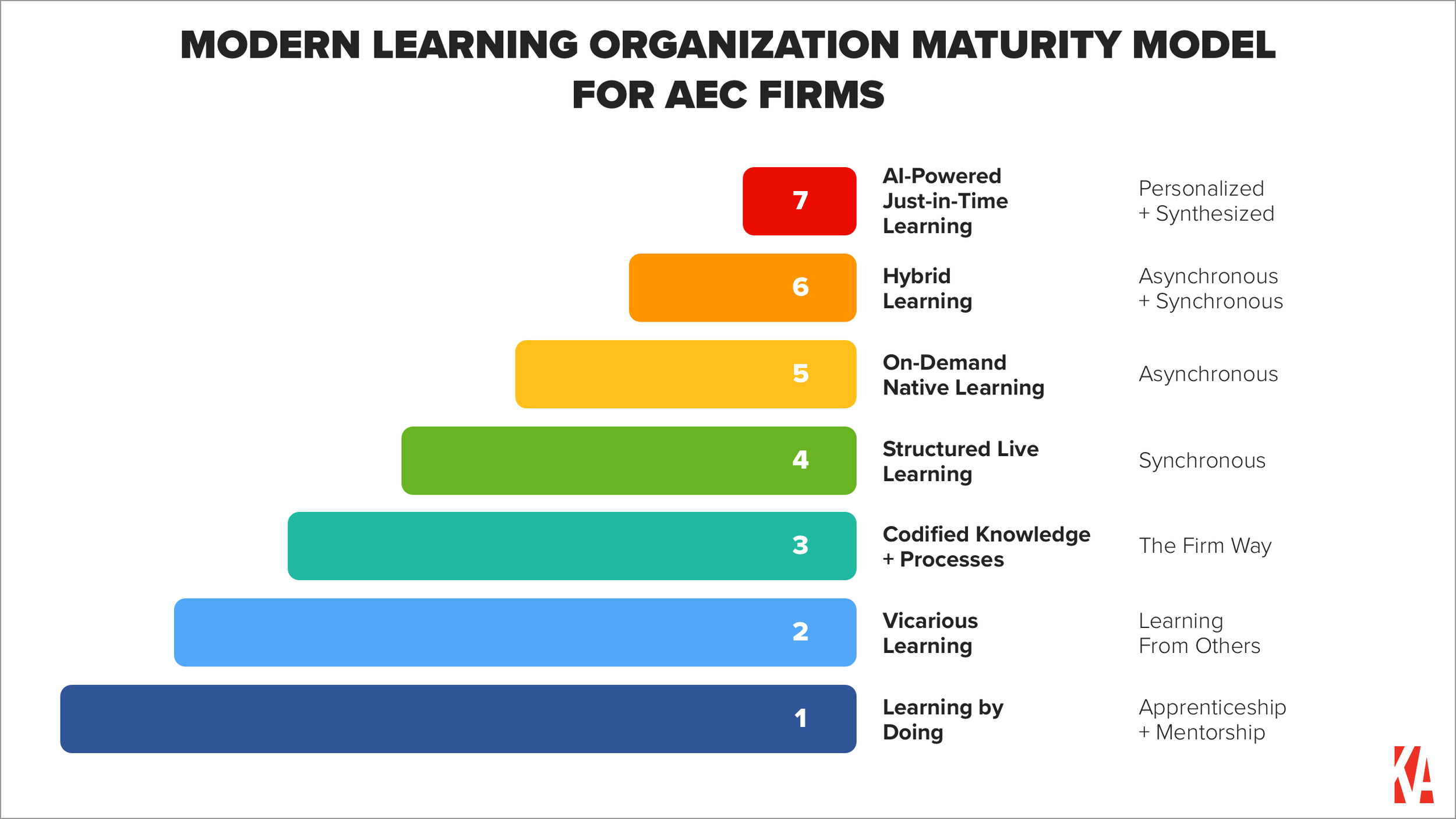
Level 1 — Learning by Doing
The foundation of every AEC firm is learning by doing.
People learn through direct experience. By working on projects, practicing skills, making mistakes, and having someone there to catch them when they fall. Over time, with the support of more experienced practitioners, they begin to develop not just competence, but confidence. They are mentored, guided, and challenged in the context of real work, and through that process, they gradually improve.
This is the apprenticeship model. But it is not simply a legacy of how the industry used to operate. It remains foundational today, even in the most advanced, technology-enabled learning organizations. No matter how sophisticated our systems become, learning by doing is still the base layer, because at some point, learning has to become action.
There is a French expression—mettre la main à la pâte—which translates to “putting your hands in the dough.” It captures something essential about how we learn. You can watch videos, read recipes, take a class, or study the theory of how to bake bread. All of those things can accelerate your understanding. They can give you structure, vocabulary, and a sense of what good looks like. But they are not, in themselves, sufficient.
At some point, you have to bake the bread. You have to put your hands in the dough, feel the texture, adjust as you go, and learn through the act of doing. You have to try, fail, and try again.
The same is true in our industry. You learn to become an architect by designing, an engineer by engineering, and a project manager by managing projects. You learn by working through real constraints, responding to real clients, and navigating real consequences. You can study best practices, attend training programs, and increasingly rely on on-demand content or AI-powered answers to guide you in the moment. These tools are valuable, and they will continue to improve. But they do not replace the experience of applying knowledge in practice.
This is what makes learning by doing so powerful. It is contextual, applied, and deeply human. It is where knowledge becomes capability, and where capability begins to evolve into judgment.
Level 2 — Vicarious Learning
As firms grow beyond a single team or a single project, a second layer of learning begins to emerge—learning that happens not just through direct experience, but through exposure to the experiences of others.
This is vicarious learning.
Instead of learning only from the project you are working on, you begin to learn from projects you are not part of. You hear how another team approached a design challenge, how a project unfolded in construction, or how a client issue was resolved. You start to build awareness of patterns, possibilities, and pitfalls beyond your immediate context.
In practice, this shows up in many familiar ways.
It can be as simple as a design crit or a pinup, where work is shared and discussed in an open setting. It can take the form of site tours, where teams walk through completed or in-progress projects and reflect on what worked and what didn’t. It often includes lessons learned sessions, lunch and learns, and informal “tips and tricks” presentations from project teams who want to share something they’ve discovered.
As firms continue to grow, these interactions expand. Communities of practice begin to form around disciplines, market sectors, or areas of specialization. Guest speakers are brought in to introduce new ideas, materials, or approaches. Conversations extend beyond individual teams, connecting people who might not otherwise work together.
In more recent years, the channels for these conversations have broadened as well. What once happened primarily in person now also takes place across platforms like Microsoft Teams, Slack, and within intranets like Synthesis, where questions can be asked, answered, and discussed across the firm.
Many of these sessions are also recorded and made available after the fact, extending their reach beyond the moment in which they occurred. A conversation that once lived only in a room can now be revisited, shared, and experienced by others who were not there when it first happened.
Over time, this has created a kind of ambient learning environment—an ongoing stream of ideas, questions, and experiences moving through the firm.
Vicarious learning expands awareness. It exposes people to ideas they might not encounter in their day-to-day work. It creates connections between individuals and teams, and it helps shape a culture where sharing is expected and where it is acceptable—even encouraged—to talk openly about both successes and failures.
In many firms, this layer represents a significant portion of learning and development activity. It is often one of the most visible and most energizing aspects of a firm’s learning culture—an enrichment layer that brings people together and helps them feel connected to the broader work of the organization.
What makes this layer so effective is also what makes it relatively easy to sustain. It does not require heavy coordination or formal design. People are typically sharing from their own experience by walking through a recent project, a lesson learned, or an approach they’ve developed. In many cases, they are building on work they have already done, whether for a client, a presentation, or an internal discussion. The barrier to contribution is low, and that makes participation feel natural rather than forced.
At the same time, this ease comes at a cost. These experiences are rarely designed around a specific individual at a specific moment in their development. They are not tightly aligned to a defined curriculum or a set of business objectives. Instead, they tend to take on a more ad hoc, broadcast-like quality—open to anyone who is interested, available when they happen, and shaped by what people are working on and willing to share.
This is part of what gives vicarious learning its energy. It is responsive, timely, and often driven by genuine curiosity. It allows ideas to circulate quickly and creates space for unexpected connections. But it also means that the impact can be uneven.
Even so, this layer plays an essential role. It broadens the field of vision within the firm and creates the conditions for knowledge to move more freely across teams, disciplines, and projects.
Level 3 — Codified Knowledge + Processes
As teams begin sharing their experiences across projects, firms begin to take a step back and ask a different kind of question: what domains of our knowledge and which core processes are important enough to codify?
This is where a firm begins to invest in making its best thinking more durable and actionable.
Rather than relying on passing along knowledge socially—through whatever someone happens to share at a given moment—the firm begins to intentionally capture and define how it works. The organization begins to articulate, in a more consistent way, what good looks like across its projects, its teams, and its areas of expertise.
Codifying knowledge and processes is how a firm begins to say, in a more concrete way, “this is how we do things here,” or “this is the firm way.”
That idea can take many forms. It might show up as standards, best practices, standard operating procedures, or playbooks. Some of these assets describe what good looks like. Others go further, outlining the steps, decisions, and workflows that guide how work is actually performed.
What is happening, fundamentally, is a shift from tacit knowledge to explicit knowledge. Knowledge that once lived in the heads of experienced practitioners, or within small groups who had worked closely together, is brought into the open.
Teams come together in committees, working groups, or task forces to reflect on their experience and distill it into something that can be shared more broadly. In some cases, firms invest in more formal approaches to critical knowledge transfer, working to surface the deep expertise of their most experienced and, at times, irreplaceable individuals—those “one and onlys” who know how to navigate a specific project type, solve a particular class of problem, or work with a certain kind of client.
Over time, this effort often extends into building a more coherent understanding of project history as well, allowing teams to draw on past work more deliberately by referencing precedents, learning from prior decisions, and building on what has already been done.
While the tools have evolved, the underlying pattern has a long history. Knowledge has moved from oral tradition to written documentation, from manuals and binders to shared drives and file systems, and eventually into searchable intranets and more integrated knowledge platforms. Each step has made it easier to document, maintain, and access what the firm knows.
But what defines Level 3 is not the format of the content. It is the intention behind it.
The firm is no longer relying on knowledge to circulate organically. It is making a deliberate investment in identifying, capturing, and maintaining the knowledge and processes that matter most and creating a shared understanding that can be accessed and applied across the organization.
Level 4 — Structured Live Learning
Once a firm has taken the time to codify its knowledge—once it has begun to define “how we do things here”—it becomes possible to teach that knowledge in a more structured and intentional way.
This is the shift to structured live learning.
If Level 3 is about defining the firm’s approach, Level 4 is about systematically delivering it to others. Instead of relying on the serendipity of whatever projects, mentors, and vicarious learning moments someone happens to encounter, the firm begins to create dedicated learning experiences designed to help people build specific skills at key moments in their development.
In practical terms, this often takes the form of project management bootcamps, technical training sessions, or introductory courses into new areas of work—healthcare 101, construction administration fundamentals, or training on how the firm uses tools like Revit. It can include leadership development programs, structured workshops, and cohort-based experiences where groups of people move through a shared learning journey together.
What makes this different from earlier levels is the intent.
In Levels 1 and 2, learning is largely shaped by circumstance—by the projects you happen to work on, the people you happen to learn from, and the conversations you happen to be part of. Over time, that can lead to uneven outcomes. Two individuals in the same role may learn very different versions of how to approach the work, depending on who was leading their project.
Structured live learning helps to address this inconsistency.
By drawing on the codified knowledge and processes developed in Level 3, organizations can more deliberately and consistently introduce people to the way the firm operates. When someone steps into a new role—becoming a project manager, entering a new market sector, or taking on a new type of responsibility—the firm can provide a more intentional learning experience to support that transition.
Even when learners are not able to immediately apply what they’ve learned on real projects, these experiences create awareness. They begin to understand that there is a standard way the firm approaches a given problem—whether it’s project scheduling, budgeting, coordination, or documentation—and that they are not expected to invent that approach from scratch.
Over time, this helps orient people within the organization. They learn not only how things are done, but where that knowledge lives. When they encounter a situation later—often under real project pressure—they have a reference point to return to. The learning may not fully stick in the moment, but it establishes a foundation that can be revisited and applied when it becomes relevant.
This creates a powerful mechanism for scaling quality and consistency across the organization, reinforcing “the firm way.”
Structured live learning offers something uniquely human that is difficult to replicate in other formats. These are often high-fidelity, synchronous learning experiences, where people engage directly with instructors and with one another. In longer or more immersive programs, participants may work through real scenarios, discuss their own experiences, and learn from the perspectives of their peers. There is space for conversation, for vulnerability, and for building trust. Over time, these experiences can strengthen not only individual capability, but also relationships across the firm, contributing to a sense of shared understanding and psychological safety.
At the same time, these experiences are typically designed for live participation. They are often cohort-based and built around a specific moment in time. While they are sometimes recorded and made available afterward, those recordings do not always fully capture the value of the original experience. The energy of the room, the interaction between participants, and the flow of discussion are difficult to reproduce when watching after the fact.
Even so, this level represents an important step forward. It allows firms to move from hoping that people serendipitously learn the right things to intentionally designing experiences that help them do so—bringing greater clarity, consistency, and support to how knowledge is developed across the organization.
From Traditional to Modern Learning Organizations
Taken together, these first four levels describe how most AEC firms have traditionally developed expertise over time.
That said, it is time to level up as learning organizations.
The traditional model works, but it is too slow, too inconsistent, too time consuming, and relies too heavily on serendipity to meet today’s challenges. It assumes that people will encounter the right projects, the right mentors, and the right learning moments at the right points in their development.
At the same time, expectations around how people access and apply knowledge have shifted. Outside of work, we are accustomed to being able to find what we need, when we need it, and to revisit it as often as necessary. That expectation does not disappear inside the firm.
Under these conditions, the limitations of the traditional model begin to surface more clearly.
The apprenticeship model remains essential, but it is difficult to scale and increasingly places too heavy a burden on experienced practitioners to develop the next generation through project work alone.
Vicarious learning continues to create valuable moments of awareness, connection, and shared experience across the firm, but much of that value remains tied to when and where those moments happen.
Codified knowledge and processes provides a durable and comprehensive foundation, but are often captured in formats that can be difficult to navigate in the moment of need—buried in long documents, manuals, or knowledge bases that require time and effort to locate, interpret, and apply effectively.
Structured learning programs provide depth and consistency, but are often scheduled via a limited number of sessions, which can make them unavailable at the moment they are needed most.
Across all four levels of the traditional learning organization, there is a common pattern: a great deal of valuable knowledge is being created and shared, but not always fully leveraged. Insights are captured in conversations, presentations, documents, and recorded sessions, but often remain underutilized—difficult to revisit, hard to navigate, or disconnected from the flow of day-to-day work.
So at this point, it has become clear: we’re going to need a bigger boat.
This is where the modern learning organization comes in.
Level 5 — On-Demand Native Learning
On-demand learning is not new. Firms have been recording presentations, training sessions, and internal knowledge-sharing events for years, with the hope that people could revisit them later if they missed something or needed a reference.
But in practice, those recordings of live events have rarely lived up to that promise.
Much of this content was not designed to be consumed on demand. It was designed to be experienced live. As a result, the recorded versions often feel like a second-class experience—long, uneven, and difficult to navigate. A one-hour session remains an hour long because that’s how meetings are scheduled, not because that’s how people learn. Introductions run long, discussions drift, questions become highly specific, and the core insight is often buried somewhere in the middle of the video.
Level 5 represents a shift in how some learning experiences are designed from the start.
Instead of recording live sessions and hoping they will be useful later, firms begin to create learning experiences that are natively on demand. They are built with the expectation that someone will access them asynchronously and independently, often in the flow of work, and often with a very specific need in mind.
This changes the design.
Content becomes more concise. A sixty-minute session is broken into shorter, focused segments. A topic is divided into lessons that can be accessed individually. Instead of asking someone to sit through an entire presentation, the goal is to make it easy to find and engage with exactly what they need.
In many cases, this leads to shorter, more targeted learning assets—five, ten, or fifteen-minute lessons that focus on a specific concept, task, or workflow. More complex topics can still be explored in depth, but are structured in a way that allows learners to move through them in manageable increments, revisiting specific sections as needed.
This allows learning to be right-sized to the problem.
Some topics are best introduced at a high level—what something is, how it works, when it matters. Others benefit from deeper explanation or step-by-step walkthroughs. Not everything needs to be delivered in the same format, and not everything needs to be delivered all at once.
On-demand native learning also changes the experience for the learner.
It allows people to move at their own pace. They can pause, rewind, and revisit material as needed. They can engage (and reengage) with content when it becomes relevant, rather than trying to retain everything in advance. In that sense, it aligns more closely with how people naturally learn—especially when they are trying to apply knowledge in real situations.
At the same time, on-demand native learning can improve the experience for subject matter experts. Instead of delivering the same material repeatedly in live sessions—particularly in areas like onboarding or foundational training—experts can invest the time to create something well-structured and reusable, increasingly by partnering with knowledge and learning management teams. Over time, this reduces repetition and allows experts to focus their energy on solving complex project issues, mentorship, and research instead of teaching the same material over and over again.
This approach also introduces more flexibility in how learning is designed. Not everything needs to be video. Text, examples, exercises, and reference materials can all be incorporated, allowing learners to engage with the content in different ways depending on the need.
As a result, learning becomes more accessible, more scalable, and more aligned with the realities of day-to-day work.
And perhaps most importantly, it becomes easier to connect learning back to practice. A project leader can point someone to a specific lesson or course before they take on a new task—reviewing site safety before a visit, or learning how to approach a door schedule before creating one—allowing the learning to happen closer to the moment it is applied.
In this way, on-demand native learning does not replace earlier levels. It builds on them. It makes the knowledge that has been shared, codified, and taught more accessible and more usable—both for the individual and for the firm as a whole.
Level 6 — Hybrid Learning
Hybrid learning blends the strengths of both live learning and on-demand learning, using asynchronous, on-demand content to deliver foundational knowledge, and reserving live, synchronous sessions for discussion, application, reflection, and practice.
In this model, the fundamentals are no longer delivered live by default. Instead, they are made available in on-demand formats that learners can engage with at their own pace—both before and after a live session. The live experience then builds on that foundation, creating space for deeper exploration, shared problem-solving, and connection between participants.
This changes the role of live learning.
Rather than trying to do everything—introducing concepts, delivering content, answering questions, and facilitating discussion in a single session—live instruction becomes more focused and more valuable. It is used to explore nuance, work through real project scenarios, and engage directly with the specific questions and experiences of the group.
In this way, each format is allowed to do what it does best via hybrid learning experiences.
On-demand learning provides consistency, accessibility, and the ability to revisit foundational material at any time. Live learning provides energy, connection, interaction, and the opportunity to learn through conversation and shared experience. Together, they create a more complete and more effective learning modality.
This approach also improves the experience for subject matter experts.
Instead of repeating the same foundational content in session after session, subject matter experts can invest in creating a clear and well-structured on-demand version of that material once, and then use live sessions to engage more deeply with learners.
Over time, this tends to be more energizing. Experts are able to focus on the parts of teaching that are most engaging: answering questions, exploring edge cases, and helping people apply what they’ve learned in real situations. Less lecture, more connection.
Hybrid learning also creates new efficiencies for the organization. Once foundational material is captured in a high-quality, on-demand native format, it can be reused across cohorts, referenced in the flow of work, and accessed without requiring a scheduled session. Live instruction can then be used more selectively, where it adds the most value.
Not every learning experience needs to be hybrid. Some—particularly those focused on leadership, culture, or relationship-building—may remain fully live and synchronous by design. But for a large portion of the firm’s core curriculum, hybrid learning offers a more scalable and effective model.
In practice, this shift is already underway for firms running Synthesis LMS. Many of the programs that were once delivered entirely through live sessions are being restructured—partially shifting foundational content into on-demand formats, and redesigning live time around interaction and application.
For a deeper look at how AEC firms are designing hybrid learning experiences, the conversation with Laura Knauss and Kristina Williams from Lionakis in Episode 6 of the offers a compelling example.
Converting learning experiences to a modern hybrid format makes them more intentional, more flexible, and more aligned with the realities of how people learn and work today.
Level 7 — AI-Powered Just-in-Time Learning
In earlier levels of the modern learning organization maturity model, firms invest heavily in creating, capturing, and organizing knowledge through experience, conversation, documentation, and structured learning.
But accessing that knowledge still requires effort. You have to know where to look, how to search, and how to interpret what you find. Even when you locate the right asset—a document, a video, or a course—you often have to work through it sequentially, reading, watching, or progressing from beginning to end in order to extract what you need.
Level 7 changes that dynamic.
With AI, it is now possible to retrieve and synthesize knowledge (in real time) in response to a specific question or need. Instead of navigating individual assets, knowledge can be dynamically assembled from many sources—documents, videos, courses, and conversations—into a response that is tailored to the problem at hand.
This is made possible, in part, by a significant improvement in video transcription technology. AI-powered transcription has become accurate enough that recorded video—a lunch and learn, a course, a lessons learned session—now carries a full, searchable text layer, making it as findable and usable as any written document. The medium is no longer a barrier to retrieval.
This enables a shift from searching for knowledge to receiving it.
Synthesis AI Search and Knowledge Agents make this possible by grounding responses in the firm’s own content and providing citations back to the underlying sources. This allows individuals not only to get an immediate answer, but also to verify that answer, explore the original context, and go deeper when needed.
In practice, this means that knowledge can be delivered in the flow of work, at the moment it is needed. Someone can ask a question and receive a personalized, synthesized response that integrates the firm’s accumulated experience—drawing on standards, past projects, training materials, and shared insights—without having to piece it together manually.
Learning becomes more immediate, more contextual, and more responsive to the specific challenges people are facing. In some cases, the AI-generated answer meets the learner’s immediate need. In others, it opens up a deeper line of inquiry, pointing back to the underlying materials and contributing experts for further exploration.
Importantly, AI-powered just-in-time learning depends entirely on the foundation built in the earlier levels.
The quality of AI-powered learning is directly tied to the quality of the underlying conversations, knowledge, processes, and courses developed in Levels 1 through 6. Without that foundation, the outputs are limited. With it, the system becomes significantly more powerful.
Level 7 does not replace the earlier levels. It amplifies them.
AI helps make the knowledge that has been created across the organization more accessible, more connected, and more usable by delivering the right knowledge to the right person at the right time.
That said, none of this replaces the need to learn by doing.
As we explored in Level 1, you still have to put your hands in the dough. You still have to bake the bread.
AI can accelerate understanding and help people get to better answers more quickly, but mastery still comes from applying that knowledge in real situations by making decisions, encountering edge cases, and learning through experience.
What Level 7 changes is not the need to do the work, but how prepared people are when they do and how well supported they are as they’re doing it.
What Changes in a Level 7 Modern Learning Organization
Reaching Level 7 does not replace the earlier stages of the model. It changes how they operate.
The introduction of AI-powered, just-in-time learning reshapes each layer—amplifying its strengths, reducing its limitations, and connecting it more tightly to the flow of work.
Level 1 — Apprenticeship Becomes More Focused and Consistent
At Level 7, the apprenticeship model is not diminished. It is elevated.
Rather than carrying the full burden of foundational knowledge transfer, apprenticeship becomes more focused on what it does best: application, judgment, and context. Learners arrive better prepared, having engaged with foundational material in advance. They are able to ask more informed questions, and mentors are able to spend less time on basics and more time on interpretation, nuance, and real project decisions.
In this way, one-on-one mentorship becomes more valuable, not less. It shifts from explaining how things work, to exploring how they should be applied.
As firms invest in defining “the firm way” through standards, guides, courses, and other shared resources—project leaders are no longer left to teach from memory alone.
In many firms, inconsistency in apprenticeship is the result of a lack of shared tools. Project leaders do not set out to teach different approaches—they do so because they don’t always have clear, accessible ways to show what “right” looks like.
When those resources exist, they are used. Leaders point team members to a course, a guide, or an example. They anchor their teaching in something shared. And as a result, apprenticeship becomes not only more focused, but more consistent—reinforcing a common standard across projects rather than reinventing it each time.
Level 2 — Vicarious Learning Becomes Searchable
At earlier levels, vicarious learning experiences—presentations, design critiques, and lessons learned—shape awareness and culture across the firm.
At Level 7, the knowledge shared in vicarious learning experiences becomes accessible via search.
Recorded sessions, once underleveraged because they were difficult to search, become part of a modern learning organization’s searchable and discoverable body of knowledge. Insights shared in a project review or a lunch and learn are no longer tied to the moment in which they occurred. They can be revisited, surfaced, and connected to new problems as they arise through AI search and knowledge agents.
What was once ephemeral becomes durable and usable.
Level 3 — Codified Knowledge and Processes Become a Living System
Codified knowledge and processes have always been foundational, but at Level 7 their importance becomes even more pronounced.
AI exposes the strengths and weaknesses of a firm’s digital knowledge foundation through daily use.
Gaps, inconsistencies, duplication, and outdated content become more visible when surfaced through AI interactions. At the same time, user behavior—what people search for, what they struggle to find, what they question—creates a feedback loop that helps prioritize what needs to be improved.
This dynamic extends beyond content. As firms begin to introduce AI into the flow of work, they are also forced to re-examine the processes that guide how work gets done.
In many cases, those processes are less defined than commonly assumed. Steps are implied rather than articulated. Decisions rely on experience rather than explicit criteria. Entire workflows may still live as tacit knowledge, understood by a few but not fully documented or shared.
As a result, bringing AI into these workflows—through agentic systems such as Synthesis Knowledge Agents—often requires firms to map, clarify, and in some cases re-engineer how their work actually happens.
This creates a second feedback loop, this time at the level of process. Just as AI reveals gaps in knowledge, it also reveals gaps in how that knowledge is applied.
The knowledge base becomes more dynamic. And increasingly, it is structured in ways that make it more usable—by both people and the AI agents designed to support them.
This is happening today with humans firmly in the loop alongside AI—using these systems to guide, accelerate, and support their work. Over time, some of these processes may become more autonomous, but always in service of the people and the organization they support, grounded in codified knowledge.
In this way, AI does not just retrieve knowledge. It helps improve it. And, in parallel, AI helps organizations design more explicit, consistent, and adaptable ways of working.
Level 4 — Live Learning Becomes More Intentional
At Level 7, structured live learning becomes more selective and more purposeful.
Rather than serving as the primary vehicle for delivering foundational knowledge, live sessions are increasingly reserved for experiences that benefit from real-time interaction, discussion, reflection, coaching, and shared exploration.
Some programs, particularly those focused on leadership, culture, and relationship-building, will remain fully live by design. But many others will evolve into hybrid experiences by shifting foundational content into on-demand formats and redesigning live time around engagement and application.
Level 4 live learning does not disappear completely, but becomes more intentional.
Level 5 — On-Demand Learning Becomes Infrastructure
At Level 5, on-demand learning improves the experience for learners. At Level 7, it becomes something more.
It becomes infrastructure.
On-demand content is no longer just a resource for individuals to consume. It becomes part of the firm’s collective intelligence—content that can be searched, retrieved, and synthesized by AI in response to real-time needs.
This creates a new design imperative. Learning content is not only created for people, it is also created in a form that can be understood and utilized by the AI-powered knowledge and learning management platform.
The result is a growing body of structured, reusable knowledge that supports both human learning and AI-powered retrieval.
Level 6 — Hybrid Learning Becomes More Fluid
Hybrid learning already blends on-demand and live formats. At Level 7, that blend becomes more fluid and more responsive.
The on-demand, foundational portion of hybrid courses becomes easier to access, revisit, and connect to real work through AI. It becomes part of a broader knowledge system that can be queried and explored at any time.
This extends the value of hybrid learning beyond the course itself. Learning does not begin and end with a scheduled experience. It becomes something that can be revisited, reinforced, and applied continuously.
Taken together, these shifts point to a broader transformation.
The earlier levels of the model focus on creating and sharing knowledge. At Level 7, the focus expands to making that knowledge accessible, connected, and usable in real time.
How to Apply the Modern Learning Organization Maturity Model
So far, this model has been presented as if a firm progresses through it as a whole.
It is natural, when encountering a framework like this, to ask: where are we? Are we a Level 3 firm? A Level 5? A Level 7?
That can be a useful exercise.
But another useful way to apply this model is to look at it through the lens of domains.
Every firm is made up of multiple domains of knowledge—markets, services, disciplines, roles, and core processes like onboarding. Each of these domains develops at its own pace, shaped by different leaders, different priorities, and different levels of investment.
When viewed this way, the model becomes less linear and more fractal.
You may find that one area of the firm is highly mature. A well-established market like higher education, for example, may have developed strong codified knowledge, standardized processes, robust learning programs, and even elements of hybrid or AI-enabled learning. At the same time, another market—perhaps one that is newer or still evolving—may be operating closer to Level 1 or Level 2, learning through project experience and early knowledge sharing.
The same pattern holds across disciplines and roles. Project management may be a strategic focus and relatively advanced, while domains like sustainability, design technology, or business development are at different stages of maturity. In many firms, onboarding provides one of the clearest windows into how the organization actually learns—revealing both strengths and gaps in how knowledge is introduced and developed.
The result is not a single maturity level for the firm, but a mosaic across domains.
The goal, then, is not to immediately push the entire firm to Level 7 across all domains. That probably wouldn’t even be possible.
The goal is to be intentional about where you deploy your resources, to understand where the firm is strong, where it is vulnerable, and where investment will have the greatest impact.
That might mean strengthening project management to improve delivery and client experience. It might mean investing in specific markets where critical knowledge is at risk of being lost due to retirements. It might mean focusing on onboarding to better support a growing team.
This model becomes most valuable not as a scorecard, but as a tool for prioritization.
It allows firms to take stock of how they learn today, and to make deliberate decisions about where to evolve next. One knowledge domain at a time.
Over time, these investments begin to add up. The overall posture of the learning organization shifts, not through a single transformation, but through a series of focused, intentional improvements across the system.
That is how modern learning organizations are built.
By design.